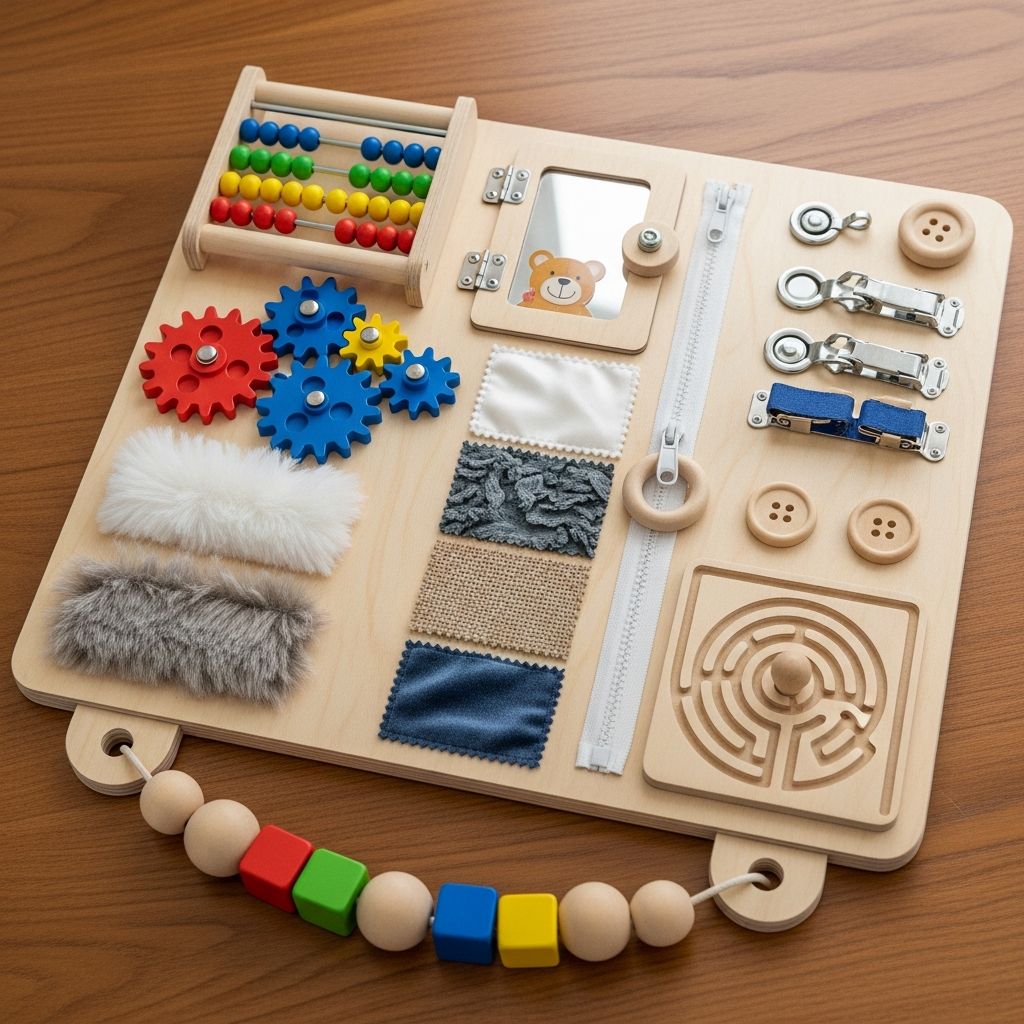
Busy boards captivate young children by offering a world of tactile discoveries on a single surface, transforming everyday curiosity into essential skill-building opportunities. These interactive panels, packed with zippers, locks, switches, and gears, empower toddlers to explore independently, fostering development in motor abilities, cognition, and sensory awareness.
Understanding the Power of Busy Boards in Early Learning
At their core, busy boards serve as multifunctional learning hubs designed to mimic real-world objects in a safe, child-sized format. Toddlers aged 1 to 3 years naturally gravitate toward manipulating doors, buttons, and latches, which mirrors their innate drive to understand their environment. This hands-on engagement stimulates neural pathways, promoting brain development through repeated actions like twisting, pulling, and pressing.
Unlike passive toys, busy boards encourage prolonged focus, often holding a child’s attention for 20-45 minutes per session, depending on age and board complexity. This sustained play reduces parental intervention, allowing kids to build confidence via trial-and-error problem-solving. Research-aligned with Montessori principles, these tools emphasize self-directed activity, helping children master practical skills while minimizing frustration from inaccessible household items.
Key Developmental Benefits for Young Explorers
Busy boards deliver targeted growth across multiple domains, making them indispensable for holistic toddler advancement.
- Fine Motor Mastery: Activities such as threading laces or operating tiny bolts strengthen finger muscles and precision grip, laying groundwork for writing and self-care tasks like buttoning clothes.
- Hand-Eye Coordination: Coordinating movements to fit shapes or flip switches refines bilateral skills, essential for later tasks like drawing or tying shoes.
- Cognitive Growth: Cause-and-effect experiments, such as turning a gear to spin wheels, teach logic and sequencing, boosting early math concepts like patterns and counting.
- Sensory Stimulation: Varied textures, colors, and sounds engage touch, sight, and hearing, enhancing perceptual awareness and emotional regulation.
- Language Expansion: Parental narration during play introduces vocabulary for objects and actions, improving speech clarity and sentence formation.
These benefits extend to perseverance; children persist through challenges, developing resilience and focus that carry into preschool years.
Choosing the Right Busy Board for Your Toddler’s Age
Selecting an appropriate board ensures maximum engagement and safety. For 1-year-olds, opt for larger, simpler elements like large toggles and soft fabrics to avoid choking hazards. Two-year-olds thrive with moderate challenges such as sliding beads or basic locks, while 3-year-olds handle complex gears and multi-step puzzles.
| Age Group | Ideal Features | Skill Focus |
|---|---|---|
| 12-18 Months | Large switches, zippers, mirrors | Sensory intro, basic grasp |
| 18-24 Months | Door latches, shape sorters, lights | Coordination, cause-effect |
| 24-36 Months | Gears, buckles, arithmetic panels | Problem-solving, logic |
Material matters too: Wood offers durability and a natural feel, aligning with eco-friendly Montessori ideals, while portability suits travel.
Top Recommended Busy Boards for Maximum Engagement
Here are standout options tailored for toddlers, each excelling in quality and variety.
- Light-Up Switch Explorer: Features multiple illuminated toggles for instant feedback, ideal for 2-year-olds building finger control and visual tracking. Parents note it mesmerizes kids during car rides.
- Modular Adventure Panel: Customizable with interchangeable activities like xylophones and knobs, growing with the child to promote fine motor and musical exploration.
- Sensory Dressing Station: Includes functional zippers and buttons mimicking clothing fasteners, perfect for independence training and sensory needs.
- Giant Playroom Wall Board: Large-scale with math puzzles and cooperative elements, suited for 3-year-olds in group settings like daycare.
- Compact Travel Buddy: Portable design with locks and gears, reducing screen time on outings while honing dexterity.
Crafting Your Own Custom Busy Board
DIY busy boards personalize play, often extending engagement as children help assemble. Start with a sturdy plywood base (at least 18×24 inches), then attach safe hardware from hardware stores: cabinet latches, door knobs, chains, and fabric swatches. Use non-toxic glue or screws, ensuring no small parts detach.
- Gather materials: Wood panel, assorted locks, zippers, Velcro, battery-operated lights.
- Plan layout: Group similar activities (e.g., all fasteners together) for intuitive flow.
- Assemble securely: Test each element for toddler-proof durability.
- Introduce gradually: Demonstrate once, then let independent exploration begin.
This approach saves costs and sparks family bonding, with kids playing longer due to ownership pride.
Integrating Busy Boards into Daily Routines
Place the board at child height on a wall or stand for easy access, rotating activities monthly to maintain novelty. Pair with quiet time post-meals or naps for 15-30 minute sessions. Supervise initially to model usage, then step back to nurture autonomy. Combine with verbal cues like “Zip it up!” to layer language learning.
For siblings, position multiple boards to prevent conflicts, or design shared oversized versions fostering cooperation.
Safety Guidelines and Common Pitfalls
Prioritize boards free of small swallowable pieces, sharp edges, or toxic paints. Check for BPA-free plastics and lead-safe certifications. Avoid battery compartments accessible without tools. Regularly inspect for wear, especially on moving parts. Not all household items suit boards—skip anything breakable or valuable.
Steer clear of overly complex designs frustrating beginners; match complexity to skill level for positive experiences.
Real Parent Experiences and Long-Term Impact
Families report busy boards slashing tantrums by channeling energy productively, with many kids returning daily for months. One parent shared their 2-year-old mastered zippers in weeks, easing dressing routines. Long-term, these tools build school-readiness: improved focus aids circle time, dexterity supports crayons.
Versatility shines as boards adapt; simple ones suit babies from 6 months, evolving into logic trainers for preschoolers.
Frequently Asked Questions
How long will my toddler play with a busy board?
Typically 20-60 minutes per session, varying by age and interest. Montessori designs promote extended self-directed play.
Are busy boards suitable for children with sensory needs?
Yes, their tactile variety aids regulation, especially with calming elements like soft fabrics or repetitive switches.
Can busy boards replace other toys?
No, but they complement by focusing on practical skills, ideally alongside blocks and books for balanced development.
What’s the best material for busy boards?
Wood for sustainability and warmth; ensure it’s sealed against moisture.
Do busy boards help with screen time reduction?
Absolutely—parents praise them for captivating attention through hands-on fun.
References
- Montessori Busy Boards and Engaged Happy Toddlers — NeuroToys. 2023. https://neurotoys.fun/en/montessori-busy-boards-and-engaged-happy-toddlers
- Montessori Busy Board for 2-3 Year Olds: A Guide to Learning Through Play — Joyreal Toys. 2024. https://joyrealtoys.com/blogs/news/montessori-busy-board-for-2-3-year-olds-a-guide-to-learning-through-play
- How Long Do Kids Play with Busy Boards? — BumbleBeeSmart. 2023. https://bumblebeesmart.com/how-long-do-kids-play-with-busy-boards/
- Busy Boards for Toddlers & Babies — Smart Baby Board. 2024. https://smartbabyboard.com/collections/frontpage
- What Is a Busy Board and Why Does Your Child Need One? — Montessori Generation. 2023. https://montessorigeneration.com/blogs/montessori/what-is-a-busy-board
- Exploring the Long-Term Value of Busy Boards for Early Childhood — Joycat. 2024. https://joycat.com/blogs/article/exploring-the-long-term-value-of-busy-boards-for-early-childhood