In an animated epic filled with powerful queens, ancient magic, and massive earth giants, Bruni — the little salamander who embodies fire in Frozen 2 — quietly became one of the film’s most memorable surprises. His brief appearances launched waves of fan art, toys, and questions from kids and parents about what, exactly, a salamander is and why he’s made of flames.
This article unpacks how Bruni fits into Frozen 2, why Disney chose a salamander as the fire spirit, and what real salamanders are like in nature, while also exploring the character’s cultural impact and appeal for families.
The Elemental World of Frozen 2
Frozen 2 expands the icy kingdom of Arendelle into a mythic landscape shaped by elemental spirits — earth, air, water, and fire — plus a mysterious fifth spirit that connects humans and nature.
- Earth: Towering stone giants roaming the forest rivers.
- Air: A mischievous wind spirit nicknamed Gale.
- Water: The Nokk, a spectral horse made of water drawn from Nordic folklore.
- Fire: An unpredictable fire spirit that turns out to be the tiny salamander we now know as Bruni.
Within the story, these spirits once clashed with humans, leaving the enchanted forest sealed off for decades. Elsa’s journey into the forest awakens them again, forcing her to confront the past and restore balance between people and nature.
Who Is Bruni? From Flaming Threat to Pocket-Sized Ally
On first encounter, the fire spirit looks like a dangerous, invisible force. It races around the forest, sending magenta and blue flames sweeping across the trees and ground.
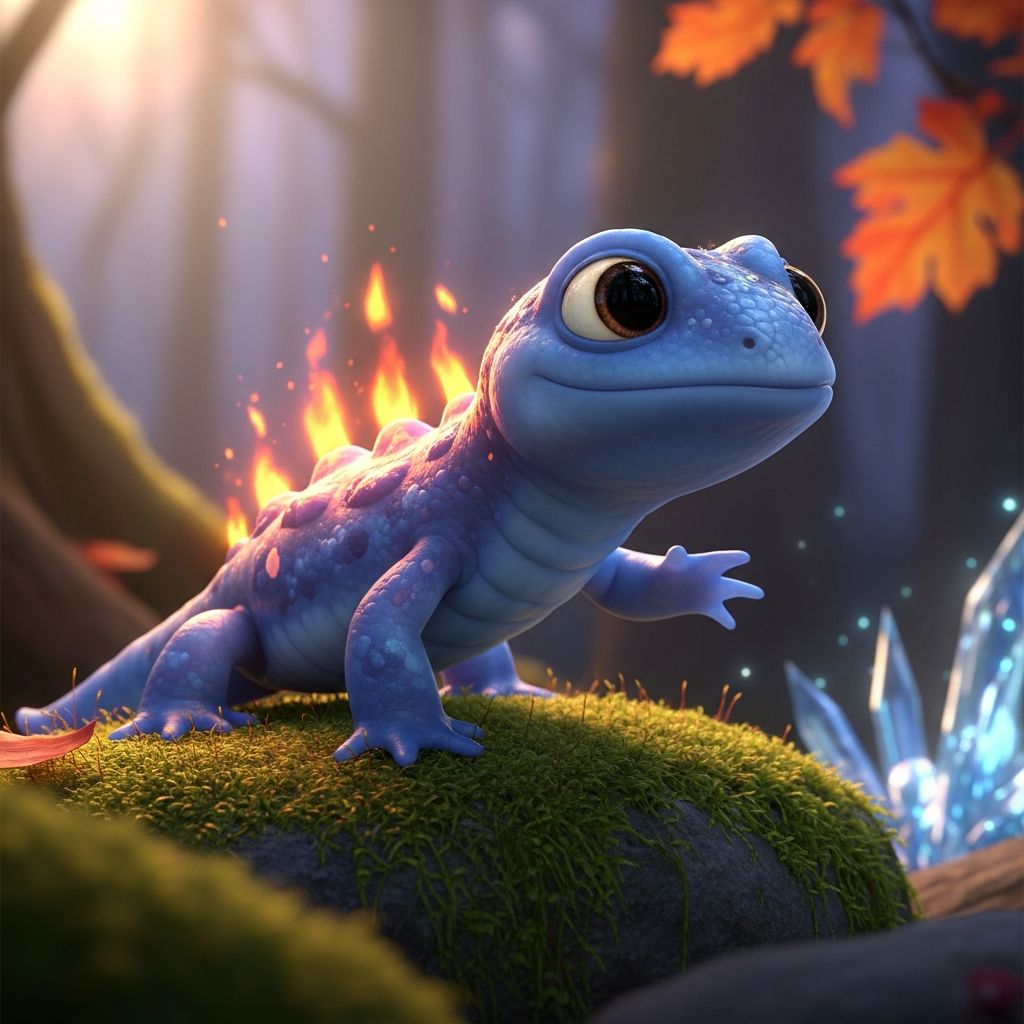
Only after Elsa calms the chaos with her ice magic do we meet the spirit’s true form: a small, bright-eyed salamander with a flickering, fire-tinted glow.
| Aspect | Bruni in the Film |
|---|---|
| Species | Salamander (amphibian), designed to be cute and expressive. |
| Element | Fire spirit of the enchanted forest. |
| Behavior | Skittish, excitable, quickly shifting from panic to affection. |
| Communication | Wordless squeaks, chirps, and exaggerated body language. |
| Connection | Forms a special bond with Elsa, whose cold magic calms his flames. |
Unlike the other spirits, Bruni warms up to Elsa almost immediately once she shows kindness and control, highlighting a recurring theme in Frozen: powerful forces are not inherently evil; they become dangerous or beautiful depending on how they are understood and guided.
Why a Salamander Represents Fire
The choice of a salamander as the embodiment of fire might feel whimsical, but it draws on centuries of European folklore.
For a long time, people believed salamanders could live in flames. One likely reason is that real salamanders often hide in rotting logs; when those logs were thrown into fires, the animals would scramble out, seemingly emerging from the flames themselves. Over time, this turned salamanders into symbols of fire in Western myth.
There is even a European species called the fire salamander (Salamandra salamandra), with black skin speckled with bright yellow or orange markings that resemble sparks or embers. Although the actual amphibian is not flame-proof, the name and coloration reinforced the mythological connection between salamanders and fire.
By making Bruni a fire salamander spirit, Disney’s artists link the character both to this older folklore and to the film’s broader theme of reimagining mythical nature spirits for a modern family audience.
Designing Maximum Cuteness: How Bruni Wins Over Kids
In reality, most salamanders are moist, often secretive, and some species carry toxic skin secretions that help deter predators. Bruni, on the other hand, is designed as the opposite of threatening:
- Large, round eyes that easily convey curiosity and emotion.
- Simplified, rounded body rather than a realistic, elongated shape.
- Smooth, appealing textures instead of clammy realism.
- Playful colors (purples and blues when fiery, cooler tones when calm) to signal mood changes and avoid looking scary.
Animation studios frequently tune creature design for emotional connection and merchandising. Small bodies and big eyes match what developmental psychologists call a “baby schema,” a set of infant-like features that many humans instinctively find cute and want to protect. This response has been exploited across animation history, from early Disney animals to modern sidekicks like Pua, Hei Hei, and now Bruni.
Elsa and Bruni: Fire Meets Ice
Story-wise, Bruni’s main purpose is more symbolic than verbal. He never speaks, but his interactions with Elsa deepen the film’s themes.
- Balancing extremes: Elsa’s ice and Bruni’s fire could easily destroy the forest, but together they produce calm, warmth, and safety.
- Trust through gentleness: Elsa tames Bruni not by overpowering him, but by offering her hand and showing consideration for his fear.
- Echoes of Elsa’s arc: Just as Elsa’s powers were once feared before she learned control, Bruni’s flames are dangerous until he learns to channel them.
Later in the movie, Bruni follows Elsa, Anna, and Olaf as a loyal companion, often perching on Elsa’s shoulder or arm. His body language mirrors the group’s emotional highs and lows, making him a visual barometer for the story’s tension.
Real Salamanders vs. Disney’s Fantasy Fire Sprite
Bruni does raise a practical question for many curious kids: what are real salamanders actually like?
According to herpetology references and wildlife agencies, salamanders are a diverse group of amphibians, with more than 700 known species worldwide. They generally have slender bodies, tails, and four limbs, and many depend on moist or aquatic environments because their skin must stay damp to function properly.
| Feature | Bruni (Frozen 2) | Real Salamanders |
|---|---|---|
| Element | Lives in and controls magical fire. | Cannot survive in fire; heat and dryness are lethal. |
| Texture | Stylized, smooth, and cuddly-looking. | Usually moist, sometimes slimy; often hidden under logs and stones. |
| Toxicity | No visible danger; safe to hold in the film. | Many species produce skin toxins that can sicken predators or pets if ingested. |
| Behavior | Highly expressive, playful, eager to bond. | Most are shy, nocturnal, and avoid open spaces or handling. |
Parents can use Bruni as a fun gateway into talking about wildlife safety: real salamanders should never be picked up casually, and chemicals or lotions on human hands can damage their sensitive skin. Watching a fantasy creature can be the spark for teaching respect for real ecosystems.
Why Kids (and Parents) Love Bruni
Bruni’s quick rise in popularity after the film’s release did not surprise Disney. Studio blogs and official fan outlets introduced him as “your cute new obsession,” highlighting his wide appeal before many viewers had even seen the movie.
Several factors make him especially compelling:
- Instant visual clarity: Children can immediately see when Bruni is excited, scared, or content based on his color shifts, body posture, and the size of his flames.
- Nonverbal storytelling: Because he doesn’t speak, his scenes are easy to understand in any language, making him globally accessible.
- Low-stakes humor: Many of his moments are small gags or sweet interactions that break tension without derailing the plot.
- Merch-ready silhouette: His simple shape translates neatly into plush toys, figurines, pajamas, and more, following a long Disney tradition.
Merchandising and the Business of Cute Sidekicks
The Frozen franchise became one of Disney’s most profitable brands, generating billions of dollars from box office, streaming, theme parks, and merchandise. Adding a new, compact side character like Bruni is partly a creative decision, but it also fits the studio’s commercial ecosystem:
- Toys and plushies that children can easily carry and collect.
- Visual variety for bedsheets, clothing, backpacks, and school supplies.
- Storybook spinoffs and picture books featuring Bruni’s adventures.
Because Bruni appears relatively briefly onscreen, he can be integrated into children’s narratives with flexibility. Parents may notice that many bedtime stories, picture books, and toys focus more on “Bruni and friends” than on the heavier themes of colonial history and reconciliation that the movie tackles in its main plot.
Teaching Moments: Nature, Myth, and Kindness
Despite being crafted for visual appeal and merchandising, Bruni also opens doors to meaningful conversations at home:
- Environmental respect: The elemental spirits in Frozen 2 embody the idea that nature is powerful and deserves care rather than exploitation.
- Understanding myths: The salamander-fire connection shows how people historically created stories to explain surprising natural events.
- Empathy and fear: Elsa calms Bruni by recognizing that his destructive behavior comes from fear and confusion, not malice — a useful metaphor for handling big emotions in children.
Parents can build on this by asking children questions like, “Why do you think Bruni was setting the forest on fire?” or “How did Elsa show him he was safe?” to connect the film’s fantasy to real emotional experiences.
Frequently Asked Questions (FAQs)
Is Bruni based on a real salamander species?
Bruni is inspired by salamanders in general and by the European fire salamander in particular, but his design is highly stylized for animation and does not match any single real species exactly.
Can real salamanders survive in fire like Bruni?
No. Real salamanders are sensitive amphibians that need moist environments. High heat and dryness, such as fire, will quickly kill them.
Why doesn’t Bruni talk in Frozen 2?
The filmmakers present Bruni as a nature spirit whose emotions are expressed through movement, color, and sound effects rather than speech. This keeps him feeling more like a magical creature than a human-like character and makes his scenes easy to understand for younger viewers.
Is Bruni the only fire spirit in Frozen 2?
Within the film’s lore, Bruni is the elemental spirit of fire who represents that force in the enchanted forest, alongside other spirits like the Nokk (water), Gale (air), and the earth giants.
Is it safe for kids to handle salamanders they find outside?
Wildlife experts generally recommend that wild salamanders be observed but not handled. Their skin is delicate, and residues from human hands can harm them; some species also produce toxins that can irritate people or pets if ingested.
References
- Who Is Bruni? The Lizard From Frozen 2 Explained — Screen Rant. 2019-11-25. https://screenrant.com/bruni-lizard-from-frozen-2-explained/
- Frozen II (2019) – Amphibians in Movies — California Herps. 2020-01-10. https://www.californiaherps.com/films/amphibianfilms/FrozenII.html
- Meet the Enchanting New Characters of Frozen 2 — D23 (The Official Disney Fan Club). 2019-11-18. https://d23.com/meet-the-enchanting-new-characters-of-frozen-2/
- Bruni — Disney Wiki (Fandom). 2020-02-01. https://disney.fandom.com/wiki/Bruni
- Salamanders — U.S. Geological Survey. 2018-06-15. https://www.usgs.gov/faqs/what-are-salamanders
- Amphibians: Salamanders — National Park Service. 2021-05-05. https://www.nps.gov/subjects/biodiversity/salamanders.htm