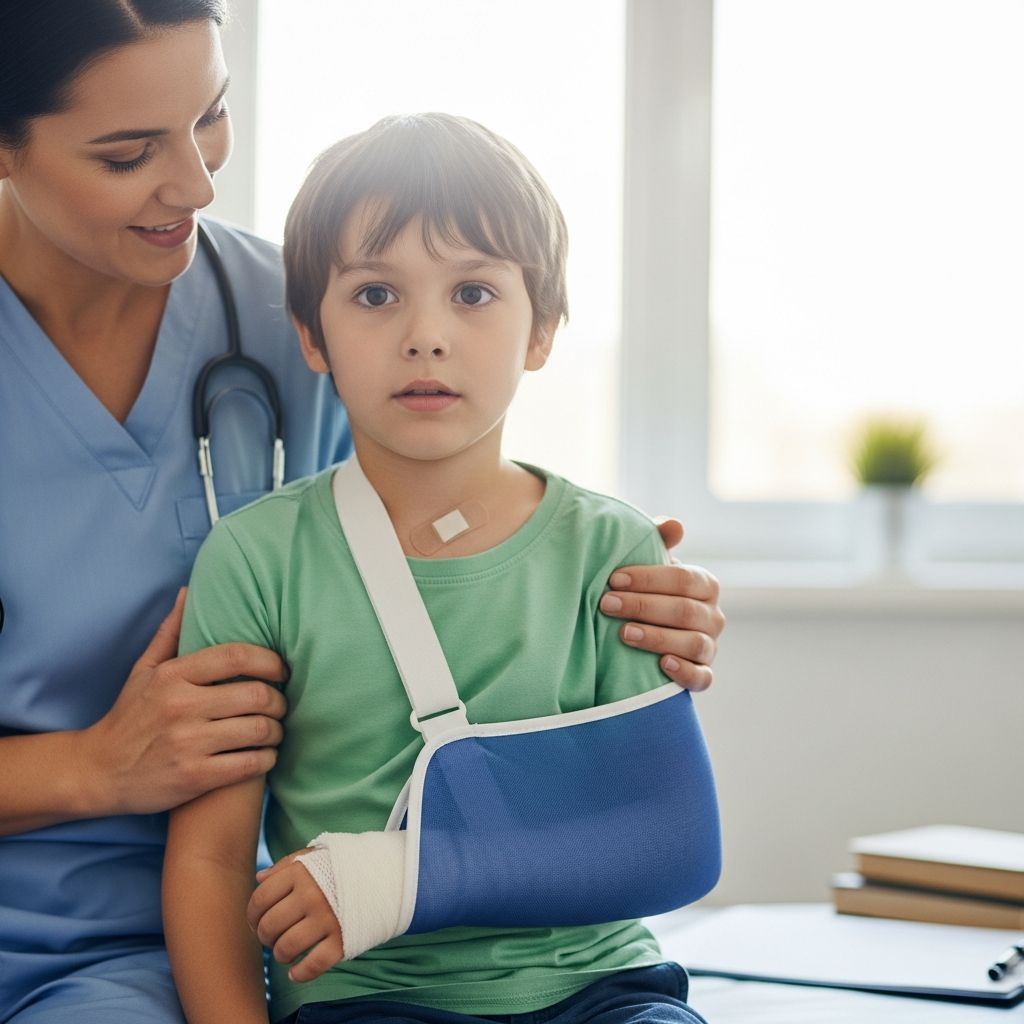
A broken collarbone, also called a clavicle fracture, is one of the most frequent bone injuries in children and teens. It can look alarming and be quite painful, but with prompt care and proper support, most kids recover fully and return to their usual activities without long-term problems.
This guide explains how to recognize a possible collarbone break, what to expect at the hospital, and how to care for your child at home during recovery.
Understanding the Collarbone and Why It Breaks Easily
The collarbone (clavicle) is the slender S-shaped bone that connects the breastbone (sternum) to the shoulder. Each person has two collarbones, one on each side of the upper chest.
In children, several features make the collarbone more vulnerable to injury:
- It is one of the last bones to fully harden and mature in the skeleton.
- Kids and teens are often active in sports and rough play, leading to falls and collisions.
- The collarbone sits close to the skin with little muscle padding, so a direct blow is more likely to cause a break.
Most clavicle fractures in young people occur from a fall onto the shoulder, a fall onto an outstretched arm, or a direct hit to the collarbone during sports, cycling, or playground activities.
Typical Causes and Risk Situations
Although any child can fracture a collarbone, some scenarios make it more likely:
- Sports with contact or falls – football, hockey, rugby, wrestling, and skiing.
- Wheeled activities – biking, skateboarding, scooters, and inline skating.
- Playground accidents – falls from monkey bars, swings, or climbing structures.
- Car or bike crashes – even with restraints or helmets, a strong impact may injure the shoulder area.
- Birth injuries in newborns – occasionally the collarbone can fracture during a difficult delivery; these usually heal very well.
Signs That Your Child May Have a Broken Collarbone
Some symptoms appear right away, while others become more obvious over several hours as swelling increases. You may notice your child:
- Cries out or reports sudden pain at the top of the chest or shoulder.
- Holds the arm close to the body and avoids moving the shoulder.
- Has difficulty lifting the arm or reaching overhead.
- Develops swelling, tenderness, or bruising along the collarbone.
- Shows a bump or visible step along the collarbone where the bone ends are not aligned.
Some children describe a grinding or crackling feeling when trying to move the shoulder. Because shoulder and upper chest injuries can sometimes be serious, it is safest to have a suspected collarbone fracture checked by a healthcare professional.
When It Is an Emergency
Call emergency services or go to the nearest emergency department right away if your child:
- Has trouble breathing or shortness of breath.
- Has numbness, weakness, or tingling in the arm or hand.
- Has very pale, cold, or blue fingers.
- Has bleeding that will not stop or bone sticking through the skin.
- Was injured in a high-speed crash or major fall and may have other injuries.
How Doctors Diagnose a Collarbone Fracture
At the clinic or emergency department, a clinician will:
- Ask what happened and when symptoms started.
- Inspect the shoulder, chest, and back for bruising, swelling, or deformity.
- Gently feel along the collarbone to find the most painful point.
- Check nerve and blood flow to the arm and hand (sensation, strength, and pulses).
Most of the time, an X-ray of the shoulder and collarbone area is ordered to confirm the fracture, show its location, and guide treatment decisions.
| Fracture Type | Location | Typical Treatment |
|---|---|---|
| Midshaft (middle) | Across the center of the bone; most common in children | Sling or shoulder immobilizer; surgery rarely needed |
| Distal (near shoulder) | Near the outer end by the shoulder joint | Usually sling; surgery considered if joints are unstable |
| Proximal (near sternum) | Near the inner end close to the chest | Careful evaluation; sometimes CT scan; sling or, rarely, surgery |
Treatment Options: What Parents Can Expect
Most collarbone fractures in children heal well without surgery because kids’ bones remodel and straighten over time as they grow.
Non-Surgical Treatment
For the majority of children and adolescents, treatment includes:
- Arm sling or shoulder immobilizer to support the weight of the arm and reduce movement.
- Pain medicine such as acetaminophen or ibuprofen, as recommended by your child’s doctor.
- Ice packs over the injured area during the first 1–2 days to reduce pain and swelling (wrapped in a thin cloth, not directly on skin).
- Activity limits – avoiding sports, rough play, and heavy lifting until cleared by the clinician.
Children can typically move the elbow, wrist, and fingers right away, which helps prevent stiffness. Shoulder movement is usually restricted at first and then gradually increased as healing progresses.
When Is Surgery Considered?
Surgery is less common in children than adults but may be recommended if:
- The bone has broken through the skin (open fracture).
- There is a large gap or severe displacement between the broken pieces.
- Nerves or blood vessels appear to be injured.
- The fracture involves a joint and is unstable.
Surgical repair usually involves aligning the bone and holding it in place with plates, screws, or other devices. Your child’s orthopedic surgeon will explain the specific approach, potential benefits, and risks.
Healing Time: How Long Will Recovery Take?
Healing speed depends on age, fracture type, and your child’s overall health. In general:
- Younger children often heal within about 3–6 weeks.
- Teens may take 6–12 weeks for full bone healing.
Your child’s doctor will usually schedule one or more follow-up visits. Repeat X-rays may be done to confirm healing before sports or other high-risk activities are restarted.
Even after the bone has healed, a small bump may remain at the fracture site for many months. This bump often shrinks as the bone remodels and may almost disappear over time, especially in younger kids.
Comfort and Daily Life While the Bone Heals
Wearing a sling and limiting movement can be frustrating for kids. A few simple strategies can ease day-to-day challenges:
- Help your child dress in loose, front-opening shirts that are easy to put on and take off.
- Place the injured side’s arm into the sleeve first when dressing and remove it last when undressing.
- Encourage sleeping in a slightly upright position (for example, with extra pillows) if lying flat increases pain.
- Support the injured arm with pillows while sitting or resting.
- Follow the pain medicine schedule recommended by the clinician, especially for the first few days.
Helping Your Child Emotionally
Pain, sleep disruption, and missing sports or favorite activities can be stressful. To support your child:
- Explain in simple terms what happened and how the body will heal.
- Reassure them that the sling and activity limits are temporary.
- Offer quiet alternatives such as reading, crafts, puzzles, audiobooks, or games that do not involve running or rough play.
- Stay positive about the progress they are making each week.
Returning to School, Sports, and Play
Most children can return to school fairly quickly, often within a few days, depending on pain levels and transportation options. Talk with your child’s doctor and school staff about:
- Excuse from physical education (PE) and contact sports until cleared.
- Help carrying a backpack or allowing a rolling bag.
- Alternative seating or extra time between classes if needed.
Doctors usually recommend waiting until:
- There is no tenderness over the fracture site.
- Full, pain-free shoulder motion has returned.
- X-rays show solid healing where needed.
Only then is it typically safe to restart higher-risk activities such as contact sports, tumbling, or high-speed biking.
Possible Complications (And Why They Are Uncommon)
Serious problems after a collarbone fracture are unusual in children, but it is helpful to know potential issues and warning signs.
Short-Term Concerns
- Skin irritation or pressure from the sling or straps.
- Stiffness in the shoulder from keeping it immobile too long.
- Nerve or vessel injury causing numbness, tingling, weakness, or color changes in the hand (rare).
Long-Term Concerns
- Nonunion (bone ends not healing together) – uncommon in children but more likely with large gaps or poor blood supply.
- Malunion (bone heals in a slightly different shape) – often still works well and may remodel over time in younger kids.
- Persistent pain or limited motion – may require further evaluation or physical therapy.
Contact your child’s doctor promptly if you notice:
- Increasing pain after the first several days.
- New swelling, redness, or drainage near the injury.
- Fever without another clear cause.
- Any changes in finger movement, color, or sensation.
Preventing Future Injuries
Not every accident can be avoided, but you can lower the risk of collarbone and other fractures through everyday safety habits:
- Ensure your child always uses seat belts and appropriate car seats or booster seats.
- Require helmets and protective gear for biking, skateboarding, skating, and similar activities.
- Teach safe rules for playgrounds and sports, including no pushing on climbing equipment.
- Encourage strong bones with a balanced diet rich in calcium and vitamin D, plus regular weight-bearing exercise.
Frequently Asked Questions (FAQs)
How can I tell if my child’s shoulder pain is a broken collarbone or just a bruise?
A bruise often causes soreness but your child may still move the shoulder fairly well. With a broken collarbone, shoulder movement is very limited, pain is sharper, and there may be a visible bump or deformity along the collarbone. Only an exam and X-ray can confirm a fracture, so any significant shoulder injury should be checked by a healthcare professional.
Will my child need physical therapy after a collarbone fracture?
Many young children regain motion and strength on their own as pain improves and activity levels increase. Older children and teens, or those with more complex fractures, may benefit from physical therapy to gently restore full shoulder range of motion and strength. Your child’s doctor will advise whether therapy is needed.
Is the bump on my child’s collarbone permanent?
It is common to see or feel a firm bump where the fracture healed. In children, this area often remodels and becomes smaller over months to a year or more. Younger children usually show the most remodeling. Some teens may have a mild bump that remains but typically does not cause pain or limit function.
Can my child sleep without the sling?
In the first days after injury, most doctors prefer that children keep the sling on, including during sleep, to protect the bone and reduce pain. As healing progresses and your clinician gives the go-ahead, the sling may be removed at night if your child is comfortable and can avoid rolling onto the injured side.
Are children more likely to break the same collarbone again?
Once fully healed, a collarbone is usually strong and does not break more easily than before. The main risk of another fracture comes from repeat high-impact falls or collisions, not from weakness at the old injury site. Good safety habits and protective gear are the best ways to reduce the chance of another injury.
References
- Clavicle Shaft Fractures — American Academy of Orthopaedic Surgeons (AAOS). 2022-08-01. https://orthoinfo.aaos.org/en/diseases–conditions/clavicle-shaft-fractures-broken-collarbone/
- Clavicle Fractures in Children — OrthoKids / Pediatric Orthopaedic Society of North America (POSNA). 2021-06-15. https://orthokids.org/i-broke-my/clavicle-fractures/
- Broken Collarbone (Clavicle Fracture) — Nationwide Children’s Hospital. 2023-03-10. https://www.nationwidechildrens.org/conditions/broken-collarbone
- Child Passenger Safety — Centers for Disease Control and Prevention (CDC). 2022-02-11. https://www.cdc.gov/transportationsafety/child_passenger_safety/index.html
- Building Healthy Bones in Childhood and Adolescence — National Institutes of Health, Osteoporosis and Related Bone Diseases Resource Center. 2021-09-01. https://www.bones.nih.gov/health-info/bone/bone-health/juvenile