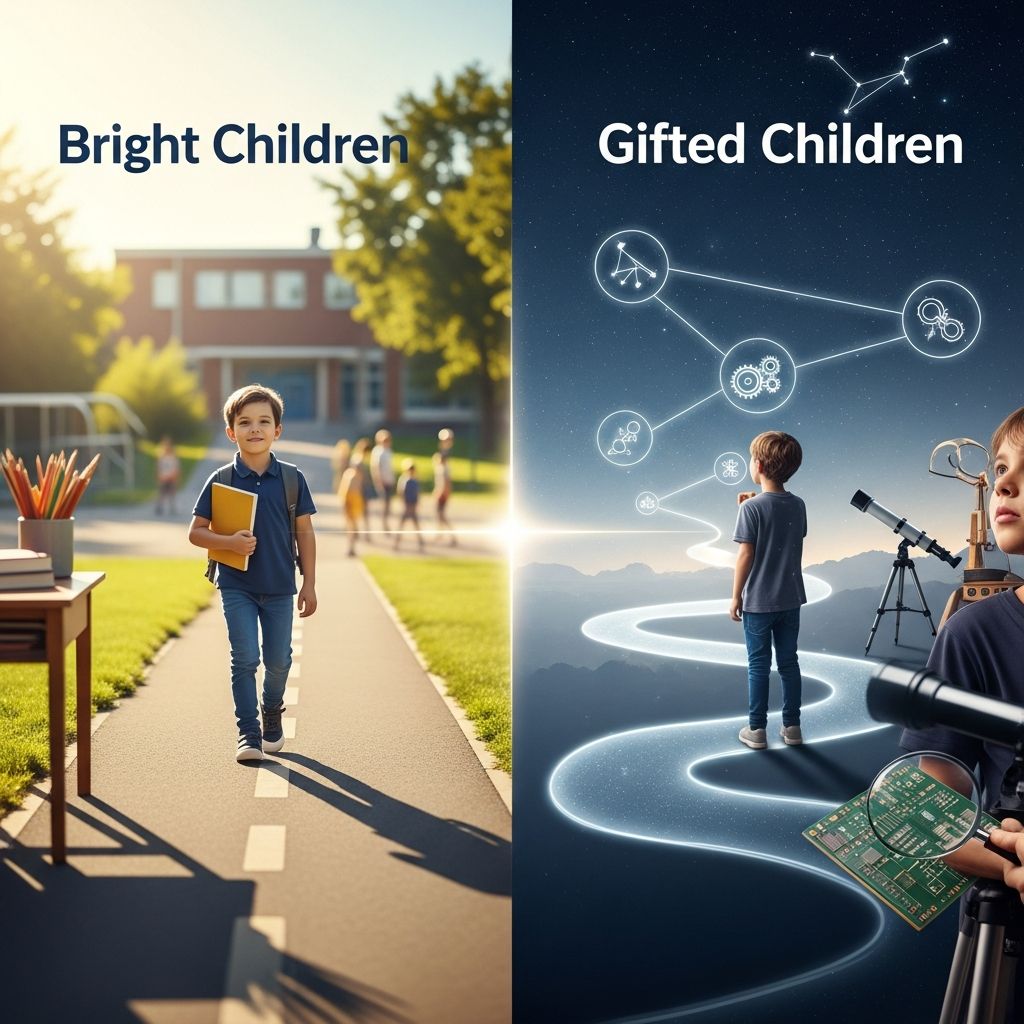
Parents and teachers often use the words gifted and bright as if they mean the same thing, but in educational psychology they describe two related yet different profiles of learners.[web:1][web:2] Recognizing these differences can help adults provide the right kind of challenge, support, and emotional guidance for each child.[web:1]
What Do “Bright” and “Gifted” Mean?
A bright child is typically a high achiever who learns quickly, performs well in school, and responds successfully to standard classroom instruction.[web:1][web:2] These children often earn strong grades, follow directions, and appear highly motivated to please adults with their performance.[web:1]
A gifted child usually shows advanced reasoning, unusual depth of understanding, and an intensity of curiosity that goes beyond simply doing well in class.[web:1][web:2] Gifted learners often make unexpected connections, ask probing questions, and may seem out of step with typical expectations for their age group.[web:2][web:4]
Key Differences at a Glance
Bright and gifted children can look similar on the surface, yet their inner learning processes and needs may be very different.[web:1][web:2] The following table highlights commonly cited contrasts between a bright child and a gifted learner.
| Bright Child | Gifted Learner |
|---|---|
| Knows the answer and recalls taught material accurately.[web:2] | Asks challenging questions and extends ideas beyond what was taught.[web:2] |
| Is interested and attentive when material is clear and well presented.[web:2] | Is intensely curious and mentally active, even when outwardly distracted.[web:2] |
| Works hard, completes assignments, and enjoys success in school routines.[web:1][web:2] | May play around, resist repetition, yet still tests very well on complex material.[web:1][web:2] |
| Enjoys straightforward, sequential instruction and clear steps.[web:2] | Thrives on complexity, nuance, and seeing the “big picture” quickly.[web:2] |
| Is pleased with personal learning and success.[web:1][web:2] | Is highly self-critical and may focus on flaws even in excellent work.[web:1][web:2] |
Intellectual and Learning Traits
Bright children typically show strong memorization skills, quick understanding of lessons, and consistent performance on grade-level tasks.[web:1][web:2] They may excel at following models, applying taught strategies, and demonstrating mastery of curriculum objectives.
Gifted children often demonstrate more qualitative differences in thinking: unusual problem-solving approaches, advanced vocabulary, or early reading and abstract reasoning beyond what they have been explicitly taught.[web:1][web:4] They may see patterns, analogies, and underlying principles that others overlook, even when they do not always complete assignments neatly.
Common Traits of Bright Children
- Respond quickly to direct teaching and practice on grade-level work.[web:1]
- Memorize facts, procedures, and sequences efficiently.[web:2]
- Show motivation to earn good grades and adult approval.[web:1]
- Enjoy clear structure, rubrics, and predictable expectations.[web:2]
Common Traits of Gifted Learners
- Learn new concepts in very few repetitions and may appear bored by review.[web:1][web:5]
- Ask probing, sometimes disruptive questions about fairness, ethics, and “why.”[web:1][web:5]
- Develop advanced interests in topics such as history, science, or philosophy at a young age.[web:1][web:4]
- Prefer complex, open-ended tasks over simple practice or worksheets.[web:2]
Behavior in the Classroom
In many classrooms, bright children are seen as ideal students because they cooperate, participate appropriately, and complete their work on time.[web:1] Teachers often experience these students as reliable, organized, and easy to teach within the standard curriculum.
Gifted children, however, may present mixed signals: they may ace tests yet forget assignments, or answer in creative ways that seem off-task to adults who expect conventional responses.[web:1][web:5] When work feels repetitive or too easy, gifted learners may disengage, daydream, or even become disruptive.
How Bright Children Typically Show Up at School
- Complete homework and classwork consistently and neatly.[web:1]
- Raise hands with correct answers and follow classroom rules closely.[web:1]
- Accept routines and grading systems without significant frustration.[web:1]
How Gifted Learners Often Show Up at School
- May resist repetitive drills and ask to move ahead more quickly.[web:1][web:5]
- Sometimes appear inattentive while actually thinking deeply about other ideas.[web:1]
- Can become disruptive or withdrawn if chronically under-challenged.[web:1][web:3]
- May produce uneven work quality despite high potential and test scores.[web:1]