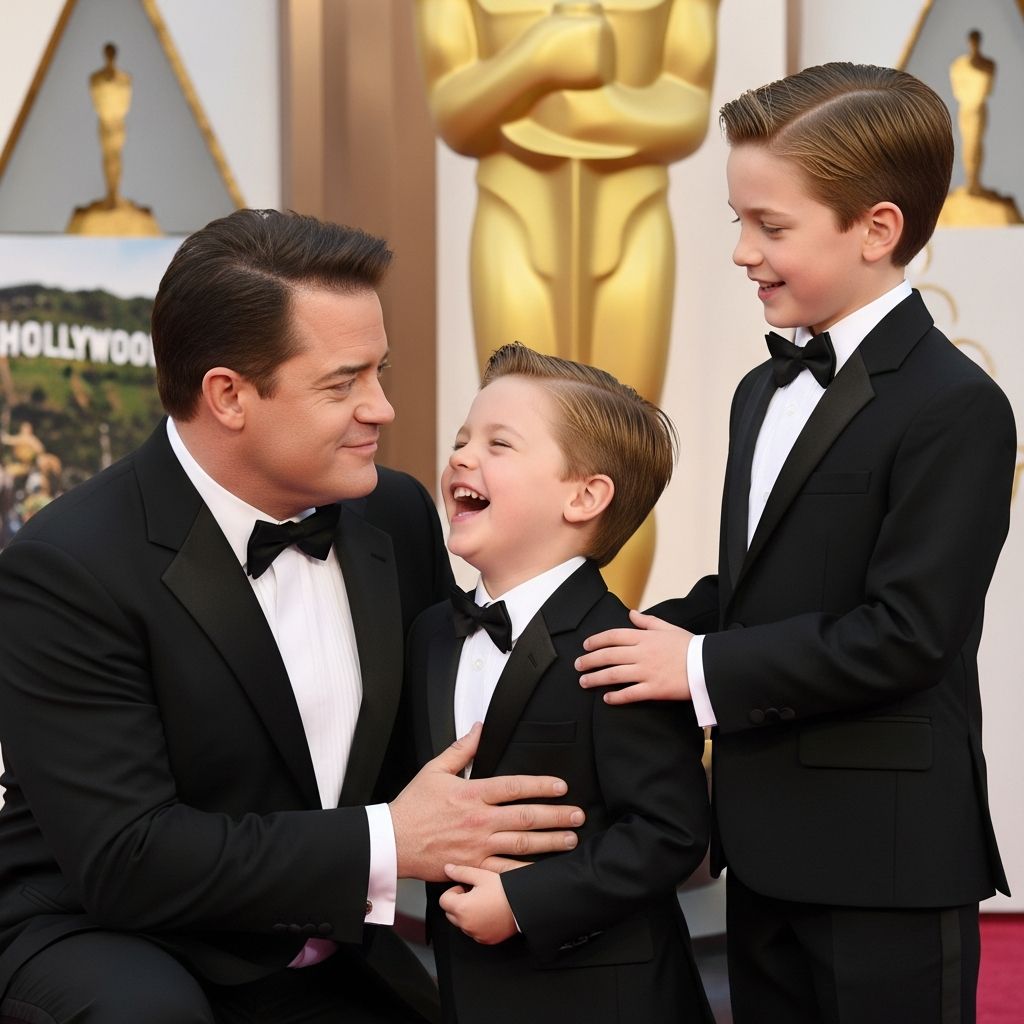
When Brendan Fraser walked the red carpet on the night he won his Academy Award, the cameras were fixed on his comeback story, his performance, and his emotional acceptance speech, but an equally compelling narrative was quietly unfolding beside him: that of a soft-spoken, loving father navigating global attention with his sons by his side.
This moment, beamed around the world, offered more than a feel-good Hollywood story; it became an unexpected blueprint for how modern dads can show up for their kids with humility, vulnerability, and pride, even when the spotlight is blinding.
The Quiet Power of a Dad on the Red Carpet
Red carpets are usually synonymous with designer gowns, media soundbites, and carefully curated personas, but Fraser’s Oscar night energy felt fundamentally different: he appeared grounded, attuned to his family, and unwilling to turn his sons into props in his big career moment.
Rather than dominating every frame, he often stepped back and allowed his sons space to react, speak, and simply exist, signaling a parenting style in which children are treated as autonomous people rather than accessories to their parents’ success.
- He shared the spotlight instead of hoarding it, a subtle but powerful message to parents watching at home.
- His demeanor suggested that professional triumph means little if it cannot be experienced alongside the people who matter most.
From Action Star to Emotional Anchor
Many adults remember Fraser as the charismatic action hero of adventure movies in the late 1990s and early 2000s, but his public image has shifted toward something more introspective and human in recent years.
His Oscar-winning performance in a deeply emotional role mirrored his real-life presence that night: open-hearted, a little vulnerable, and keenly aware of the emotional stakes of being seen, not just as an actor, but as a father.
- His career resurgence arrived during the same period that cultural expectations for fathers have evolved, with greater emphasis on emotional literacy.
- By appearing with his sons and acknowledging them in his moment of victory, he bridged the gap between public achievement and private responsibility.
What Children Learn When Parents Are Vulnerable
One of the most striking elements of Fraser’s Oscar journey was his willingness to express emotion openly, including in front of his children, rather than hiding behind a stoic façade.
For sons raised on cultural ideals of toughness and silence, seeing a father tear up, express gratitude, and speak from the heart can be transformative, modeling that strength and sensitivity can coexist.
- When parents cry, thank others, or admit past struggles in front of their kids, children learn that vulnerability is not a weakness but a form of courage.
- This kind of emotional transparency gives children permission to name their own feelings instead of burying them.
Red Carpet Parenting: Lessons for Everyday Families
Most parents will never guide their children through a high-pressure awards show, but the way Fraser moved through that surreal environment offers surprisingly practical takeaways for everyday life.
Whether the “stage” is a school ceremony, a sports final, or a family gathering, the same principles of respect, reassurance, and shared experience still apply.
- Talk kids through big events beforehand, so they know what to expect and where the focus will be.
- During the moment, check in with them—through eye contact, a quiet word, or a hand on the shoulder—to anchor them emotionally.
- Afterward, prioritize decompression together over chasing more praise or attention.
A Snapshot of Modern Fatherhood Values
Fraser’s public interactions with his sons align with an emerging model of fatherhood that values presence over performance and connection over control.
Instead of embodying the distant, hyper-masculine archetype that dominated many past depictions of fathers, he appears as a gentle guide, proud but not possessive, affectionate without embarrassment.
| Aspect | Traditional Stereotype | Emerging Model (Seen in Fraser’s Example) |
|---|---|---|
| Emotions | Stoic, feelings kept private. | Open expression of pride, gratitude, and tears in front of children. |
| Visibility | Father as background provider. | Father as emotionally present, visible source of support. |
| Children’s Role | Expected to observe quietly. | Encouraged to participate, react, and speak as individuals. |
| Success | Measured by income and status. | Measured by shared experiences and strong relationships. |
How Fame Complicates, and Clarifies, Parenting
Parenting in the public eye amplifies every choice, from how often children appear in photos to what is said about them in interviews, yet Fraser’s approach signals a protective instinct cloaked in warmth.
He appears to let his sons be visible without turning their private lives into content, an important distinction for any parent navigating social media and digital footprints today.
- Parents can take inspiration from the way he balances pride with boundaries, sharing selective moments without oversharing details.
- This approach respects children’s right to grow into their own identities without feeling fully defined by their parent’s fame or online narrative.
When Children Witness a Parent’s Comeback
Another layer of Fraser’s Oscar story is the long arc of his career, from early stardom through quieter years and then a widely celebrated return, all of which his children have partially witnessed.
For kids, seeing a parent weather professional downturns and then rebuild not only reshapes how they view success, it also normalizes setbacks and makes resilience a lived, not just preached, value.
- Parents who share age-appropriate stories of professional ups and downs help kids understand that life is not a straight line.
- Celebrating effort, persistence, and integrity over sheer visibility gives children a more sustainable template for their own ambitions.
Practical Takeaways for Dads Watching from Home
While the Oscars are a rarefied world, the underlying behaviors that made Fraser’s presence resonate are deeply accessible and replicable for fathers everywhere.
Transforming those behaviors into practical habits can turn any living room, school auditorium, or grocery store aisle into a space where children feel genuinely seen and valued.
Everyday Ways to Show Up Like This
- Name your pride out loud: Tell your kids specifically what you appreciate about them—”the way you helped your sibling” or “how you stuck with that hard assignment”—rather than only praising outcomes.
- Share your own nerves: Before a work presentation or big meeting, mention that you feel nervous and explain how you plan to cope, modeling healthy emotional strategies.
- Create shared rituals: Whether it is a pre-game handshake, a bedtime debrief, or a weekly walk, anchor connection in consistent habits.
- Protect their story: Ask your children before posting their photos or sharing anecdotes about them, reinforcing their sense of ownership over their own narrative.
Why Representation of Soft-Spoken Dads Matters
Seeing a man celebrated at the highest level of his profession while openly centering his children sends a quiet corrective to generations of media that framed fatherhood as either comic relief or distant authority.
Each time a widely admired figure demonstrates that warmth, gentleness, and protective love can exist alongside ambition and success, it becomes easier for other men to embrace those traits without shame.
- Boys and girls who grow up watching these examples are less likely to equate masculinity with emotional withdrawal.
- Partners benefit too, as caregiving and emotional labor are shared more equitably when fathers internalize this more expansive script.
Building a Family Culture Around Gratitude
Gratitude ran through Fraser’s public remarks and demeanor, from thanking collaborators to acknowledging the people closest to him, and such habits can shape family culture in profound ways.
When kids repeatedly see gratitude practiced, not just preached, it becomes part of the unspoken rules of how family members treat one another and the wider world.
- Parents can initiate daily or weekly check-ins where everyone shares something they are grateful for, big or small.
- Expressing thanks to children specifically—for their help, their honesty, or their effort—teaches them that their contributions matter.
Frequently Asked Questions
Why did Brendan Fraser’s Oscar night resonate so strongly with parents?
Many parents connected with the way Fraser combined professional achievement with visible affection and respect for his children, presenting a version of fatherhood that felt emotionally present and humble rather than performative.
What can non-celebrity parents actually copy from his behavior?
Parents can emulate his open gratitude, his willingness to express emotion in front of his kids, and his habit of centering family even during big personal milestones, whether that is a promotion, graduation, or community award.
Does public vulnerability from fathers really impact children?
Yes, when children see fathers cry, apologize, or share feelings constructively, it helps dismantle harmful stereotypes about masculinity and gives them permission to develop healthier emotional lives themselves.
How can parents balance sharing family moments with protecting children’s privacy?
Taking cues from carefully curated public appearances, parents can celebrate family milestones while withholding sensitive details, always prioritizing a child’s comfort and long-term digital footprint over short-term attention.
Is it important for sons specifically to see this type of fatherhood?
Exposure to gentle, emotionally literate father figures gives sons alternative models to traditional toughness-only ideals, helping them build identities that include empathy, communication, and care without feeling less masculine.
From Award to Everyday Life
Brendan Fraser’s Oscar night ultimately served as a reminder that the most meaningful part of any victory is the people with whom it is shared, and that a father’s love can be both quiet and unmistakably powerful in even the loudest rooms.
For parents watching from their couches, the spectacle distilled into a simple, actionable truth: children remember not the size of the stage, but how it felt to stand next to the adults who loved them there.