You do not need machines or heavy barbells to develop strong, athletic legs. Well-designed bodyweight leg workouts can improve strength, balance, mobility, and endurance using nothing more than gravity and your own body mass.
This guide walks you through the benefits of bodyweight leg training, explains how to warm up safely, breaks down key exercises, and ends with ready-to-use sample routines and FAQs.
Why Train Legs With Just Your Bodyweight?
Lower-body strength is crucial for almost every daily task: walking, climbing stairs, picking up kids, or playing sports. Bodyweight leg exercises offer several unique advantages backed by research and expert guidance.
- Convenience: Train anywhere, anytime, with no equipment.
- Functional movement: Most exercises mimic real-life patterns like squatting, lunging, stepping, and jumping.
- Joint-friendly: No external load makes them easier to learn and often safer for beginners.
- Scalable difficulty: You can progress by changing tempo, range of motion, leverage, or unilateral variations.
- Cardio and strength combined: Circuits of leg moves can challenge your heart and muscles at the same time.
Key Muscles Targeted
Well-rounded leg sessions should target these major muscle groups:
- Quadriceps: Front of the thigh; important for squatting, standing, and stair climbing.
- Hamstrings: Back of the thigh; assist hip extension and knee flexion, crucial for running and deceleration.
- Glutes: Buttock muscles; major drivers of hip extension, posture, and explosive power.
- Calves: Lower leg muscles; essential for walking, jumping, and balance.
- Hip stabilizers: Small muscles around the hips; help control knee alignment and pelvis stability.
Warm-Up: Prepare Your Hips, Knees, and Ankles
A short dynamic warm-up improves mobility, activates key muscles, and can reduce injury risk.
- Time: 5–8 minutes before each workout.
- Goal: Raise body temperature and move joints through controlled ranges of motion.
Sample dynamic warm-up:
- 30–45 seconds marching in place or light jogging
- 10–12 bodyweight half-squats
- 10 leg swings each leg (front-to-back, then side-to-side)
- 10 hip circles each direction
- 10 calf raises with a brief pause at the top
Foundational Bodyweight Leg Movements
These exercises form the backbone of most no-equipment leg routines. Start with versions you can perform with solid technique, then progress gradually.
1. Squat Variations
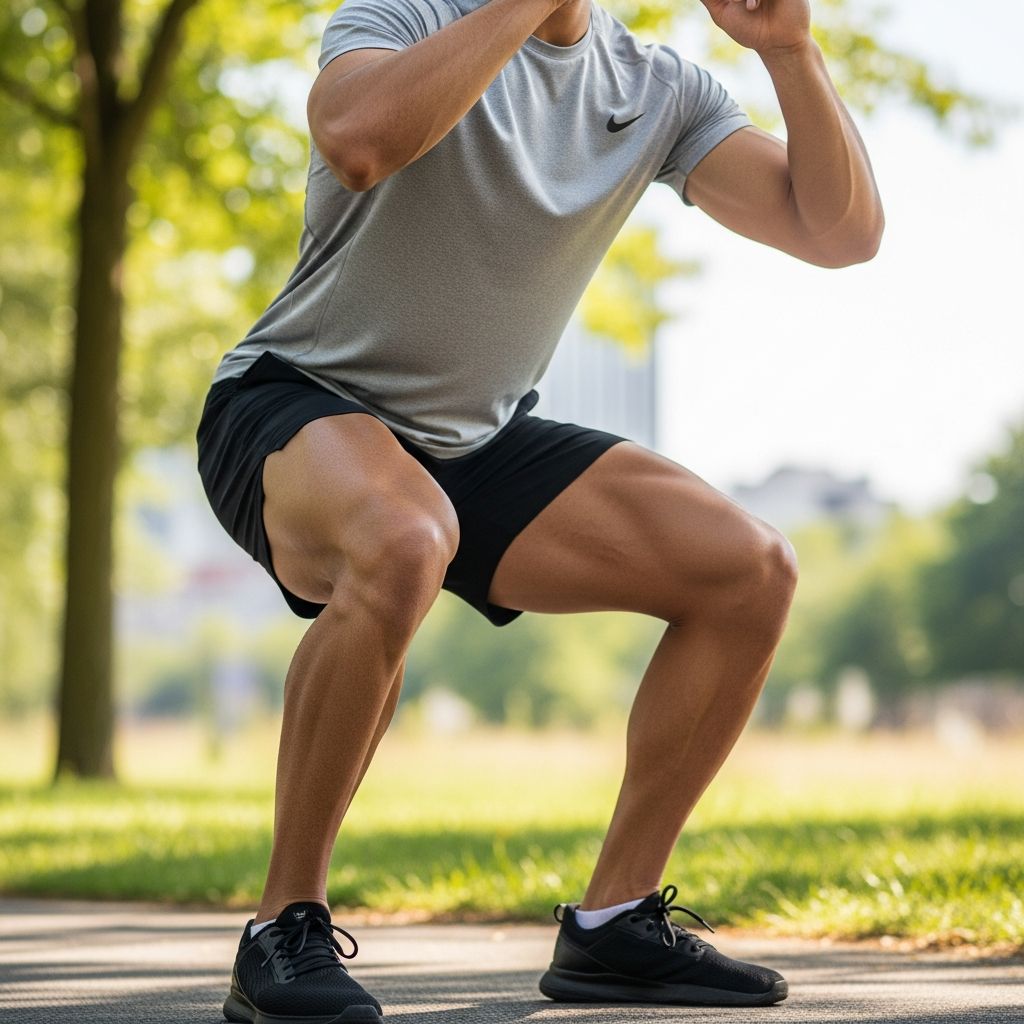
Squats are one of the most important functional movements. Research shows that even squats performed without weights can improve coordination, strength, and mobility.
- Primary muscles: Quadriceps, glutes, hamstrings.
- Secondary muscles: Core, calves.
Basic bodyweight squat cues:
- Stand with feet about hip- to shoulder-width apart.
- Brace your core and keep your chest gently lifted.
- Push your hips back and bend your knees as if sitting into a chair.
- Keep heels on the floor and knees tracking roughly over the middle of the foot.
- Go as low as you can with control, then push through your feet to stand.
Progressions:
- Tempo squats (3–4 seconds down, 1–2 seconds pause, fast up)
- Pause squats at the bottom
- Narrow-stance or wide-stance squats
- Assisted single-leg squat to a chair (pistol regression)
2. Lunge and Split-Stance Movements
Lunging patterns challenge single-leg strength, balance, and hip stability. Unilateral work helps correct side-to-side differences.
- Primary muscles: Glutes, hamstrings, quadriceps.
- Secondary muscles: Calves, core, hip stabilizers.
Basic forward lunge cues:
- Stand tall, feet together, core braced.
- Step forward and lower until both knees are bent roughly 90 degrees.
- Front knee should stay above the ankle, not collapsing inward.
- Push through the front foot to return to standing, then alternate legs.
Useful variations:
- Reverse lunges (step backward instead of forward; often easier on knees)
- Static split squats (feet fixed, move only up and down)
- Walking lunges (more conditioning and balance demand)
- Rear-foot elevated split squats (back foot on a step or sofa for extra challenge)
3. Hip Hinge and Bridge Patterns
Many people have strong quads but underactive glutes and hamstrings. Bridge and hinge variations help restore balance and support a healthy spine and hips.
- Primary muscles: Gluteus maximus, hamstrings.
- Secondary muscles: Core, lower back.
Glute bridge cues:
- Lie on your back with knees bent and feet flat, hip-width apart.
- Brace your core, press your lower back gently toward the floor.
- Drive through your heels to lift your hips until shoulders, hips, and knees form a straight line.
- Pause briefly while squeezing your glutes, then lower with control.
Progressions:
- Feet-elevated bridge (heels on a step or low chair)
- Single-leg glute bridge (one foot in the air)
- Hip thrusts with upper back on a couch or bench
4. Calf and Ankle Strength
Strong calves and mobile ankles support jumping, walking, and balance. They also play a role in absorbing impact when you land from a step or jump.
- Primary muscles: Gastrocnemius and soleus (calf muscles).
Standing calf raise cues:
- Stand upright, feet about hip-width apart, lightly holding a wall or chair for balance if needed.
- Rise onto the balls of your feet, lifting your heels as high as possible.
- Pause for 1–2 seconds, then lower slowly until your heels lightly touch the floor.
Progressions:
- Single-leg calf raises
- Calf raises on a step (allowing heels to drop below toe level)
- Slow tempo (3–4 seconds lowering) to increase time under tension
Sample Bodyweight Leg Workouts
Below is a simple way to structure your training week. Adjust volume based on your fitness level. Focus on excellent technique before increasing difficulty or volume.
| Level | Sessions/Week | Sets | Reps/Time | Rest Between Sets |
|---|---|---|---|---|
| Beginner | 2 | 2–3 | 8–10 reps | 60–90 seconds |
| Intermediate | 2–3 | 3–4 | 10–15 reps | 45–75 seconds |
| Advanced | 3 | 4–5 | 12–20 reps or 30–45 seconds | 30–60 seconds |
Beginner-Friendly Routine (Full Lower Body)
Perform this circuit 2 times per week with at least one rest day between sessions.
- Bodyweight Squats – 3 sets of 8–10 reps
- Reverse Lunges – 3 sets of 6–8 reps per leg
- Glute Bridges – 3 sets of 10–12 reps
- Standing Calf Raises – 3 sets of 12–15 reps
Rest 60–90 seconds between sets. As it becomes easier, add 2–3 reps per set or an extra set per exercise.
Intermediate Strength and Stability Session
Once you can easily perform the beginner routine, try this slightly more challenging plan 2–3 times per week.
- Tempo Squats (3 seconds down, 1 second pause) – 3–4 sets of 10–12 reps
- Walking Lunges – 3 sets of 8–10 steps per leg
- Single-Leg Glute Bridges – 3 sets of 8–10 reps per leg
- Single-Leg Calf Raises – 3 sets of 10–12 reps per leg
Rest about 45–75 seconds between sets. If you want more conditioning, shorten rests and move through the exercises in a circuit style.
Advanced Power and Endurance Circuit
For experienced exercisers with no current lower-body injuries, power-focused moves can build explosive strength and endurance. Ensure you have a stable surface and enough space before trying these.
- Jump Squats – 3–4 sets of 8–10 reps
- Rear-Foot Elevated Split Squats – 3–4 sets of 8–10 reps per leg
- Single-Leg Hip Thrusts – 3 sets of 10–12 reps per leg
- Alternating Jump Lunges (or regular lunges if impact is an issue) – 3 sets of 10–12 total reps
Rest 45–60 seconds between sets. Focus on soft landings and maintaining solid alignment: knees tracking over the middle of the feet, not collapsing inward.
Programming Tips for Bodyweight Leg Progress
To keep getting stronger and avoid plateaus, treat bodyweight training with the same structure and intent you would give to lifting weights.
- Increase difficulty gradually: More reps, more sets, slower tempo, deeper range of motion, or more challenging variations are all valid progression tools.
- Prioritize form: Quality repetitions provide better results and help prevent overuse injuries.
- Train through full, comfortable ranges: Within your mobility limits, deeper squats and lunges recruit more muscle fibers.
- Include unilateral work: Single-leg exercises improve balance and reduce left–right imbalances that may contribute to injury risk.
- Balance strength and mobility: Include dynamic warm-ups and occasional stretching to maintain healthy joint range of motion.
How Bodyweight Leg Workouts Support Overall Health
Beyond visible muscle tone, lower-body training impacts posture, daily function, and long-term joint health.
- Posture and core stability: Many leg exercises demand trunk control, which can support spinal alignment and reduce back stress.
- Mobility and flexibility: Regular movement through squats, lunges, and hip hinges helps preserve joint range of motion and may reduce stiffness as you age.
- Metabolic boost: Large leg muscles are energy-hungry; training them can increase calorie expenditure during and after workouts.
- Functional independence: Strong legs help older adults maintain balance, climb stairs, and reduce fall risk, contributing to longer independence.
Frequently Asked Questions (FAQs)
How many times per week should I do a bodyweight leg workout?
Most people do well with 2–3 leg-focused sessions per week, leaving at least one day of rest between intense lower-body workouts. Beginners can start with 2 sessions and add a third once recovery feels comfortable.
Can bodyweight leg exercises really build muscle?
Research indicates that structured bodyweight programs can significantly improve lower-body strength and, when taken close to fatigue, can promote muscle growth comparable in some cases to machine-based training. Progressing to harder variations and higher volumes over time is key.
What if I have knee discomfort when squatting or lunging?
First, reduce depth and choose more joint-friendly patterns such as reverse lunges, supported squats to a chair, or shorter ranges of motion. Focus on keeping knees in line with the toes and avoid sudden increases in training volume. If pain persists, consult a qualified healthcare or rehab professional before continuing.
How long should a bodyweight leg workout last?
A focused session can be effective in 20–35 minutes, including warm-up. Longer workouts are not automatically better; consistency and effort matter more than duration.
Do I need to stretch after training?
Including a brief cooldown with gentle stretching or easy walking can help you wind down and maintain flexibility, especially around the hips, quads, hamstrings, and calves. Spend 3–5 minutes moving slowly and breathing deeply.
References
- 9 Bodyweight Leg Exercises for Every Body — Healthline. 2021-01-27. https://www.healthline.com/nutrition/bodyweight-leg-exercises
- 10 Benefits of Bodyweight Exercises, According to Experts — Nike. 2023-02-10. https://www.nike.com/a/bodyweight-exercise-benefits
- Best Bodyweight Exercises for Strong Legs — International Sports Sciences Association (ISSA). 2022-08-15. https://www.issaonline.com/blog/post/best-bodyweight-exercises-for-strong-legs
- 10 Best Bodyweight Leg Workouts for Strength & Endurance — Speediance. 2023-06-01. https://www.speediance.com/blogs/fitness/best-boydweight-leg-exercises
- 6 Single Leg Exercises To Build Unilateral Strength And Stability — Gymshark. 2022-11-03. https://www.gymshark.com/blog/article/the-best-unilateral-leg-exercises-for-building-muscle