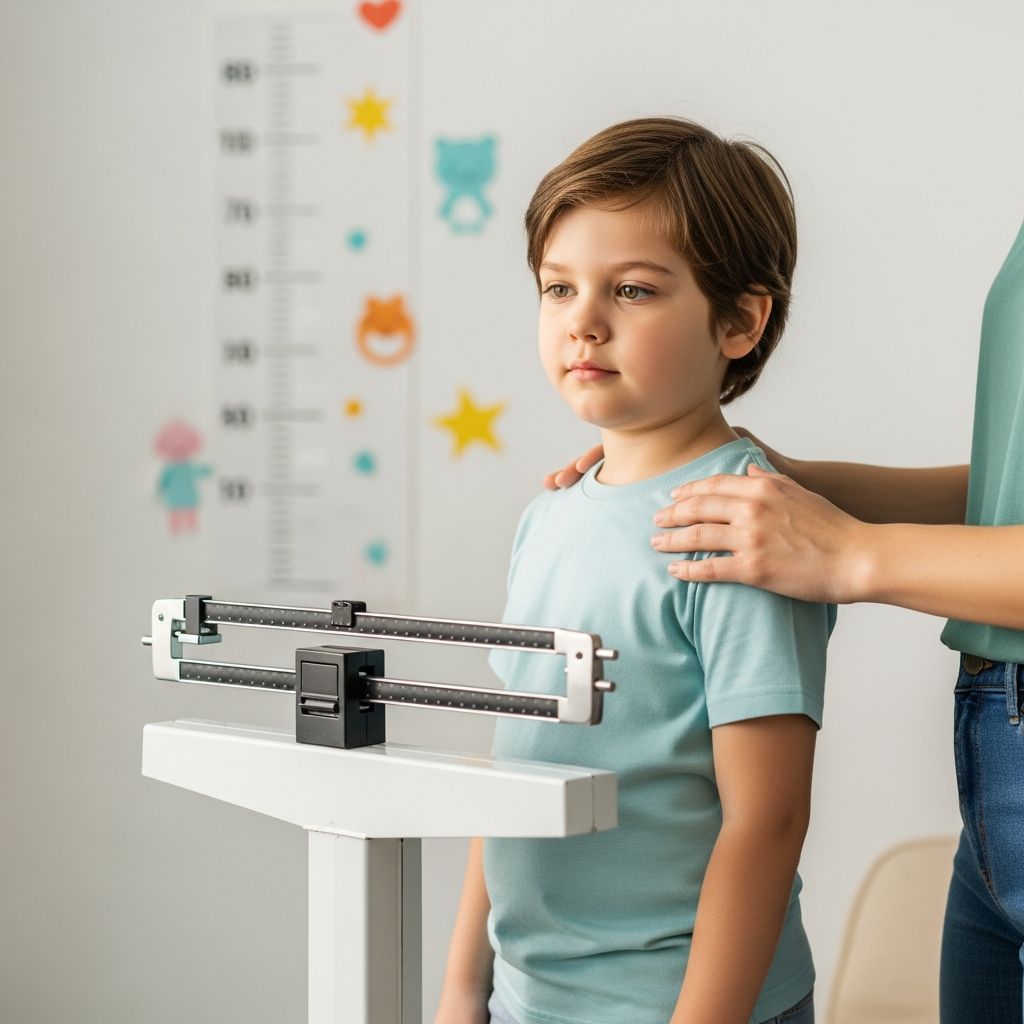
Parents often hear about body mass index (BMI) at checkups but are left wondering what the number truly means for their child’s health. BMI can be a useful starting point, yet it never tells the whole story about a growing body.
This guide explains how BMI works for children, how doctors interpret BMI-for-age charts, why trends over time matter, and how to use this information to support your child’s well-being without focusing only on weight.
What BMI Actually Measures
BMI is a way to relate a person’s weight to their height using a simple mathematical formula. For children, that number is then compared with other kids of the same age and sex to see how they are growing.
- BMI is a screening tool, not a diagnosis. It can point to possible concerns but cannot confirm a health problem on its own.
- BMI does not directly measure body fat. Muscles, bones, and even hydration can influence the number.
- Children’s bodies change quickly, so a healthy BMI for a 5-year-old is not the same as for a 15-year-old.
Because of these differences, professionals look at BMI very differently in children than in adults.
How BMI-for-Age Works for Kids
For adults, BMI is usually compared with fixed cutoffs. In children, BMI is interpreted using percentiles that come from large national surveys of growth patterns. This is why you may hear the term “BMI-for-age percentile” at pediatric visits.
To find a child’s BMI-for-age percentile, a clinician will usually:
- Measure the child’s height and weight accurately.
- Calculate the BMI number using a standard formula or calculator.
- Plot the BMI on a sex-specific BMI-for-age chart.
- Read the percentile line that the BMI falls on or between.
The percentile shows how a child compares with others of the same age and sex. For example, a BMI at the 70th percentile means the child’s BMI is higher than that of 70% of peers and lower than 30%.
Common BMI-for-Age Categories
Health professionals group BMI-for-age percentiles into broad weight-status categories. The exact percentile ranges can vary slightly by organization, but they generally follow a similar pattern.
| BMI-for-Age Percentile | General Category | What It Usually Suggests |
|---|---|---|
| Below 5th percentile | Underweight | May indicate not getting enough energy or nutrients; needs medical evaluation. |
| 5th to less than 85th percentile | Healthy weight | Weight is generally considered appropriate for age, sex, and height. |
| 85th to less than 95th percentile | Overweight | May be at increased risk for weight-related health issues; follow-up recommended. |
| 95th percentile and above | Obesity | Higher risk for health concerns; often calls for more detailed evaluation and support. |
These categories are only starting points. A child with a BMI above the 95th percentile may still be generally healthy, while a different child at the same percentile may already have related medical issues. That is why context matters so much.
Why BMI Is Different for Children and Teens
Children are constantly growing, and their body composition shifts from infancy through adolescence. A growth pattern that is normal for a toddler would be very different for a teenager.
- Age matters: As kids get older, their proportions of muscle, bone, and fat change in predictable ways.
- Sex matters: Boys and girls have different body composition patterns, especially during and after puberty.
- Timing of puberty matters: Early or late growth spurts can temporarily push BMI higher or lower.
All of these factors mean that a BMI number should never be judged in isolation. Instead, it is interpreted against what is typical for a child’s age and sex, along with their overall health picture.
Interpreting Your Child’s BMI Wisely
When you see your child’s BMI percentile, it is normal to wonder whether you should be worried. Rather than focusing on a single reading, think of the BMI as one piece of an ongoing story about your child’s growth.
Helpful questions to consider include:
- Has my child’s BMI stayed in roughly the same range over time or changed suddenly?
- Does the BMI align with what I see in daily life, such as energy levels, eating patterns, and physical activity?
- Are there any medical conditions or medications that may affect growth or appetite?
Your child’s healthcare provider will usually look at blood pressure, family history, sleep, and other factors, rather than relying solely on BMI to assess health.
Limitations and Pitfalls of BMI
Although BMI can be a convenient measure, it has important limitations, especially in a diverse, growing population of children and teens.
- It does not distinguish between fat and muscle. Athletic children with solid muscle mass can have a high BMI even when their body fat is low.
- Body shapes vary by culture and genetics. A BMI that is concerning in one child may be less so in another context.
- It may not reflect regional fat distribution. For example, weight carried mostly around the abdomen can be more concerning than weight carried more evenly.
Because of these limitations, many experts recommend using BMI only as a starting point and emphasizing healthy behaviors and well-being over strict numerical goals.
Growth Patterns: Watching the Trend, Not Just the Number
One of the most valuable uses of BMI in childhood is to monitor changes over time. A single elevated or low reading can be misleading, but a consistent pattern across several visits often tells a clearer story.
Some growth patterns that may prompt extra attention include:
- A rapid rise across several percentile lines over a short period.
- A steady decline in percentile that is not explained by a recent illness or growth spurt.
- A BMI that has been at an extreme (very low or very high) for a long time.
Keeping regular checkups allows providers to catch concerning trends early and work with families to make gradual, sustainable changes.
Talking About BMI with Children
How adults talk about bodies has a powerful effect on how children feel about themselves. The goal is to use BMI information to guide healthy habits without creating shame, fear, or an obsession with weight.
Consider these approaches when discussing health with your child:
- Emphasize strength, energy, and what bodies can do, rather than appearance.
- Use neutral, non-judgmental language such as “growing bodies” and “healthy habits.”
- Avoid labeling your child as “overweight” or “underweight” in front of them; instead, talk privately with the healthcare provider.
- Focus on family-wide changes (like more home-cooked meals or active play) instead of singling out one child.
When kids see adults model respectful attitudes toward their own bodies, they are more likely to develop a balanced, confident relationship with food and movement.
Healthy Habits That Matter More Than the Number
Regardless of where your child’s BMI falls, the same core habits support better health, mood, and development. Shifting attention from the number to these habits often leads to more successful and less stressful outcomes.
Everyday Nutrition Tips
- Offer regular meals and snacks with a mix of whole grains, fruits, vegetables, protein, and healthy fats.
- Keep sugary drinks and highly processed snacks as occasional treats instead of everyday staples.
- Eat together as often as possible; shared meals are linked with better nutrient intake and emotional connection.
- Encourage kids to listen to hunger and fullness cues rather than pressuring them to “clean the plate.”
Encouraging Fun Physical Activity
- Help your child find activities they genuinely enjoy, such as biking, dancing, swimming, or team sports.
- Limit long stretches of screen time and balance them with movement breaks.
- Plan family activities—walks after dinner, weekend hikes, or backyard games—that build active routines.
- Celebrate effort and persistence in active play, not just performance or wins.
Sleep and Stress
- Establish a consistent bedtime routine so your child gets enough sleep for their age.
- Protect sleep by limiting screens before bed and keeping devices out of the bedroom.
- Teach simple stress-management skills, such as deep breathing or journaling, especially for teens.
These lifestyle factors influence health markers such as blood pressure, mood, school performance, and energy levels—often more directly than BMI alone.
When to Seek a Professional Evaluation
It is appropriate to ask for extra guidance whenever your child’s BMI falls in the underweight, overweight, or obesity range, or when something simply does not feel right about their growth pattern. Acting early can make changes easier and more effective.
A more detailed evaluation may include:
- Reviewing growth charts from infancy to the present to understand long-term patterns.
- Checking blood pressure, lab tests, or other markers if appropriate.
- Discussing eating patterns, exercise, sleep, screen time, and emotional well-being.
- Referrals to a dietitian, counselor, or specialist if needed.
Parents should feel empowered to ask questions, request explanations in plain language, and be active partners in any plan developed for their child.
Special Situations Where BMI Can Be Misleading
There are several scenarios where BMI may not accurately reflect a child’s true health status. Recognizing these situations can prevent unnecessary worry or missed concerns.
- Highly athletic children: Kids who do regular strength-based or intense sports can have higher BMI due to muscle mass.
- Chronic medical conditions: Some illnesses or medications affect appetite, water balance, or growth patterns, which can distort BMI.
- Developmental differences: Children with certain genetic or developmental conditions may have body proportions that do not fit standard charts.
In these cases, healthcare providers may rely more on other assessments, such as detailed growth histories, body composition measures, or additional medical tests.
Using BMI as One Piece of a Bigger Picture
Ultimately, BMI for children is most helpful when it is seen as a single snapshot within a much larger album of your child’s health. It serves as a flag that invites closer attention, not a judgment about your child or your parenting.
Focusing on nurturing habits that support strength, resilience, and self-worth—instead of chasing a specific number—helps children grow into adults who respect and care for their bodies over a lifetime.
Frequently Asked Questions (FAQs)
Is a high BMI always a problem for kids?
No. A high BMI is a signal to look more closely at a child’s overall health, but it is not a diagnosis by itself. Some children with elevated BMI are very muscular and otherwise healthy, while others may have underlying health risks that need attention.
Can a child be unhealthy with a “normal” BMI?
Yes. A BMI in the healthy range does not guarantee that a child is eating well, getting enough movement, or free of medical issues. That is why providers also look at blood pressure, lab tests, mental health, and daily habits.
Should I track my child’s BMI at home?
For most families, it is better to leave formal BMI tracking to healthcare visits. Home tracking can easily create anxiety for both parents and children. Instead, pay attention to how your child feels, functions, and grows between appointments.
What if my child’s BMI has changed quickly?
A rapid jump up or down in BMI-for-age percentile is a good reason to talk with your child’s healthcare provider. Sudden changes may be linked to growth spurts, changes in activity or eating, emotional stress, or medical issues that need evaluation.
How can I support a child with a very high or very low BMI without harming their body image?
Focus on family-wide healthy habits and avoid weight-centered comments or strict dieting rules. Offer a variety of nourishing foods, encourage enjoyable physical activities, and praise your child for who they are and what they can do, not for their size.