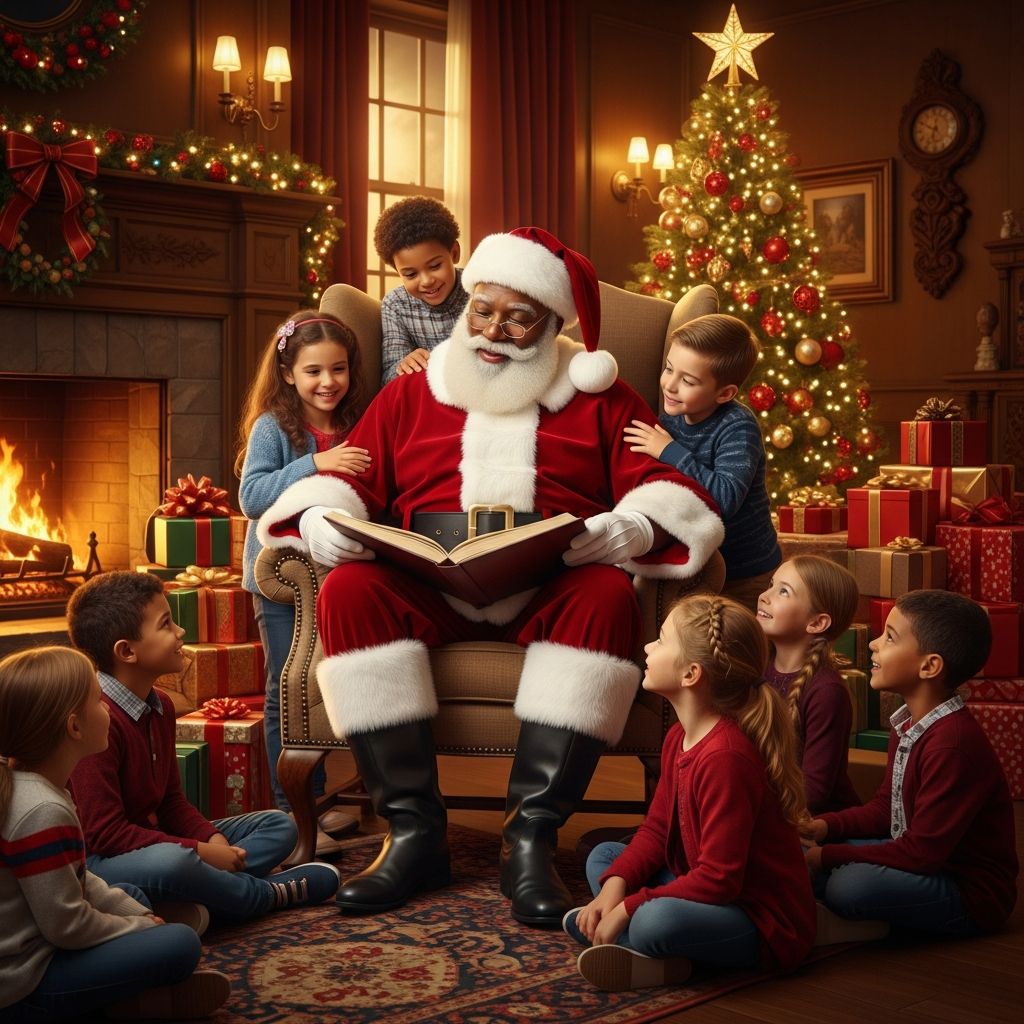
The holiday season evokes images of twinkling lights, warm gatherings, and a jolly figure in red delivering gifts. Yet, for many families, the traditional portrayal of Santa Claus as a white man overlooks the rich diversity of modern society. Enter Black Santa—a vibrant movement where performers of color step into the role, bringing representation, joy, and a fresh perspective to this iconic character. This shift not only honors historical roots but also empowers children from underrepresented backgrounds to feel seen and celebrated.
Historical Roots Beyond the Stereotype
Santa Claus’s origins trace back to Saint Nicholas, a fourth-century bishop from Myra in what is now Turkey—a region in the Middle East where people of diverse ethnicities resided. Far from the rosy-cheeked, white-bearded figure popularized in American media, the real Saint Nick likely had olive or darker skin, reflecting his Mediterranean heritage. Over centuries, commercial illustrations by artists like Thomas Nast and Coca-Cola ads cemented the Caucasian image, but this was a cultural evolution, not historical fact.
Today, recognizing these origins fuels the push for diverse Santas. Performers argue that reclaiming Santa’s multicultural beginnings dismantles limiting stereotypes and aligns the character with global realities. As one organizer notes, debating skin color misses the point—Santa symbolizes generosity and kindness, qualities universal across cultures.
The Power of Seeing Yourself in Santa
Representation matters profoundly during childhood, a time when self-image forms through cultural mirrors. For Black, Hispanic, Asian, and Indigenous children, encountering a Santa who shares their features sparks belonging. ‘If you see it, you can be it,’ echoes a common sentiment among advocates, emphasizing how visual affirmation boosts confidence and imagination.
Professional Black Santas like Andre Parker, known as Santa Andre, report children of all races flocking to them without hesitation. ‘They run up and you know, I’m Santa, that’s it,’ Parker shares, highlighting pure joy unmarred by bias. Similarly, Larry Jefferson, a 20-year veteran Santa, stresses that kids from minority groups need a figure they can identify with, fostering pride and emotional connection.
- Boosts self-esteem: Children feel validated seeing Santa resemble their family.
- Encourages aspiration: Diverse icons show kids they belong in any role.
- Builds empathy: Exposes all children to varied representations, promoting understanding.
Real Stories from Black Santa Performers
Across the U.S., Black Santas are making waves. In suburban Atlanta, Santa Andre delights families in pajamas, his Marine background adding disciplined cheer. In Little Rock, Chris Kennedy overcame racist backlash to feature in HBO’s ‘Santa Camp,’ proving resilience amid adversity.
Santa Dee, ‘The Real Black Santa,’ leads the Santas of Color Coalition, focusing on diversity, equity, and inclusion. He describes eyes lighting up as children connect personally, transcending color lines. In Oregon, events feature Black Santa alongside Indigenous ‘Solte Santa’—a warrior-inspired figure honoring Native veterans—drawing long lines for photos and wishes.
These performers infuse cultural flair: multilingual greetings in Spanish, Swahili, or dialects make interactions welcoming. One Santa Keyes from North Carolina’s ‘Santas Just Like Me’ normalizes diversity in icons, telling kids, ‘I belong too’.
Overcoming Pushback and Building Community
Not all reactions are merry. Kennedy received anonymous hate for his decorations, and traditionalists sometimes resist change. Yet, performers stay positive: ‘Stay positive and not let negativity get in your way,’ advises Santa Allan.
The broader Santa community supports this evolution. The New England Santas Society trains diverse performers, including transgender and disabled Santas, while Santa True’s Santa school offers scholarships to people of color, female Santas, and Mrs. Clauses of varied races. ‘We need new opinions, new ideas, and especially new communities,’ True affirms.
| Challenge | Response | Impact |
|---|---|---|
| Racist notes or comments | Focus on joyful interactions | Strengthens resolve, highlights positivity |
| Lack of training access | Scholarships and inclusive schools | Increases diverse performers |
| Traditional expectations | Cultural spins like languages | Enhances inclusivity |
Inclusive Training and Year-Round Impact
Diversification extends to education. Organizations host workshops teaching the ‘fundamentals of being Santa’ while celebrating uniqueness. Santa Myk pairs multicultural colleagues for gigs, ensuring visibility. Events like Sacramento’s ‘Christmas in Oak Park’ feature Black Santa at Black-owned bookstores, blending literacy and holidays.
Beyond December, these efforts promote tolerance. Raised in the segregated South, advocates like Cassandra Jennings see inclusivity as essential for societal progress: ‘Love for one another is what’s going to make our society a better place’. Media experts like Corsbie-Massy add that varied Santas meet community needs for self-representation, enriching the holiday idea.
Why Families Choose Diverse Santas
Parents seek Black Santa for authenticity in diverse neighborhoods. ‘Now we know ain’t no white man gonna come up in this neighborhood and talk about bringing some toys,’ jokes one Chicagoan, underscoring cultural fit. Families report deeper magic when Santa mirrors their world.
- Personalized experiences through bilingual interactions.
- Home visits building intimate memories.
- Events promoting community unity.
Researcher Bori Csillag notes performers ‘hear the calling in their heart,’ succeeding regardless of mainstream images.
Frequently Asked Questions (FAQs)
What inspired the Black Santa movement?
The movement draws from Saint Nicholas’s non-white origins and a desire to reflect today’s diverse populations, with performers filling representation gaps.
Do children accept Black Santas?
Absolutely—kids embrace them as Santa, focusing on joy over appearance, as shared by multiple performers.
How can I hire a Black Santa?
Look for groups like Santas of Color Coalition or local performers via community events and social media.
Is there training for diverse Santas?
Yes, inclusive programs like Santa True’s school provide scholarships and fundamentals training.
Does this change Santa’s magic?
No—it enhances it by adding cultural relevance and empathy-building representation.
Future of Holiday Icons: A Call for Broader Diversity
The rise includes Latin, Asian, Indigenous, and drag Santas, signaling a holistic evolution. Transponder’s Yasuhara advocates embracing change for empathy: ‘Marginalized communities see themselves, and we see others’. With fewer than 5% non-white professional Santas historically, progress is vital.
For parents, choosing diverse Santas teaches children inclusivity early. It transforms holidays from nostalgic rituals into bridges of understanding, ensuring every child believes in magic that looks like them.
References
- Men who dress up as Black Santa Claus spread joy, diversity and inclusion for the holidays — St. HOPE / USA TODAY. 2022-12-21. https://www.sthope.org/article/men-who-dress-black-santa-claus-spread-joy-diversity-and-inclusion-holidays
- Diverse Santas seen as an important evolution for St. Nick — ABC News. 2022-12-00. https://abcnews.go.com/US/diverse-santas-important-evolution-st-nick/story?id=93267123
- The rise of the multicultural Santa Claus — USC Storyspace. 2023-2024. https://uscstoryspace.com/2023-2024/mrarmend/Fall_Final/
- Santa Claus on the Importance of Representation — WTTW Chicago News. 2022-12-22. https://news.wttw.com/2022/12/22/santa-claus-importance-representation
- Santa Dee on the importance of having a diverse representation of Santa Claus — WABE. N/A. https://www.wabe.org/santa-dee-on-the-importance-of-having-a-diverse-representation-of-santa-claus/
- Diverse Santas give Oregonians an inclusive Christmas icon — OPB. 2025-12-23. https://www.opb.org/article/2025/12/23/diverse-santas-christmas-inclusive-image/