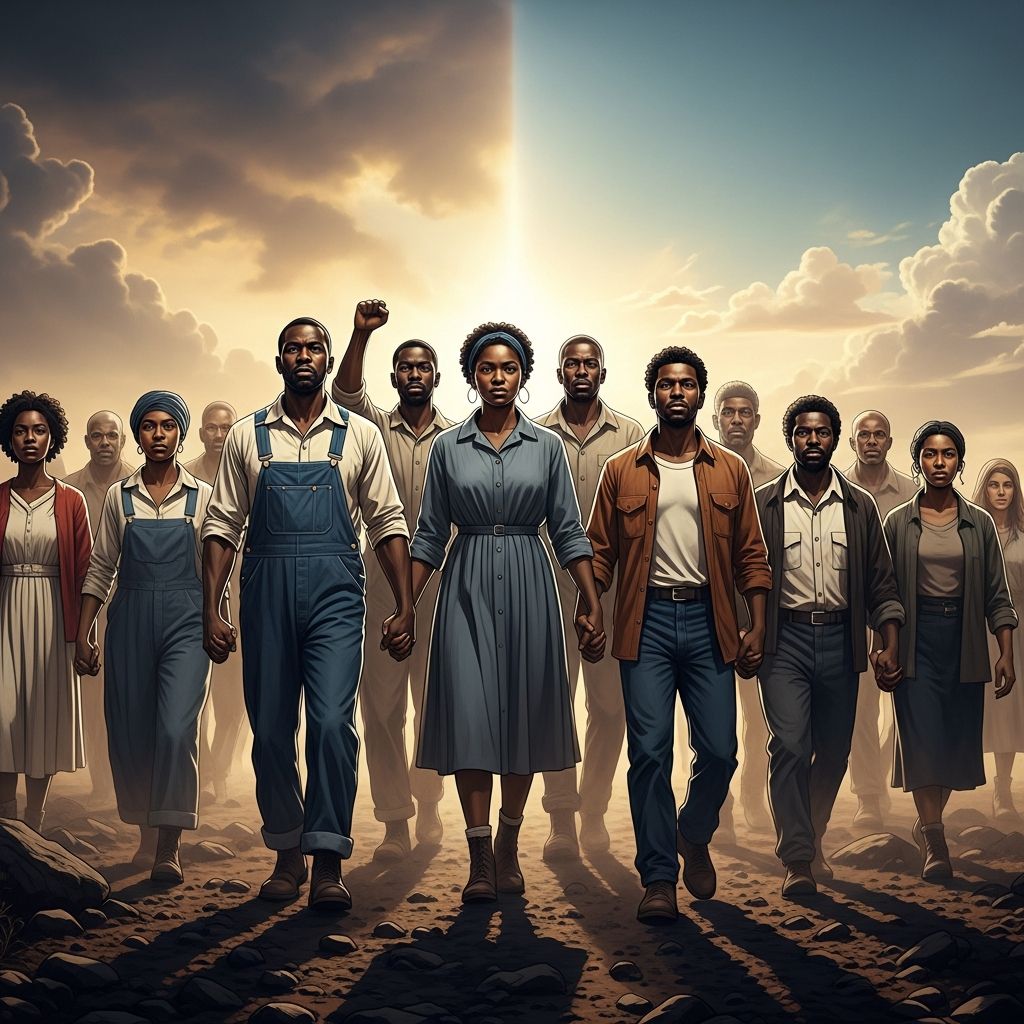
Black resistance in America represents a continuous thread of courage and determination woven through centuries of adversity. Beginning with the earliest acts of defiance against enslavement, African Americans have consistently challenged systems of oppression, reshaping the nation’s social fabric. This history is not merely a record of struggle but a testament to resilience that propelled landmark legal victories, cultural shifts, and ongoing advocacy for equity.
Roots of Rebellion: Early Acts Against Enslavement
The story of Black resistance commences in the late 17th century, as enslaved Africans arriving in colonial Virginia began organizing against their brutal captivity. These initial efforts laid the groundwork for a legacy of opposition that persisted through the eras of slavery, Reconstruction, and beyond. Enslaved people employed diverse tactics, from subtle acts of sabotage to organized uprisings, demonstrating an unquenchable desire for liberty.
Resistance took myriad forms: slowing work paces, feigning illness, or escaping to form maroon communities in remote areas. These actions disrupted the economic engine of slavery and asserted human dignity amid dehumanization. By the 19th century, this defiance escalated into notable revolts, signaling to enslavers the inherent instability of their system.
- Enslaved individuals destroyed tools and livestock to undermine plantation productivity.
- Escape networks like the Underground Railroad emerged, aiding thousands in flight to freedom.
- Maroon societies in swamps and mountains provided safe havens and bases for raids on plantations.
The Fight for Emancipation: Abolition and Insurrection
As abolitionist sentiments grew, Black resistance intertwined with broader movements. Figures like Frederick Douglass and Harriet Tubman became icons, using oratory, writing, and direct action to dismantle slavery. Armed rebellions, though often suppressed, amplified calls for immediate emancipation and influenced public opinion.
Key insurrections highlighted the ferocity of this struggle. In 1831, Nat Turner’s rebellion in Virginia resulted in the deaths of nearly 60 white people, prompting harsher slave codes but also galvanizing abolitionists. Similarly, the 1811 German Coast Uprising in Louisiana involved hundreds marching toward New Orleans, demanding freedom.
| Event | Date | Key Figures | Impact |
|---|---|---|---|
| Nat Turner’s Rebellion | 1831 | Nat Turner | Intensified debates on slavery; led to stricter laws |
| Amistad Mutiny | 1839 | Joseph Cinqué | U.S. Supreme Court ruled for captives’ freedom |
| Underground Railroad Operations | 1830s-1860s | Harriet Tubman | Rescued over 300 enslaved people |
These events underscored that Black resistance was both individual and collective, forcing America to confront the moral contradictions of its founding ideals.
Reconstruction and the Rise of Jim Crow: Persistent Pushback
Following the Civil War, Reconstruction offered fleeting hope as Black Americans voted, held office, and built institutions. Yet, the imposition of Jim Crow laws ushered in a new era of segregation and disenfranchisement. Undeterred, Black communities resisted through legal challenges, economic cooperatives, and cultural expression.
The Niagara Movement, founded in 1905 by W.E.B. Du Bois, advocated for full civil rights, evolving into the NAACP in 1909. This organization pursued court battles against lynching and segregation, achieving early wins like Guinn v. United States (1910), which struck down grandfather clauses.
- Black newspapers like the Chicago Defender encouraged the Great Migration, shifting demographics and political power.
- Economic self-reliance through groups like the National Negro Business League countered boycotts and exclusion.
- Literary works by authors like Zora Neale Hurston preserved and celebrated Black resilience.
Mid-20th Century Momentum: The Modern Civil Rights Era
The 1950s and 1960s marked the zenith of organized nonviolent resistance, catalyzed by Supreme Court decisions and grassroots mobilization. The Brown v. Board of Education ruling in 1954 declared school segregation unconstitutional, igniting widespread action.
Rosa Parks’ refusal to relinquish her bus seat in Montgomery, Alabama, on December 1, 1955, sparked a 381-day boycott led by Martin Luther King Jr., culminating in the Supreme Court’s affirmation of bus desegregation. This victory inspired the Southern Christian Leadership Conference (SCLC) and Student Nonviolent Coordinating Committee (SNCC), amplifying youth involvement.
Freedom Rides in 1961 tested interstate bus integration, facing violent backlash but pressuring federal intervention. The 1960 Greensboro sit-ins by four students at a Woolworth’s lunch counter spread nationwide, desegregating public facilities.
Birmingham and the Children’s Crusade
In 1963, Birmingham’s campaign exposed segregation’s brutality via Bull Connor’s use of dogs and fire hoses against protesters, including children. Global outrage compelled negotiations, yielding desegregation.
Selma and Voting Rights
The 1965 Selma marches, particularly Bloody Sunday on March 7, where state troopers assaulted marchers on the Edmund Pettus Bridge, galvanized passage of the Voting Rights Act. John Lewis and others embodied sacrificial courage.
Black Power and Urban Uprisings: A New Phase
Parallel to nonviolence, Black Power emerged, emphasizing self-determination. Stokely Carmichael’s 1966 coinage during James Meredith’s March Against Fear marked this shift. Malcolm X’s assassination in 1965 symbolized ideological tensions, yet his legacy endured.
Urban rebellions like Watts (1965), with 34 deaths and $40 million in damage, and Detroit (1967), killing 43, highlighted socioeconomic grievances. The Kerner Commission warned of America’s division into separate societies.
| Uprising | Date | Casualties | Key Findings |
|---|---|---|---|
| Watts Riot | Aug 1965 | 34 deaths | Poverty, poor housing drove unrest |
| Detroit Riot | Jul 1967 | 43 deaths | Racism, discrimination root causes |
Legal Milestones and Institutional Change
Federal actions advanced resistance goals: Executive Order 11246 (1965) mandated equal employment by contractors. Military integration progressed, with full reserve units desegregated by 1962. Voter registration drives, despite violence like church burnings in Georgia (1962), boosted participation.
Cultural Resistance: Art, Music, and Identity
Beyond protests, Black artists fueled resistance. Blues, jazz, and later hip-hop chronicled struggles and celebrated triumphs. Literature from Richard Wright to James Baldwin critiqued systemic racism, fostering global solidarity.
- Motown and soul music provided anthems like “A Change Is Gonna Come.”
- Black Arts Movement promoted cultural nationalism.
- Contemporary works continue amplifying marginalized voices.
Legacy and Contemporary Echoes
Today’s movements like Black Lives Matter build on this foundation, addressing police violence and inequality. From Albany protests (1961-62) to ongoing voter suppression fights, resistance evolves but remains rooted in collective power.
The perseverance of figures like Fannie Lou Hamer, who faced eviction for registering to vote in 1962, exemplifies enduring commitment. This history teaches that progress demands vigilance and unity.
Frequently Asked Questions (FAQs)
What sparked the Montgomery Bus Boycott?
Rosa Parks’ arrest on December 1, 1955, for refusing to give up her seat triggered the 381-day boycott, ending segregation on Montgomery buses.
Why is Bloody Sunday significant?
On March 7, 1965, in Selma, police brutally attacked peaceful marchers, footage of which pressured Congress to pass the Voting Rights Act.
What was the impact of the Greensboro sit-ins?
Starting February 1, 1960, they spread nationally, leading to desegregation of lunch counters and inspiring further nonviolent protests.
How did Black Power differ from nonviolent civil rights?
Black Power, popularized in 1966, focused on self-defense, pride, and economic independence, contrasting with integrationist nonviolence.
What caused the Watts and Detroit riots?
Police brutality and entrenched poverty ignited these 1965 and 1967 uprisings, revealing urban Black communities’ dire conditions.
References
- Timeline of the civil rights movement — Wikipedia. Accessed 2026. https://en.wikipedia.org/wiki/Timeline_of_the_civil_rights_movement
- Timeline of the American Civil Rights Movement — Encyclopædia Britannica. Accessed 2026. https://www.britannica.com/list/timeline-of-the-american-civil-rights-movement
- Resistance and Black History — Facing History and Ourselves. Accessed 2026. https://www.facinghistory.org/ideas-week/resistance-black-history
- A Timeline of Resistance: The Perseverance of African Americans — National Park Service. Accessed 2026. https://www.nps.gov/articles/series.htm?id=AC49644F-F7EC-D294-47BE88F7D642EA83
- Civil Rights Era – Timeline — Jim Crow Museum, Ferris State University. Accessed 2026. https://jimcrowmuseum.ferris.edu/timeline/civilrights.htm