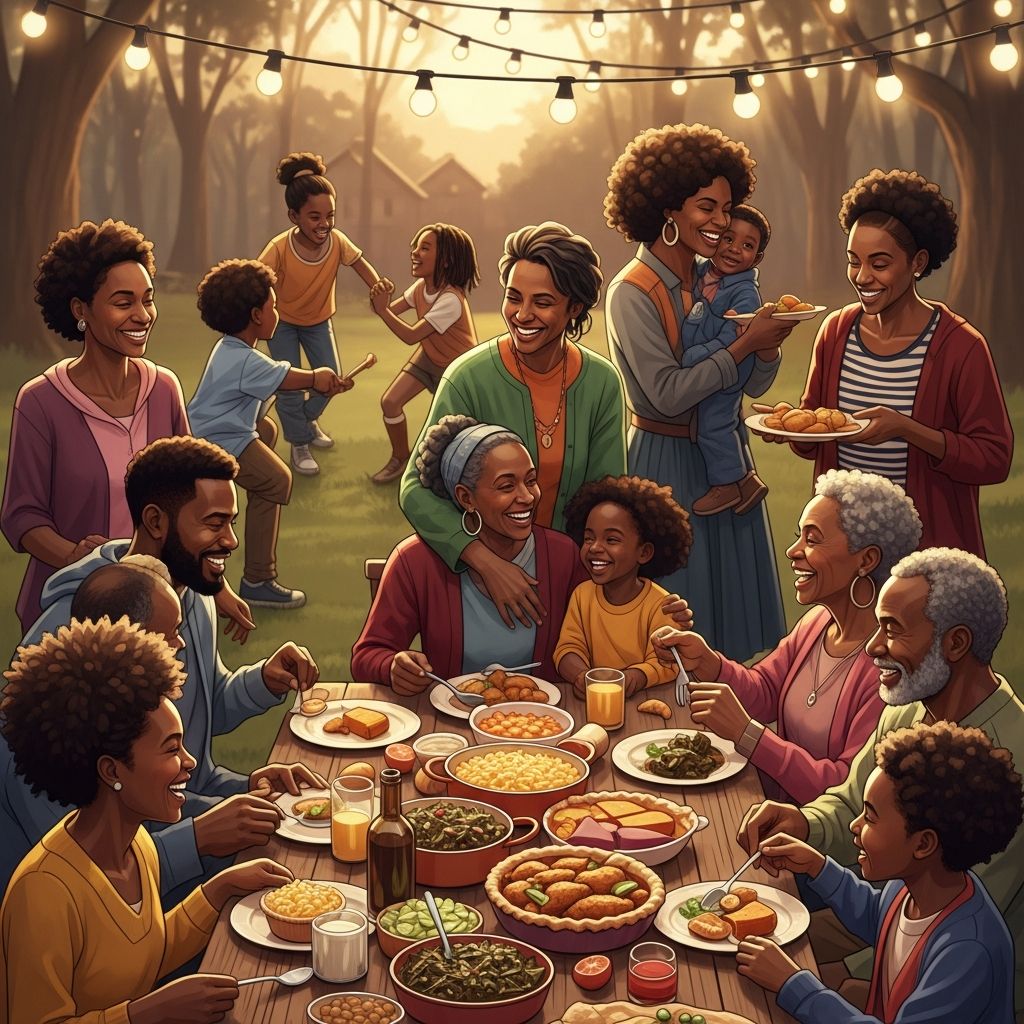
Black family structures have long transcended biological ties, weaving intricate webs of support through extended relatives, close friends, and community members who function as kin. This approach, rooted in African traditions and forged in the crucible of American history, emphasizes collective resilience over isolated nuclear units.
Historical Foundations of Expansive Family Ties
The story of Black family networks begins with the forced migration of the transatlantic slave trade, which shattered traditional African family units but sparked innovative adaptations. Enslaved Africans, separated from blood relatives, formed “fictive kin” relationships—bonds with non-blood individuals treated as family—to recreate stability and emotional anchorage.
From the 1650s to the 1800s, colonial laws and slavery institutionalized disruptions, yet communities responded by building extended kinship systems. By 1880, census data from Philadelphia revealed that about 75% of Black families operated as nuclear units, but this masked broader networks where aunts, uncles, and grandparents routinely shared child-rearing duties.
Post-emancipation, these patterns persisted. Between 1880 and 1960, two-parent households dominated, yet single-parent homes remained stable until a sharp rise post-1960. Scholars note that traditional African emphases on communal child-rearing influenced these structures, modified by slavery’s alienation from both African and European norms.
Core Elements of Black Kinship Systems
Black families embody a twelve-part typology highlighting diversity: nuclear families with two biological parents; extended families incorporating grandparents and cousins; augmented households with non-relatives acting as kin; single-parent setups, often matriarchal; blended families from remarriages; and foster arrangements.
- Nuclear Families: Two parents and children, forming the baseline but often embedded in larger networks.
- Extended Families: Multi-generational homes pooling resources for economic and emotional support.
- Augmented and Fictive Kin: Friends or neighbors integrated as family, providing childcare and mutual aid.
- Single-Parent and Segmented Structures: Predominantly mother-child households, twice as common in Black communities as others.
Andrew Billingsley’s framework adds depth: structural (household composition), functional (roles in nurturing), cultural (traditions and spirituality), and social substructures (church and neighborhood ties). These layers ensure families thrive despite external pressures.
Mutual Aid and Resource Sharing in Practice
A hallmark of Black family networks is the robust exchange of goods, services, and support. Research shows strong interaction patterns, with kin providing loans, meals, clothing, housing, and childcare—functions typically nuclear-family bound.
Carol Stack’s observations of lower-class Black communities highlight “family networks” as the smallest durable kin units, ensuring child survival through daily cooperation. Ties endure across distances and economic strata, with little marriage pressure due to extended household security.
Three-generation households exemplify this: parents aid adult children financially and socially, while grandparents offer reciprocal care. This bidirectional flow eases solo parenting strains and adapts to poverty.
| Family Network Function | Examples in Black Communities | Benefits |
|---|---|---|
| Economic Cooperation | Shared housing, loans between kin | Resource pooling amid inequality |
| Childcare and Socialization | Informal adoption, grandparent involvement | Child stability, reduced role strain |
| Emotional Support | Fictive kin rituals, church gatherings | Cultural resilience, crisis response |
Church and Community as Family Extensions
Churches serve as vital social substructures, amplifying kinship networks. African Americans are more likely to live in extended households, which pool resources and distribute caregiving—arrangements research deems beneficial.
These institutions host spiritual practices central to cultural substructures, fostering values passed intergenerationally. Neighborhoods and friends form safety nets, especially in crises, embodying James Stewart’s view of family as an institution interacting with broader Black societal networks in economics, education, and health.
Modern Evolutions and Challenges
Today, 44% of Black children live with single mothers, reflecting shifts from 1960s two-parent majorities. Yet, this statistic overlooks enduring kin networks. The Blaxit movement sees African Americans relocating to Africa, integrating into traditional extended units.
Diverse structures—married, cohabiting, coparenting—raise children effectively when supported by networks. Critics like E. Franklin Frazier noted patriarchal vs. matriarchal models, but contemporary views stress adaptation over pathology.
Steven Ruggles’ historical analysis confirms single parenthood predates welfare expansions, rooted in slavery-era patterns. Extended households, once more common among whites after controlling for absent parents, highlight Black innovation.
Resilience Through Adaptive Strategies
Black families exemplify the “cultural variant” model: distinctive norms substituting for nuclear ideals via kin networks functional in poverty adaptation. Nobles’ African model underscores communalism, while Stack’s work details flexible patterns navigating welfare systems.
Informal adoption—taking in non-biological children—further illustrates adaptability. These networks counteract racism and group superiority biases, per Robin Williams, striving for survival.
Recent studies affirm extended families’ benefits: economic sharing, caregiving distribution. Even as two-parent homes correlate with outcomes, they don’t erase racial inequalities alone.
Frequently Asked Questions
What defines a Black family network?
A dynamic system of blood relatives, fictive kin, and community members providing mutual support beyond nuclear models.
How did slavery influence Black family structures?
It fragmented ties but prompted fictive kin and extended networks for emotional and practical survival.
Are single-parent Black families less stable?
No, kin networks provide nuclear-like functions, easing strains through aid exchanges.
What role does the church play?
It extends social substructures, offering spiritual, emotional, and material support.
Is the extended family tradition fading?
No, modern data shows persistence, with evolutions like Blaxit reinforcing it.
Preserving and Celebrating These Traditions
Black family networks demand recognition as strengths, not deficits. Policymakers should support them via community programs amplifying kin roles. Education on these histories fosters pride, ensuring cultural endurance.
From slavery’s shadows to today’s vibrant communities, these structures prove kinship’s power. By honoring expansive definitions, Black families model inclusive love for all.
References
- African-American family structure — Wikipedia. 2023-10-15. https://en.wikipedia.org/wiki/African-American_family_structure
- Distinctive Features of the African-American Family — Scholars Compass, VCU. 1980-01-01. https://scholarscompass.vcu.edu/cgi/viewcontent.cgi?article=1132&context=esr
- The Origins of African-American Family Structure — University of Minnesota Population Center. 1994-01-01. https://users.pop.umn.edu/~ruggl001/Articles/Af-Am-fam.pdf
- African American Extended Family and Church-Based Social Support — PMC (NCBI). 2017-04-24. https://pmc.ncbi.nlm.nih.gov/articles/PMC5417543/
- The Black Family Blueprint — The Heritage Foundation. 2023-01-01. https://www.heritage.org/black-family-blueprint