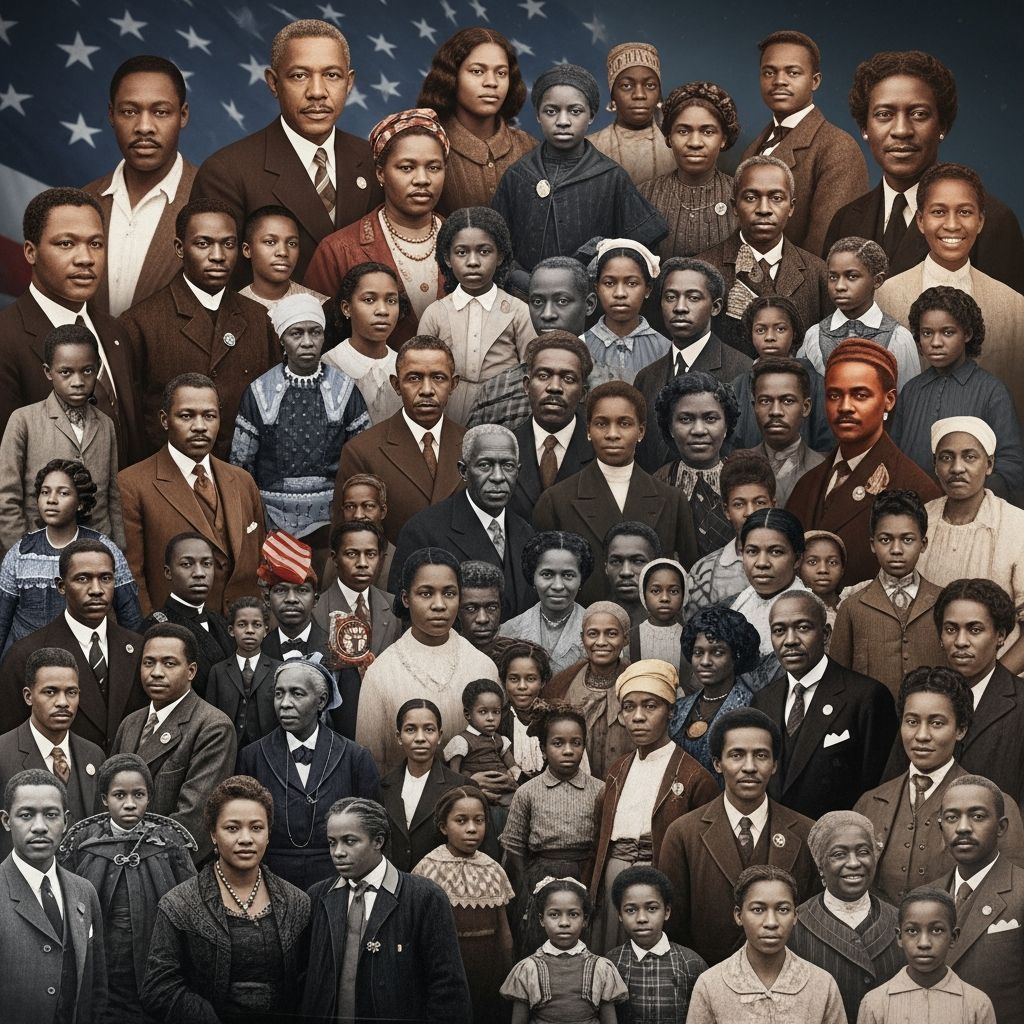
Throughout American history, Black families have stood at the forefront of progress, challenging systemic barriers and contributing immensely to the nation’s social, economic, and political fabric. From the fight against slavery to the push for civil rights and beyond, these families exemplify resilience, leadership, and innovation. This article delves into their stories, highlighting how collective efforts across generations forged lasting change.
Pioneers of the Revolutionary Era: The Forten Legacy
James Forten emerged as a key figure during the American Revolution, born free in Philadelphia in the 1760s. As a young sailor, he served aboard a privateer ship, experiencing capture by the British yet returning to build a thriving sailmaking business along the Delaware River. His enterprise not only made him one of the wealthiest Black men in the nation but also a vocal abolitionist who used his platform to advocate for emancipation.
Forten’s family extended his influence profoundly. His daughter Sarah Forten published anti-slavery poetry and essays, while Charlotte Forten Grimké became a pioneering educator and diarist, documenting racial injustices. The family’s involvement spanned business acumen, philanthropy, and activism, influencing cross-racial alliances in Philadelphia up to the Civil War era. Their story underscores how economic independence fueled broader social justice efforts.
- Key Contributions: Revolutionized sailmaking with innovative tools; funded abolitionist publications; supported women’s suffrage.
- Legacy: Inspired exhibits like the Museum of the American Revolution’s display on their 1776-1876 journey.
Church Builders and Independence Seekers: Allen and Vesey Dynasties
Richard Allen’s family laid foundational stones for Black religious autonomy. Born into slavery in 1760, Allen purchased his freedom and founded the African Methodist Episcopal (AME) Church in 1816 after facing segregation in white congregations. This Philadelphia-based institution became the first independent Black denomination, growing rapidly and serving as a hub for community organizing.
Meanwhile, Denmark Vesey’s lineage in Charleston highlighted bold resistance. Having bought his freedom via a lottery win, Vesey co-founded the AME church there, amassing over 1,800 members. Though accused of plotting a slave revolt in 1822—leading to his execution—his efforts symbolized early calls for liberation, galvanizing future movements.
These families transformed spiritual spaces into centers of empowerment, education, and resistance against oppression.
| Family | Founding Role | Impact |
|---|---|---|
| Allen | AME Church Founder | First Black denomination; community leadership |
| Vesey | AME Co-Founder | Resistance symbol; church growth |
Abolitionists and Suffragists: Harper and Truth Households
Frances Ellen Watkins Harper’s family embodied multifaceted activism. Born free in Baltimore in 1825, Harper became a prolific poet, teacher, and Underground Railroad conductor. She co-founded the National Association of Colored Women in 1894, advocating for Black women’s rights and education. Her writings challenged racial and gender inequalities, influencing generations.
Sojourner Truth’s path from enslavement to icon status is legendary. Escaping in 1826, she successfully sued for her son’s freedom and delivered the iconic “Ain’t I a Woman?” speech in 1851. Truth petitioned for land grants to freed slaves and supported suffrage, her family’s story reflecting personal triumph turned public crusade.
- Harper’s innovations: Blended literature with oratory for abolition.
- Truth’s boldness: Legal victories and mass mobilization.
Media Moguls and Legal Trailblazers: Abbott and Bolin Lines
Robert Sengstacke Abbott revolutionized Black media with the Chicago Defender in 1905. Starting as a modest pamphlet, it grew into a powerhouse encouraging the Great Migration, offering economic hope to Southern Blacks. Abbott’s family vision birthed modern publications like Ebony, shaping public discourse.
Jane Bolin broke judicial barriers as the first Black woman judge in 1939 after graduating Yale Law in 1931. Her rulings pushed merit-based hiring, combating discrimination. Serving on NAACP boards, Bolin’s family advanced legal equity and child welfare.
Civil Rights Warriors: Evers and Rustin Clans
Medgar Evers, NAACP field secretary in Mississippi, fought school desegregation post-Brown v. Board. Assassinated in 1963, his death fueled protests and cultural works; buried at Arlington with honors, his family’s sacrifice amplified the movement.
Bayard Rustin orchestrated the 1963 March on Washington despite personal challenges as a gay activist with past communist ties. His strategic genius advanced jobs and wages campaigns.
Modern Icons: Obama and Bridges Families
The Obama family marked a milestone as the first Black First Family, with Barack’s presidency (2009-2017) symbolizing progress amid ongoing struggles.
Ruby Bridges, at age six in 1960, integrated a New Orleans school, her courage sparking desegregation. Her foundation now combats racism.
Immigrant Innovators: Russwurm’s Enduring Influence
John Brown Russwurm, son of a Jamaican enslaved woman and English merchant, graduated Bowdoin College in 1826—the first Black alumnus. Co-founding the first Black newspaper, he later governed Maryland in Liberia, blending journalism and statecraft.
Entrepreneurial Dynasties: Gordy and Beyond
The Gordy family built Motown Records, revolutionizing music and culture. Berry Gordy Sr.’s descendants created global hits, fostering Black economic power.
Other lineages like the Bustills contributed to Underground Railroad networks, while the Batiste family excels in jazz preservation.
Cross-Generational Themes of Triumph
These families navigated slavery, segregation, and discrimination through education, faith, business, and activism. Their stories reveal patterns: economic self-reliance funding advocacy; intergenerational knowledge transfer; alliances with white reformers.
Statistics highlight impact: AME Church membership exceeds 2.5 million today; Great Migration relocated 6 million Blacks northward, spurred by media like Abbott’s Defender.
Frequently Asked Questions
What role did Black families play in the American Revolution?
Figures like James Forten fought in the war and built businesses, advocating abolition while embodying revolutionary ideals.
How did religious institutions aid Black progress?
AME Churches founded by Allen and Vesey provided spiritual, educational, and resistance hubs.
Who were key Black women suffragists?
Harper, Truth, and Forten Grimké combined abolition with women’s rights advocacy.
What is the Great Migration’s connection to Black media?
Abbott’s Chicago Defender promoted Northern opportunities, driving mass relocation.
How has the Obama family influenced perceptions of Black achievement?
As the first Black First Family, they symbolized barrier-breaking leadership.
References
- Black Founders: The Forten Family of Philadelphia — Museum of the American Revolution. 2023-02-11. https://www.amrevmuseum.org/exhibits/black-founders-the-forten-family-of-philadelphia
- Notable Black Americans who helped change the world — ABC7 Chicago. 2025. https://abc7chicago.com/post/black-history-month-2025-famous-americans-helped-change-united-states-world/14404708/
- Black History Month: 10 Famous Black Immigrants — Illinois Coalition for Immigrant and Refugee Rights. N/A. https://www.ilctr.org/about-immigrants/ilc-publications-and-resources/black-history-month/
- 31 History-Making Black Americans Everyone Should Know — Oprah Daily. N/A. https://www.oprahdaily.com/life/g25954127/african-american-historical-figures/
- 7 Famous Black Families Influential in the United States — Macaroni Kid Roseville. 2022. https://rosevilleca.macaronikid.com/articles/6298f50b48f6784340e881c3/7-famous-black-families-influential-in-the-united-states