In the first weeks of life, a newborn’s world is surprisingly blurry and muted, yet the brain is working at incredible speed to make sense of light, shapes, and movement. High-contrast black-and-white toys meet babies exactly where their vision is, offering clear, bold images that are easier to see and more engaging than subtle colors. Choosing a few well-designed monochrome toys can gently stimulate visual pathways, support brain growth, and turn everyday moments into meaningful developmental play.
Why Newborns Love Black and White
At birth, babies see best at close range and are especially sensitive to stark contrasts like black against white or dark against light. Their retinas detect strong differences in brightness more easily than fine details or pastel shades, so bold patterns stand out and hold their attention. Because of this, black-and-white toys act like visual training wheels, giving the eyes something clear to focus on while the brain learns to interpret what it sees.
- Newborn vision is blurry and highly contrast-dependent, especially in the first few months.
- Bold patterns are easier for the brain to register than complex, multicolored designs.
- High-contrast toys provide a strong, simple visual “signal” that supports early neural connections.
How High-Contrast Toys Support Development
Black-and-white toys do more than look stylish in the nursery; they actively participate in vision, brain, and social-emotional development. When a baby studies a high-contrast image, optic nerves fire repeatedly, strengthening pathways between the eyes and the visual centers of the brain.
- Visual development: Repeated exposure to clear, high-contrast patterns helps babies learn to focus, track, and coordinate eye movements.
- Cognitive growth: As babies notice shapes, lines, and symmetry, they begin forming early concepts about patterns and object boundaries.
- Attention span: Interesting monochrome designs can encourage babies to look a bit longer, gently extending their ability to concentrate.
- Social bonding: When caregivers use high-contrast books or toys during play, babies pair visual interest with comforting voices and touch, supporting secure attachment.
Age-by-Age Guide to Black-and-White Play
High-contrast toys are most powerful in the newborn and early-infant stage, but how you use them should shift as your baby grows. The goal is to match toys to developmental needs, then gradually introduce color and more complex visuals as vision matures.
| Age range | What baby sees best | How to use black-and-white toys |
|---|---|---|
| 0–2 months | High-contrast shapes at close range (20–30 cm from the face). | Use simple cards, mobiles, or soft toys near baby’s line of sight during awake time. |
| 2–4 months | Improving focus; starting to track moving objects. | Slowly move toys side to side to practice tracking; place cards for tummy time motivation. |
| 4–6 months | Better color perception; more interest in reaching and grabbing. | Combine black-and-white with bright colors and varied textures to support reaching, grasping, and exploration. |
| 6+ months | Richer color vision and depth perception. | Use high-contrast elements as part of mixed-color toys, books, and play spaces rather than the only visual input. |
Types of High-Contrast Toys Worth Considering
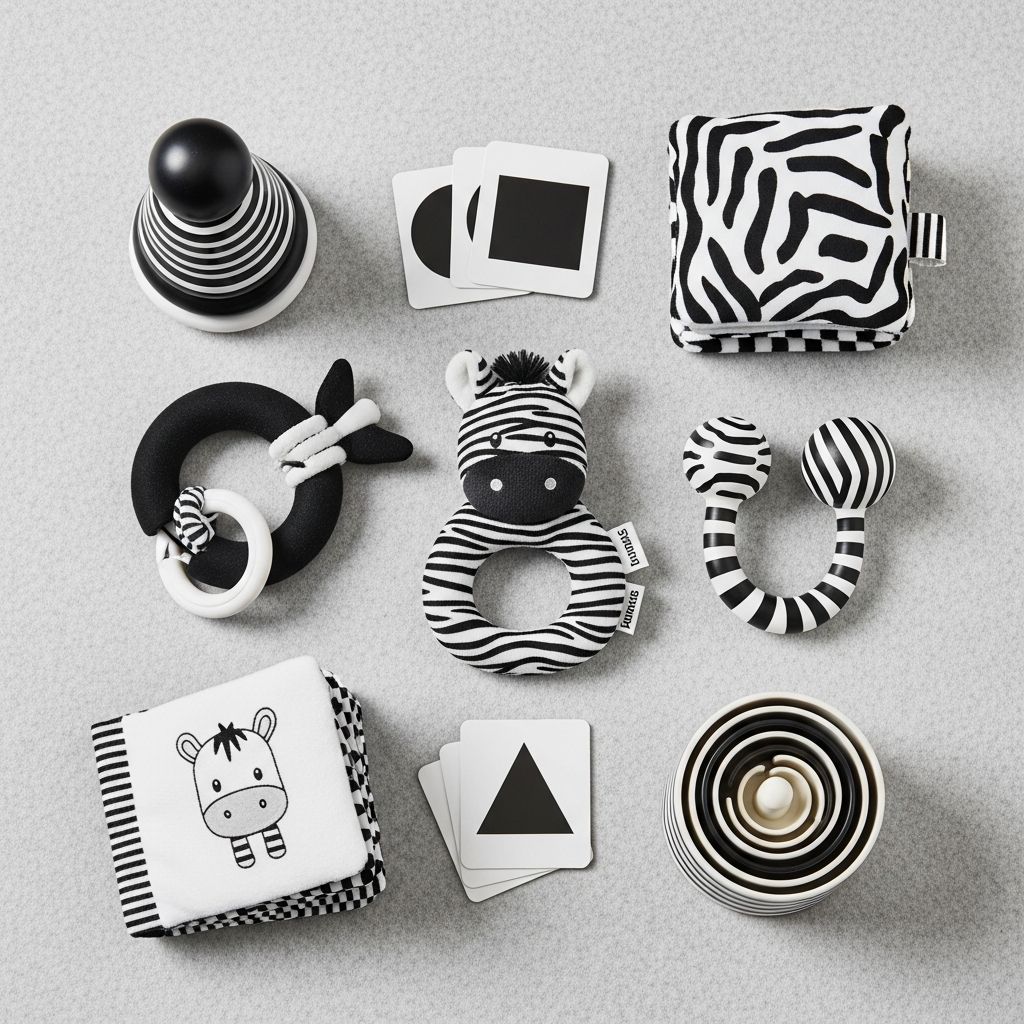
Not all black-and-white toys are equally helpful; some are mostly decorative while others are designed with infant vision in mind. Look for clear, bold designs with simple forms instead of busy, tiny patterns that can blur together for a newborn.
- Sensory cards and books: Flat cards and cloth or board books with thick lines, geometric shapes, and simple animals are excellent for very young babies.
- Mobiles: Over-crib or stroller mobiles with large, contrasting shapes can encourage looking and early tracking when used safely and at the right distance.
- Soft toys and rattles: Plush toys or rattles with bold patches or stripes provide both visual and tactile stimulation as babies start to grab and mouth objects.
- Playmats and tummy time props: Mats with high-contrast panels or fold-out screens placed in front of a baby during tummy time help keep them engaged and lifting their head.
Black-and-White Toys vs. Colorful Toys
Parents sometimes worry that using black-and-white toys will limit their baby’s exposure to color, but these tools are best seen as a starting point, not a permanent replacement. High-contrast toys suit the visual stage of the first months, while colorful toys become more valuable as color perception matures.
| Feature | Black-and-white toys | Colorful toys |
|---|---|---|
| Primary benefit | Strong early visual signals and attention for newborns. | Support color discrimination and more complex visual processing in older infants. |
| Best age window | Most helpful from birth through around 3–4 months. | Increasingly beneficial from about 4 months onward. |
| Attention style | Encourages focused, calm looking without overwhelming detail. | Can be exciting and stimulating but potentially distracting if too busy for very young babies. |
| Use over time | Ideal foundation; should be gradually complemented by other visuals. | Becomes the main visual input as vision matures, alongside remaining contrast elements. |
Safety Checklist for High-Contrast Baby Toys
Developmental benefits only matter if toys are safe, durable, and appropriate for your baby’s age and stage. Simple, well-constructed toys tend to be safer than overly complex items with many detachable or electronic parts.
- Age-appropriate labels: Choose toys clearly marked for your baby’s age range and follow manufacturer guidance.
- Secure construction: Avoid small parts, loose stitching, or decorations that could detach and become choking hazards.
- Non-toxic materials: Look for toys made with baby-safe inks, dyes, and plastics, especially for items that will be mouthed.
- Easy to clean: Select toys that can be wiped down or washed frequently to manage drool and everyday germs.
- Safe placement: Mobiles and hanging toys should be securely installed and kept out of reach once baby can sit or pull up.
Using High-Contrast Toys in Everyday Routines
Integrating black-and-white toys into daily rhythms makes it easier to offer frequent, short bursts of visual stimulation without turning playtime into a project. Many experts recommend weaving visual play into ordinary caregiving moments instead of creating separate, intensive sessions.
- During diaper changes: Attach a simple black-and-white card near the changing area to give baby something soothing to look at while you work.
- For tummy time: Prop up a fold-out contrast board or book in front of baby to encourage head lifting and longer stretches on the tummy.
- In a stroller or car seat (when stationary): Show a high-contrast card for a minute or two to entertain your baby while you chat and make eye contact.
- Before sleep: Brief, gentle looking at a calm pattern can be part of a soothing wind-down routine, as long as toys are removed from the sleep space before baby is left alone.
When to Transition Beyond Black and White
As color vision improves, babies benefit from a richer visual world that includes bold hues, varied textures, and more complex patterns. High-contrast toys are still useful, but they should gradually share space with objects that challenge new abilities, like depth perception and color discrimination.
- From around 3–4 months, begin adding toys that combine black-and-white elements with bright colors, such as red or yellow.
- Over time, introduce books and toys that feature more detailed scenes and multiple objects, while watching for signs of overstimulation like fussiness or turning away.
- Keep a few high-contrast favorites on hand as familiar, calming options, especially in new or busy environments.
Frequently Asked Questions
Do babies really see only black and white at first?
Newborns do not experience the world in full vivid color, but their vision is not strictly limited to black and white either. They perceive high-contrast differences and shades of gray more clearly than subtle colors, and richer color perception appears gradually over the first few months.
Are black-and-white toys enough for healthy vision development?
High-contrast toys are a helpful tool, particularly in the newborn period, but they are just one piece of a healthy visual environment. Face-to-face interaction, varied lighting, movement, and eventually colorful toys all work together to support visual and cognitive growth.
Can I overuse high-contrast toys?
Babies usually signal when they have had enough stimulation by looking away, fussing, or closing their eyes. Short, frequent exposures to black-and-white images are generally more beneficial than long, continuous sessions, especially in the early weeks.
Do I need to buy a lot of specialized products?
A small selection of thoughtfully chosen items is usually sufficient, such as a set of cards, a simple book, and one or two soft toys. Everyday objects with clear contrast, like patterned blankets or household items placed safely at a distance, can also provide visual interest when used carefully.
When should I be concerned about my baby’s vision?
If your baby never seems to fixate on faces or high-contrast objects, does not track slow movement by a few months, or shows a pronounced eye turn, discuss these observations with a pediatrician or pediatric eye specialist. Early evaluation can identify potential issues and offer targeted support when it is most effective.
Key Takeaways for Busy Parents
Black-and-white, high-contrast toys align beautifully with how newborns actually see, giving them clear, engaging images during a period of intense brain development. Used thoughtfully, they can strengthen early vision, support attention and bonding, and ease tummy time without overwhelming your baby’s senses.
- Focus on a few safe, simple, high-contrast toys rather than a crowded collection.
- Integrate them into natural routines—diaper changes, tummy time, and quiet wakeful moments.
- Gradually add color and complexity as your baby’s vision matures and curiosity expands.