Many parents discover that a white noise machine can feel like a secret weapon in the struggle for better baby sleep. Used wisely, steady background sound can help your little one settle faster, link sleep cycles, and stay asleep longer, giving the entire household a much-needed break.
This guide explains what white noise for babies actually does, how to choose a safe and effective machine, and practical tips to get the most out of it without becoming overly dependent on any gadget.
Why White Noise Helps Babies Sleep
Inside the womb, babies are surrounded by constant sound: whooshing blood flow, rhythmic heartbeats, and muffled voices. The outside world, by contrast, is full of sudden noises and stretches of quiet that can feel unfamiliar. A white noise machine recreates that steady soundscape so your baby can relax more easily.
When the brain hears a consistent sound in the background, it is less likely to react to random noises like a barking dog, clattering dishes, or a creaky floorboard. For many babies, that means fewer startles and less frequent wake-ups, especially in the early months when their nervous systems are still developing.
- White noise can make it easier for babies to fall asleep in noisy homes or small apartments.
- It can help smooth the transition from arms to crib by keeping the sensory environment steady.
- It may support longer stretches of sleep by reducing how often a baby fully wakes between cycles.
White Noise vs. Other Sleep Aids
Parents often try a mix of strategies: swaddles, pacifiers, rocking, or black-out curtains. White noise is different because it does not hold, feed, or stimulate the baby; it simply shapes the sensory environment. That makes it a flexible tool that can be used alongside most other calming techniques.
Unlike music toys or mobile apps that play variable sounds and melodies, white noise is designed to be predictable and uninteresting. There are no sudden high notes or complex rhythms. This stability can help signal, “It’s time to sleep,” without competing for the baby’s attention.
Types of Sound Machines for Babies
Not all sound machines are built with babies in mind. Some are made for adults who want help sleeping through traffic noise or for office workers who need to mask conversations. Understanding the basic categories will help you focus on products that truly fit nursery needs.
Dedicated Nursery White Noise Machines
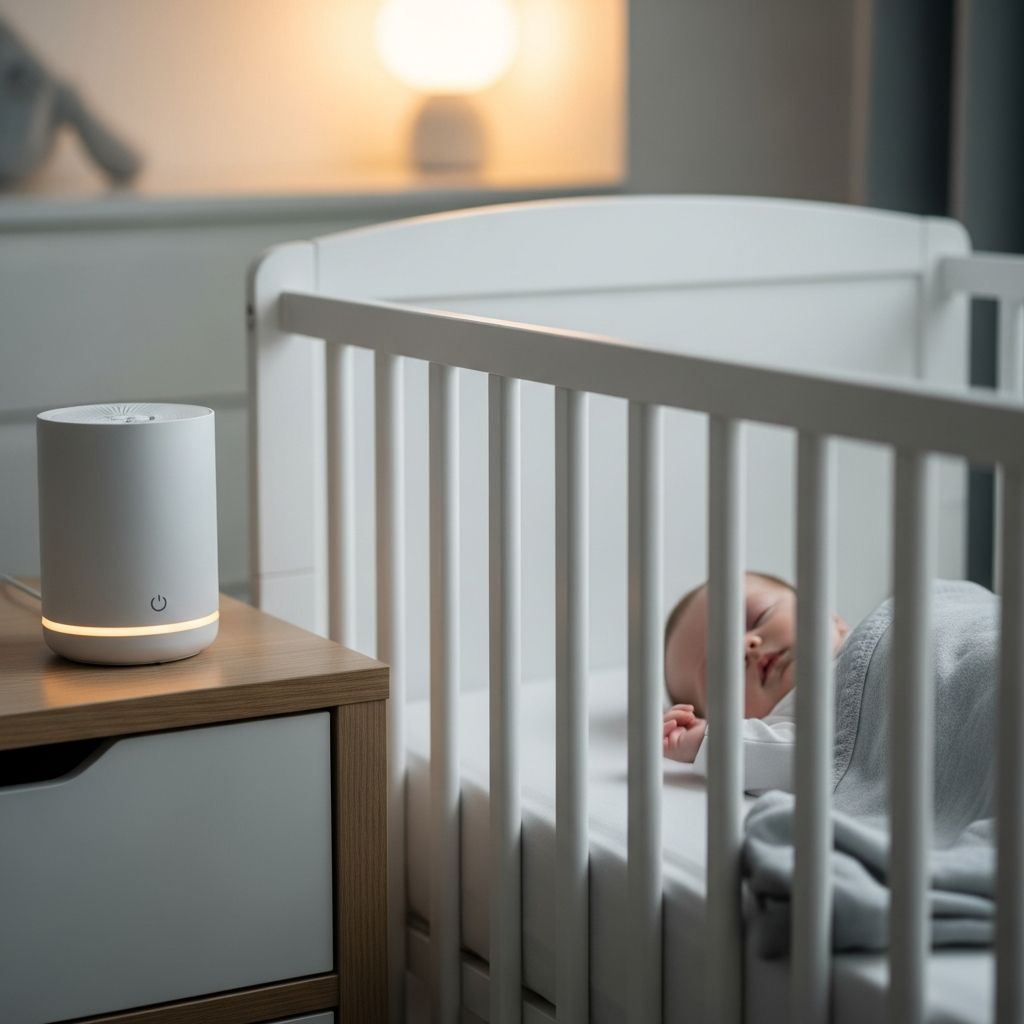
These devices are designed specifically for use around infants and young children. They tend to combine white noise with gentle night lights, simple controls, and safety-focused features such as capped volume ranges and child-safe design.
- Often include several noise colors (white, pink, or brown) and soothing nature sounds.
- May have a dimmable night light, helpful for overnight feeds and diaper changes.
- Controls are usually intuitive enough to adjust in the dark with one hand.
Portable and Travel Sound Machines
Portable models are built with on-the-go families in mind. They attach to a stroller, car seat handle, or diaper bag, and run on rechargeable batteries or disposable cells so you can use them without an outlet.
- Compact and lightweight, ideal for naps in the car, stroller, or hotel rooms.
- Battery life is a major factor; you want it to last through multiple naps.
- Some double as clip-on night lights for travel cribs and play yards.
Smart and App-Connected Sound Machines
Smart sound machines add connectivity and automation on top of basic sound playback. You can usually control them from your phone, set schedules, or integrate them into a broader smart home setup.
- Allow you to start, stop, or change sounds without entering the nursery.
- Can follow programmable routines, such as dimming lights and starting white noise at a set time each night.
- Sometimes offer sleep tracking or coaching features for older babies and toddlers.
Key Features to Consider Before You Buy
With many attractive options on the market, it is easy to get distracted by bells and whistles. Instead of focusing on how many sounds a machine offers, prioritize a handful of core features that affect safety, convenience, and real-world performance.
Sound Quality and Noise Options
A baby does not need dozens of tracks, but the sounds provided should be smooth, loop seamlessly, and avoid harsh or metallic tones. Some babies prefer a deeper, more “rumbly” sound (often called pink or brown noise), while others settle with classic fan-like white noise.
- Avoid sounds that have obvious repeating patterns, beeps, or chirps that might become distracting.
- Look for at least a few continuous noise options plus one or two gentle nature sounds, such as rain or ocean waves.
- If possible, test sample audio from the manufacturer to ensure the sound is pleasant to your ears too.
Volume Range and Safety Controls
Babies have sensitive ears, so the ability to keep sound at a safe level matters more than sheer loudness. A good nursery machine makes it easy to adjust volume in small increments and often includes recommended ranges or built-in limits.
- Choose a device with many volume steps rather than just a low/medium/high switch.
- Plan to keep the sound at roughly the level of a running shower or softer, never at maximum volume.
- Place the machine several feet away from the crib and avoid pointing the speaker directly at your baby’s head.
Timers, Schedules, and Continuous Play
Some parents prefer to run white noise all night, while others only want it during the settling phase. Timers and scheduling options give you flexibility to match the machine to your approach and your baby’s age.
- Auto-off timers can prevent batteries from draining and encourage gradual weaning off sound as your baby grows.
- Continuous play mode is useful for babies who wake when sound changes suddenly.
- Smart models can follow a predictable bedtime routine, making sleep cues more consistent.
Power Source and Portability
A nursery-based machine that stays in one place can rely on wall power, while frequent travelers will appreciate long-lasting rechargeable batteries. Think about where and how you plan to use the device before you decide.
| Power Type | Best For | Main Advantages | Possible Drawbacks |
|---|---|---|---|
| Plug-in only | Permanent nursery setups | Unlimited runtime; no battery swapping; generally stronger speakers | Less flexible; needs outlet placement near crib but still safely out of reach |
| Rechargeable battery | Families who travel or nap on the go | Can move from room to room; no ongoing battery purchase | Must remember to recharge; battery capacity can decline over time |
| Disposable batteries | Occasional use or backup device | Works anywhere immediately; convenient for emergencies | Ongoing battery costs; used batteries require careful disposal |
Night Light and Extra Features
A gentle night light can make overnight care easier without fully waking your baby. Some machines offer a single warm glow, while others let you cycle through multiple colors and brightness levels.
- Prefer soft, warm tones for nighttime; bright, cool colors can feel more energizing than calming.
- Look for physical buttons that are easy to find by touch, so you do not have to turn on another light to adjust settings.
- Consider extras like sleep training lights for toddlers, but treat them as a bonus, not a requirement.
Safety Guidelines for Using White Noise with Babies
White noise machines are generally considered safe when used thoughtfully. The main concerns are related to volume, distance, and how often the device runs. Following a few simple rules will allow you to enjoy the benefits while minimizing potential risks.
Volume and Distance Basics
Keep the machine at a comfortable, moderate level—loud enough to mask household noise, but not so loud that you have to raise your voice to talk over it. If you feel the urge to shout while standing next to the crib, the volume is too high.
- Place the machine at least a few feet from your baby’s head, ideally across the room or on a nearby shelf.
- Aim the speaker away from the crib, letting the sound fill the room indirectly.
- When in doubt, start quieter; you can always increase the volume slightly if necessary.
Safe Placement and Cord Management
Anything powered by electricity should be positioned with curious little hands in mind. Even newborns quickly become more mobile than expected, so planning ahead for safety is worthwhile.
- Keep power cords well out of reach and secured along walls or behind furniture.
- Never place a sound machine inside the crib or bassinet, even if it looks like a stuffed animal.
- If you use a portable clip-on model, attach it to the outside of the crib slats and position it high enough that your baby cannot grab it.
Avoiding Over-Reliance
White noise can be incredibly helpful, but it should remain a tool, not the only way your baby can fall asleep. As your child grows, you may decide to reduce how often or how long you run the machine, particularly if you notice that sleep is impossible without it.
- Begin by using white noise mostly for nighttime sleep and particularly tricky naps.
- Once sleep patterns are more mature, experiment with lowering the volume or turning the machine off partway through naps.
- Pair sound with other healthy sleep cues, such as a short bedtime routine and a consistent bedtime.
How to Introduce White Noise to Your Baby
If your baby has never slept with white noise, introduce it gradually rather than switching from silence to loud sound overnight. Babies are adaptable, but a slow transition gives you a chance to observe how your child responds.
Step-by-Step Introduction
- Start during naps. Begin with daytime naps so you can keep an eye on your baby’s reaction and adjust quickly if needed.
- Set a moderate volume. Turn on the machine a few minutes before nap time, keeping the sound at a comfortable level.
- Watch for cues. If your baby seems calmer or falls asleep more easily, continue; if they seem unsettled, try a different sound type.
- Extend to nights. Once naps are going smoothly, use the machine as part of the bedtime routine.
- Keep cues consistent. Turn the white noise on at the same point in the routine—after reading, before placing your baby in the sleep space.
Combining White Noise with Bedtime Routines
A simple, predictable routine helps your baby recognize that sleep is coming. White noise can be one step in that routine, sitting alongside feeding, bathing, gentle rocking, or story time.
- Use the same sound every night so it becomes a familiar signal.
- Keep the last few minutes before bed calm and low-stimulation.
- Avoid bright screens and noisy toys near bedtime, even if white noise is running in the background.
Choosing the Right White Noise Machine for Your Family
Every household is different. A family in a small city apartment may have very different needs from parents in a quiet rural home. Before you buy anything, take a moment to think through how and where you expect to use the machine most often.
Questions to Ask Yourself
- Will this stay in the nursery, or does it need to travel between rooms or on trips?
- Is your home already fairly quiet, or do you need strong sound masking for siblings, traffic, or shared walls?
- Do you prefer simple buttons that always work the same way, or are you comfortable managing settings from your phone?
- Would a built-in night light be helpful, or do you already have one you like?
- Is there a specific budget you want to stay within, especially if you plan to buy more than one unit?
Feature Priorities by Scenario
| Family Situation | Top Priorities | Nice-to-Have Extras |
|---|---|---|
| Small apartment, thin walls | Good sound masking; fine-grained volume control; continuous-play mode | Smart scheduling; app control |
| Frequent travelers | Compact size; long battery life; durable casing | Clip attachment; USB-C charging |
| Newborn with many night feeds | Warm night light; easy one-touch controls; reliable plug-in power | Multiple noise colors; lullaby options |
| Toddler sharing a room with siblings | Stronger sound output; sleep-training light; child lock on buttons | App-based routines; integrations with alarm clocks |
Frequently Asked Questions About Baby White Noise
Is white noise safe for newborns?
White noise is considered safe for newborns when used at a moderate volume and placed at a reasonable distance from the baby’s sleep space. The key is to treat it like any other nursery tool: helpful in moderation and combined with safe sleep practices such as placing your baby on their back on a firm, bare surface.
How loud should the sound be?
The sound should be loud enough to soften household noise but not so loud that it feels overwhelming. As a general rule, if you can speak in a normal tone near the crib without straining your voice, the volume is likely appropriate. When in doubt, turning it slightly down is safer than cranking it up.
Can my baby become dependent on white noise?
Babies can come to expect whatever consistent cues you use for sleep, whether that is rocking, nursing, or sound. White noise is often easier to phase out later than more hands-on soothing methods. When your child’s sleep becomes more predictable, you can gradually reduce the volume or switch the machine off partway through the night.
Should I leave the machine on all night?
Many families do leave white noise running all night, particularly in noisy environments. Others prefer to use a timer so the machine turns off once the baby is in a deeper sleep. You can experiment to see what works best, keeping in mind that sudden silence can wake a very light sleeper, so gradual changes often work better than abrupt ones.
Is an app on my phone enough?
Phone apps can be handy in a pinch, but a dedicated sound machine has advantages: more reliable loops, better speakers, safer placement away from the crib, and no risk of notifications or calls interrupting sleep sounds. Many parents use apps as a backup option when away from home rather than as the primary solution.
Final Thoughts for Tired Parents
A white noise machine will not magically solve every sleep challenge, but it can make a meaningful difference by creating a consistent, calm backdrop for rest. When paired with age-appropriate routines and safe sleep habits, it becomes one of those small tools that quietly supports better nights and more predictable naps.
By focusing on safe volume levels, thoughtful placement, and features that truly match your lifestyle, you can choose a sound machine that helps your baby—and the rest of your family—enjoy more peaceful, restorative sleep.