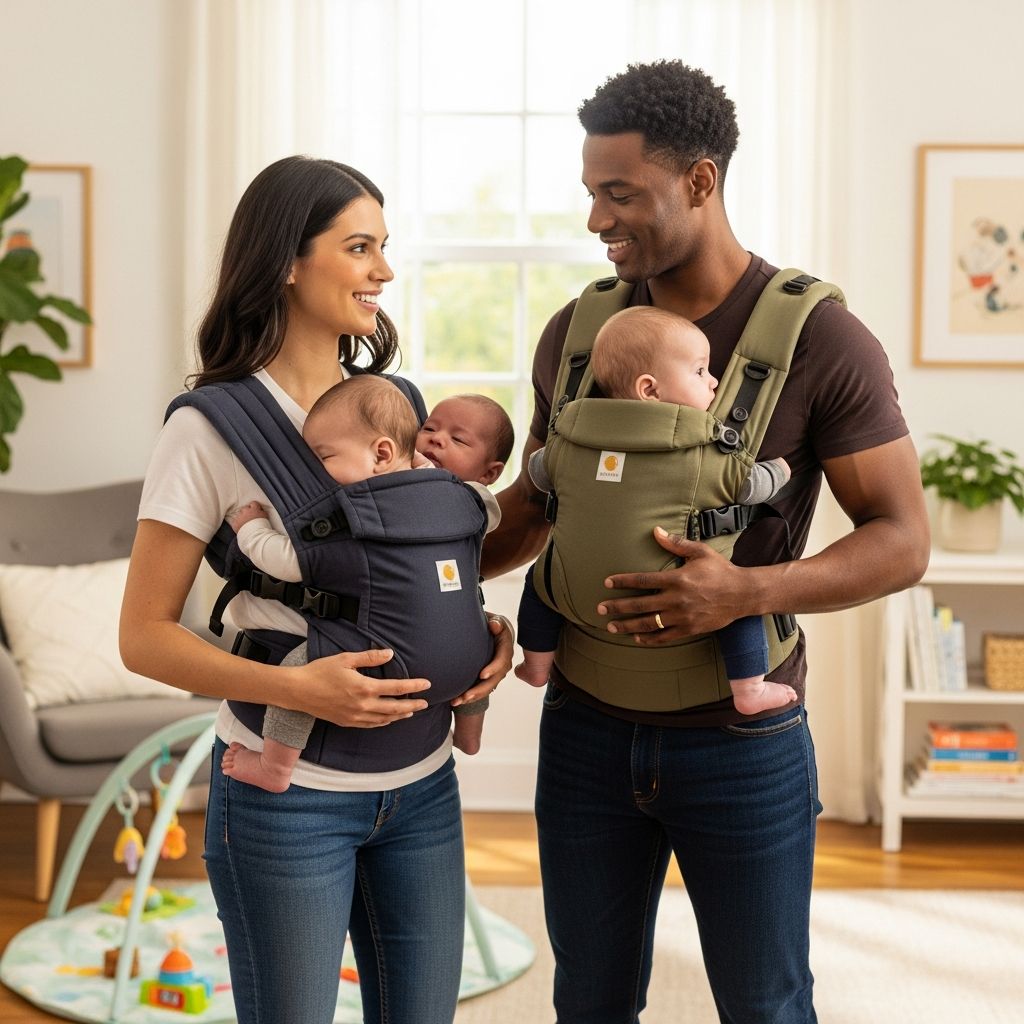
Babywearing twins can make everyday life more manageable, freeing your hands while keeping both babies close. This guide explains the main types of twin carriers, what features matter most, and how to use them safely and comfortably.
Why Babywearing Twins Can Be a Game-Changer
For parents of multiples, simply leaving the house can feel like a logistical puzzle. A well-chosen twin baby carrier can help you:
- Keep both babies close while still having your hands free for bags, doors, or older siblings.
- Support bonding and attachment through physical closeness, which is associated with more responsive caregiving and infant calmness.
- Reduce crying and fussiness as carrying and skin-to-skin contact can help regulate babies’ temperature, heart rate, and stress.
- Maintain mobility in tight spaces where a double stroller is awkward, such as small shops or public transport.
For families with preterm twins, appropriate babywearing and skin-to-skin (sometimes called kangaroo care) can also support temperature regulation and breastfeeding, when done following medical guidance.
Core Principles of Safe and Ergonomic Twin Babywearing
Before choosing a specific carrier, it helps to understand the basic safety and ergonomic principles that apply to all carriers, especially when two babies are involved.
1. Airway and Breathing Safety
Every baby carrier should allow a clear airway. Leading babywearing safety campaigns recommend that babies be held high and tight on your body so that you can easily monitor their breathing and position.
- Face visible: You should always be able to see your baby’s face without moving fabric.
- Chin off chest: There should be at least one adult finger’s width between chin and chest to keep the airway open.
- Head support: Newborns and preterm babies need extra support behind the head and neck.
- No slumping: The carrier should hold babies snugly enough that they cannot curl into a C-shape that compresses the airway.
2. Hip-Healthy Positioning
Health organizations emphasize that carriers should support healthy hip positioning, especially in the first months when hip joints are still forming.
- Knees higher than bottom: Thighs supported from knee to knee in an “M” shape.
- Hips flexed and abducted: Legs spread naturally around the wearer’s torso, not hanging straight down.
- No overstretching: Avoid carriers that let the legs dangle with all the weight at the crotch.
International pediatric and orthopedic groups have highlighted that incorrect leg-dangling positions may aggravate underlying hip instability in some infants, while ergonomic, seated positions are considered hip-healthy.
3. Comfort and Load Distribution for the Adult
Two babies mean significantly more weight on your body. Research on wearable loads shows that better weight distribution reduces strain and fatigue.
- Wide waistband or hip belt to shift some weight from shoulders to hips.
- Padded, adjustable shoulder straps that do not dig into the neck.
- Balanced carrying positions: Front-and-back setups usually feel lighter than carrying both babies on the front as they grow.
- Realistic time limits: Even with a good carrier, most adults will tolerate shorter stretches with heavier twins.
Types of Twin Baby Carriers
Most products for twins fall into a few broad categories. Understanding these can help you match a carrier to your babies’ ages, your body, and your lifestyle.
| Carrier Type | Typical Age Range* | Main Advantages | Main Challenges |
|---|---|---|---|
| Stretchy or knit wraps (twin-friendly) | Preterm guidance / newborn to ~3–4 months | Very snuggly, great for skin-to-skin and small babies | Learning curve; less supportive as babies get heavier |
| Hybrid wraps and ring slings (two slings) | Newborn to around 6–9 months | Custom fit; can carry each baby separately | More fabric to manage; may feel hot in warm climates |
| Twin-specific soft structured carriers | Newborn or 1–2 months up to toddler, depending on model | Built-in structure, easier learning curve, often allow front+back | Bulkier; some only fit for a limited age/weight window |
| Two single carriers used together | Usually from ~4–6 months, good head control | Maximum versatility; can be shared between caregivers | More straps and buckles; requires practice to position safely |
*Always follow the specific weight and age guidelines of each product.
Matching Carrier Types to Your Twins’ Stage
Most families do not use one carrier from birth through toddlerhood. Instead, needs change as babies grow, gain muscle control, and become more active.
Newborn and Early Months (Including Preterm Twins)
For the first months, priorities are airway safety, support for a still-rounded spine, and hip-healthy positioning, as well as ensuring you can monitor two small babies at once.
- Soft twin-specific carriers designed for newborns: These often have two sewn-in pouches or compartments for each baby, with built-in support for smaller bodies.
- Stretchy or hybrid wraps: Some stretch or semi-stretch wraps allow front tandem carries with both babies high on the chest.
- Skin-to-skin (kangaroo care): In hospital or at home, specialized wrap-style garments may support twin kangaroo care when supervised by healthcare providers.
Always consult your pediatric team before babywearing preterm or medically fragile twins, as they may have specific recommendations or restrictions.
Middle Months (4–9 Months)
Once babies have better head and trunk control, more carrier options open up.
- Twin-specific soft structured carriers: Many allow a front-and-back configuration, which can feel more balanced as weight increases.
- Two single carriers: Some families use two ergonomic single-baby carriers at once, with one baby on the front and one on the back.
- Ring slings: Experienced wearers sometimes use two slings in a hip or front tandem carry, although this requires practice.
Older Babies and Toddlers
As twins approach toddlerhood, they may not both want to be carried at the same time, but a carrier can still be essential for travel or outings.
- Front-and-back setups: When both need to be carried, a front-and-back configuration with sturdy carriers is usually the most comfortable.
- Occasional tandem use: You may only need short tandem carries for transitions (for example, from the car to home).
- Flexible systems: Carriers that convert from tandem to two separate single carriers can be economical and practical.
Key Features to Look for in a Twin Carrier
Beyond the basic type, focus on a few core features that strongly affect comfort and safety.
1. Supportive Structure and Adjustability
- Panel height and width: Panels should reach at least to the nape of a newborn’s neck and firmly support the back, while allowing a seated, spread-squat position.
- Multiple adjustment points: Look for buckles or rings at shoulders, chest, and waist so different caregivers can get a snug fit.
- Separate support for each baby: In twin-specific carriers, each baby should have their own secure compartment, harness, or panel.
2. Fabric and Climate Considerations
- Breathable materials: Mesh panels or lighter fabrics help prevent overheating when carrying two babies against your body.
- Soft but supportive: Fabric should be soft enough for newborn skin but not so stretchy that it sags under combined weight.
- Easy to wash: Machine-washable carriers are highly practical for the inevitable spills and spit-up.
3. Ease of Use and Learning Curve
With twins, you are often managing two hungry or fussy babies at once. A realistic assessment of your tolerance for complicated tying or multiple buckles matters.
- Clear instructions: Good carriers offer detailed illustrations or instructional videos.
- Solo loading: Check whether you can safely get both babies in and out by yourself, or if you will usually have help.
- Practice with a second adult: Especially for back carries, it is recommended to learn with another adult nearby until you are confident.
4. Size Range and Inclusivity
- Waist and shoulder range: Ensure the carrier’s sizing accommodates your body and any other regular caregivers.
- Postpartum comfort: Wide waistbands worn above a healing incision can be more comfortable for parents recovering from cesarean birth.
- Different body types: If two caregivers of very different sizes will share the carrier, look for generous adjustability.
Practical Tips for Everyday Twin Babywearing
Even the best carrier will feel awkward at first. A few practical habits can make the transition smoother.
- Start with one baby: Learn the basic fit and adjustments with a single baby or a doll, then add the second baby once you feel confident.
- Use a safe surface: Put babies somewhere safe (like a firm surface or the floor) while adjusting the carrier; avoid balancing them on couches or beds.
- Dress in light layers: Your body heat plus two babies can be quite warm; light clothing and breathable fabrics help.
- Check positioning often: During the first 10–15 minutes in a new setup, regularly check breathing, temperature, and head position.
- Limit first sessions: Start with short periods until your body adjusts to the extra weight and you learn what feels comfortable.
Common Mistakes to Avoid
Knowing what to avoid is just as helpful as knowing what to look for.
- Using non-approved DIY solutions: Always use purpose-built carriers and follow the manufacturer’s instructions; improvised solutions can fail under twin weight.
- Ignoring weight limits: Carriers are tested up to specific combined weights. Exceeding these limits can compromise safety.
- Carrying too low: If babies’ heads are near your mid-torso, they are probably too low. A simple rule is that you should be able to kiss the top of each baby’s head with a slight tilt.
- One-size-fits-all assumptions: What works for a friend’s twins might not fit your body or your babies’ proportions.
- Skipping breaks: Even if your twins fall asleep, your body still needs rest; alternate between babywearing, stroller, and floor time when possible.
Balancing Carriers, Strollers, and Other Gear
A twin carrier is rarely the only transport solution you will use. Many families find a combination works best.
- Carrier + double stroller: One twin in a carrier and one in a stroller can be easier in busy places or for longer walks.
- Carrier at home: During the newborn stage, parents often use the carrier more indoors for soothing and contact naps.
- Travel setups: In airports, a carrier for each adult can be far more efficient than trying to maneuver a large stroller through security.
Ultimately, the “best” twin carrier is the one that you can put on quickly, that keeps your babies secure and comfortable, and that you are happy to use regularly.
Frequently Asked Questions About Twin Baby Carriers
Q: When can I start using a twin carrier with my babies?
A: Many twin-specific carriers are designed for use from birth within specified weight limits, but you should always confirm that your babies meet the manufacturer’s minimum weight and consult your pediatrician, especially for preterm or low-birth-weight twins.
Q: Is it safe to carry both twins on my chest?
A: For the first months, some carriers are designed to hold both babies on the front at once in a high, snug position. Safety depends on using a carrier that is rated for tandem use, respecting weight limits, and keeping each baby’s airway visible and unobstructed.
Q: How long can I wear my twins at one time?
A: There is no universal time limit, but your comfort and the babies’ cues are good guides. Take breaks if you feel strain in your back, shoulders, or hips, and alternate babywearing with stroller or floor time to protect your own body.
Q: Can twin babywearing help with bonding if my twins spent time in the NICU?
A: Gentle, supervised skin-to-skin contact and appropriate babywearing can support bonding, breastfeeding, and regulation for babies who had early medical challenges, though any plan should be discussed with your NICU or pediatric care team.
Q: Do both caregivers need their own twin carrier?
A: Not necessarily. Some systems separate into two single carriers so that each adult can carry one baby. Others have enough adjustability to fit people of different sizes, but if you will frequently split duties, owning flexible, shareable carriers can be very convenient.
References
- Knapik JJ et al. Load carriage using packs: a review of physiological, biomechanical and medical aspects. — Journal of Strength and Conditioning Research. 2004-02-01. https://pubmed.ncbi.nlm.nih.gov/14971968/
- de Bock F et al. Influence of baby carriage systems on gait and posture in parents. — Gait & Posture. 2013-10-01. https://pubmed.ncbi.nlm.nih.gov/23871393/
- International Hip Dysplasia Institute. Baby Carriers & Hip Dysplasia. — International Hip Dysplasia Institute. 2022-05-01. https://hipdysplasia.org/baby-carriers/
- Babywearing International. Babywearing Safety and Positioning Guidelines. — Babywearing International (archived educational materials). 2018-01-01. https://babywearinginternational.org/
- World Health Organization. Kangaroo mother care to reduce morbidity and mortality in low-birth-weight infants. — WHO Recommendations on Newborn Health. 2015-11-01. https://www.who.int/publications/i/item/9789241509147