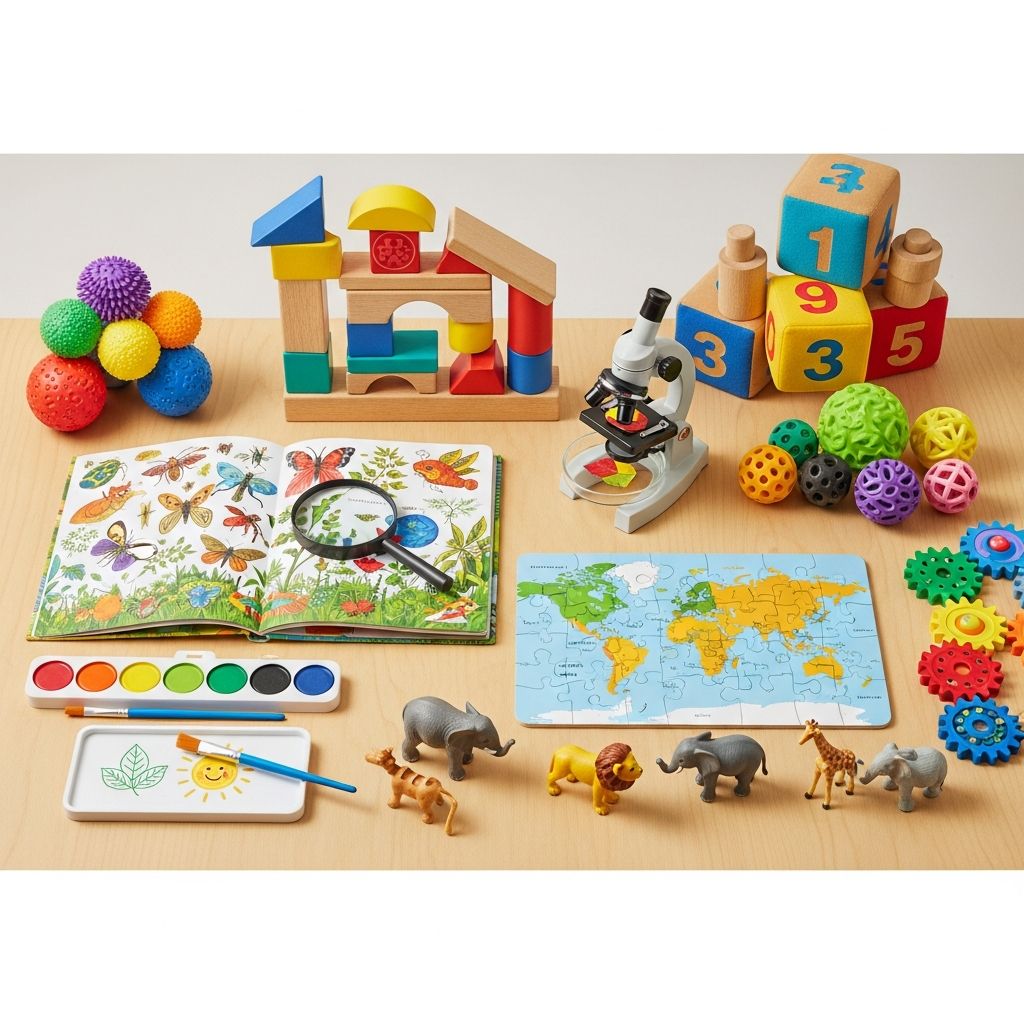
Five-year-olds live in a world of big questions, big feelings, and even bigger imagination. The right toys can channel that energy into play that builds language, problem-solving, self-control, and social skills, all while still being genuinely fun.
This guide walks you through toy ideas that support how 5-year-olds grow and learn, with examples across creativity, STEM, movement, and social-emotional play. Use it as a starting point to choose toys that fit your child’s personality and your family’s values.
What 5-Year-Olds Need From Play
Before picking toys, it helps to understand what’s happening developmentally around age five. Research on early childhood shows that quality play supports:
- Language and early literacy – storytelling, pretend play, and games with rules help grow vocabulary and narrative skills.
- Executive function – turn-taking games and pretend scenarios strengthen attention, self-control, and flexible thinking.
- Early math and problem-solving – building, sorting, and simple board games introduce counting, patterns, and logic.
- Social understanding – cooperative play and role-play help kids practice empathy and conflict resolution.
- Physical coordination – active play boosts strength, balance, and fine motor control.
With that in mind, think of toys as tools: they should invite open-ended play, challenge your child just enough, and leave plenty of room for imagination rather than doing all the “thinking” for them.
Quick Overview: Toy Types That Shine at Age Five
| Toy Category | Main Skills Supported | Great For Kids Who… |
|---|---|---|
| Imaginative & Role-Play | Language, social skills, emotional understanding | Love stories, costumes, acting things out |
| STEM & Building Toys | Problem-solving, spatial skills, early math concepts | Enjoy constructing, figuring out how things work |
| Art & Craft Supplies | Fine motor skills, creativity, focus | Like drawing, coloring, making things |
| Active & Outdoor Toys | Gross motor skills, confidence, self-regulation | Have lots of energy and need to move |
| Board & Card Games | Turn-taking, strategy, numeracy, literacy | Enjoy rules, challenges, and family play |
Imagination in Full Color: Pretend Play & Story Toys
At five, children’s pretend play becomes more complex and story-like. Psychologists have linked this kind of imaginative play with stronger language skills and social understanding, especially when kids negotiate roles and plots with others.
Helpful Pretend-Play Toy Ideas
- Dress-up collections
Instead of full, character-specific costumes, consider:
- Capes, hats, vests, and simple accessories
- Fabric pieces for capes, forts, or “magic carpets”
- Reusable masks or headbands
These encourage kids to invent their own characters and stories, not just copy a show.
- Pretend play sets
Look for sets that invite role-play, such as:
- Doctor, vet, or dentist kits with basic tools
- Kitchen and food play sets for cooking and restaurant games
- Tool, construction, or repair kits for building scenarios
These scenarios help children work through real-world experiences like doctor visits or family routines.
- Small-world play
Figures and vehicles can turn the living room rug into an entire city. Consider:
- People and animal figures of varied ages and backgrounds
- Simple buildings (houses, barns, fire stations) or blocks that become buildings
- Vehicles like buses, trains, or rescue trucks
Try asking open questions like, “Who lives here?” or “What problem are they solving today?” to extend the play.
STEM & Building: Toys That Invite Tinkering
Five-year-olds are ready for more complex construction sets and early STEM (science, technology, engineering, math) play. Play with blocks and building materials can improve spatial skills, which research links to later success in STEM learning.
STEM-Friendly Toy Suggestions
- Classic building blocks
Wooden blocks, magnetic tiles, and interlocking bricks are still powerhouses at this age. They support:
- Balance and stability experiments
- Symmetry and pattern creation
- Simple engineering challenges (bridges, towers, ramps)
- Beginner engineering & gear sets
Starter kits with gears, pulleys, or basic connectors encourage kids to test ideas like cause and effect, speed, and motion.
- Introductory science kits
Age-appropriate kits (adult supervised) might include:
- Color mixing and simple chemistry experiments
- Magnifiers and bug viewers for nature observation
- Magnets and simple circuits with clear safety guidelines
Look for kits that emphasize observation and open-ended inquiry over flashy reactions.
- Early math games and puzzles
Toys that use number lines, dot patterns, or simple word problems can build number sense and reasoning in playful ways.
Creative Hands: Art, Craft, and Early Writing Toys
Fine motor skills are rapidly developing at five, and kids are often eager to write their name, draw recognizable people, and make “real” projects. Providing rich but simple materials matters more than fancy gadgets.
Art & Craft Staples Worth Having
- Basic drawing and coloring tools
Stock up on:
- Thick and thin markers
- Crayons and colored pencils
- Plain paper, not just coloring books
Plain paper invites original creations rather than just filling in someone else’s design.
- Cutting and gluing practice
Child-safe scissors, glue sticks, and a box of recyclable materials support hand strength and creativity. Collage projects are forgiving and satisfying for this age.
- Modeling materials
Clay or dough sets build hand strength and coordination, which supports later handwriting. Add tools like rollers, plastic knives, and shape cutters.
- Early writing tools
Consider:
- Dry-erase boards for low-pressure writing practice
- Letter stencils or sandpaper letters to trace
- Blank mini “books” for kids to illustrate and dictate stories
Move, Jump, Climb: Active Toys for Growing Bodies
Guidelines from pediatric experts recommend that young children get at least several hours of physical activity spread through the day, including energetic play. Toys that encourage movement help with health, sleep, and self-regulation.
Movement-Friendly Toy Ideas
- Ride-on and balance toys
Depending on your child’s skill level and local safety rules, this can include:
- Balance bikes or small pedal bikes with helmets
- Three-wheeled scooters
- Simple ride-on vehicles for indoor or outdoor use
- Gross motor toys
Simple equipment can transform the backyard or living room:
- Soft balls of different sizes
- Jump ropes, hula hoops, or beanbags
- Tunnels, stepping stones, or balance beams
- Indoor energy outlets
For small spaces or cold weather, look for:
- Foam climbing blocks or cushions
- Mini trampolines with safety handles
- Yoga or movement cards with kid-friendly poses
Games That Bring Everyone to the Table
Board and card games can be powerful tools for learning turn-taking, handling frustration, and basic strategy. Games also offer screen-free family time, which many health organizations encourage as part of healthy media habits.
Choosing Games for 5-Year-Olds
- Cooperative games
In cooperative games, players work together toward a common goal rather than competing against each other. These can reduce pressure while still teaching:
- Planning ahead
- Working as a team
- Managing disappointment if the team loses
- Simple strategy games
At five, children can begin learning:
- How to think a move or two ahead
- Basic probability (like drawing cards)
- Beginning number skills through counting spaces or pieces
- Fast, replayable games
Short rounds (5–15 minutes) fit young attention spans. Matching games, simple dice games, and picture-based card games are usually a good fit.
Quiet Time & Independent Play Toys
Independent play gives caregivers breathing room and helps kids develop focus and self-direction. Quiet-time toys are especially helpful before bed or during midday downtime.
Ideas for Calming, Independent Play
- Puzzles
Look for:
- 24–60 piece jigsaw puzzles with clear images
- Floor puzzles for full-body engagement
- Progressive puzzle sets that increase in difficulty
- Simple building challenges
Magnetic tiles, snap-together building sets, or pegboards offer repetitive, soothing play that still engages the brain.
- Audio stories and books
Books, especially when combined with caregiver reading, remain one of the most powerful tools for literacy and attachment. Consider:
- Picture books and early readers your child can “read” using the images
- Recorded stories with printed books to follow along
- Wordless books that invite children to narrate their own stories
Choosing Toys Wisely: Safety, Quality, and Values
Beyond fun, toys should be safe, durable, and aligned with what you want to nurture in your child. Consider the following when you shop.
Safety First
- Check age recommendations – these consider small parts, complexity, and typical abilities for the age range.
- Look for safety certifications – for example, compliance with standards like ASTM or EN71 indicates testing for hazards such as lead and choking risks.
- Inspect small parts – avoid loose, detachable small pieces if younger siblings are around.
- Follow active-toy guidelines – helmets for bikes and scooters, soft surfaces for climbing toys, and close supervision help prevent injuries.
Quality Over Quantity
- Favor open-ended toys – blocks, art supplies, and figures can be used in many different ways, extending their life span.
- Choose durable materials – solid wood, sturdy plastic, and washable fabrics typically outlast novelty gadgets.
- Avoid overly scripted toys – toys that only work one way or constantly talk and flash can limit creativity and be overstimulating.
Aligning Toys With Your Family’s Values
- Representation matters – choose figures and story characters that reflect diverse backgrounds and abilities, which can broaden children’s understanding of the world.
- Encourage kindness and cooperation – look for games and pretend scenarios that highlight helping, problem-solving, and teamwork.
- Consider environmental impact – fewer, higher-quality toys, secondhand options, and recyclable materials reduce waste.
Balancing Screens and Traditional Toys
Digital play is part of many families’ lives. Guidance from pediatric organizations emphasizes high-quality content, limited screen time, and plenty of hands-on play and sleep.
- Prioritize hands-on toys for most daily play, especially for young children.
- Use screen time intentionally – for video chats with family or carefully chosen educational content, rather than background TV.
- Aim for shared screen experiences when possible, such as playing a digital game together and talking about it.
- Protect consistent device-free times, such as meals, before bed, and outdoor play.
Practical Tips When Buying Toys for 5-Year-Olds
- Observe your child’s current play
Notice what they do with the toys they already own. Do they build, nurture, act out stories, or invent games? Choose toys that deepen those interests or gently broaden them.
- Think in “play themes”
Instead of single, isolated toys, build small collections around themes like “builders,” “artists,” “scientists,” or “storytellers.” This makes it easier for kids to combine toys in creative ways.
- Rotate toys
Storing some toys and rotating them every few weeks can make old favorites feel new and reduce clutter and overwhelm.
- Involve your child
At five, kids can help choose between a few options. Ask what kinds of things they want to build, pretend, or learn about, rather than focusing on brands.
Frequently Asked Questions About Toys for 5-Year-Olds
How many toys does a 5-year-old really need?
There is no magic number, but many families find that fewer, higher-quality toys lead to deeper, more focused play. Rotating toys in and out of sight can prevent boredom without constantly buying new items.
What is the best single toy to start with?
If you are starting from scratch, a versatile building set or a collection of magnetic tiles is a strong choice. These can be used for solo play, family projects, and combined with figures, vehicles, and pretend scenarios.
How can I tell if a toy is truly educational?Educational toys encourage children to think, create, and solve problems rather than passively watch or press a single button. Look for toys that invite open-ended play, require some effort or planning, and can grow with your child’s skills.
Q: My 5-year-old still likes “younger” toys. Is that a problem?
Not usually. Development is individual, and familiar toys can be comforting. You can gently introduce new challenges—like more complex puzzles or games—while allowing them to keep using beloved toys in new ways.
How do I support play if I do not have much space?
Choose compact, flexible toys like foldable tunnels, stacking blocks, a small art caddy, and board games. Storage bins or baskets that slide under beds or into closets make cleanup easier. Remember that play can also use household items like pillows, cardboard boxes, and kitchen utensils (safely supervised).
References
- The Power of Play: A Pediatric Role in Enhancing Development in Young Children — American Academy of Pediatrics. 2018-08-20. https://publications.aap.org/pediatrics/article/142/3/e20182058/38618/The-Power-of-Play-A-Pediatric-Role-in-Enhancing
- Tips for Choosing Safe Toys — U.S. Consumer Product Safety Commission. 2022-11-10. https://www.cpsc.gov/Safety-Education/Safety-Education-Centers/toy-safety
- Block Play and Early Mathematics — National Association for the Education of Young Children (NAEYC). 2015-11-01. https://www.naeyc.org/resources/pubs/yc/nov2015/block-play
- Physical Activity Guidelines for Americans, 2nd edition — U.S. Department of Health and Human Services. 2018-11-01. https://health.gov/paguidelines/second-edition/
- Developing Fine Motor Skills — KidsHealth, Nemours Children’s Health. 2023-03-01. https://kidshealth.org/en/parents/development-3yrs.html
- Media and Young Minds — American Academy of Pediatrics. 2016-10-21. https://publications.aap.org/pediatrics/article/138/5/e20162591/60318/Media-and-Young-Minds