Choosing toys for a 4-year-old girl is about much more than buying something cute in pink packaging. At this age, her brain is wiring at high speed, her imagination is exploding, and her social world is expanding every day. The right toys can support those changes while keeping play joyful and low-pressure.
What 4-Year-Old Girls Are Learning Right Now
By around age four, most children are stretching their language skills, experimenting with friendships, and starting to show real persistence with puzzles, crafts, and make-believe scenarios. They want to do things “by myself,” yet still need gentle guidance and opportunities to practice new skills in safe ways.
Because development at this age varies widely, it is more useful to think in terms of skills rather than strict milestones. When you choose toys that match these skill areas, you help her build confidence, problem-solving, and creativity while she simply feels like she’s having fun.
- Stronger fine motor skills: holding crayons, scissors, and small pieces.
- Richer pretend play: acting out stories, roles, and real-life routines.
- Emerging early literacy and numeracy: recognizing letters, numbers, and patterns.
- Social growth: sharing, turn-taking, and negotiating rules in games.
- Big energy: a growing need to move, climb, run, and balance.
How to Choose Toys Without Getting Overwhelmed
The toy aisle can feel like a wall of noise, and it’s easy to default to whatever is labeled “for girls.” Instead, step back and think about the experiences you want to offer. Look for toys that invite her to do something—build, create, imagine, move—rather than just watch or press a single button.
The best toys at this age tend to be open-ended. That means there is no one “right” way to use them, and they can grow with her over time as she invents new games and storylines.
- Prioritize toys that can be used in multiple ways rather than one-time novelties.
- Favor sturdy, safe materials that stand up to rough preschool play.
- Check that pieces are large enough not to pose a choking hazard.
- Limit toys that do all the work for her with lights and sounds only.
- Mix active toys, quiet toys, and social toys for a balanced play space.
Key Toy Categories That Support Growth
Instead of thinking in terms of “girl toys,” it helps to organize choices by the kind of development they support. Below is a quick overview of core categories you might want represented on her shelf or in her playroom.
| Category | What It Builds | Example Types of Toys |
|---|---|---|
| Creative & Artsy Play | Fine motor skills, self-expression, focus | Art kits, play dough sets, beginner craft projects |
| STEM & Problem-Solving | Logical thinking, spatial skills, persistence | Building blocks, simple puzzles, magnetic tiles |
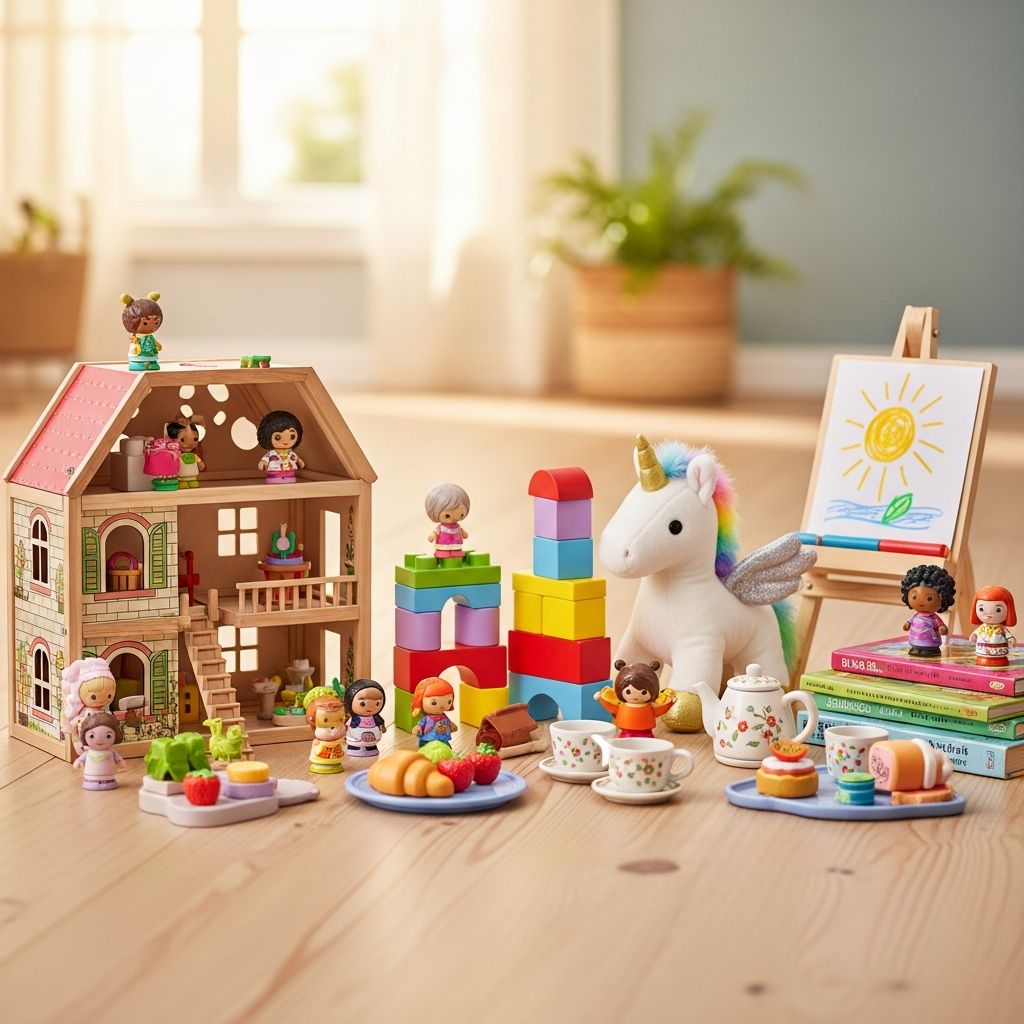
| Pretend & Role Play | Language, empathy, social understanding | Play kitchen, doctor set, small world playsets |
| Movement & Outdoor Toys | Balance, coordination, body awareness | Ride-on toys, balls, balance bike, obstacle gear |
| Cozy & Quiet Time | Emotional regulation, early literacy | Storybooks, storytelling props, simple board games |
Creative Toys for Budding Artists
Many 4-year-old girls love to create: drawing entire families, gluing bits of paper together, and proudly taping their masterpieces to the wall. Instead of focusing on perfection, choose tools that encourage exploration, mess, and experimentation.
At this age, art is about the process rather than the final product. The more freedom she has to try new marks, colors, and textures, the more she learns about cause and effect and about her own preferences.
Smart Ideas in the Arts & Crafts Zone
- Washable art kits: Large crayons, chunky markers, watercolor palettes, and big sheets of paper so she can draw without worrying about staying inside small spaces.
- Beginner craft boxes: Pre-cut shapes, stickers, glue sticks, pom-poms, and simple instructions she can follow with minimal help.
- Reusables: Dry-erase boards, chalkboards, or reusable sticker scenes that let her change her mind and start again.
- Modeling materials: Non-toxic dough or soft clay to roll, squish, cut, and sculpt, strengthening hand muscles needed later for writing.
STEM-Friendly Toys That Make Learning Natural
Science, technology, engineering, and math skills start with simple acts like stacking towers, sorting colors, and figuring out why one ramp is faster than another. A 4-year-old does not need worksheets; she needs hands-on materials to tinker with.
When you give her toys that invite building, counting, and experimenting, she learns that problem-solving is fun and that mistakes are just part of the process. This mindset is far more important than getting the “right” answer.
STEM Toy Ideas for Preschoolers
- Building blocks and magnetic tiles: Great for towers, houses, castles, and wild designs that introduce balance and symmetry.
- Chunky puzzles: Peg puzzles, shape puzzles, and simple jigsaw sets that encourage visual matching and persistence.
- Sorting and counting sets: Collections of objects in different colors and sizes that she can group, line up, and compare.
- Cause-and-effect sets: Marble runs or ball tracks designed for her age level so she can see how small changes alter the outcome.
Pretend Play & Role-Playing: Where Stories Come Alive
A 4-year-old’s imagination is incredibly rich. She might spend an afternoon being a vet, a chef, a superhero, and a teacher—all before dinner. Toys that support role-playing help her understand the world, process experiences, and build empathy.
Open-ended pretend toys work well because they can fit any storyline. One day a cardboard box is a rocket ship; the next day, it is a puppet theater. Lean into that flexibility instead of buying highly specific sets she will outgrow quickly.
Role-Play Essentials
- Play kitchen or café set: Encourages sequencing (“first cook, then serve”), language, and social skills as she hosts pretend meals.
- Doctor or vet kits: Help reduce anxiety around real medical visits and introduce basic caring behaviors.
- Dress-up trunk: Capes, hats, scarves, simple skirts, and non-restrictive costumes that invite creativity over strict characters.
- Small world figures: People, animals, and vehicles that can star in her own stories on the floor or in a sensory bin.
Movement and Outdoor Toys for Active Play
Four-year-olds are built to move. Movement play helps refine coordination, strengthens muscles, and gives a healthy outlet for big emotions. Outdoor toys do not need to be complicated to be effective.
Think about your available space: a small balcony, a backyard, or a local park. Even in tight spaces, you can offer simple tools that inspire jumping, throwing, balancing, and dancing.
Outdoor & Active Toy Suggestions
- Ride-on toys: Balance bikes, scooters with three wheels, or foot-to-floor cars that build leg strength and balance.
- Balls of different sizes: For kicking, catching, rolling, and inventing their own games.
- Movement gear: Stepping stones, balance beams, or hopscotch mats that help with coordination and body awareness.
- Simple sports sets: Lightweight bats, soft frisbees, or beginner soccer goals that introduce basic rules without pressure.
Cozy Toys for Quiet Moments and Emotional Growth
Even the most energetic preschooler needs downtime. Quiet play supports emotional regulation, helps her wind down for naps or bedtime, and makes space for reflection and storytelling.
These toys and tools are especially helpful on days when she seems overwhelmed, after busy social events, or during daily routines like bedtime stories.
Quiet-Time Favorites
- Storybooks and picture books: Fuel early literacy, vocabulary, and a love of reading when shared together.
- Soft toys and dolls: Provide comfort, support nurturing play, and give her a “friend” to care for.
- Simple board games: Teach turn-taking, following rules, and coping with winning and losing.
- Calming sensory items: Glitter jars, sensory bottles, or soft weighted lap pads to help her relax.
Tips for Building a Balanced Toy Collection
A well-rounded toy selection does not have to be huge or expensive. A small set of thoughtful toys can cover many play themes, especially when you rotate items in and out to keep things feeling fresh.
Focus on quality and versatility, then add a few special interest pieces that match her current passions—unicorns, space, cooking, animals, or anything else that makes her eyes light up.
- Include at least one toy from each major category: creative, STEM, pretend, active, and quiet.
- Look for toys that work solo and with friends or siblings.
- Store toys so she can reach them herself and choose what to play with.
- Consider rotating toys monthly so she rediscovers old favorites.
- Invite her input when choosing new toys; kids enjoy being part of the decision.
Common Mistakes to Avoid When Buying Toys
Even with the best intentions, it is easy to fall into traps—buying what is trending, accumulating clutter, or picking toys that look educational but frustrate her in practice. A few small shifts can help you avoid wasted money and unused gifts.
When in doubt, imagine how she might use the toy over the next year. If you can picture several different games or scenarios, it is likely a better investment than a one-trick gadget.
- Avoiding overly complicated sets: Too many pieces or steps can be overwhelming and end up gathering dust.
- Resisting gender stereotypes: Do not skip building sets, science kits, or vehicles just because the box does not feature a girl.
- Watching for “noise toys” overload: A few sound effects are fine, but a room full of loud push-button toys can be stressful.
- Not chasing every trend: Some fads fade quickly, while classic toys stay interesting for years.
Frequently Asked Questions About Toys for 4-Year-Old Girls
1. How many toys does a 4-year-old really need?
There is no magic number, but most children play more deeply when they have fewer, better-chosen toys. Aim for a small, varied collection that covers different play types rather than shelves packed with items she rarely uses.
2. Are “educational” toys always better?
Labels can be misleading. A simple set of blocks might be more educational than a flashy device because it requires active thinking, planning, and imagination. Look at how the toy is used, not just the claims on the box.
3. What if she wants toys that feel too “old” or “young” for her?
Children move back and forth between stages. It is normal for a 4-year-old to enjoy baby dolls and also ask for more advanced building sets. As long as the toy is safe and she is genuinely engaged, it can still be valuable.
4. How do I handle gifting from relatives who insist on stereotypical toys?
You can set gentle boundaries by sharing a wish list or specific suggestions ahead of birthdays and holidays. If stereotypical items still show up, you might mix them into broader play themes and balance them with other kinds of toys in your home.
5. Are screens okay at this age, and do they count as toys?
Short, supervised screen time can be part of modern life, but physical toys offer richer sensory and social experiences. Think of screens as a side dish rather than the main course, and prioritize hands-on play in her daily routine.
Putting It All Together
Supporting a 4-year-old girl through toys is not about perfection or following a rigid list. It is about giving her a mix of tools that invite creativity, movement, curiosity, and connection. When you observe what she naturally gravitates toward and build from there, you create a play environment that celebrates who she already is while gently stretching her skills.
Whether you are shopping for a birthday, a holiday, or just because, use these principles—open-ended play, varied categories, and respect for her individuality—to guide your choices. The result is a collection of toys that truly serves her growth and makes your home a richer, more playful place to be.