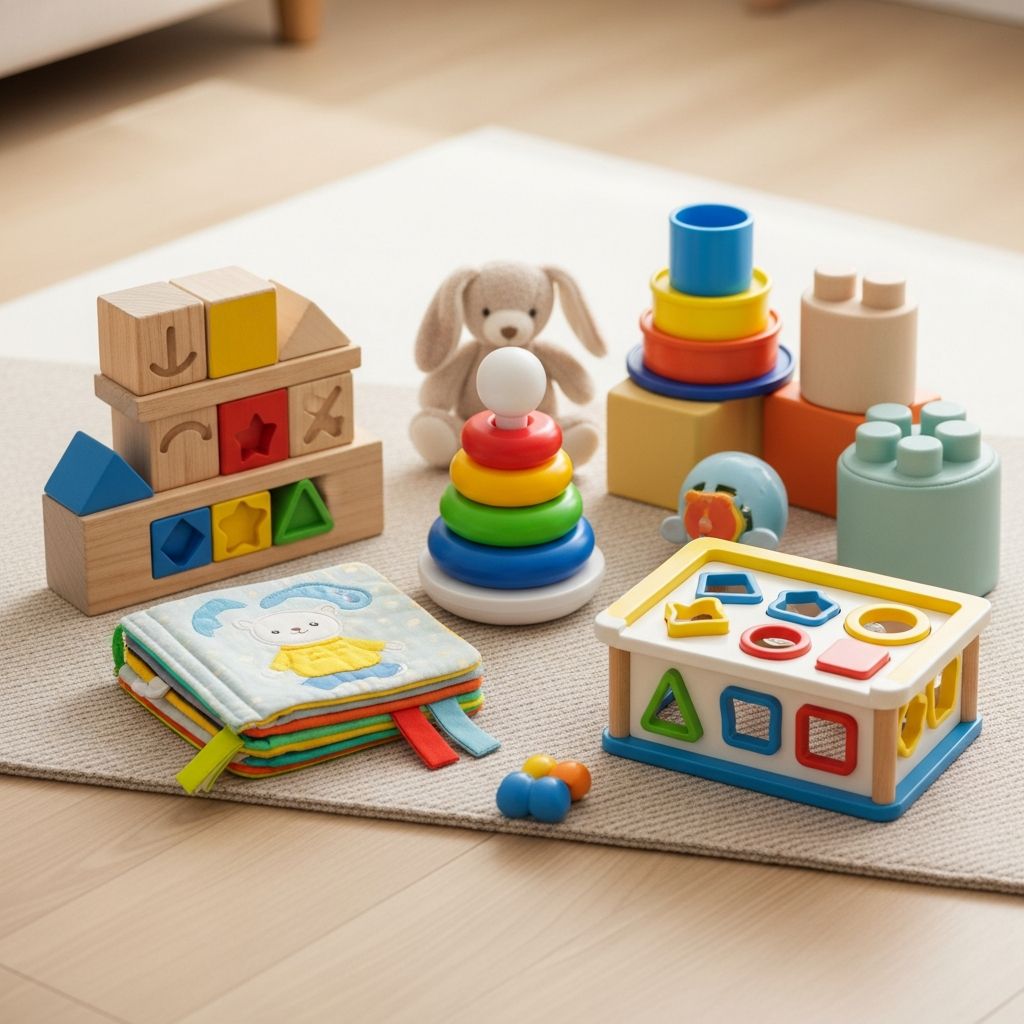
Turning one is a huge milestone, and the toys you choose now do more than just entertain your child—they actively shape how they move, think, communicate, and connect with you. At this age, the right toys invite exploration, build confidence, and make daily life a little more fun for everyone.
This guide explains how to choose the best toys for 1-year-olds, which features really matter, and how to use everyday playtime to support healthy development without an overflowing toy box.
Why Toys Matter So Much at Age One
By their first birthday, most children are busy practicing new skills: pulling up, cruising along furniture, babbling, pointing, and experimenting with cause and effect. Well-chosen toys give them a safe, engaging way to repeat those skills over and over, which is exactly how their brains learn.
- Cognitive growth: Simple problems like fitting a block into a bucket or stacking rings in order help your child learn about size, shape, cause and effect, and early problem-solving.
- Physical skills: Push toys, balls, and soft climbing objects challenge balance, coordination, and strength while still being safe for wobbly little legs.
- Social and emotional development: Dolls, stuffed animals, and pretend play props give children a way to explore feelings, empathy, and relationships through play.
- Language skills: Books, musical toys, and items that invite back-and-forth interaction naturally encourage more talking, listening, and imitation.
Key Safety Checks Before You Buy Any Toy
Safety should always come before novelty or aesthetics. One-year-olds still explore with their mouths and often play in rough, unpredictable ways, so toys must be durable and appropriately sized.
- Check age recommendations: Look for toys clearly labeled for ages 12 months and up. These have been designed and tested with your child’s abilities and safety in mind.
- Avoid small parts: Anything that could fit through a cardboard toilet paper tube is a choking risk. Inspect removable pieces, buttons, wheels, and decorative add-ons.
- Look for non-toxic materials: Favor toys made with BPA-free plastics, untreated or baby-safe finished wood, and non-toxic paints or dyes.
- Test sturdiness: If it can crack, chip, or break when dropped or thrown, it’s not a good match for a 1-year-old’s play style.
- Beware of long cords: Skip toys with strings, cords, or ribbons longer than roughly 30 cm, which can pose a strangulation hazard.
What 1-Year-Olds Are Learning Right Now
Understanding the skills your child is working on makes it much easier to choose useful toys instead of just cute ones. Every child develops at their own pace, but many 1-year-olds are exploring similar abilities.
| Emerging Skill | What It Looks Like | Helpful Toy Types |
|---|---|---|
| Gross motor | Pulling to stand, cruising, first steps, climbing on low furniture | Push walkers, ride-ons, soft climbing blocks, balls |
| Fine motor | Picking up small objects, turning pages, pointing, poking, stacking | Stacking cups, chunky puzzles, shape sorters, large building blocks |
| Language | Babbling, saying first words, copying animal sounds, pointing to pictures | Board books, picture cards, puppets, simple musical toys |
| Social-emotional | Clinginess, offering toys to others, hugging dolls, copying daily routines | Dolls, stuffed animals, pretend feeding sets, toy phones |
| Thinking skills | Searching for hidden items, repeating actions to see what happens | Pop-up toys, nesting toys, cause-and-effect activity centers |
Open-Ended vs. One-Trick Toys
When choosing toys for a 1-year-old, it is helpful to think about how many different ways your child can use a single item. Open-ended toys can be played with in many ways, while “one-trick” toys usually do just one thing, like flashing or making noise when a button is pressed.
- Open-ended toys: Blocks, stacking cups, simple vehicles, scarves, and dolls support creativity because your child decides how to use them each time.
- Single-purpose toys: Electronic toys that only play sounds or songs when activated can be fun briefly but may not hold interest for long or encourage deep exploration.
A small collection of versatile toys often gives more value than a crowded shelf of noisy gadgets that all work the same way.
Essential Toy Categories for 1-Year-Olds
You do not need every toy in the store. Focusing on a few core categories will cover most of your child’s developmental needs while keeping your home manageable.
1. Toys for Moving and Balancing
Mobility toys encourage your child to practice standing, cruising, and walking while building strength and confidence. They also help burn energy in a positive, safe way.
- Push walkers and carts: Sturdy push toys with wide bases give support to new walkers. Look for models that move slowly and do not tip easily.
- Ride-on toys: Low ride-ons that allow children to sit and push with their feet build leg muscles and coordination.
- Balls: Soft, lightweight balls are perfect for rolling, chasing, and tossing, which supports balance and hand-eye coordination.
- Indoor climbers: Foam blocks or low ramps allow safe climbing and sliding without sharp edges.
2. Stacking, Sorting, and Building Toys
Stacking and sorting activities give your child practice with problem-solving and fine motor control. Short, repeated sessions of this kind of play help strengthen attention span too.
- Stacking cups and rings: Your child can nest them, stack them, bang them together, scoop with them in the bath, and eventually explore size order.
- Shape sorters: In the beginning, your child may simply put shapes in and out through the lid, which is still valuable practice. Matching shapes to holes comes later.
- Large blocks: Lightweight wooden or foam blocks encourage building and knocking down towers, a favorite game at this age.
- Nesting boxes: Boxes that fit inside one another offer early lessons in size, order, and spatial awareness.
3. Sensory and Musical Toys
Sensory toys focus on touch, sound, and visual interest. These toys are especially soothing and engaging for curious toddlers who are constantly experimenting with their senses.
- Textured balls and blocks: Raised patterns, bumps, and ridges give little fingers more to feel and explore.
- Simple instruments: Baby-friendly drums, shakers, or xylophones allow your child to create sounds by hitting or shaking, which teaches cause and effect.
- Soft light-up toys: Gentle, non-overwhelming light effects can be captivating for short periods, especially in a calm, dim room.
- Water play items: Cups, funnels, and floating toys turn bath time into a sensory lab while you supervise closely.
4. Pretend Play and Social Toys
Even at one, many children begin to imitate what they see adults doing. Pretend play gives them a safe way to rehearse everyday routines and experiment with roles.
- Dolls and stuffed animals: Soft, simple dolls and plush toys invite hugging, feeding, rocking, and carrying, which nurtures empathy and nurturing behavior.
- Pretend feeding or care sets: Toy bottles, spoons, plates, and small blankets help children copy mealtime or bedtime routines.
- Toy phones and remotes: These satisfy the urge to use “grown-up” objects and reduce fights over real devices.
- Puppets: Finger or hand puppets make it easy for adults to turn simple stories into engaging, interactive play.
5. Books and Early Learning Toys
Books are some of the most powerful “toys” you can offer a 1-year-old. They support language, attention, and emotional connection every time you read together.
- Board books: Durable pages, simple pictures, and few words make it easy for toddlers to handle books and follow along.
- Lift-the-flap books: Hidden animals or objects keep toddlers engaged and encourage interaction as they uncover surprises.
- Photo books: Albums with family pictures give toddlers a chance to practice names and recognize familiar faces.
- Early puzzles: Wooden puzzles with large knobs and just a few pieces support hand-eye coordination and early matching skills.
How Many Toys Does a 1-Year-Old Really Need?
Parents often feel pressure to provide a constant stream of new toys, but most 1-year-olds benefit from fewer, better items that they see regularly and know how to use. Too many choices can actually make it harder for them to focus.
- Choose a small selection from each key category: one or two mobility toys, a few building or stacking options, several books, and a handful of pretend and sensory toys.
- Rotate toys every week or two: Put a few items away and bring them back later. Toys often feel brand new when your child hasn’t seen them for a while.
Budget-Friendly Ways to Support Play
Great play does not have to be expensive. Everyday household objects can be just as captivating as store-bought toys when used safely and creatively.
- Kitchen treasures: Plastic bowls, wooden spoons, measuring cups, and silicone muffin pans become drums, scoops, and stacking tools.
- Recycling bin finds: Clean cardboard boxes, paper towel tubes, and plastic containers can be turned into tunnels, towers, and fill-and-dump play.
- Scarves and cloths: Lightweight scarves or small cloths are perfect for peek-a-boo, dancing, and hiding toys underneath.
- DIY sensory bins: A shallow bin filled with large pasta shapes or big pom-poms (used with close supervision) gives your child a rich tactile experience.
Tips for Playing with Your 1-Year-Old
The most important “toy” your child has is you. How you interact, respond, and join in their games can transform simple objects into powerful learning tools.
- Follow their lead: Watch what your child is doing, then join in instead of directing every move. This builds confidence and keeps play enjoyable.
- Describe the action: Use simple language to talk about what your child is doing: “You’re pushing the car. The car goes fast!” This naturally builds vocabulary.
- Repeat favorite games: Young toddlers love repetition. Playing the same stacking or hiding game many times helps solidify new skills.
- Keep sessions short: Many 1-year-olds prefer frequent, brief bursts of play. It is normal for them to switch activities often.
Sample Toy Capsule for a 1-Year-Old
If you are starting from scratch or trying to simplify, it can help to think in terms of a “capsule” collection—a compact set of toys that cover all the major types of play.
| Category | Number of Toys | Examples |
|---|---|---|
| Movement | 2 | Push walker, soft ball |
| Stacking & sorting | 2–3 | Stacking cups, ring stacker, shape sorter |
| Sensory & music | 2 | Textured ball set, baby drum or shaker |
| Pretend play | 2 | Soft doll or plush, toy feeding set |
| Books & puzzles | 4–6 | Board books, one or two simple knob puzzles |
Frequently Asked Questions About Toys for 1-Year-Olds
Are electronic toys good for 1-year-olds?
Electronic toys can be entertaining in short bursts, but they are not necessary for healthy development. Toys that respond with lights and sounds when a button is pushed may teach basic cause and effect, yet they often leave little room for imagination or open-ended play.
Non-electronic toys encourage your child to move, experiment, and invent more of the action themselves, which typically offers deeper learning. If you choose electronic toys, use them as a small part of your collection rather than the main focus.
How often should I introduce new toys?
There is no strict rule, but rotating toys instead of constantly buying new ones keeps things fresh without overwhelming your home. Swapping out a few items every week or two often revives your child’s interest in toys they had previously ignored.
Pay attention to what your child is trying to do—climb more, imitate you, point to pictures—and add or rotate toys that support those new interests.
What if my 1-year-old only plays with household objects?
It is completely normal for toddlers to prefer real-life objects like spoons, containers, and remote controls. Everyday items are fascinating because they see adults use them constantly.
You can lean into this interest by offering safe “yes” versions of these objects, such as a toy phone, a set of kitchen tools just for play, or a basket of safe household items to explore under supervision.
How long should my child be able to play with one toy?
Many 1-year-olds move between activities quickly. A few minutes of focused play is already a success at this age. Attention span gradually increases over the next several years, especially when adults join in and keep interactions warm and responsive.
If your child loses interest quickly, try simplifying the play space by reducing the number of visible toys and putting away distracting clutter.
What is the best single toy to start with?
If you are choosing just one multipurpose toy, stacking cups are a strong contender. They can be nested, stacked, used in the bath, filled and dumped, hidden under, and even incorporated into pretend play as bowls or containers.
However, the “best” toy is always the one that matches your child’s current interests and stage—so if your toddler is determined to walk, a stable push toy might be just as valuable right now.
Final Thoughts: Focus on Connection Over Perfection
At the end of the day, your 1-year-old does not need trendy toys or a perfectly curated playroom. A few safe, thoughtfully chosen toys combined with your presence, encouragement, and willingness to play are more than enough.
When you prioritize open-ended toys, simple activities, and regular moments of connection, you create a rich play environment that supports your child’s body, mind, and heart—one game at a time.