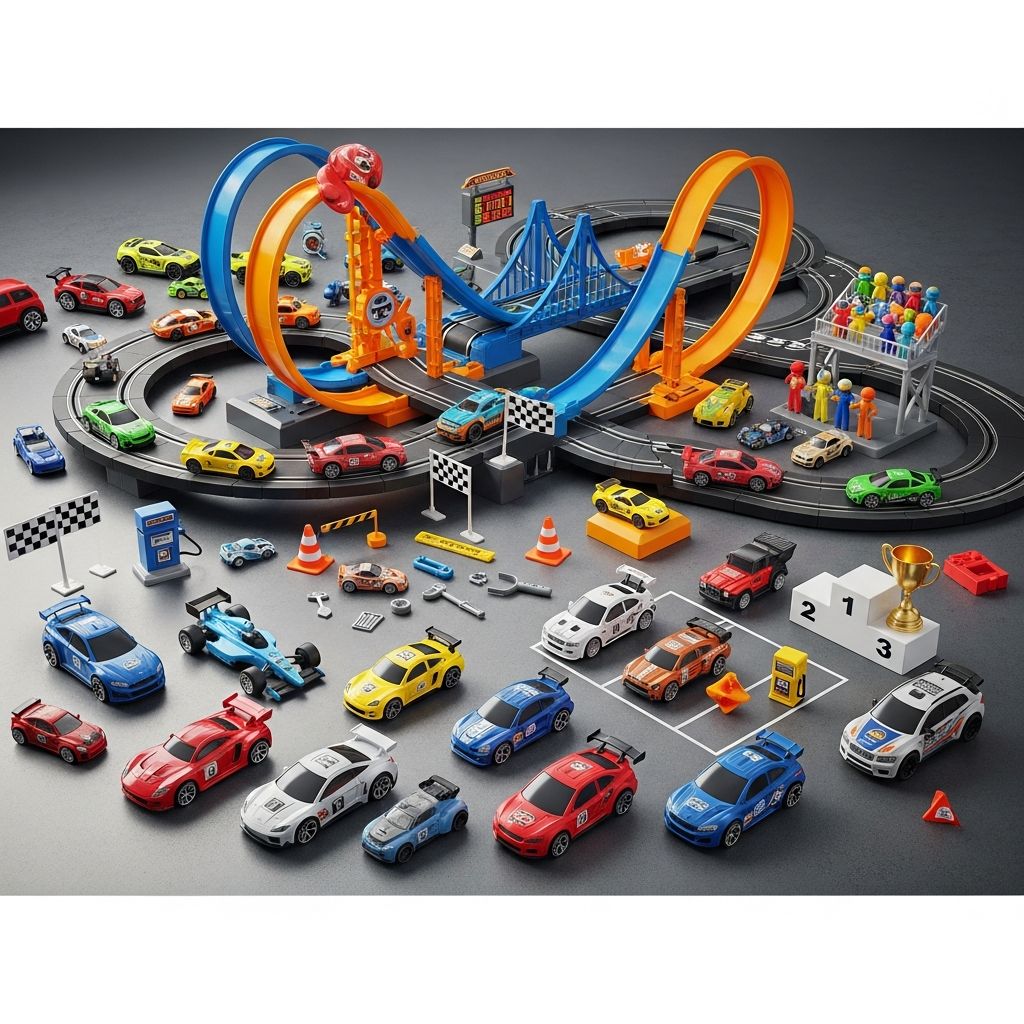
Race track toys are more than looping plastic and fast cars – they are compact playgrounds for imagination, problem-solving, and hands-on science. When chosen thoughtfully, a simple set of tracks can keep children engaged for years while helping them grow key physical, social, and thinking skills.
Why Race Track Toys Still Matter in a Digital World
In a time when children are surrounded by screens, race track toys stand out as an active, tactile alternative. They invite kids to build, experiment, and move, rather than passively watch. This kind of play supports healthier development and can help balance the lure of tablets and TV.
Beyond the thrill of watching cars zoom past, track sets encourage kids to plan layouts, test ideas, and work with siblings or friends. That combination of fun and learning makes race tracks a reliable choice for both homes and classrooms.
Key Benefits of Race Track Toys for Child Development
Good race track sets do more than entertain; they subtly teach children how the world works while strengthening important skills. Here are the main developmental benefits parents often notice.
Physical and motor skills
- Fine motor skills: Connecting track pieces, placing cars at starting points, and pressing launchers help train the small muscles in the hands and fingers.
- Hand–eye coordination: Steering cars along a path or adjusting track angles so cars land where expected challenges children to link what they see with how they move.
- Gross motor activity: Larger sets that stretch across rooms encourage kids to crawl, reach, and move around the track instead of sitting in one spot.
Cognitive and STEM learning
- Cause and effect: Children quickly notice how changing the slope, length, or direction of a track changes how the cars behave.
- Early physics concepts: As kids experiment, they start to grasp ideas like speed, gravity, momentum, and friction in a hands-on way.
- Problem-solving: When a car keeps flying off a bend or stalls halfway down, children must adjust the layout and think through why it is happening.
Social and emotional growth
- Turn-taking and sharing: Race track toys naturally lead to “my turn, your turn” moments and cooperative building sessions.
- Handling frustration: Tracks that do not work perfectly right away teach patience and resilience as kids try again.
- Confidence: Successfully building a long track or solving a “crash” problem gives children a powerful sense of achievement.
Imagination and language
- Storytelling: Kids often invent characters, destinations, and dramatic races, which builds narrative skills.
- Vocabulary: Words like “faster,” “steep,” “curve,” and “finish line” become part of everyday conversation as they play.
Types of Race Track Toys and How to Choose
Race track toys come in many shapes and materials, from chunky toddler ramps to sophisticated electronic tracks. Understanding the main types helps you match a set to your child’s age and interests.
Common race track styles
- Ramp and gravity tracks: Simple tracks where cars roll downhill using gravity alone; ideal for toddlers and young preschoolers.
- Looping stunt tracks: Sets with loops, jumps, and dramatic stunts that appeal to kids who love speed and spectacle.
- Modular road or city systems: Tracks that connect like puzzle pieces to form streets, bridges, and intersections for more open-ended play.
- Electric or battery-powered tracks: Cars are powered by motors or electricity and run on fixed rails for high-speed racing.
- Magnetic or wooden tracks: Often more durable and tactile, with a slower pace that suits quieter play and younger children.
Quick comparison of track types
| Type | Best for ages | Main appeal | Typical drawbacks |
|---|---|---|---|
| Ramp & gravity | 1–4 years | Simple cause-and-effect, easy setup | Less challenging for older kids |
| Looping stunt | 4–8 years | High-speed action, tricks, jumps | Can be noisy and space-hungry |
| Modular road/city | 3–8 years | Open-ended building and storytelling | Many pieces to store |
| Electric/battery | 6+ years | Competitive racing, precise control | More fragile, often pricier |
| Magnetic/wooden | 2–6 years | Durable, tactile, quieter play | Usually fewer stunts, slower pace |
Age-by-Age Guide to Choosing a Track
There is no single “best” race track toy. The right choice depends heavily on your child’s age, attention span, and interests. Use this age guide as a starting point and then adapt to your child’s personality.
For toddlers (about 1–3 years)
Toddlers need sturdy, simple tracks with large pieces that are easy to grasp and difficult to swallow. They enjoy repeating the same action over and over, such as dropping a car at the top and watching it roll down.
- Pick sets with smooth edges, big cars, and minimal small accessories.
- Look for bright colors, clear ramps, and a short setup time.
- Avoid electric tracks or pieces that easily detach into tiny parts.
For preschoolers (about 3–5 years)
Preschoolers are ready to design layouts, mix pieces from different sets, and narrate stories. They still benefit from durable pieces but can handle more complexity than toddlers.
- Choose modular tracks that allow multiple configurations.
- Consider sets that combine roads with buildings, garages, or bridges for imaginative city play.
- Introduce simple stunts like gentle jumps or small hills.
For early school-age kids (about 5–8 years)
Children in this group love challenges and competition. They may enjoy timing races, experimenting with track designs, or adding themed sets like construction zones or space tracks.
- Look for stunt tracks and expansion packs that extend the base set.
- Encourage kids to measure race times or distances to blend fun with basic math.
- Consider sets that allow two or more cars to race side by side.
For older kids (about 8+ years)
Older kids may gravitate toward realistic racing experiences or technically complex builds. They can handle more delicate mechanisms and understand rules that protect the set from damage.
- Explore electric or battery-powered tracks with controllers for lane changes and speed adjustments.
- Look for sets with advanced building challenges, such as multi-level layouts.
- Encourage them to document designs or create house rules for races.
Essential Safety and Durability Checklist
Safety should always come before speed. Even a simple plastic track can pose risks if pieces are too small, too sharp, or made from questionable materials. A short inspection before buying makes a big difference.
Safety points to review
- Age rating: Respect manufacturer age recommendations, especially regarding small parts.
- Choking hazards: Ensure any detachable car wheels, figures, or accessories are too large to fit into a young child’s mouth.
- Stable construction: Long or tall tracks should stand firmly without tipping over easily.
- Non-toxic materials: Check for trusted safety labels and avoid strong chemical smells.
Durability and ease of use
- Connection quality: Track pieces that snap together securely but not too tightly reduce frustration.
- Repairability: Sets with replaceable cars or available spare parts often last longer.
- Storage: Prefer sets that pack into a bin, box, or bag without elaborate disassembly.
Maximizing Learning With Simple Play Ideas
Race track toys naturally support learning, but a few guided activities can deepen the benefits without making playtime feel like school. Small tweaks turn ordinary races into rich learning moments.
STEM-inspired challenges
- Ramp experiments: Build ramps at different heights and ask children to predict which car will travel farthest.
- Friction tests: Try racing cars over smooth plastic, carpet, and a cardboard surface to compare speed.
- Weight comparisons: Use light and heavy cars on the same track and observe differences in performance.
Language and storytelling prompts
- Invite your child to name the cars and describe where they are going and why.
- Turn races into mini-dramas: a rescue mission, a delivery run, or a space launch on wheels.
- Ask open questions like “What could we change to make this car go faster?”
Social play ideas
- Organize a family race night with simple rules and a rotating “track designer.”
- Encourage siblings to build one shared layout instead of separate tracks to practice cooperation.
- Use a timer or homemade score sheet to keep races friendly and fair.
Practical Buying Tips for Parents
With so many options available, it can be hard to know which race track is worth the investment. Focusing on a few practical questions helps narrow down the search.
Questions to ask before purchasing
- How much space do we have? Measure the play area and make sure the track will fit comfortably.
- Will this grow with my child? Expansion packs and modular designs often extend the toy’s lifespan.
- Is it compatible with cars we already own? Some systems work best with specific car sizes or brands.
- How noisy is it? Electric tracks and launchers can be loud; this may matter in small homes or apartments.
Budget and long-term value
- Instead of the biggest set, look for a well-made starter track that can be upgraded over time.
- Consider the cost of batteries if choosing a motorized system.
- Sometimes two smaller, compatible sets offer more flexibility than one oversized layout.
Organizing, Storing, and Maintaining Track Sets
Even the best race track toy can become a headache if it is constantly underfoot. A simple storage system keeps pieces accessible for kids and manageable for adults.
Storage strategies that work
- Use clear bins or labeled boxes so children can quickly find track pieces and cars.
- Keep tiny accessories in smaller containers or pouches inside the main box.
- Store instruction booklets or layout ideas in a folder or zip bag for easy reference.
Basic maintenance tips
- Wipe plastic or wooden track pieces with a damp cloth when dusty or sticky.
- Check cars regularly for loose wheels or sharp edges and remove damaged pieces.
- Disassemble tall structures when not in use to avoid warping or breakage.
Frequently Asked Questions About Race Track Toys
Are race track toys safe for toddlers?
Race track toys can be safe for toddlers if they are specifically designed for that age group. Look for large, chunky pieces, cars without removable small parts, and clear age ratings from the manufacturer.
How many cars does a child really need?
Most children are satisfied with just a few cars, especially when the focus is on track-building and storytelling. Extra cars become useful when siblings or friends play together or when you want to explore differences in size and speed.
Do motorized race tracks teach anything, or are they just noisy?
Motorized tracks can still support learning if children are involved in building layouts, solving track issues, and comparing how different cars behave. The key is to balance automatic speed with opportunities for children to make decisions and experiment.
Can race tracks work in small spaces?
Yes. Look for compact sets that build vertically, fold away, or pack into a single storage case. Some flexible tracks can be rolled up when not in use and brought out only during playtime.
How long do kids stay interested in race track toys?
Interest varies by child, but sets with multiple configurations and expansion options usually stay appealing longer. Rotating track pieces, introducing new challenges, or occasionally adding a small accessory pack can refresh interest without buying a whole new system.
Final Thoughts: Choosing the Right Track for Your Family
Race track toys remain popular because they blend excitement with real developmental benefits. When you select a set that matches your child’s age, personality, and play space, you gain a tool that can support learning, cooperation, and creativity for years.
Whether you start with a small gravity ramp or a detailed city layout, the most important part is sharing in the building, experimenting, and laughing together as the cars race by.