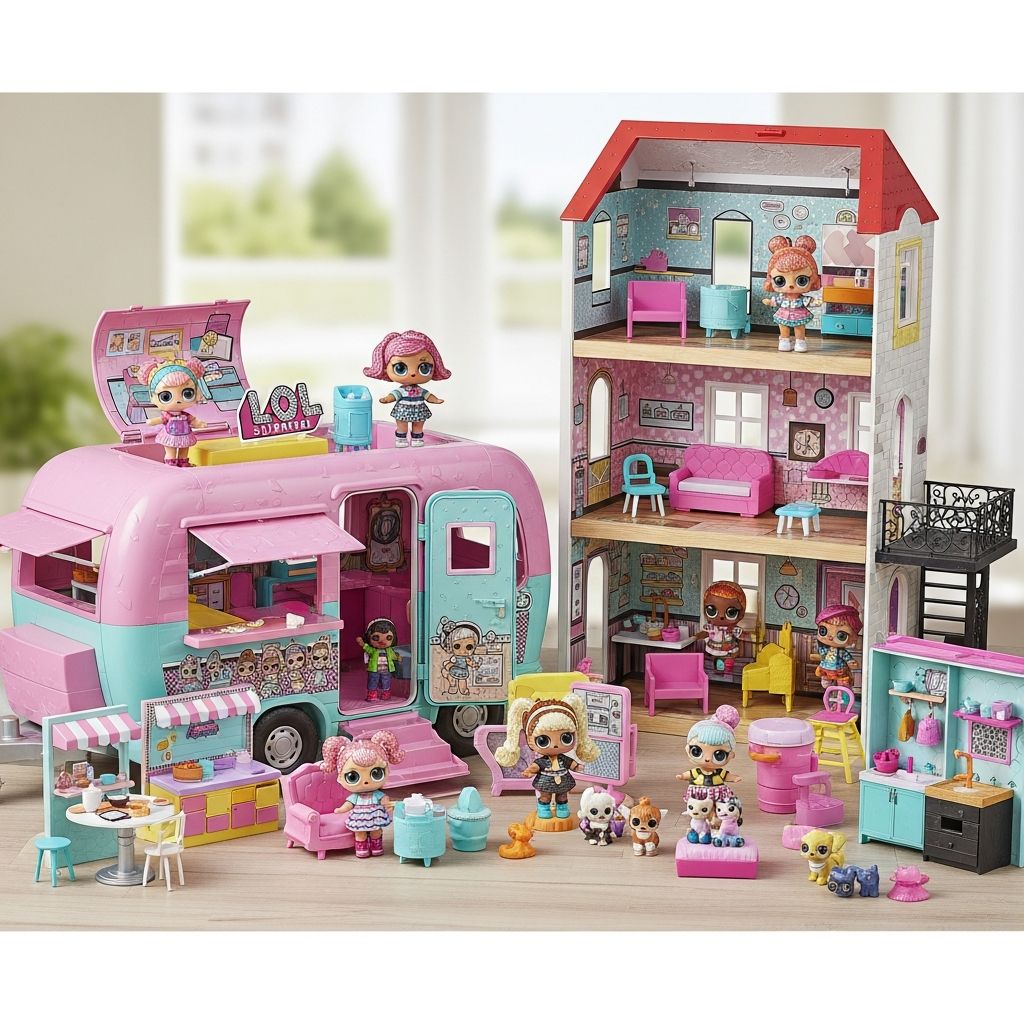
If your child has fallen in love with LOL Surprise dolls, the next request is usually bigger: a camper, a dollhouse, or a full playset “so they can all live together.” Before a giant plastic glam-mobile moves into your living room, it helps to understand what these sets really offer, how kids tend to use them, and which features are worth paying for.
Why Kids Obsess Over LOL Surprise Playsets
LOL Surprise campers and dollhouses are designed as miniature worlds, giving kids a dedicated stage for all the dolls and accessories they’ve slowly accumulated. The bright colors, tiny details, and moving parts invite kids to keep inventing new stories, whether that’s a road trip, a pool party, or a sleepover in a bunk bed.
For many kids, the appeal goes beyond just a vehicle or a house. These sets feel like a “base camp” for their entire collection, turning scattered dolls and accessories into a single, coherent universe where everyone has a place to sleep, eat, swim, and perform.
Types of LOL Surprise Playsets
Not all LOL Surprise sets are created for the same kind of play. Some work like compact travel playsets, while others transform into sprawling dollhouses that command a permanent spot on the floor. Understanding the broad categories makes it easier to match a toy to your space and your child’s habits.
Campers and Glampers
Campers (often branded as “glampers” because nothing about LOL is subtle) usually start as a vehicle and then unfold into something much bigger. They tend to include features like water slides, pools, bunks, and kitchen or BBQ areas, turning what looks like a van into a full-blown mobile mansion.
Because campers are vehicles, they add a sense of movement to play. Kids can stage road trips, music tours, or camping adventures, then park the camper, open it up, and shift into house-style pretend play with bedrooms, bathrooms, and hangout corners.
Traditional Dollhouses
LOL-branded dollhouses are closer to classic dollhouses, with multiple floors, themed rooms, and furnishings sized for LOL dolls. They usually don’t move around easily once built, but they offer vertical play and a more stable home base.
If your child likes setting up long-running storylines—who lives in which room, who owns the café downstairs, who always hogs the bathroom—a dollhouse can become the main stage while smaller sets and vehicles orbit around it.
Compact Playsets and Rooms
Smaller sets focus on a single scene: a car, a bedroom, a salon, a café, or a stage. These are good options if you don’t have space for a giant camper or house but still want to give kids a “home” for their dolls.
Many families mix and match a larger central piece (camper or house) with one or two of these smaller sets, expanding play options without doubling the footprint in the living room.
Key Features That Actually Matter
Marketing promises a lot—dozens of surprises, light-up features, and complex transformations. Underneath the shiny packaging, only certain features end up being used day after day. Focusing on these helps you choose something that won’t turn into a dust-collecting monument.
Size, Footprint, and Storage
Before saying yes to any camper or house, measure the space where it will live. Many sets look manageable on the box but unfold into wide, multi-panel layouts that take over coffee tables or most of the playroom rug.
Look for designs where doors, floors, and accessories fold back into the vehicle or structure. Built-in storage compartments and removable trays make cleanup easier and shrink the footprint when the playset is packed away.
| Type | Approx. Size When Open | Ideal Storage Situation |
|---|---|---|
| Large camper/glamper | About the size of a small coffee table | Needs a corner of the room or under-bed space when closed |
| Multi-floor dollhouse | Taller than most preschoolers; wide base | Permanent spot along a wall; not easy to move daily |
| Compact room or vehicle | Roughly the size of a shoebox | Fits in cubes, toy bins, or shelves |
Lights, Sounds, and Water Features
Many LOL campers and houses come with light-up pools, working headlights, horns, or sound effects. These features are immediately exciting, especially when kids first unbox the toy, and they add a “party” feel to play.
However, they also add a layer of maintenance: batteries need changing, and water features need to be emptied and dried. If your child is sensitive to noise or you’d rather avoid water near the rug, prioritize playsets where these features are optional rather than central.
Bedrooms, Hangout Zones, and Functional Areas
Once the novelty of unboxing wears off, kids gravitate toward spaces that support stories: bunks for sleepovers, a kitchen or café, a bathroom, a vanity for “getting ready,” and a pool or dance floor for parties. Playsets that divide the interior into clearly defined areas usually stay interesting longer.
Look for:
- Multiple seating or sleeping spots so more than one doll can participate.
- Vertical variety—ladders, slides, different floors—to encourage movement.
- Small details like tiny food, plates, makeup bottles, and records that trigger imaginative scenarios.
Matching a Playset to Your Child
The “best” LOL camper or dollhouse is the one that fits your child’s play style, not just the biggest or flashiest model on the shelf. Paying attention to how your child already uses toys can guide you more reliably than age ranges printed on a box.
For Story-Driven Kids
Some kids treat dolls like characters in a long-running TV show. They remember who is shy, who loves music, and who always sleeps on the top bunk. For them, a set with distinct rooms and clear roles (kitchen, bedroom, beauty area, pool) will feed that storytelling instinct.
A larger camper or house with multiple zones works especially well, because it lets your child stage entire episodes: getting ready, traveling, performing, relaxing, and sleeping, all in one location.
For Builders and Tinkerers
Other kids love the transformation aspect—unfolding panels, extending slides, rearranging furniture and re-sticking decals. They may spend as much time setting up the camper as they do playing with the dolls themselves.
If that sounds familiar, focus on sets with movable pieces: removable tables, fold-down beds, repositionable seating, doors that open and close, and customizable sticker sheets for decorating the interior.
For Social Play and Siblings
When more than one child is involved, cramped interiors can lead to arguments. In that case, sprawling campers or wider dollhouses that open fully on one side make it easier for siblings or friends to play together without hovering over the same small corner.
Shared play works best when each child can control “their” zone—one managing the pool and slide, another running the café or DJ booth, another organizing the beds. Look for sets that naturally divide into these kinds of zones.
Age, Complexity, and Durability
LOL Surprise toys are often marketed for kids starting around preschool age, but not every playset is equally easy for little hands to manage. Some have small pieces, stiff doors, and compartments that need adult strength to open.
Assembly and Setup
Expect some assembly, particularly with larger campers and houses. Parents often need to help with attaching stickers, snapping in furniture, and installing railings or slides. In some designs, battery compartments are hidden behind screws that require a small screwdriver.
It can be worth treating assembly as a joint project. Let your child peel and place stickers, hand you parts, and “discover” each feature as it becomes available, rather than trying to rush through the build on your own before gifting the toy.
Handling Wear and Tear
Moving parts—fold-out walls, sliding sections, and detachable doors—are the most likely to show wear over time. Some doors may pop off under enthusiastic play, which can be frustrating in the moment but is sometimes by design to prevent snapping.
Before you recycle the box, take a quick photo of the fully assembled set. If something comes loose later, that photo becomes a low-stress reference for how everything fits back together.
How Kids Actually Use the Accessories
LOL Surprise sets are famous for “surprises”: tiny bags and boxes holding furniture, dishes, clothing, and décor. These accessories are a huge part of the unboxing rush, but it’s useful to set expectations about what stays in rotation and what ends up under the couch.
The Most-Played-With Pieces
Certain accessories almost always become staples:
- Chairs, stools, and beds that help dolls sit, sleep, and gather.
- Food, drink, and tiny kitchen items that support pretend meals and parties.
- Beauty items (tiny combs, makeup bottles) that become part of daily routines in kids’ storylines.
Pieces that integrate directly with core play areas—like a tray that slots into the camper or a table that locks into the floor—are less likely to wander than completely loose items.
Managing the Inevitable Tiny Chaos
Even the most organized parents eventually find LOL shoes in sofa cushions. Investing in a couple of small, labeled containers just for LOL accessories helps keep things under control and makes cleanup part of the routine instead of a scavenger hunt.
Some families store rarely used accessories separately and rotate them in like new “surprises” a few weeks later. This keeps the toy feeling fresh without buying new sets every time interest dips.
Making the Most of a Big LOL Playset
Once a large camper or house joins the household, it can be more than just a toy. With a bit of intention, it can become a recurring part of family life, a catalyst for storytelling, and even a quiet tool for practicing responsibility and problem-solving.
Encouraging Imaginative Storylines
Parents don’t have to “play LOL” for hours to support imaginative play. Sometimes a simple prompt—“Who’s driving the camper today?” or “What’s on the menu at the LOL café?”—is enough to spark a whole storyline kids then run with on their own.
Rotating which dolls are “on tour” in the camper or who gets to move into the house can also shake up repetitive play patterns and push kids to invent new scenarios.
Using the Set for Gentle Responsibilities
Large sets with many pieces create natural opportunities for simple routines:
- “Parking” the camper in a designated spot at night.
- Setting dolls back in beds or seats before dinner.
- Drying out any water features and putting away loose accessories.
These micro-tasks can help kids practice cleanup and care for their belongings without turning playtime into a chore list.
Budgeting for LOL Campers and Dollhouses
LOL Surprise playsets span a wide price range, from small vehicles and single-room sets to premium campers and multi-story houses. The more elaborate the transformation, lights, and water features, the higher the price tends to climb.
Where to Spend and Where to Save
If your child is just beginning an LOL collection, starting with a mid-sized vehicle or room set is often enough to create a satisfying “home base.” You can always add a larger camper or house later if interest stays high.
Families with established collections might find that one flagship piece—a large camper or tall house—goes a long way, especially if combined with a few smaller, less expensive add-ons over birthdays or holidays.
Secondhand and Hand-Me-Down Options
Because these toys are made from sturdy plastic and have long-lasting themes (parties, sleepovers, camping trips), they tend to hold up well over time. Buying secondhand or accepting hand-me-downs can dramatically reduce cost while still delivering the full play experience.
When picking up a used camper or house, check that moving parts (slides, ladders, doors) still function and that key accessories—ladders, beds, and central furniture pieces—are present. Missing tiny décor is usually less of a deal-breaker than missing structural elements.
Frequently Asked Questions
Are LOL Surprise campers and dollhouses worth the space they take up?
For kids deeply into LOL dolls and pretend play, a camper or dollhouse can become a daily destination rather than a once-a-month novelty. If you have a consistent spot where the set can live—under a window, in a playroom corner, or even next to the couch—it often sees enough use to justify its footprint.
Will my child actually use all the features, like pools and slides?
Typically, pools, slides, and runways are most exciting right after unboxing, but many kids keep returning to them as part of their ongoing stories: pool parties, fashion shows, or camping adventures. The key is choosing a set where those features complement everyday play rather than being the only attraction.
How many dolls can a camper or dollhouse realistically handle?
Even though packaging photos may show a crowd of dolls, most campers and houses are most playable with a handful of characters, not an entire collection at once. Rotating dolls in and out of the main scene helps keep play manageable and reduces overcrowding in small areas.
What’s the best way to store all the tiny accessories?
Using small, sealable containers or drawer organizers labeled just for LOL items is often the simplest solution. Some families keep one container for “everyday” pieces like chairs, food, and bedding, and another for extra outfits and décor that only come out occasionally.
Should I choose a camper or a classic dollhouse if I can only get one?
If your child loves cars, road trips, and moving toys around the room, a camper offers both vehicle play and house-style play in one. If they prefer long, stable storylines about who lives where and what happens at home, a classic multi-room dollhouse will probably hold their interest longer.