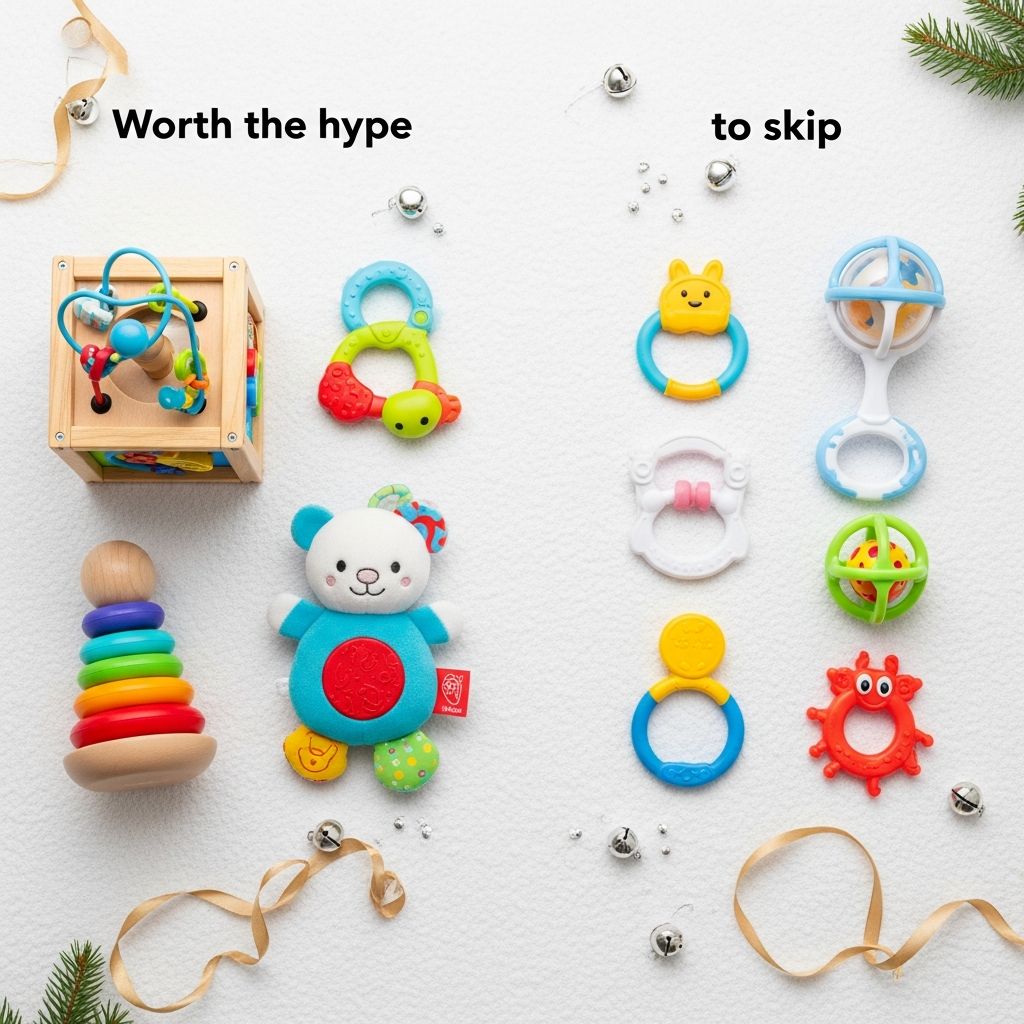
The holiday season makes it easy to believe that every shiny, noisy, light-up toy on the shelf is a must-have for your baby. Between retailers’ “hot toy” lists, influencer roundups, and family expectations, it can feel like your baby’s first (or second) holiday is a high-stakes shopping test. This guide cuts through the noise to help you figure out which toys are likely to be genuine hits, which are safe to skip, and how to shop in a way that fits both your child’s needs and your family’s budget.
What Babies Actually Need From Toys
Babies do not need a toy box overflowing with complicated gadgets. What they need most is a small set of safe, engaging objects that support exploration, movement, language, and connection with their caregivers. A good holiday toy is one that encourages your baby to reach, grasp, roll, bang, chew, stack, look, listen, and eventually pretend.
- For infants under 6 months, simple toys that stimulate the senses (sight, touch, sound) and encourage head turning, reaching, and tracking are most useful.
- Between 6 and 12 months, toys that support sitting, crawling, pulling up, and cause-and-effect play become more appealing.
- From 12 to 24 months, toddlers benefit from toys that allow early problem solving, simple pretend play, and plenty of gross motor practice (pushing, pulling, climbing).
When you start from developmental needs instead of marketing claims, it becomes much easier to sort the true hits from the holiday hype.
Features That Make a Baby Toy a “Hit”
Popular baby toys tend to share a handful of characteristics, no matter the year or trend. You don’t have to chase the exact item everyone is posting online if you understand what makes a toy truly engaging and useful.
- Open-ended play potential: Toys that can be used in more than one way (stacking cups, soft blocks, nesting bowls) stay interesting longer than single-function gadgets.
- Baby-powered, not battery-powered: Toys that react to your baby’s actions (a ball that rolls, a rattle that makes noise when shaken) help build cause-and-effect understanding and motor skills.
- Sensory variety: Different textures, soft sounds, and high-contrast patterns give babies something to explore without overwhelming them.
- Room to grow: A toy that works for a 9-month-old and is still fun at 18 months offers far more value than something your child outgrows in a week.
If a toy encourages exploration and doesn’t do all the work for your baby, it is much more likely to become a long-term favorite instead of a short-lived novelty.
Common Holiday Toy “Misses” for Babies
Some holiday toys look impressive in the box or on a gift guide but deliver very little once your baby starts using them. Understanding the typical pitfalls helps you avoid clutter and frustration.
- Overstimulating activity centers: Toys that flash, play songs, spin, and talk all at once can overwhelm babies, shorten attention spans, and leave very little room for active exploration.
- Complicated, multi-step gadgets: Anything that requires a lot of buttons, modes, or menu navigation is usually better suited to older children, not infants or young toddlers.
- Age-inappropriate tech: Tablet-like baby toys, remote-style gadgets, and “baby tablets” are often marketed as educational but rarely support meaningful skill development at this age.
- Huge, space-eating gear with limited use: Oversized baby gear that is only fun for a narrow window of months (and hard to store) may not be worth the cost or footprint.
When in doubt, imagine how your baby would actually interact with the toy in everyday life, not just how it looks in a promotional photo. If most of the action comes from the toy itself rather than your child, you can usually skip it.
Baby Toy Hits by Age Group
Below is a quick overview of toys that tend to be winners for common baby and toddler age ranges. These are broad categories you can use to evaluate any specific product you see this holiday season.
| Age Range | Great Holiday Toy Types | Why They Work |
|---|---|---|
| 0–6 months | High-contrast cloth books, soft rattles, crinkle toys, baby-safe mirrors, simple playmats | Support visual tracking, grasping, tummy time, and early social engagement. |
| 6–12 months | Stacking cups, soft blocks, shape-agnostic rings, rolling balls, push-along toys for early walkers | Encourage sitting balance, crawling, cause-and-effect, and pulling to stand. |
| 12–18 months | Simple shape sorters, chunky puzzles, ride-on toys, basic musical instruments, sturdy dolls or stuffed animals | Promote problem solving, gross motor practice, and early pretend play. |
| 18–24+ months | Blocks, basic play kitchen items, pretend phones and keys, toddler-safe art supplies, simple vehicles | Support imaginative play, language, fine motor skills, and early storytelling. |
This framework gives you flexibility. You can choose any brand or style that fits your family while still covering the key types of play your baby needs.
Red Flags When Evaluating Popular Baby Toys
Holiday advertising can make nearly any toy sound magical. It helps to have a mental list of red flags to check when you see something on a “hot toys” list or a viral gift guide.
- Vague educational claims: Phrases like “boosts IQ” or “teaches reading” for babies usually signal marketing, not science. Babies learn best from real-world, hands-on experiences.
- Inconsistent age recommendations: If a toy is labeled for 3+ years but is being hyped for babies, there may be choking hazards or complexity that isn’t obvious at first glance.
- Lots of small, detachable parts: Babies explore with their mouths. Loose pieces that can fit through a cardboard toilet paper tube are usually too small.
- No clear way for baby to “do” something: If your baby can only watch, listen, or press one button, the toy may get boring very quickly.
Doing a 30-second mental safety and usefulness check before buying can prevent a lot of wasted money and unwanted clutter.
Balancing Classic Toys and Trendy “Hot” Toys
Parents often feel pressure to choose between timeless classics and the season’s trendiest items. The reality is that you can combine both in a way that makes sense for your family and your baby’s stage of development.
- Consider choosing one or two buzzworthy toys that genuinely match your baby’s age and interests, then rounding out your list with simpler, proven items like blocks, balls, and books.
- Remember that babies are usually most excited about interaction and novelty, not brand names. A basic stacking toy can be just as thrilling as a heavily advertised gadget.
Holiday joy for babies comes more from the experience—lights, sounds, people, and routines—than from owning a particular “hot” toy that everyone else is buying.
Practical Shopping Tips for Parents
A little planning before you shop can make holiday toy buying more enjoyable and less overwhelming. Having a clear strategy also makes it easier to answer relatives who want suggestions.
- Start with a short wish list: List 3–5 categories of toys (e.g., something for movement, something for bath time, something for books) rather than specific brands. This gives gift-givers flexibility while keeping clutter under control.
- Set a budget early: Decide how much you want to spend before you start browsing. Toys for babies do not need to be expensive to be valuable.
- Check reviews for durability: Babies can be surprisingly hard on toys. Look for mentions of sturdiness, washability, and how well items hold up over time.
- Think about storage: Before buying large items, picture where they will live in your home. If there is no obvious spot, consider a smaller alternative.
Using a simple plan like this helps you stay focused on what will actually support your baby’s daily play rather than getting lost in endless product options.
Non-Toy Gifts That Still Delight Babies
Not every holiday gift for a baby has to be a toy. In fact, some of the most practical and appreciated presents are items that improve daily routines or create comfort and connection.
- Books: Sturdy board books and cloth books encourage early language skills and can become part of bedtime rituals.
- Cozy essentials: Soft pajamas, sleepsacks, and baby blankets get daily use and still feel special when they are new and seasonal.
- Experience-based gifts: Memberships to local zoos or children’s museums can become meaningful experiences as your baby grows.
These choices take some pressure off finding the “perfect” toy and still make the holiday feel special for both you and your child.
FAQs About Holiday Baby Toys
How many toys should a baby get for the holidays?
There is no strict rule, but babies typically benefit more from a small number of thoughtfully chosen toys than from a mountain of packages. A reasonable approach is to focus on a few items that cover different types of play—movement, sensory, early problem solving—rather than multiple versions of the same thing.
Are electronic toys bad for babies?
Electronic toys are not automatically harmful, but they often offer less opportunity for active, hands-on learning than simple, baby-powered toys. If you choose electronic items, look for those that respond clearly to your baby’s actions and avoid toys that constantly flash, sing, or talk without any input from your child.
What should I tell relatives who want to buy big, flashy toys?
It can help to give relatives a short list of baby-friendly categories and explain what your child is working on developmentally, such as crawling or naming familiar objects. You can also suggest practical limits like size or number of pieces, framing it as wanting your baby to be able to enjoy everything they receive rather than being overwhelmed.
Do babies care about brands or characters?
Very young babies are mostly drawn to high-contrast colors, interesting textures, and familiar faces, not specific brands or characters. While older toddlers may recognize favorite characters, babies under one year are more interested in interaction and novelty than in logos or popular franchises.
How can I avoid toy clutter after the holidays?
Consider rotating toys by keeping a small selection out and storing the rest in a bin or closet, swapping every week or two. This keeps playtime fresh without needing more toys, and it allows your baby to fully explore what they already have instead of being surrounded by too many options at once.
When you focus on development, simplicity, and connection, holiday toy shopping for babies becomes far more manageable. You do not need every trending item on a list; you just need a few well-chosen toys that invite your child to explore, move, and interact with the people they love most.