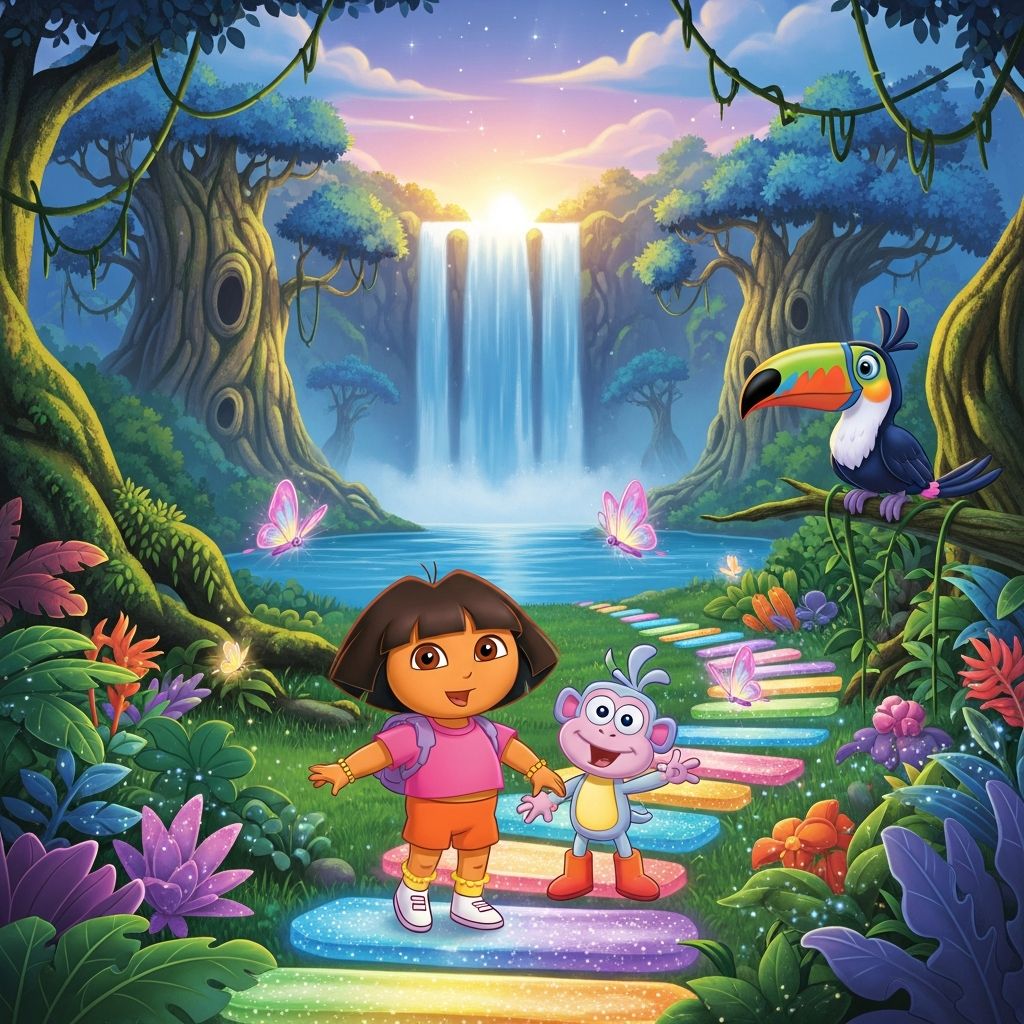
For many families, Dora the Explorer is more than background TV. It is often a child’s first hero, first Spanish teacher, and first guide to problem-solving and teamwork. This guide highlights some of Dora’s most memorable adventures and explains how parents can use these episodes to support early learning, curiosity, and confidence.
Instead of listing every episode in the series, this article groups standout adventures into themes: first-time introductions, map-filled journeys, music-packed quests, friendship stories, and big milestone specials. Each section offers examples of episodes that fit the theme, why kids love them, and how you can turn screen time into learning time.
Why Dora the Explorer Still Matters for Preschoolers
Research over the past two decades has shown that when children engage actively with high-quality educational media, they can build real skills in math, language, and spatial thinking. Dora’s adventures are designed around these ideas, encouraging kids to:
- Answer Dora’s questions out loud
- Practice simple Spanish words and phrases
- Follow maps and directions
- Count, compare, and organize objects
- Move their bodies (jumping, clapping, pointing) to solve problems
Studies have found that children who feel a strong connection to an on-screen character can learn academic concepts more effectively from them, including early math skills. Other research on Dora suggests that frequently watching her map-based adventures can improve preschoolers’ spatial concepts and map understanding compared with peers who do not watch the show.
Getting Started: Dora Episodes That Welcome New Viewers
If your child is just meeting Dora for the first time, it helps to start with adventures that clearly introduce the show’s pattern: a goal, a map, three main stops, and a final celebration.
What Makes a Great “First Dora” Episode?
- Simple quest – A clear, easy-to-follow objective (like finding a lost friend or returning a special item).
- Frequent repetition – Songs, phrases, and routines that repeat so kids quickly learn to join in.
- Gentle pacing – Enough time between questions and answers for young children to respond.
- Low stakes – Mild conflicts and friendly outcomes that feel safe for anxious or sensitive viewers.
When you watch these early adventures together, pause occasionally and invite your child to predict what Dora will do next or which path she should choose on the map. This helps develop early problem-solving and narrative skills.
Map Adventures: Episodes That Build Spatial and Direction Skills
Every Dora adventure features the talking Map, but some episodes lean especially hard on spatial thinking: following routes, choosing paths, and using positional words like “over,” “through,” and “behind.” Researchers who studied Dora’s map-based episodes found that preschoolers who watched them regularly performed better on tasks measuring spatial concepts like direction and position, compared with a control group.
What to Look For in Map-Heavy Dora Episodes
- Several distinct locations that must be visited in a specific order
- Clear use of directional language like “left,” “right,” “near,” and “far”
- Scenes where Dora and Boots must adjust their route due to obstacles
- Moments when the map is shown from above, like a simple aerial view
While watching, you can reinforce these skills by asking questions like:
- “Which place do they visit first?”
- “Are they going around the hill or over it?”
- “Can you point the way Dora should go?”
| Skill Focus | How Dora’s Map Helps | How Parents Can Extend It |
|---|---|---|
| Direction vocabulary | Characters constantly use words like “up,” “down,” “under,” and “around.” | Ask your child to follow simple direction games at home (“Go under the chair, then around the table”). |
| Route planning | Dora and Map plan three-step routes to reach a goal. | Draw simple paths on paper and let your child trace a way from home to a playground. |
| Perspective taking | Map shows an overhead view, helping kids imagine spaces from above. | Use toy figures to recreate the journey on the floor and look “from above.” |
Spanish & Bilingual Fun: Language-Rich Dora Episodes
Dora was one of the first mainstream preschool shows to center a bilingual Latina heroine, and its use of Spanish-English mixing was carefully researched. Educational advisors observed children in classrooms and found that even kids who did not speak Spanish were eager to repeat new words alongside Dora. Over time, Spanish-speaking children also showed pride in hearing their home language represented on screen.
Features of Strong Language-Learning Episodes
- Clear call-and-response – Dora pauses while inviting kids to repeat a Spanish word.
- Themed vocabulary – Words grouped around a topic like animals, emotions, or travel.
- Embedded in the story – Spanish words that help solve problems, not just a random list.
- Gentle correction – Dora models the correct pronunciation if the character or viewer “gets it wrong.”
If you are a Spanish-speaking family, these episodes can help your child see their language valued and celebrated. If you are not, they offer a playful introduction to multilingualism, which research associates with cognitive benefits such as flexible thinking and attention control.
Musical Adventures: Sing-Along Episodes Kids Rewatch
For many preschoolers, Dora’s songs are what make the show unforgettable. Musical episodes usually include more original songs, dance breaks, and rhythm games. Singing along does more than entertain; it helps children remember sequences, vocabulary, and story structure.
Why Musical Dora Episodes Work So Well
- Repetition – Melodies repeat key lines, making new words easier to remember.
- Movement – Dora invites kids to jump, clap, or dance along, combining gross motor skills with language.
- Emotional cues – Music signals excitement, danger, or victory, helping kids track the story.
- Social connection – Singing with Dora can feel like singing with a friend, which deepens engagement.
When your child discovers a favorite song-heavy episode, lean into the repetition. Play the songs outside of viewing time and let your child take the lead in remembering the lyrics and actions.
Friendship & Feelings: Heartwarming Dora Stories
Beyond puzzles and routes, many memorable Dora episodes revolve around relationships: helping a friend, making amends with Swiper, celebrating birthdays, or welcoming new characters. These storylines offer gentle ways to talk about empathy, sharing, disappointment, and making mistakes.
Signs of a Great Feelings-Focused Dora Episode
- A friend or family member is facing a problem (lost gift, missed party, fear of something new).
- Dora and Boots respond with kindness and active help.
- Characters talk about how they are feeling in simple, clear language.
- The ending shows repair – an apology, a reunion, or a creative solution.
These episodes can be especially helpful during transitions or conflicts in your child’s own life. After watching, you might ask:
- “How did Dora know Boots was sad?”
- “What did the friends do to make things better?”
- “Have you ever felt like that?”
Educators have noted that children often use familiar characters like Dora to process social ideas such as fairness, kindness, and inclusion, especially when teachers or parents build on what they see on screen.
Big Specials and Milestones: Dora’s Extra-Long Adventures
Some Dora episodes are longer specials or celebrate a major event: a big trip, a holiday, or a character milestone. These episodes usually weave together many of the show’s key ingredients—maps, songs, Spanish phrases, and emotional arcs—into one extended quest.
Why Longer Dora Specials Are Worth the Time
- Complex storytelling – Multiple mini-quests within one overarching goal.
- Character development – We see Dora take on new responsibilities or face bigger challenges.
- Richer themes – Ideas like courage, perseverance, or family traditions are explored in more depth.
- Opportunities for breaks – The longer format includes natural pause points, which you can use for conversation or movement.
When watching a special with younger kids, consider breaking it into two viewings. Ask your child to recap “what has happened so far” before you resume; this simple practice strengthens memory and narrative skills.
Using Dora Episodes as Learning Tools at Home
High-quality children’s media tends to be most beneficial when adults join in. Studies on character-based learning show that when parents or teachers reference familiar characters during real-world activities, children’s engagement and understanding increase.
Simple Ways to Extend Learning from Dora
- Turn everyday errands into map quests
Draw a quick “map” of your trip to the grocery store or playground and let your child guide you from stop to stop, just like Dora. - Use Spanish phrases in context
Pick a few words from a favorite episode (like hola, vámonos, or colors) and use them during playtime or meals. - Act out episodes with toys
Let stuffed animals play the roles of Dora, Boots, and Swiper. Re-tell the story—and then change the ending. - Create your own “Swiper” moments
Playfully hide an item and say “Swiper no swiping!” as your child tries to spot what is missing.
Choosing the Right Dora Episode for Your Child
With many seasons available, it can be hard to decide where to start. Use your child’s current interests and needs as a guide.
Quick Guide: Matching Episode Types to Your Child’s Interests
| If your child loves… | Look for Dora episodes that emphasize… | What they might practice |
|---|---|---|
| Cars, trains, and travel | Journeys with multiple map stops and different vehicles | Directions, sequencing, planning routes |
| Music and dancing | Song-heavy, rhythm-focused adventures | Language through song, coordination, memory |
| Animals and nature | Episodes set in forests, mountains, or around animal friends | Animal names, habitats, caring behaviors |
| Birthdays and holidays | Special celebration episodes and extended quests | Patience, gratitude, family traditions |
| New languages | Bilingual vocabulary stories with clear call-and-response | Basic Spanish words, pronunciation, listening skills |
Frequently Asked Questions (FAQs)
Is Dora the Explorer really educational or just entertainment?
Multiple studies have found that Dora’s design—especially her use of direct questions, maps, and bilingual vocabulary—can support early learning. For example, preschoolers who regularly watched Dora’s map-heavy adventures performed better on spatial concept tasks than those who did not. Another study showed that young children with a strong connection to a character like Dora learned math concepts more effectively in a digital game context when the character taught them, compared with a disembodied voice.
What age is Dora the Explorer best suited for?
Dora is primarily created for preschoolers, roughly ages 2 to 6. The show’s pacing, repetition, and interactive pauses are designed to match how young children think and respond. However, older siblings may still enjoy rewatching certain episodes, especially musical specials or nostalgic favorites, and can help younger kids answer Dora’s questions.
Does watching Dora help with learning a second language?
Dora introduces children to Spanish vocabulary in short, meaningful bursts. Research on the series’ development found that both Spanish- and English-speaking children were eager to repeat new words with Dora, and that Spanish-speaking kids, in particular, felt pride in seeing their language on screen. While the show alone will not make a child bilingual, it can spark interest in language learning and normalize multilingual environments.
How much Dora is too much for my child to watch?
Professional organizations such as the American Academy of Pediatrics recommend that preschool screen time be limited and focused on high-quality, age-appropriate content, ideally viewed together with an adult. Dora fits the “high-quality” category for many families, but it is still best used in moderation and balanced with active play, reading, and offline exploration.
How can I tell if a particular Dora episode is right for my child?
Preview the first few minutes and pay attention to pacing, intensity, and themes. If your child is sensitive to tension, you may want to avoid episodes with extended chase scenes or loud sound effects. In general, episodes that center on helping friends, following maps, and solving simple puzzles are safe, engaging choices for most preschoolers.
References
- Digital ‘Dora the Explorer’ Helps Young Children Learn Math, Study Finds — Education Week / Sarah D. Sparks. 2019-12-11. https://www.edweek.org/leadership/digital-dora-the-explorer-helps-young-children-learn-math-study-finds/2019/12
- The Effects of Dora the Explorer on Preschool Children’s Spatial Concept Acquisitions and Spatial Abilities — European Scientific Journal / Zeynep Kılıç & Tülay Kaya. 2016-10-31. https://eujournal.org/index.php/esj/article/view/8739/8353
- Lessons from Dora the Explorer — Joan Ganz Cooney Center / Cristián V. Figueroa & Carolina Diaz-Wionczek (interview). 2016-07-19. https://joanganzcooneycenter.org/2016/07/19/lessons-from-dora-the-explorer/
- How Dora the Explorer helped map one grad’s path to inclusive education — Brock University / Maryanne St. Denis. 2025-10-18. https://brocku.ca/brock-news/2025/10/education-grad-turns-page-on-transformative-university-career/
- Geographic Education for Preschoolers: The Dora the Explorer Television Series — Texas State University Digital Library / Richard G. Boehm & co-authors. 2013. https://digital.library.txst.edu/items/13a30a64-e9f6-4859-b669-47d799bf81e0
- Dora the Explorer and the Training of the Preschool Viewer(s) — Theatre Journal / Amy Villarejo. 2009. https://digitalcommons.chapman.edu/cgi/viewcontent.cgi?article=1012&context=theatre_articles