Preparing for twins means double the joy and double the logistics—especially when it comes to safe sleep. A thoughtfully chosen bassinet setup can make nights easier, feeding more manageable, and recovery smoother while still following modern safety standards.
Why a Thoughtful Sleep Setup Matters for Twins
Twins often arrive earlier and smaller than singleton babies, which makes a calm, accessible, and safe sleep space especially important. Parents also juggle more night wakings, more feedings, and more laundry, so reducing friction around the sleep environment quickly pays off.
A twin-friendly bassinet setup helps you:
- Keep both babies within arm’s reach for faster soothing, feeding, and diaper changes.
- Maintain safe sleep practices without resorting to unsafe shortcuts born of exhaustion.
- Preserve precious floor space while still giving each baby a separate surface, as recommended by pediatric guidelines.
Safe Sleep Basics When You Have Two Babies
Before comparing specific bassinets or setups, it helps to anchor decisions in core safe sleep principles. These guidelines do not change simply because you have two babies instead of one.
Core Safe Sleep Rules
- Always place babies on their backs for every sleep, including naps.
- Use a firm, flat mattress with a fitted sheet only—no extra blankets, bumpers, pillows, or stuffed animals.
- Keep the sleep surface free of positioners, wedges, or loose accessories marketed as sleep aids.
- Room-share, not bed-share: babies sleep in the same room as caregivers, but on their own dedicated surfaces.
With twins, the key additional point is that each baby should have a separate sleep surface, even if that surface is part of a single double bassinet frame or a divided play yard.
Common Twin Bassinet Setups (And Who They Suit)
There is no single “best” bassinet for all twin families. Instead, there are several common setups, each with strengths and trade-offs depending on space, budget, and your body’s needs after birth.
1. One Dedicated Double Bassinet
A double bassinet is a single unit designed for twins, usually with a divider down the middle to create two separate sleep areas.
This style tends to work best for parents who:
- Want both babies in one central spot next to the bed.
- Have limited floor space and need a compact footprint.
- Prefer one purchase rather than managing two separate pieces of furniture.
2. Two Individual Bassinets
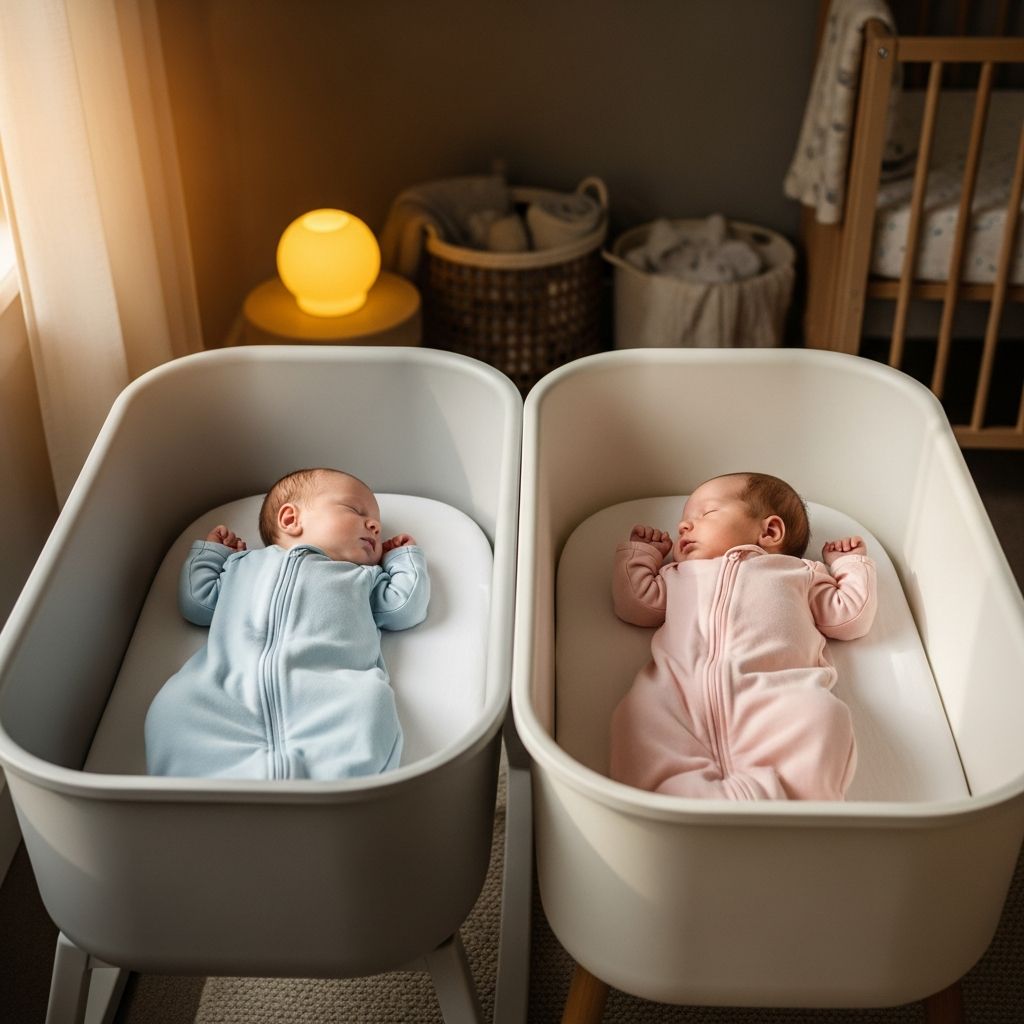
Another option is to purchase two matching single bassinets and place them side by side in the parents’ room.
This tends to appeal to families who:
- Have enough space to line up two slim bassinets or place one on each side of the bed.
- Like the flexibility of later moving one bassinet to another room for naps or solo sleeps.
- Want the option to separate babies more as their sleep patterns or medical needs diverge.
3. Play Yard With Twin Bassinet Attachments
Some large play yards can be transformed into twin sleep spaces by adding a compatible bassinet insert or twin “nursery center” on top.
This setup can work well if you:
- Value long-term use; once the bassinet phase ends, the play yard can serve as a safe play space or travel bed.
- Plan to move the unit around the home for daytime naps and overnight sleep.
- Want an all-in-one hub that may also include a changing station or storage pockets.
4. Bedside Sleeper or Swivel-Style Twin Bassinet
Some twin-specific units are designed to nestle close to the bed, sometimes with adjustable height, sliding under-bed legs, or swiveling tops.
These styles particularly benefit:
- Parents recovering from a C-section who cannot easily sit up, twist, or bend to reach low cribs.
- Families who want maximum nighttime proximity without bed-sharing.
- Caregivers who need to access both babies from a single seated position.
Key Features to Look For in Twin-Friendly Bassinets
Once you have a rough idea of your preferred setup, home in on the features that will actually make a difference during 2 a.m. feeds and diaper blowouts.
Safety and Certification
- Check that the bassinet meets current safety standards in your region and comes from a reputable manufacturer.
- Look for a stable base, secure locking mechanisms, and sturdy materials that do not wobble when nudged.
- Prefer breathable mesh sides or panels to promote airflow and visibility.
Space and Layout
- Measure the area next to your bed (length, width, and clearance under the bed if the legs tuck underneath).
- Consider walking paths; you should still be able to get out of bed safely without tripping over a wide base.
- Think beyond the bedroom—can the unit roll through doorways if you plan to move it?
Adjustability and Accessibility
- Height adjustment helps align the sleep surface with your mattress for easy reaches.
- Drop-down or compressible sides can dramatically reduce strain, especially post-surgery.
- Swiveling or rotating tops make it simpler to reach the farther twin without climbing over the nearer one.
Comfort and Practical Details
- Removable, washable mattress covers and sheets are crucial with two newborns.
- Built-in storage pockets can keep burp cloths, pacifiers, and spare onesies close at hand.
- Optional vibration, sounds, or soft lights can be helpful, but should remain adjustable and not replace consistent sleep routines.
Portability and Longevity
- Wheels or a compact fold make it easier to move the bassinet between rooms or take it for travel.
- Some systems convert from double bassinet to single large play yard, extending their useful life.
- Check weight limits and age recommendations to avoid outgrowing the product sooner than expected.
Comparing Popular Twin Sleep Approaches
The table below summarizes common bassinet strategies for twin families and how they stack up on a few key factors. It is meant as a quick decision aid, not a list of specific brands.
| Setup Type | Best For | Space Needs | Typical Cost Range | Notable Pros | Potential Drawbacks |
|---|---|---|---|---|---|
| Dedicated double bassinet | Parents wanting one central unit for both babies | Moderate; footprint often similar to a wide armchair | Mid to high | Compact, twin-specific design; both babies in view; often includes dividers and storage | Heavier and harder to move; less flexible once babies outgrow the bassinet stage |
| Two single bassinets | Families with wider rooms or different sleep areas | Higher; requires space for two separate frames | Mid to high (depending on model) | Highly flexible placement; can separate or reposition easily; each baby fully isolated | More surfaces to change and clean; higher total cost if you buy premium models |
| Play yard with twin bassinet insert | Parents wanting an all-in-one solution that grows with babies | Moderate to large footprint | Mid | Converts to play space later; often includes changing station and storage; travel-friendly | Higher sides can be awkward immediately after birth; may feel bulkier next to the bed |
| Bedside / swivel twin bassinet | C-section recovery, limited mobility, or very tight spaces | Moderate; base can slide under the bed but may be wide | High | Excellent access to both babies; minimal bending; ideal for frequent night feeds | Usually heavy; not ideal for frequent room-to-room moves; often pricier than standard options |
Planning Your Twin Bassinet Placement
Even the perfect bassinet can feel frustrating if it is awkwardly positioned. A few minutes of planning the room layout can dramatically improve how the first months feel.
Measure and Mock Up
- Measure your bed height, the distance from bed to wall, and door clearance.
- Use painter’s tape to outline where the bassinet or play yard will sit so you can test walking paths.
- Check that any drawers, closets, and doors can still open freely with the bassinet in place.
Think About Night Flow
Visualize a typical night: which side of the bed do you usually exit from, and where will you store diapers, wipes, and clean swaddles? Placing the bassinet near your usual exit point can reduce climbing and awkward maneuvers when you are half asleep.
If one partner is returning to work earlier or is a lighter sleeper, you may decide to place the bassinet closer to the primary nighttime caregiver’s side of the bed to limit disruptions.
Managing Noise, Light, and Different Sleep Personalities
Twins rarely sleep in perfect sync. One may be noisy while settling, while the other snoozes peacefully. Your bassinet choice can support how you manage these differences.
Responding When One Twin Wakes
- If your twins are in a double bassinet, gently shield the sleeping twin with your body or a dim nightlight directed away while you feed or change the waking baby.
- With two separate bassinets, you can pull one slightly farther away during rough nights without fully leaving the room.
- White noise placed safely away from the bassinets may help mask little grunts and squeaks so they disturb each other less.
Light and Temperature Considerations
Overhead lights are harsh and fully wake everyone up. Instead, use a very dim, warm-tone nightlight near the changing supplies so you can see enough to work while still signaling “nighttime” to both babies.
Twins share not just parents but also room conditions, so keep the room at a comfortable, steady temperature and dress each baby in a single layer of sleepwear plus a wearable blanket if needed—never loose blankets in the bassinet.
Budgeting for Twin Bassinets Without Regret
It is easy to feel pressure to buy the most fully loaded bassinet system on the market, especially when you are already anxious about managing two newborns. A more grounded approach is to match spending to how long and how intensely you expect to use the product.
Questions to Ask Before You Buy
- How long do we plan to room-share? If you expect to move twins to cribs by three to four months, a mid-range option may serve you just as well as a premium one.
- Will we travel frequently in the first year? If yes, a portable or play yard–based solution may stretch your dollars further.
- Can we borrow or buy secondhand from trusted friends while still following safety guidelines and replacing mattresses if needed?
Where Not to Cut Corners
- Do not ignore recalls or visible damage to frames, legs, or locking points.
- Always use the correct, firm mattress pad designed for that specific bassinet model.
- Do not improvise DIY attachments or add untested sleep accessories to save money; safety is non-negotiable.
Practical Tips for Daily Life With a Twin Bassinet
Once the bassinet is assembled and placed, the daily routines around it will determine how smoothly your nights go. Small systems and habits prevent chaos when you are sleep-deprived.
Set Up a Simple Nighttime Station
- Keep a small bin or organizer nearby stocked with diapers, wipes, diaper cream, clean onesies, and extra swaddles or sleep sacks.
- Place burp cloths within easy reach on both sides so you can grab one without fully turning away from the babies.
- Use a lidded trash can or diaper pail close enough for quick changes but far enough that curious hands will not reach it later.
Tag-Team Strategies for Partners
Many twin parents find it helpful to assign each adult a “primary” baby at night for feeds and diaper duty, at least temporarily. This simple rule can reduce confusion and resentment when everyone is exhausted.
Another strategy is to alternate nights rather than individual wakings: one caregiver handles most of one night’s disruptions while the other focuses on getting a longer stretch of sleep, then swap roles the next night.
Frequently Asked Questions About Twin Bassinets
Can my twins safely share the same bassinet mattress?
Current safety guidance recommends that each baby sleep on a separate surface. In practice, this means choosing either two bassinets or a twin-specific product that clearly divides the sleep area into two spaces, even if they share a single frame.
How long can twins stay in a bassinet?
Most bassinets are designed for use until babies reach a specific weight limit or show signs of rolling, pushing up, or sitting, which often happens around three to six months. With twins, one baby may hit these milestones earlier, so plan to transition both when the more active twin outgrows the bassinet stage.
Is a twin bassinet really necessary, or can we go straight to cribs?
Many families successfully use full-size cribs from day one, even with twins. However, a bassinet or bedside sleeper can make the early weeks easier by keeping both babies closer to the parents, especially during nighttime feeds and postpartum recovery.
What about secondhand twin bassinets—is that safe?
Buying used from a trusted source can be reasonable if the item has no recalls, no structural damage, and is assembled according to the manufacturer’s instructions. Always purchase a new, correctly sized mattress and avoid any product that is missing parts or has been modified.
Will a bassinet with motion or sound create bad habits?
Features like gentle vibration, rocking, or white noise can be helpful tools, not guaranteed problems. The key is to use them as temporary support, not as the only way your babies ever fall asleep, and to gradually reduce reliance on them as your twins mature.
Final Thoughts: Choose the Bassinet That Fits Your Reality
The best bassinet for twins is not just the one with the most features; it is the one that aligns with your space, your budget, your bodies, and your tolerance for middle-of-the-night gymnastics. For some families that means a swivel bedside unit, for others a twin play yard, and for still others two simple standalone bassinets.
Twins bring built-in unpredictability, so favor flexibility, safety, and ease of use over trends. A well-chosen bassinet setup will not make every night perfect, but it can make the chaos more manageable and give your growing family a calmer start.