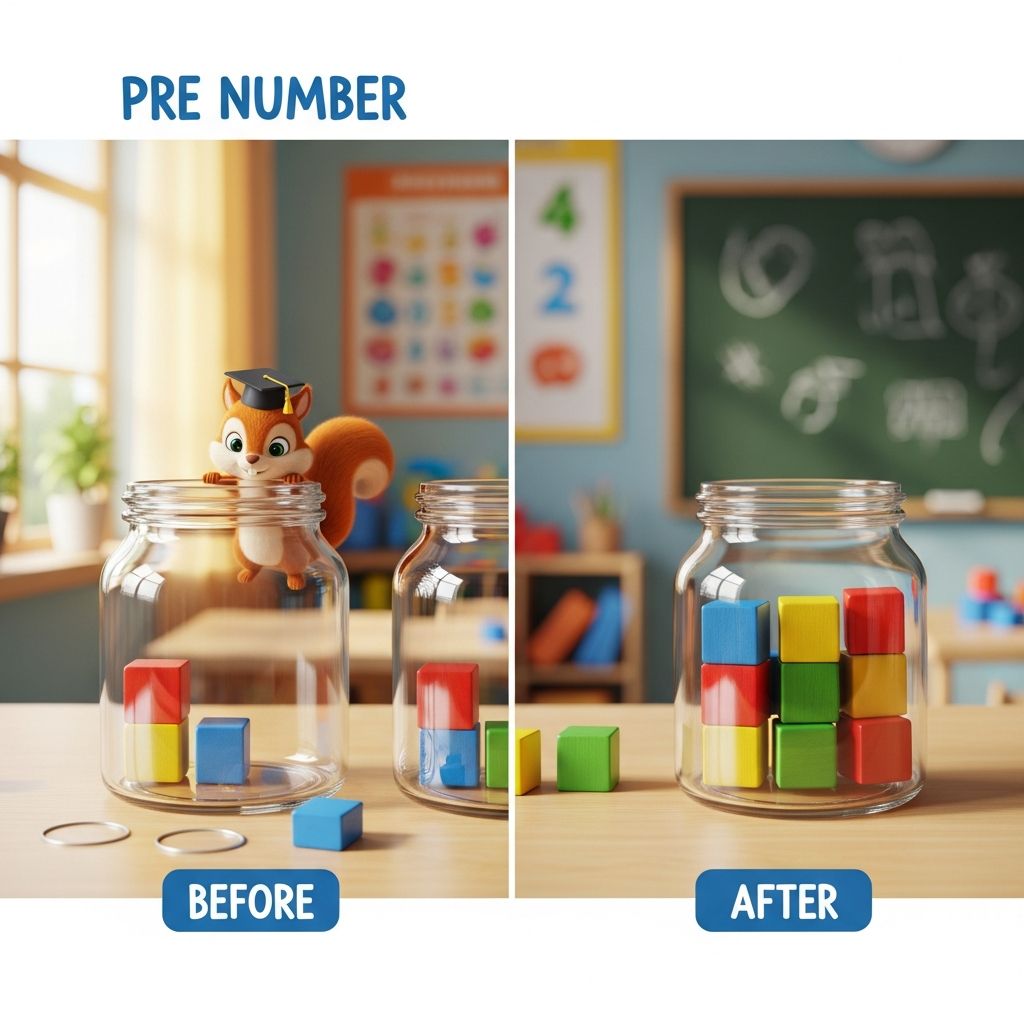
Understanding what comes before and what comes after a number is a key early math milestone that prepares children for counting, ordering, and basic arithmetic. The before-and-after prenumber concept helps children see numbers as part of a sequence rather than as isolated symbols.
This guide explains what the prenumber concept is, why it matters, when to introduce it, and how to teach it using concrete activities, visuals, games, and everyday situations.
What Is the Before and After Prenumber Concept?
The before and after prenumber concept refers to a child’s ability to identify the number that comes immediately earlier (before) or immediately later (after) in a sequence. For example, given 6, a child learns that 5 comes before and 7 comes after.
- “Before” means the number that appears just earlier in the counting sequence.
- “After” means the number that appears just later in the counting sequence.
- The concept can also extend to understanding numbers that come between two numbers, although this is often introduced slightly later.
These ideas are called “prenumber” because they support early number sense that later leads into formal operations like addition, subtraction, and comparison.
Why Before and After Matter in Early Math
Before-and-after understanding is more than a memorization exercise. It builds a mental number line and reinforces that numbers follow a consistent, predictable order. When children grasp this order, they are better prepared for more complex concepts.
- It supports forward counting and backward counting, both of which are needed for basic arithmetic.
- It strengthens number sense, including understanding of quantity and relative size (e.g., 8 is greater than 7 because it comes after 7).
- It lays the groundwork for recognizing patterns and sequences, skills that will appear repeatedly in elementary math.
When Children Are Ready for the Concept
Most children are ready to learn before and after numbers once they can confidently count in order, usually within the range of 1–10 or 1–20. They should recognize number symbols and have some experience matching spoken numbers to written digits.
Readiness signs include:
- Counting objects one by one without skipping consistently.
- Identifying written numerals, at least from 1 to 10.
- Answering simple questions like “What number is this?” or “Can you count from 1 to 10?”
If a child struggles deeply with basic counting, focus on that foundation first before expecting success with before-and-after tasks.
Key Skills Involved in Before and After
Teaching the prenumber concept taps into several overlapping skills. Being aware of them helps adults break the learning into manageable steps.
- Sequential counting: Saying numbers in the correct order.
- Symbol recognition: Matching spoken numbers to their written forms.
- Directional thinking: Moving forward (for after) and backward (for before) along a mental number line.
- Language comprehension: Understanding positional words like “before,” “after,” “next,” “previous,” and “between.”
Because these skills develop at different speeds, patient repetition and multiple representations are essential.
Using Number Lines to Teach Before and After
A number line is one of the most effective tools for teaching before and after, because it makes the order of numbers visible and concrete. Children see that each number has neighbors and a fixed place in the row.
Simple Number Line Activities
- Display a horizontal number line from 1 to 10 or 1 to 20 at the child’s eye level.
- Point to a number and ask, “What number comes before this?” and “What number comes after this?”
- Cover a number with a sticky note and invite the child to guess what is hidden, using the numbers on each side as clues.
- Have children place a marker or clothespin on a number you call out, then slide it one step left (before) or right (after) when prompted.
Start with a small range of numbers to build confidence. Later, extend to larger ranges and even vertical number lines or floor lines made from tape.
Teaching Before and After with Manipulatives
Concrete objects help children “feel” the idea of order and position. Blocks, counters, toy cars, or even crayons can stand in for numbers during hands-on activities.
Sample Manipulative Activities
- Place a row of numbered cards on the table and ask the child to line up counters on each card. Then remove one counter and ask which one is missing and where it belongs.
- Use colored blocks labeled with numbers. Build a tower in order and ask “What block is before 4?” or “What block is after 6?”
- Arrange toy cars with numbers on them in a “traffic line,” then move one car and ask the child to restore it to its correct position.
Manipulatives reduce abstraction and give children something real to touch and rearrange, making the concept more intuitive.
Connecting Before and After to Real-Life Situations
Real-life examples make the prenumber concept meaningful and memorable. Children naturally notice order when waiting in lines or looking at pages in a book.
- Use lining up at the door: Ask, “Who is before you?” and “Who is after you?”
- Point out page numbers in a story: “This is page 5. Which page is before it? Which is after it?”
- Refer to calendar dates: “Today is the 10th. What day comes before the 10th? What day comes after?”
- Talk about house numbers or seat numbers when traveling or visiting new places.
Such moments embed math into daily routines and show that numbers and positions matter beyond worksheets.
Step-by-Step Progression for Teaching
Breaking learning into stages helps prevent confusion and frustration. A simple progression might move from oral practice to visual practice and then to symbolic tasks.
| Stage | Focus | Example Activities |
|---|---|---|
| 1. Oral counting | Fluent forward counting within a small range | Chanting numbers 1–10, clapping for each number, counting steps while walking |
| 2. Forward after | Identifying what comes after a given number | “What comes after 4?” using number lines, songs, and call-and-response games |
| 3. Backward before | Identifying what comes before a number | Backward counting from 10, guessing the number that comes before a card you show |
| 4. Mixed practice | Switching flexibly between before and after | Quick-fire questions, card games, and simple worksheets with missing numbers |
| 5. Extension | Working with larger ranges and between numbers | Finding the number between two others, working up to 50 or 100 in small steps |
Children may move back and forth between stages as needed. The goal is not speed but comfort and understanding.
Common Difficulties and How to Help
Several predictable challenges appear when children first work with before and after numbers. Recognizing them helps adults respond constructively.
- Confusing the words: “Before” and “after” sound similar, and children may mix them up.
- Struggling with backward thinking: After is often easier because it fits natural counting habits, while before requires moving in reverse.
- Skipping numbers: Children may jump over numbers when counting quickly.
Support strategies include slowing the pace, pointing to each number while counting, using gestures (e.g., left for before, right for after), and revisiting smaller number ranges until mastery is clear.
Games and Activities to Reinforce Learning
Playful practice keeps children engaged and willing to repeat the same concept in different forms. Games can be informal and require little preparation.
Ideas for Before-and-After Games
- Number hop: Place number cards on the floor. Call out a number and an instruction (“jump to the number after 6”) and let the child hop to the correct card.
- Spin and move: Use a spinner or dice to generate a number, then ask what comes before or after. Children can move a game piece on a simple board numbered in order.
- Flash-card challenge: Quickly show a card with a number and ask “before or after?” questions, giving points or stickers for correct answers.
- Missing neighbor: Show three-number sequences with the middle or one side missing (e.g., __, 5, 6 or 7, __, 9) and have the child fill the gap.
Short, frequent bursts of practice—five to ten minutes at a time—are often more effective than long, infrequent sessions.
Integrating Simple Worksheets and Written Tasks
Once children are comfortable with oral and hands-on tasks, written practice can help reinforce the concept and prepare them for classroom expectations. Worksheets should remain clear, uncluttered, and age-appropriate.
- Use exercises where children circle which number comes before or after a given number.
- Create fill-in-the-blank activities such as “6, 7, __” or “__, 9, 10.”
- Include matching tasks where children draw lines between numbers and their before/after partners.
Encourage children to refer to a posted number line rather than guessing; this supports independence and self-checking.
Adapting for Different Ages and Levels
The same basic idea of before and after can be used from preschool through early primary grades by adjusting the number range and level of abstraction. Younger children can work with objects and small numbers, while older children can handle larger numbers and more symbolic tasks.
- For preschoolers, focus on 1–5 or 1–10 using concrete objects and simple visuals.
- For kindergartners, extend to 1–20, use number lines more often, and start mixing before and after questions.
- For early primary, increase the range to 50 or 100, incorporate between numbers, and connect before-and-after thinking to addition and subtraction.
Always monitor the child’s confidence. If frustration rises, step back to a smaller range or more concrete materials.
Linking Before and After to Addition and Subtraction
Once children are secure with before and after, it becomes easier to show how counting forward and backward relates to basic operations. Moving **one step after** a number resembles adding one, while moving **one step before** resembles subtracting one.
- Show that “after 7 is 8” is similar to “7 plus 1 equals 8.”
- Show that “before 6 is 5” is similar to “6 minus 1 equals 5.”
- Use a number line to visually represent these tiny moves before introducing symbolic equations.
This connection helps children see arithmetic as movement on a number line, not just as memorized facts.
Frequently Asked Questions (FAQs)
1. At what age should children learn the before and after concept?
Many children start exploring before and after numbers around ages four to six, once they have a stable grasp of counting and can recognize basic numerals. There is no strict age limit, and the focus should be on readiness rather than rushing.
2. What if a child can say numbers in order but cannot answer before-and-after questions?
This situation is common. Counting by rote and understanding number positions are related but different skills. Support the child with visuals like number lines, model how to count up or down from a given number, and give time for the new skill to develop.
3. Is it important to teach “between” at the same time as before and after?
Between is a natural extension of before and after, but it can be introduced slightly later. Many children benefit from mastering simple before and after questions first, then moving on to finding the number that lies between two given numbers.
4. How long does it usually take for children to master this concept?
Mastery varies widely. Some children grasp the idea in a few sessions, while others need weeks of short, repeated practice. Consistency, patience, and varied activities are more important than speed.
5. What should parents do if their child becomes frustrated?
If frustration rises, simplify the task: reduce the number range, return to hands-on objects, or shift to a game-like activity. Encouragement, praise for effort, and a relaxed atmosphere help children stay open to learning.
Final Thoughts on Building Strong Prenumber Skills
Teaching the before and after prenumber concept gives children a powerful mental framework for understanding how numbers relate to one another. With number lines, manipulatives, real-life examples, and playful practice, adults can turn an abstract idea into something concrete and enjoyable.
By moving step by step and respecting each child’s pace, parents and teachers help lay the foundation for confident, flexible mathematical thinking that will support learning for years to come.