The beep test – also called the bleep test or 20-meter shuttle run – looks simple on paper, but anyone who has pushed past a few levels knows it can leave your lungs burning and your legs shaking.
Used worldwide by schools, sports teams, and uniformed services, the test is designed to push your cardiovascular system to its limit in a very short time.
What Exactly Is the Beep Test?
The beep test is a progressive running assessment where you shuttle back and forth over a 20-meter distance, trying to reach each line before a recorded beep sounds.
As the test continues, the beeps get closer together, forcing you to run faster each minute until you can no longer keep up with the pace.
Key Features of the Test
- Distance: 20 meters between two lines marked on the ground.
- Format: Continuous back-and-forth shuttles in sync with audio beeps.
- Intensity: Speed starts low and increases in small steps every minute or “level.”
- End point: You stop when you miss the line twice in a row or choose to quit from exhaustion.
What the Beep Test Really Measures
The beep test was originally created as a field-based way to estimate maximal oxygen uptake, often referred to as VO2 max – essentially, how efficiently your body can use oxygen during intense exercise.
Because it progressively ramps up intensity, it challenges both your heart and lungs as well as your legs’ ability to repeatedly accelerate, decelerate, and change direction.
Systems Under Stress
- Cardiovascular system: Your heart rate climbs rapidly as each level shortens the time between shuttles.
- Respiratory system: Lungs work harder to deliver oxygen as running speed increases and recovery time disappears.
- Muscular endurance: Your legs absorb repeated braking and turning forces over short intervals.
- Mental toughness: Discomfort builds quickly, forcing a decision between stopping and pushing for one more level.
Why the Beep Test Feels So Brutal
The test feels worse than a steady jog because the intensity increases in discrete steps while the recovery never improves, trapping you in a narrow corridor of rising fatigue.
You are also constantly turning at the 20-meter lines, which adds eccentric muscle load and joint stress that you would not experience in straight-line running at the same speed.
Common Physical Reactions
- Burning lungs from rapid breathing at high intensities.
- Heavy, jelly-like legs due to accumulated fatigue and repeated accelerations.
- Elevated heart rate that can stay near maximum by the final levels.
- Lightheadedness or nausea if pacing, hydration, or warm-up are poor.
Step-by-Step: How the Beep Test Is Run
Most standard protocols follow a similar structure, even if the branding or audio tracks differ slightly between organizations.
Understanding the format before test day can massively reduce anxiety and improve your pacing choices.
Typical Test Procedure
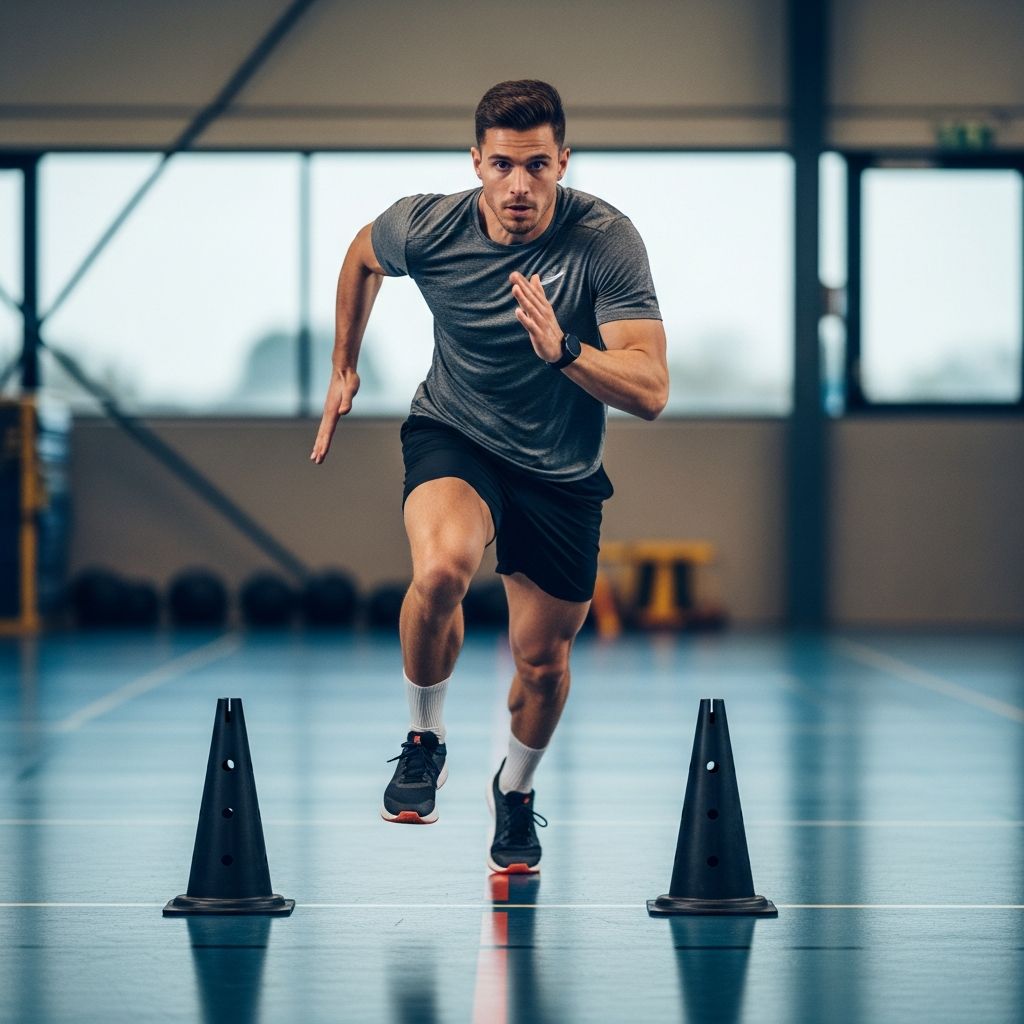
- Two lines are marked 20 meters apart with cones or tape.
- Participants line up behind one line and start when the initial beep sounds.
- Each beep signals that you must have reached the opposite line, turn, and wait or immediately go again if the next beep is close.
- Every minute, the level increases and the time between beeps decreases, requiring higher running speed.
- Missing the line before a beep usually results in a warning; two consecutive misses normally mean the test is over for you.
- Your final level and shuttle count are recorded as your score.
How Scores Are Recorded
Scores are usually written in a level.shuttle format, such as 7.5 or 12.3, which indicates the level reached and the number of shuttles completed in that level.
Some organizations may convert this into estimated VO2 max or categorize results as poor, average, or excellent based on age and gender.
Sample Beep Test Levels and Speeds
The table below gives an approximate picture of how speed ramps up across levels in a commonly used 20-meter test protocol. Exact values can vary slightly between audio versions.
This helps illustrate why early levels feel easy but later stages become overwhelmingly intense in just a few minutes.
| Level | Approx. Speed (km/h) | Shuttles in Level | Approx. Cumulative Time |
|---|---|---|---|
| 1 | 8.5 | 7–8 | ~1 minute |
| 5 | 10.5 | ~9 | ~5 minutes |
| 8 | 12.0 | ~9 | ~8 minutes |
| 12 | 14.0 | ~9 | ~12 minutes |
| 15+ | 15.5+ | ~9 | 13–15+ minutes |
Who Uses the Beep Test and Why
Because it needs only a small space, audio track, and a few cones, the beep test is popular with schools, team sports, and military or emergency service recruiters.
Coaches and trainers also use it to track changes in aerobic fitness over a season, comparing scores from different dates rather than obsessing over VO2 max estimates.
Common Settings
- School physical education classes assessing general cardio fitness.
- Team sports such as football, rugby, and hockey where repeated running and turning are important.
- Police, fire, and military selection processes with minimum score requirements.
- Gyms and training groups using it as a periodic benchmark test.
Is the Beep Test Safe?
For healthy individuals who warm up properly and stop when they reach genuine fatigue, the beep test is generally considered safe and widely accepted in educational and professional settings.
However, because it pushes you near your maximal capacity, people with cardiovascular, respiratory, or joint problems should get medical clearance and may need alternative assessments.
Practical Safety Tips
- Get a health check if you have a history of heart, lung, or serious joint issues.
- Warm up for at least 10–15 minutes with light jogging, mobility drills, and a few short accelerations.
- Stop if you feel chest pain, severe dizziness, or unusual shortness of breath.
- Avoid maximal effort testing when ill, sleep-deprived, or severely dehydrated.
Training So the Test Does Not Destroy You
You do not need to grind through endless full beep tests to improve your score; targeted conditioning and movement practice are far more efficient and less draining.
A good approach combines aerobic base work, interval training, change-of-direction drills, and specific pacing practice.
Foundational Aerobic Work
- 2–3 sessions per week of 20–45 minutes of steady jogging, cycling, or other cardio at a moderate intensity.
- Goal: Build heart and lung capacity so higher levels feel less shocking.
Short, Sharp Intervals
- 1–2 weekly sessions of high-intensity intervals, such as 30–60 seconds fast running followed by equal or slightly longer recovery.
- Repeat for 6–10 rounds, depending on your fitness and experience.
- These mimic the rising intensity and incomplete recoveries of the test.
Change-of-Direction and Turn Technique
- Practice 10–20 meter shuttle runs, focusing on low, controlled turns instead of wild lunges.
- Use small, quick steps into the line and drive out using your hips, not just your knees.
- Efficient turning saves energy and reduces stress on ankles and knees.
Beep-Test-Specific Rehearsals
Every few weeks, perform a partial beep test – for example, stopping at level 6–8 – so you can experience the rhythm and work on pacing without exhausting yourself.
This familiarization effect is known to improve test performance because you are less surprised by the increasing speed and turning pattern.
Smart Strategies on Test Day
How you pace, turn, and breathe during the test can make the difference between dropping out early and squeezing out an extra level or two.
A few small tactical changes can dramatically reduce how harsh the test feels on your lungs and legs.
Practical Pacing and Technique Tips
- Start relaxed: The first levels are intentionally slow, so avoid sprinting and save energy for later.
- Arrive just before the line: You do not gain anything by standing and waiting; time your steps so you hit the line as the beep sounds.
- Use efficient turns: Keep your center of gravity low, plant one foot near the line, and pivot smoothly instead of making big looping turns.
- Control breathing: Inhale and exhale rhythmically rather than gasping only at the lines; this helps manage the feeling of burning lungs.
- Know your limit: Plan a realistic target level based on training so you are less likely to misjudge your effort early.
Using Beep Test Scores the Right Way
While some charts convert levels into VO2 max estimates, these calculations are only approximations and can vary based on protocol and individual differences.
The most useful way to use the beep test is to compare your own scores over time under similar conditions, rather than obsess over exact VO2 numbers.
Tracking Progress
- Test every 6–8 weeks under similar weather, surface, footwear, and time-of-day conditions.
- Record level, shuttle, and any notes on how you felt or what training you did recently.
- Look for upward trends of at least half a level to one level over a training cycle.
Beep Test Myths and Misconceptions
Despite its popularity, the beep test is often misunderstood or used in ways that create unnecessary fear and discomfort.
Separating myth from reality helps you treat it as a training tool instead of a one-off torture session.
Common Myths
- Myth: It is the best test for everyone. In reality, it favors those used to running and turning; other tests may be better for different populations.
- Myth: You must go to absolute collapse. Many programs accept scores achieved before true maximal exhaustion, especially in youth or general fitness settings.
- Myth: Your score defines your athletic potential. It is only one snapshot of aerobic and movement capacity, not a judgment on overall ability or worth.
FAQs About the Beep Test
What is a good beep test score?
There is no single “good” score because results depend on age, sex, and training background, but many sources note that healthy adults often fall somewhere around levels 7–8, while trained athletes commonly exceed that.
Recruitment standards for professions such as policing or firefighting may specify minimum levels that are higher or lower depending on job demands.
How often should I do the beep test?
Because it is demanding, most people only need to perform the full test every 6–8 weeks, using lighter interval sessions in between to build fitness.
More frequent testing can lead to fatigue, reduced training quality, and an increased risk of minor injury or burnout.
Can beginners attempt the beep test?
Beginners can attempt a modified version by stopping at an earlier level or using walk-jog intervals, but should prioritize building a base of regular walking or light jogging first.
Those with medical conditions or long periods of inactivity should seek professional guidance before trying maximal or near-maximal efforts.
Is the beep test better than a treadmill VO2 test?
Laboratory treadmill or cycle tests with gas analysis are more precise for measuring VO2 max, but they require expensive equipment and trained staff.
The beep test trades some accuracy for convenience, allowing large groups to be tested quickly with minimal resources.
Can I improve my beep test score without running more?
Cross-training such as cycling, rowing, or swimming can improve general cardiovascular fitness, which supports better beep test performance, especially if you are currently deconditioned.
However, because the test involves running, turning, and braking, some specific shuttle running and technique work is almost always needed for meaningful improvement.
Turning a Tough Test Into a Useful Tool
The beep test can feel like a lung- and leg-destroying ordeal when taken cold, but with structured training, smart pacing, and respect for safety, it becomes a powerful indicator of progress rather than a punishment.
Used thoughtfully, it can motivate you to build aerobic capacity, sharpen your change-of-direction skills, and develop mental resilience that carries over to sports and everyday life.