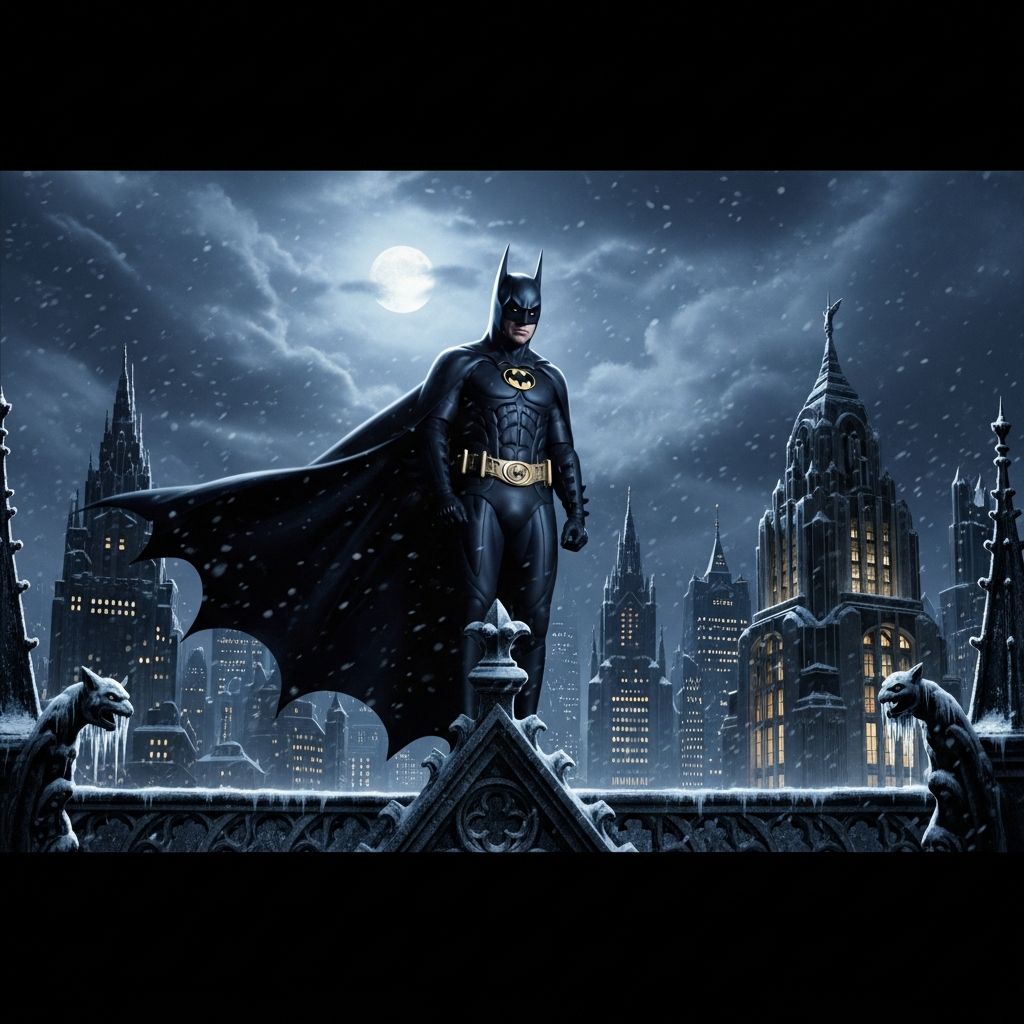
When Batman Returns arrived in 1992, it was sold as a bigger, louder follow-up to 1989’s box office smash Batman. Yet over time, the sequel has become something very different: a moody, strange, and deeply personal film that feels less like a standard superhero blockbuster and more like a twisted holiday fable about lonely monsters in capes and claws.
Rather than simply repeating the first film’s formula, director Tim Burton leaned further into his own obsessions: gothic architecture, misfit outsiders, tragic romance, and dark humor. The result is a movie that alienated some audiences on release but has steadily evolved into a cult favorite often argued to be artistically bolder—and for many viewers, simply better—than its predecessor.1
The Evolution from Blockbuster to Cult Classic
At the time of its release, Batman Returns was a commercial success but also a source of controversy. Its bleak tone, violent imagery, and overt sexual innuendo prompted backlash from parents and sponsors who expected a more family-friendly brand extension of Gotham City.2 Over the years, however, the same qualities that unsettled studio marketers have become the film’s key strengths.
- Not a repeat of 1989’s formula: Instead of centering on Batman’s origin or a single flamboyant villain, the film focuses on a fraught triangle between Penguin, Catwoman, and a corrupt businessman, Max Shreck.
- Gothic tone over comic-book gloss: The movie doubles down on expressionistic lighting, snow-drenched streets, and towering sets that look like a nightmare sketch of an old European city.
- Slow-burn appreciation: As superhero films became more standardized and quippy in later decades, Batman Returns began to stand out as something singular—uneasy, emotionally jagged, and defiantly weird.
Film critics looking back on the movie have increasingly framed it as one of the most distinctive studio comic-book films ever made, particularly for the way it foregrounds psychological damage and social exclusion over straightforward heroism.1
Gotham as a Haunted Stage: Style, Sets, and Snow
Visually, Batman Returns abandons the pulp-art deco vibe of the first film for a more exaggerated, almost theatrical version of Gotham City. Much of the production was built as large-scale sets on soundstages, giving Burton near-total control over the look and atmosphere.2
- Endless winter: Setting the story during Christmas creates a stark contrast between holiday lights and moral darkness. Snow falls on every rooftop ambush and alleyway confrontation, turning Gotham into a black-and-white snow globe.
- Monumental architecture: The city is dominated by grotesque statues, narrow alleys, and towering corporate buildings that dwarf the people who move among them, emphasizing how tiny individuals are against systems of power.
- Burton’s signature touch: Twisted metal, crooked lines, and theatrical lighting echo the director’s work on films like Edward Scissorhands, transforming Gotham into a physical representation of its characters’ fractured inner lives.2
The design choices don’t just decorate the plot; they are the plot. Gotham’s icy plazas and looming skyscrapers mirror the movie’s emotional terrain: cold, isolating, and built on foundations of hidden corruption.
Three Misfits, One City: Batman, Penguin, and Catwoman
More than heroic triumph, Batman Returns is about three damaged people wrestling with identity, anger, and the impossibility of belonging. Rather than simple good-versus-evil, the film plays like a tragic ensemble piece where everyone wears a mask and no one gets a clean ending.
Batman: The Hero Who Can’t Go Home
Michael Keaton’s Batman is quieter and more withdrawn than in the first movie. He speaks less, broods more, and seems most alive only when he puts on the cowl. Instead of centering Bruce Wayne’s public persona, the sequel treats him as a ghost in his own mansion, waiting for the Bat-Signal like an addict waits for the next hit of purpose.
- Alienation as default: Bruce’s wealth isolates him physically and emotionally. The cavernous Wayne Manor feels more like a museum than a home, reinforcing how small and lonely he is inside his own privilege.
- Romantic conflict: His relationship with Selina Kyle isn’t just a love story—it’s a mirror. Each recognizes in the other a double life, a trauma-driven obsession, and the knowledge that any chance at normal happiness might destroy the fragile balance keeping them functional.
- A reactive protagonist: The film allows Batman to be overshadowed by his foes, which some fans see as a flaw. Yet this marginalization underlines a key point: this Gotham does not revolve around the hero; it’s a battleground of competing wounded egos.
Penguin: A Villain Built from Rejection
The Penguin is reimagined not as a dapper mob boss but as a literal outcast—an abandoned child raised in the sewers who crawls back to the surface seeking power and recognition. His grotesque appearance and theatrical bile embody Gotham’s cruelty toward anyone who doesn’t fit its narrow standards of acceptability.3
| Aspect | Traditional Penguin | Penguin in Batman Returns |
|---|---|---|
| Social Role | High-society criminal, refined gangster | Abandoned outsider turned populist figurehead |
| Primary Motivation | Wealth and respectability | Revenge, recognition, and distorted belonging |
| Symbolism | Corrupt elite | Society’s discarded and deformed underclass |
Burton emphasizes Penguin’s status as a mirror of Gotham’s conscience: repulsive on the surface, shaped by cruelty, and yearning for acknowledgement even as he plans the city’s destruction.
Catwoman: Trauma, Rebirth, and Refusal
Selina Kyle’s transformation into Catwoman is one of the most enduring elements of the film. After surviving a violent attack, she reinvents herself as a stitched-together embodiment of rage and self-assertion. Her leather suit, hand-sewn and increasingly frayed, visually tracks how her newfound power is always on the verge of coming apart.3
- From compliance to defiance: Selina begins as an overworked, overlooked assistant in a male-dominated corporate hierarchy. Catwoman is her answer to that erasure: flamboyant, confrontational, and uninterested in apologizing.
- Conflicted morality: She will save a woman from a mugger and then chastise her for waiting for a hero. Her ethics are personal, not systemic; she’s punishing the world that tried to kill her.
- Romantic paradox: With Bruce, she shares a genuine bond. With Batman, she shares a battlefield. The tragedy is that both pairs are the same people, and neither side can fully reconcile love with vengeance.
Catwoman refuses tidy closure. Rather than returning to a secret identity or accepting redemption through romance, she chooses a path that leaves her morally ambiguous but emotionally honest.
Power, Image, and Corruption: The Film’s Political Undercurrent
Running through the story is an anxious satire about politics, media manipulation, and corporate influence—issues that remain deeply relevant. The film’s non-costumed villain, industrialist Max Shreck, embodies the idea that the most dangerous people in Gotham don’t wear masks at all.
- Corporate villainy: Shreck aims to exploit Gotham’s energy grid under the guise of public service, a reflection of real-world anxieties about private power and deregulated industries that were highly debated in late-20th-century politics.4
- Manufactured candidates: Shreck’s attempt to turn Penguin into a populist mayoral candidate highlights how charisma, media spectacle, and narrative framing can outweigh competence or integrity in electoral politics.
- Media as amplifier: News broadcasts and staged events in the film show how public perception can be engineered, echoing concerns scholars have raised about media concentration and agenda-setting in modern democracies.4
These themes give Batman Returns a bitter edge: crime in Gotham isn’t just about costumed robbers; it’s about structural exploitation disguised as progress.
Why Many Viewers Prefer It to the 1989 Batman
Comparisons between Batman (1989) and Batman Returns are inevitable. While the first film is often praised for Jack Nicholson’s Joker and the novelty of a serious Batman adaptation, the sequel has earned admiration for taking bigger creative risks.1
- More cohesive mood: Where the original juggles pulp adventure with crime drama, the sequel presents a more unified tone—a dark fairy tale set in a snowbound metropolis.
- Richer character dynamics: Instead of one flamboyant villain, the sequel features intersecting arcs of three damaged leads whose goals overlap, conflict, and intertwine.
- Greater directorial imprint: The sequel feels unmistakably like a Tim Burton film, less constrained by the need to prove Batman can work as a movie and more interested in exploring obsession, duality, and alienation.
For some viewers, this makes Batman Returns less accessible than the original. For others, it’s precisely why the film has aged so intriguingly, standing out from the more formula-driven superhero movies that followed in the 1990s and 2000s.
Legacy in the Age of Modern Superheroes
In an era dominated by shared universes, crossovers, and post-credit teases, Batman Returns looks almost radical. It does not set up sequels, it allows its characters to end in unresolved states, and it never pauses to reassure the audience with easy moral victories.
- Against the grain of franchise logic: Contemporary superhero films often prioritize continuity and tonal consistency across multiple entries. Burton’s film instead feels like a closed, self-contained nightmare.
- Influence on later interpretations: The emphasis on Batman as a psychologically tormented figure surfaced more explicitly in later works such as Christopher Nolan’s trilogy and various graphic novels that foreground his mental and moral strain.1
- Enduring cult appeal: The movie’s mix of gothic melodrama, bleak humor, and unapologetic weirdness continues to attract audiences who want their comic-book adaptations to feel idiosyncratic rather than algorithmic.
Far from being just a darker sequel, Batman Returns has become a reference point in discussions about how flexible superhero cinema can be when a director’s voice is allowed to take the lead.
Frequently Asked Questions
Is Batman Returns suitable for children?
Many parents in the early 1990s found the film too dark and sexually charged for young children, especially compared with typical family-oriented superhero marketing of the time.2 Today, it is often recommended more for teens and adults who can process its violent imagery and complex themes.
Why is Batman less central than the villains in this film?The narrative is structured as an ensemble piece, giving substantial emotional weight to Penguin and Catwoman. This shifts Batman from a dominating protagonist to one part of a tragic triangle, emphasizing themes of duality and loneliness rather than straightforward heroism.
Q: Does Batman Returns follow the comic books closely?
The film borrows names and broad archetypes from the comics but reimagines many details, particularly Penguin’s origin and Catwoman’s supernatural-tinged rebirth. This creative license has been both criticized by purists and praised by those who see it as a bold reinterpretation.
How does Batman Returns compare to modern superhero films?Compared with contemporary franchises, Batman Returns is slower, moodier, and more self-contained. It focuses less on world-building and more on psychological symbolism, making it feel closer to a stylized art film than to the interconnected blockbusters that dominate the genre now.
Q: Is Batman Returns considered a Christmas movie?
Because the entire story takes place during the Christmas season and repeatedly uses holiday imagery as a counterpoint to its bleak narrative, many viewers now treat it as an unconventional Christmas film—much like other dark seasonal favorites that contrast festive decor with grim subject matter.
References
- Retrospective Review: Batman Returns (1992) — Elving’s Musings. 2022-03-04. https://elvingsmusings.wordpress.com/2022/03/04/retrospective-review-batman-returns-1992/
- The Art of Batman Returns (1992): a retrospective movie review — RL Terry ReelView. 2016-08-05. https://rlterryreelview.com/2016/08/05/batmanreturns/
- Special Review: Batman Returns – Villainy of Biblical Proportion — The Viewer’s Commentary. 2012-04-06. https://viewerscommentary.com/2012/04/06/special-review-batman-returns-villainy-of-biblical-proportion/
- Batman Returns — Reelviews Movie Reviews. 1992-06-19 (review date). https://www.reelviews.net/reelviews/batman-returns