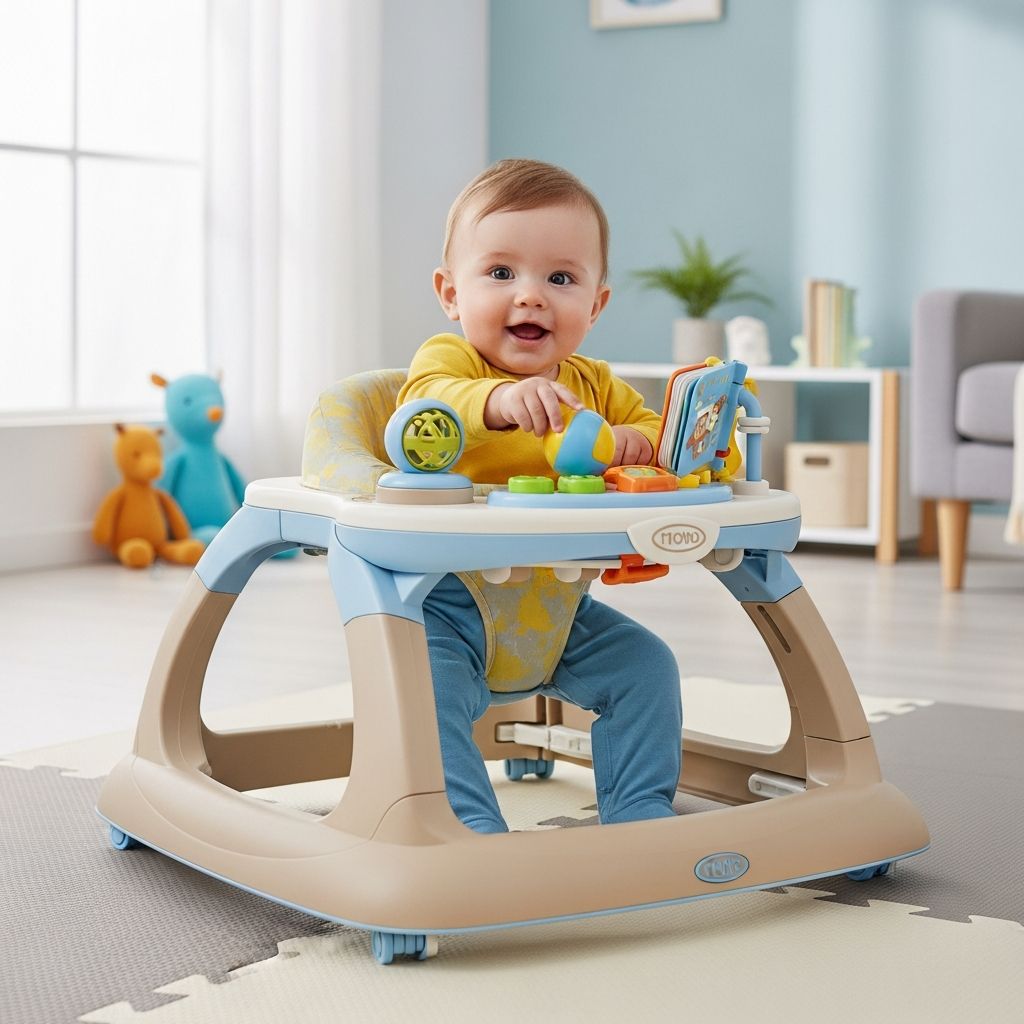
Once babies start pulling to stand and cruising along furniture, many caregivers begin wondering if a baby walker is the right tool to support those first steps. Walkers can look fun and convenient, but they also come with important safety considerations and developmental questions that parents need to understand before buying.
This guide explains what baby walkers do, the different styles on the market, what experts say about their safety, and how to choose safer alternatives or use walkers more thoughtfully if you decide to have one in your home.
Understanding What a Baby Walker Really Is
People use the term “baby walker” to describe several different products. Knowing the difference helps you compare options more clearly.
| Type | How It Works | Age Typically Used* | Key Considerations |
|---|---|---|---|
| Traditional sit-in walker | Baby sits in a suspended seat within a wheeled frame and pushes with their feet to move. | Roughly 4–10 months (once baby can hold head up) | Associated with the highest injury risk; can move quickly and reach hazards. |
| Push / walk-behind walker | Baby stands behind and pushes a stable frame or toy cart as they walk. | Usually 9+ months, when pulling to stand and cruising. | Allows natural practice of walking; still needs close supervision. |
| Stationary activity center | Baby sits or stands inside a fixed base with toys but no wheels. | Often 4–12 months, depending on design. | Recommended by pediatric groups as safer alternatives to wheeled walkers. |
*Always follow the manufacturer’s weight and developmental guidelines; ages are general ranges only.
What Pediatric Experts Say About Baby Walkers
Before choosing any walker, it is important to understand the current safety and health recommendations.
- The American Academy of Pediatrics (AAP) has called for a ban on traditional wheeled sit-in walkers because of the risk of serious injuries such as falls down stairs, burns, and access to dangerous objects.
- Canada has already banned the sale, importation, and advertisement of baby walkers due to these risks.
- Injuries can occur even with supervision because babies can suddenly move much faster and farther than expected, reaching stoves, heaters, cords, or stairs before adults can react.
- Research on whether walkers affect development is mixed. A systematic review found earlier small studies suggesting potential delays, while larger and more rigorous studies did not confirm clear developmental harm when other factors were considered. Development is influenced by many variables, so the main concern remains safety, not proven delay.
Because of these concerns, many pediatric and safety organizations recommend avoiding wheeled sit-in walkers and instead using stationary activity centers, push toys, or simply safe floor play.
Key Safety Risks You Must Know
If you are considering a walker, you need to be clear about how injuries typically happen so you can prevent them as much as possible.
- Falls down stairs: Historically the most serious and common injuries associated with wheeled walkers.
- Reaching higher hazards: Being elevated and mobile lets babies grab hot drinks, stove knobs, cords, or small objects they could not reach otherwise.
- High speed and sudden movement: Once they figure out how to push, babies can move quickly toward pools, heaters, or other dangers before a caregiver can intervene.
- Tip-overs and collisions: Walker frames can tip on uneven surfaces or when hitting obstacles, leading to head and face injuries.
- Overconfidence in safety features: Newer designs may include friction pads or wider bases, but manufacturers and reviewers emphasize that no feature can guarantee safety in all situations.
Because of these risks, safety experts stress that no baby should ever use a wheeled walker near stairs, steps, or drop-offs, and that an adult must be within arm’s reach at all times.
Core Features to Look for If You Choose a Walker
Some families will still opt to use a walker in limited, supervised situations. In that case, prioritize features that reduce known risks.
Essential Safety Features
- Wide, stable base to make tipping less likely and limit how close baby can get to counters and hot surfaces.
- Stair-fall prevention such as non-skid friction pads or lower rails designed to catch on stair edges and stop forward motion.
- Wheel locks or brakes to convert a wheeled walker into a stationary play space when needed.
- Anti-tip design with low center of gravity and robust frame construction.
- Safety certification showing the product meets current standards, such as ASTM International standards or similar regulatory requirements.
Comfort and Fit
- Adjustable height so baby’s feet are flat on the floor and knees slightly bent, rather than dangling or tiptoeing.
- Supportive, padded seat that keeps baby upright without forcing an extreme arch in the back.
- Appropriate weight limits to ensure the walker remains stable and safe as your child grows.
Ease of Use for Caregivers
- Easy folding and storage so the walker is not left open and tempting when you are not supervising.
- Removable, washable fabrics for hygiene when there are inevitable spills and diaper leaks.
- Simple, reliable mechanisms for height adjustments, wheel locks, and folding, to reduce the chance of misuse.
Comparing Sit-In Walkers, Push Walkers, and Alternatives
Different products support different stages of movement and carry different levels of risk. This comparison can help you decide what best fits your home and comfort level.
| Option | Main Benefits | Main Drawbacks | Best For |
|---|---|---|---|
| Sit-in wheeled walker | Allows movement before baby can walk; built-in toys can entertain. | High injury risk, especially near stairs; not recommended by AAP. | Families who accept higher risk and use only in fully baby-proofed, level spaces. |
| Push / walk-behind walker | Supports natural walking practice; encourages balance and leg strength. | Can still roll too fast on hard floors; needs supervision and safe environment. | Babies already pulling to stand and cruising along furniture. |
| Stationary activity center | Engaging toys without mobility; recommended as a safer alternative to wheeled walkers. | Still limits free floor movement; use time should be moderated. | Short play periods when caregiver needs hands free but is nearby. |
| Simple floor play & furniture cruising | Encourages natural motor development; no device-related injury risk. | Requires more caregiver setup (gates, safe spaces, supervision). | Every baby learning to roll, crawl, stand, and walk. |
How to Use a Baby Walker More Safely
If you decide that a walker fits your family, treating it like a tool—not a babysitter—is crucial.
Set Strict Rules for Where and When
- Never near stairs, steps, or drop-offs—even with safety pads or gates.
- Keep away from kitchens while cooking to prevent burns from hot liquids, ovens, or stovetops.
- Avoid balconies, patios, and pools altogether when a walker is in use.
- Use only on flat, level floors free of cords, small toys, or rugs that could catch wheels.
Supervise at All Times
- Stay within arm’s reach so you can react immediately if the walker moves unexpectedly.
- Limit use to short sessions rather than long stretches, giving baby plenty of time on the floor to roll, crawl, and explore naturally.
- Check that wheels, brakes, and pads are working properly each time before use.
Support Healthy Development
- Make sure baby can sit steadily and hold their head up before using devices that support them upright.
- Offer plenty of tummy time, crawling, and pulling-to-stand opportunities on the floor, which are key for motor skills and strength.
- Avoid using a walker to “teach” walking; consider it a short, fun activity rather than a developmental necessity.
Buying Checklist: Questions to Ask Before You Choose
Use this quick checklist when comparing walkers online or in-store:
- Does this product meet current safety standards in your region (e.g., ASTM, CPSC or equivalent)?
- Is the base wide and stable, with anti-tip design and high-quality materials?
- Are there reliable brakes, wheel locks, or friction pads to limit movement when needed?
- Can the height adjust to keep baby’s feet flat and posture neutral as they grow?
- Is the seat removable and washable for hygiene?
- Does the design fit your living space (narrow halls, small rooms, hard floors versus carpet)?
- Have you already installed stair gates, outlet covers, and cabinet locks in the rooms where it will be used?
Alternatives That Support Walking Without the Same Risks
If you are unsure about traditional walkers, there are many other ways to support your baby’s gross motor development while reducing injury risk.
Stationary Activity Centers
- These provide 360-degree play with toys, sounds, and textures but do not roll across the floor.
- They can be helpful when you need your hands free for a short time but can stay nearby.
- Rotate toys occasionally to keep baby engaged without increasing complexity or height risks.
Push Toys and Wagons
- Many pediatric organizations recommend sturdy push toys or wagons as a safer way to encourage walking than sit-in walkers.
- Look for wide wheelbase, adjustable resistance, and stable handles so the toy does not tip easily.
- Use on non-slippery surfaces and supervise closely, especially early on when babies can still fall forward.
Simple Floor Play and Furniture Cruising
- Create a safe play zone with foam mats or rugs and minimal furniture edges.
- Encourage babies to pull up on sturdy furniture, shuffle sideways (cruising), and sit back down safely.
- Offer toys slightly out of reach on the floor so they practice crawling and shifting weight instead of relying on devices.
Frequently Asked Questions About Baby Walkers
Are baby walkers safe if I watch my child the whole time?
Even with close supervision, wheeled sit-in walkers are considered unsafe by organizations like the American Academy of Pediatrics, mainly because babies can move suddenly and reach dangerous areas faster than adults anticipate. Constant supervision helps, but it does not remove the underlying risks of speed, stairs, and access to hazards.
Do baby walkers help babies learn to walk faster?
Evidence does not show that walkers make children walk earlier. A systematic review of research concluded that higher-quality studies do not demonstrate clear developmental benefits or consistent delays; walking is largely driven by each child’s biology and overall environment rather than devices. Floor play, cruising, and practice standing are still the most natural ways to support walking.
At what age can a baby use a walker?
Manufacturers often market walkers for babies who can sit independently and support their heads, which may be around 4–6 months for some children. However, safety experts emphasize that age alone is not the only factor; they recommend avoiding wheeled sit-in walkers altogether and focusing more on developmental readiness and safer alternatives.
Are stationary activity centers and jumpers safer than walkers?
Stationary activity centers remove the risk of rolling into hazards because they do not move across the floor, which is why many pediatric experts prefer them over traditional walkers. However, they should still be used in moderation so babies have plenty of time to explore on the floor, crawl, and practice natural movements.
How long should my baby stay in a walker or activity center at one time?
There is no single rule, but many pediatricians suggest using devices like walkers and activity centers in short sessions, focusing most of the day on free floor play and caregiver interaction. Think of these products as occasional tools rather than places for babies to spend large portions of their awake time.
References
- Why Baby Walkers Aren’t Safe—and What to Buy Instead — The Bump / quoting American Academy of Pediatrics experts. 2023-08-01. https://www.thebump.com/a/baby-walkers
- Best Baby Walkers of 2025, Tested & Reviewed — Mommyhood101. 2025-01-05. https://mommyhood101.com/best-baby-walkers
- The Effect of Baby Walker on Child Development: A Systematic Review — Fallah et al., International Journal of Preventive Medicine. 2017-11-16. https://pmc.ncbi.nlm.nih.gov/articles/PMC5703622/
- Baby Walker Types: A Complete Guide for Parents and Retailers — Craft Child. 2023-06-10. https://www.craft-child.com/blog/baby-walker-types-guide/
- Choosing the Best Baby Walker: Features, Safety and Top Picks — Nini and Loli. 2023-04-15. https://niniandloli.com/blogs/articles/choosing-the-best-baby-walker-features-safety-and-top-picks-from-nini-and-loli
- Top 10 Baby Walkers That Are Flying Off the Shelves — Outree. 2023-05-20. https://outree.com/blogs/parenting-tips/top-10-baby-walkers-that-are-flying-off-the-shelves
- How to Choose the Perfect Baby Walker: Features Every Parent Should Know — 1st Step. 2023-07-12. https://1ststep.com/blogs/news/how-to-choose-the-perfect-baby-walker-features-every-parent-should-know