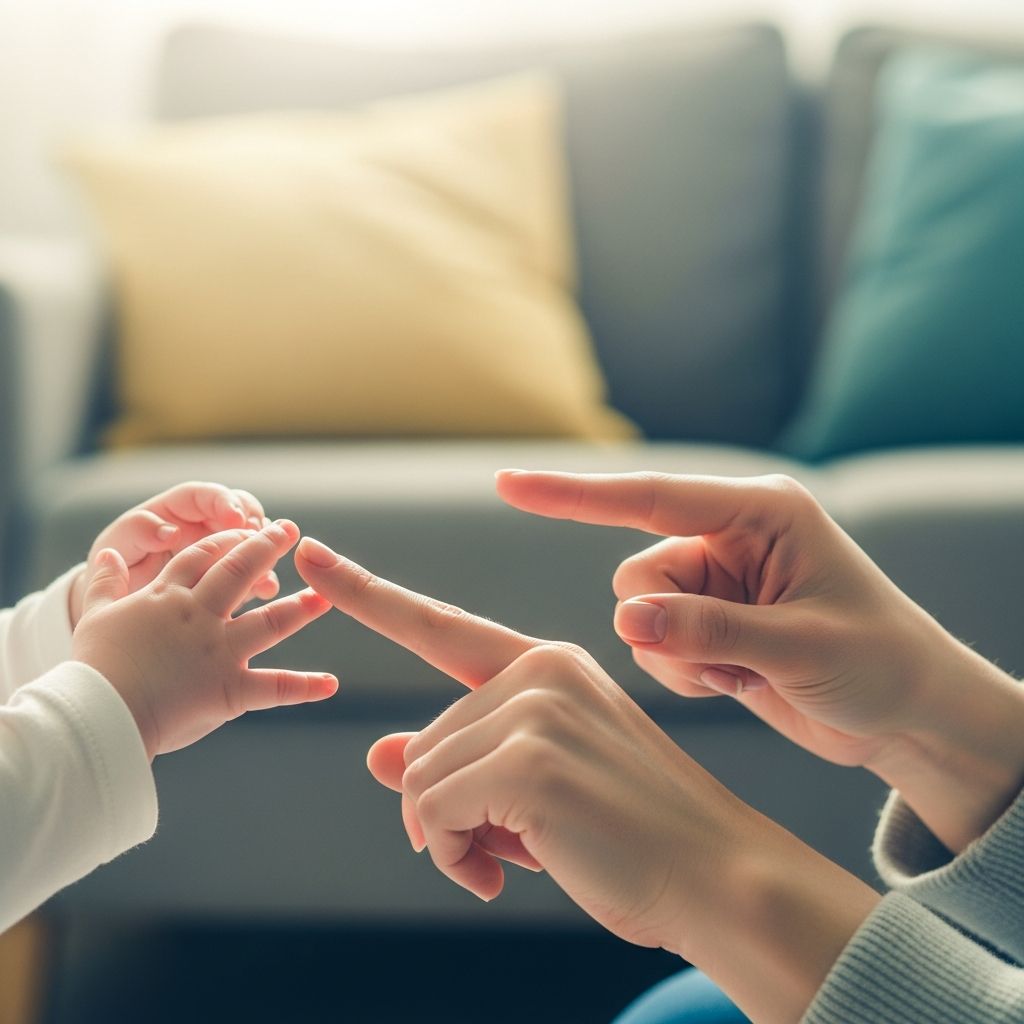
Introducing sign language to infants opens a vital channel for expression before spoken words emerge, helping parents decipher needs and curb distress signals like crying. This approach leverages simple gestures tied to routine activities, promoting cognitive growth and emotional security from early months.
Why Baby Sign Language Transforms Early Interactions
Gestural communication equips babies with tools to convey hunger, fatigue, or joy months ahead of verbal ability, slashing tantrums and enhancing mutual understanding. Research highlights reduced parental stress and accelerated language milestones when signs integrate into play and care moments.
- Cognitive Boost: Signing stimulates brain areas linked to memory and motor skills, laying groundwork for vocabulary expansion.
- Emotional Ties: Immediate responses to signs build trust, as infants feel heard during pre-verbal stages.
- Practical Gains: Families report fewer mealtime battles and smoother bedtimes through clear need-signaling.
Experts from early childhood programs affirm that consistent signing correlates with advanced expressive skills by toddlerhood, without hindering speech development.
Prime Age to Introduce Gestures
Begin modeling signs around 4-6 months, when babies grasp joint attention—tracking your hands and gaze during interactions. Preverbal cues like cooing intensify here, priming them for gesture imitation by 6-9 months.
| Age Range | Developmental Milestone | Signing Focus |
|---|---|---|
| 0-4 months | Visual tracking emerges | Observe and model passively |
| 4-6 months | Joint attention develops | Start core routine signs |
| 6-9 months | First imitations appear | Expand to 10-15 signs |
| 9-12 months | Independent signing | Incorporate phrases |
No rigid cutoff exists; continue signing alongside emerging words for hybrid communication, fading gestures as speech dominates.
Core Signs for Everyday Routines
Prioritize 10-20 practical signs matching high-frequency needs: nourishment, rest, play. Visual simplicity aids retention—open palms, taps, waves.
- Milk: Close fists, shake gently near mouth like squeezing.
- More: Flat hands tap fingertips together repeatedly.
- Eat: Single ‘more’ hand arcs to lips.
- All Done: Palms flip outward from chest briskly.
- Help: Dominant hand palm-up under other flat palm.
- Play: Fists twist wrists, thumbs/pinkies out.
- Sleep: Rock arms like cradling.
- Hug: Cross arms over chest.
- Hot/Cold: Breathe on hands or hug self.
- Book: Palms together, open like pages.
These form a foundational kit; introduce via real contexts, like signing ‘milk’ pre-feedings.
Proven Techniques for Effective Teaching
Success hinges on repetition, positivity, and multisensory input—voice, motion, touch. Avoid drills; weave signs into joyful exchanges.
- Capture Attention: Use name, toy, or eye-level position; ensure gaze meets hands.
- Demonstrate Clearly: Exaggerate motions, elongate words: ‘Moooore bubbles?’
- Guide Hands: Gently shape baby’s fingers over yours while verbalizing.
- Deliver Promptly: Honor attempts instantly—more milk on ‘milk’ sign reinforces links.
- Repeat Daily: 5-10 times per routine, across caregivers for immersion.
External aids like apps or videos amplify modeling; select those endorsed by speech therapists.
Integrating Signs into Daily Life
Anchor learning in rituals: breakfast for ‘eat/more’, baths for ‘water’, outings for ‘car’. Narrate surroundings—sign ‘dog’ spotting one curbs frustration.
- Feedings: Milk, eat, all done, more.
- Playtime: Ball, play, help, book.
- Bedtime: Sleep, hug, all done.
- Diaper Changes: Help, cold/hot.
Joint attention thrives: follow baby’s gaze, sign observed items aloud. Nursery rhymes with pauses invite participation.
Navigating Challenges and Milestones
Babies may take 1-3 months to reciprocate; persistence pays off. Imperfect signs count—respond enthusiastically to approximations.
Common hurdles:
- No Response: Persist 8 weeks; vary excitement in delivery.
- Forgetting Signs: Rotate fewer at once; chart progress.
- Speech Delay Fears: Signing complements, doesn’t replace, verbal practice.
Track via journal: first ‘more’ at 8 months signals readiness for phrases like ‘more milk’.
Enriching with Resources and Community
Leverage free videos, flashcards, classes from reputable outlets. Group sessions build family consistency.
Parental testimonials underscore joy: ‘My 7-month-old’s ‘all done’ ended spoon fights.’
Frequently Asked Questions
At what age should I start baby sign language?
Begin modeling at 4-6 months, with imitations likely by 6-9 months.
Will signing delay my baby’s speech?
No; it enhances language foundations, per speech experts.
How many signs to teach initially?
Start with 5-10 daily essentials, expanding gradually.
What if my baby doesn’t sign back right away?
Normal—consistent modeling over months yields results; respond to efforts.
Can dads or grandparents join in?
Absolutely; uniform signing across caregivers accelerates mastery.
References
- How to Teach Baby 29 Important Words in Baby Sign Language — The Bump. 2023-05-15. https://www.thebump.com/a/how-to-teach-baby-sign-language
- Baby Sign Language: How and When to Teach, from the Experts — Fargo Mom. 2022-11-10. https://fargomom.com/baby-sign-language-how-and-when-to-teach-from-the-experts/
- How Can I Practice Baby Sign Language? — Pathways.org. 2024-01-22. https://pathways.org/how-can-i-practice-baby-sign-language
- Teaching American Sign Language to Infants and Toddlers — Head Start (headstart.gov). 2023-08-01. https://headstart.gov/culture-language/article/teaching-american-sign-language-infants-toddlers
- Baby sign language: A helpful communication tool — Michigan State University Extension (canr.msu.edu). 2021-07-20. https://www.canr.msu.edu/news/baby_sign_language_a_helpful_communication_tool