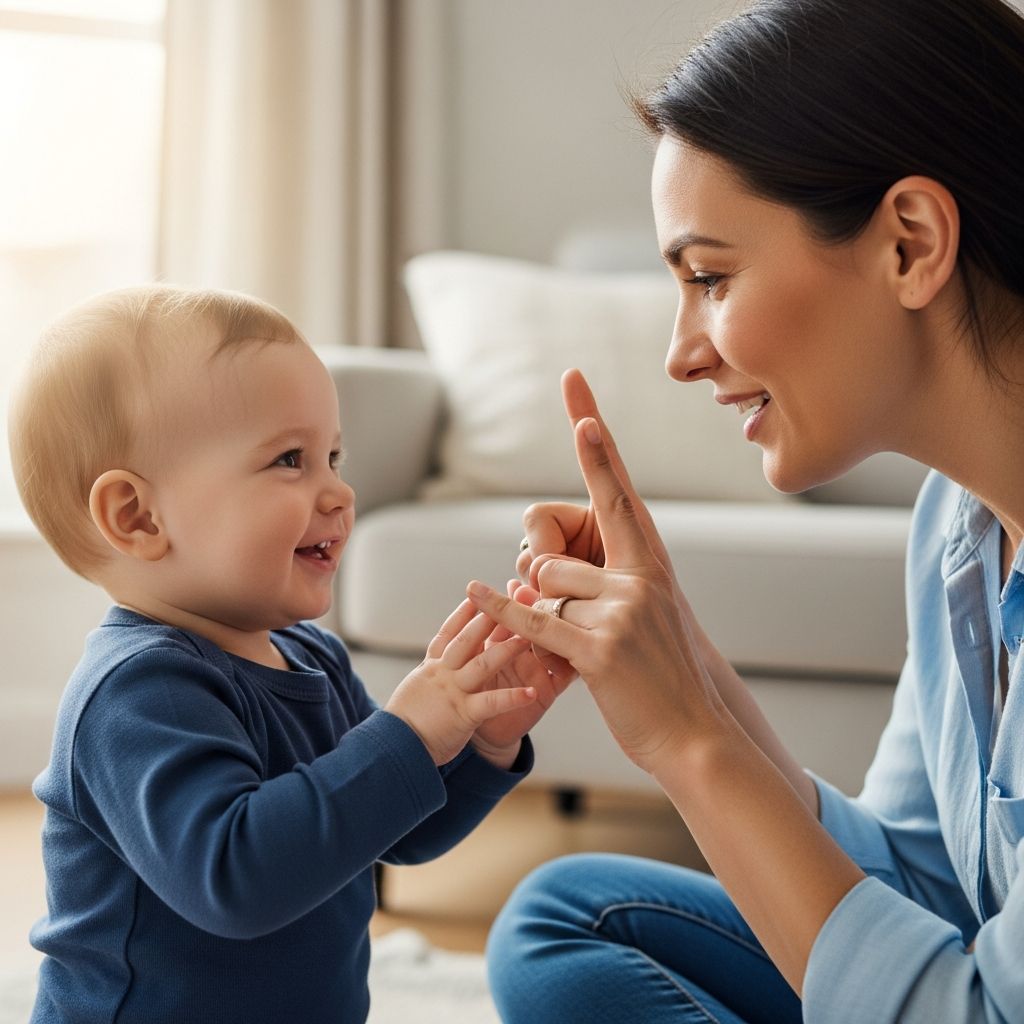
Teaching infants simple hand gestures adapted from sign language opens a bridge to understanding their world long before spoken words form. This practice, known as baby sign language, allows babies as young as 6 months to convey hunger, tiredness, or joy, transforming cries into clear signals and easing daily interactions.
Why Baby Signs Matter: Core Advantages for Infants and Families
Baby sign language bridges the gap between a baby’s inner thoughts and their ability to share them verbally. Research indicates it accelerates cognitive growth and emotional regulation by providing a tool for expression during the pre-verbal stage.
Parents often notice immediate changes: fewer tantrums occur as babies signal specific needs instead of relying solely on crying. One study found infants trained in signs showed reduced distress behaviors, with signing replacing whining when consistently reinforced. This shift not only calms the child but also empowers parents, making them feel more attuned and responsive.
- Emotional Relief: Babies express frustration less through tears, gaining confidence in communication.
- Stronger Bonds: Shared signing moments increase eye contact and interaction quality.
- Cognitive Boost: Early gesturing correlates with larger vocabularies and advanced language milestones.
Beyond daily ease, these signs lay groundwork for literacy. Gestures mimic language structure, enhancing vocabulary comprehension and phonemic awareness critical for reading later. A National Institutes of Health-funded study revealed signing babies outperformed verbal-only peers in speech development by age 2, maintaining leads into toddlerhood.
Scientific Evidence Supporting Baby Signing Practices
Decades of studies affirm baby sign language’s value without delaying speech—in fact, it often propels it forward. In controlled trials, 11-month-olds taught signs surpassed verbal-trained counterparts in expressive language, with advantages persisting at age 3.
Peer-reviewed work from the University of California, Davis, links signing to superior cognitive outcomes and vocabulary size. Similarly, NIH research demonstrated symbolic gesturing enhanced receptive and expressive skills over vocal prompts alone. Parents in surveys reported heightened connection and feasibility in daily use, aligning with Bronfenbrenner’s ecological theory of child development.
Critically, benefits peak when signs pair with spoken words, reinforcing dual pathways to language mastery. No evidence suggests harm; instead, signing babies hit milestones faster, with some studies noting IQ gains and literacy readiness.
| Benefit | Key Finding | Source |
|---|---|---|
| Language Acceleration | Signing infants lead in verbal skills by 3 months at age 2 | |
| Frustration Reduction | Fewer cries/tantrums via sign extinction of whining | |
| Literacy Foundation | Larger vocabularies predict reading success | |
| Parent Confidence | Improved attunement and responsiveness |
Prime Signs to Introduce First: A Practical Starter Kit
Begin with high-impact signs tied to essentials. Consistency across family members ensures quick uptake, typically within weeks for motivated babies.
Daily Needs Signs
- Milk: Close fingers to thumb at mouth, mimicking nursing grasp. Babies use this early for feeding requests.
- More: Tap fingertips together horizontally, signaling desire for extras like food or play.
- All Done: Wave hands outward from chest, perfect for ending meals or activities.
- Help: Palm up, raise hand slightly—useful for reaching toys or assistance.
Emotion and Comfort Signs
- Hurt: Two fingers tap the hurt spot, helping pinpoint discomfort.
- Sleep: Side of hand slides down opposite cheek, imitating head rest.
- Love You: Cross arms over chest in a hug, fostering affection exchanges.
Visualize these through repetition: model the sign while saying the word clearly, exaggerating motions for clarity. Babies often sign back first with one hand, refining later.
Step-by-Step Guide: Teaching Signs Effectively
Success hinges on patience and routine integration. Start at 6-8 months when motor skills allow, though some grasp earlier.
- Choose 3-5 Signs: Focus on baby’s priorities, like eat or drink.
- Model Constantly: Sign during real contexts, e.g., ‘milk’ at bottles.
- Respond Promptly: Acknowledge approximations to encourage repetition.
- Expand Gradually: Add signs weekly, celebrating first uses.
- Involve Everyone: Consistent modeling from all caregivers accelerates learning.
Track progress in a journal: note first signs around 8-12 months, fading as speech emerges by 18-24 months. Combine with reading aloud for compounded literacy gains.
Addressing Myths: Does Signing Slow Speech?
A common worry—signing might hinder talking—is unfounded. Evidence shows the opposite: signs ‘jump-start’ verbal growth by building neural language pathways early. Babies naturally phase out signs for words, using both concurrently during transition.
SLPs endorse it for typically developing kids and those with speech delays, as gestures prompt vocalization. Temporary dual use strengthens overall communication without interference.
Real Parent Experiences: Transformations Through Signing
Families worldwide share triumphs. One mother noted her 6-month-old mastering 10 signs, slashing mealtime cries and sparking early speech. Surveys reveal parents feel more ‘tuned in,’ with interactions turning positive.
In classrooms and homes, signing fosters joint attention, vital for learning. Michigan State Extension highlights its role in supporting diverse communication styles.
Advanced Tips: Integrating Signs into Routines
Weave signs into bedtime, meals, and play. During stories, sign key actions like ‘eat’ or ‘run’ to link gestures with narrative. Music pairs well: rhythmic signing boosts retention.
For multiples, teach sibling signs to reduce rivalry. Adapt for mobility: car seats allow ‘more’ for songs. Monitor for overuse; rotate to match evolving needs.
Frequently Asked Questions
When should I start teaching baby signs?
Begin modeling at 6 months, with most babies signing back by 8-12 months. Earlier exposure builds familiarity.
Will signing delay my baby’s talking?
No—studies show it accelerates speech, with signing babies ahead in vocabulary by age 2.
How many signs should we learn?
Start with 5-10 essentials; expand to 50+ as confidence grows. Quality over quantity.
Do all babies respond the same?
Responses vary by temperament and modeling consistency, but benefits accrue broadly.
Can signing help with speech delays?
Yes, it prompts language in delayed cases, per speech pathology guidelines.
Long-Term Impacts: From Signs to Lifelong Learning
Baby signing seeds habits enduring beyond infancy. Enhanced early vocabularies predict academic prowess, with gestures training brain areas for syntax and comprehension. Families report lasting closeness, as early successes build trust in communication.
Integrate with tech-free play for maximal effect. As babies speak, celebrate the transition, knowing signs paved the way. This tool empowers not just expression, but a foundation for curious, connected kids.
References
- BENEFITS AND EFFECTS OF BABY SIGN LANGUAGE — UNC Digital Repository. 2012. https://cdr.lib.unc.edu/downloads/qj72pc58z
- Research on Baby Sign Language — BabySignLanguage.com. Accessed 2026. https://babysignlanguage.com/basics/research/
- How Baby Sign Language Boosts Early Literacy Skills — IU Blogs. 2025-02-21. https://blogs.iu.edu/earlyliteracy/2025/02/21/signs-of-success-how-baby-sign-language-boosts-early-literacy-skills/
- Baby Sign Language: Benefits & Tips — Bright Horizons. Accessed 2026. https://www.brighthorizons.com/article/toddler/baby-sign-language-benefits-and-tips
- Enhancing Early Communication through Infant Sign Training — PMC (NIH). 2007-04-30. https://pmc.ncbi.nlm.nih.gov/articles/PMC1868823/
- About Language Learning — UC Davis Language Learning Lab. Accessed 2026. https://languagelearninglab.ucdavis.edu/for-parents/about-language-learning