Selecting the right shoes for your baby is crucial for comfort, mobility, and foot health. Unlike adult shoes, infant footwear must accommodate rapid growth while preventing issues like blisters or restricted movement. This guide provides everything parents need to measure feet accurately at home, interpret size charts, and choose shoes that promote proper development.
Why Accurate Shoe Sizing Matters for Infants
Improperly fitted shoes can lead to discomfort and long-term foot problems. Babies’ feet grow quickly—up to a full size every two to three months in the first year—making regular measurements essential. A good fit allows about 1/2 inch (1.27 cm) of space beyond the longest toe for growth, ensuring toes can wiggle freely without slipping.
Health experts emphasize flexible soles and wide toe boxes in baby shoes to mimic barefoot walking, which strengthens arches and muscles. Tight shoes restrict this natural process, potentially causing misalignment.
Essential Tools for Measuring Baby Feet
Gather these simple items before starting:
- A sheet of plain paper (letter size, 8.5×11 inches)
- A pencil or fine-tip marker
- A ruler or measuring tape (preferably in both inches and cm)
- Flat surface like a table or floor
Optional: Printable foot charts from reputable brands for scale verification. Print at 100% scale and use a credit card to check accuracy against marked guides.
Step-by-Step: Measuring Your Baby’s Feet at Home
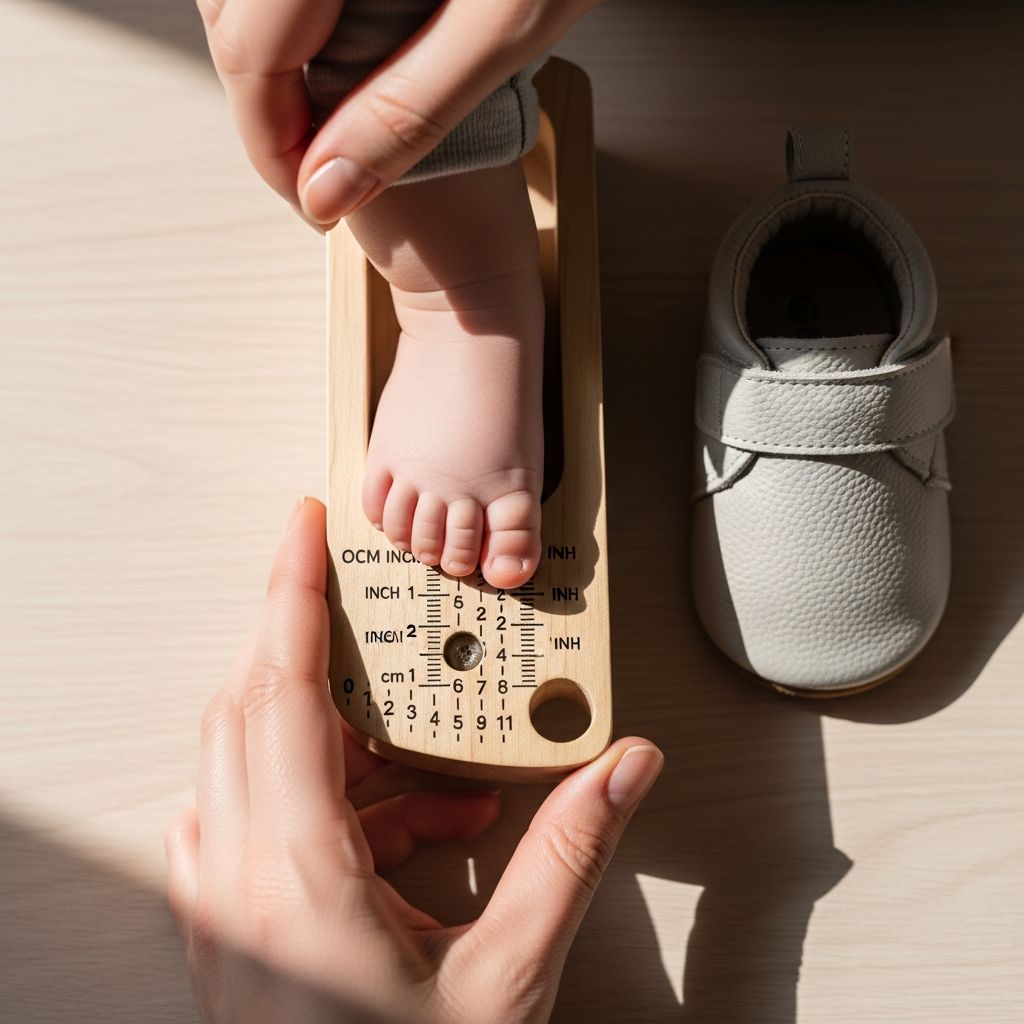
Follow these precise steps for reliable results. Measure both feet, as one is often slightly larger—always size for the bigger one.
- Prepare the baby: Ensure feet are bare, clean, and relaxed. Have your baby lie down or sit if very young; for older infants, have them stand.
- Position the paper: Place paper on a flat surface. For newborns, lay the foot flat; for standing babies, align the heel with the paper’s edge.
- Trace the outline: Gently hold the foot steady. Trace around the perimeter, keeping the pencil vertical against the skin. Mark heel back and tip of longest toe (often the big toe, but check second toe).
- Measure length: Draw a straight line from heel mark to longest toe mark. Use a ruler to measure this distance in cm or inches.
- Check width if needed: Measure across the widest part (ball of foot) for brands offering width options.
- Repeat and compare: Do both feet in the afternoon when feet may be slightly swollen for worst-case sizing.
Pro tip: Avoid curling toes by gently extending the foot. Measure weekly for newborns or monthly thereafter to track growth.
Understanding Infant Shoe Size Charts by Age
Shoe sizes vary by brand and region, but age-based charts provide starting points. These are averages; always prioritize foot length over age.
| Age Range | Foot Length (inches) | Foot Length (cm) | US Size |
|---|---|---|---|
| Newborn (0-3 months) | 3.5-3.75 | 8.9-9.5 | 0-1 |
| 3-6 months | 3.75-4.125 | 9.5-10.5 | 1-2 |
| 6-9 months | 4-4.5 | 10.2-11.4 | 2-3 |
| 9-12 months | 4.5-4.75 | 11.4-12.1 | 3-4 |
| 12-18 months | 4.75-5 | 12.1-12.7 | 4-5 |
| 18-24 months | 5-5.25 | 12.7-13.3 | 5-6 |
Use this table as a reference. For example, a 6-month-old with 4-inch feet fits US size 2. Add 0.5 inches to measured length for ideal shoe interior space.
International Shoe Size Conversions
Shopping globally? Convert between systems easily. US sizes are common in North America, but EU (numbered by length in cm) and UK differ.
| US Size | EU | UK | cm (approx.) |
|---|---|---|---|
| 1 | 16-17 | 0-1 | 9.5 |
| 2 | 17-18 | 1 | 10.2 |
| 3 | 18 | 2 | 10.8 |
| 4 | 19-20 | 2.5-3 | 11.4 |
| 5 | 20-21 | 4 | 12.1 |
| 6 | 22 | 5 | 13 |
Other regions like JP (13.5 for US 6) or AU (5.5) follow similar patterns. Always check brand-specific charts, as styling affects fit.
Signs of a Proper Shoe Fit and Red Flags
Test fit in-store or at home:
- Thumb test: Slide thumb between heel and shoe—should fit snugly.
- Toe space: 1/2 inch from longest toe to shoe end.
- Width: No bulging sides or pinching; toes fan naturally.
- Flex test: Bend shoe at toes—should crease where natural foot bends.
Warning signs: Heel slippage, toes overriding each other, blisters, or reluctance to walk. Replace shoes every 3-6 months or at 1/2 inch growth.
Shoe Sizing for Toddlers and Beyond
As babies transition to toddlers (12+ months), sizing shifts from infant (0-4) to toddler (5-10). Stand measurements become key. Growth slows but monitor every 2 months. Preschool (10.5-3) and grade school (3.5+) follow numeric increases toward adult sizes at 13.5+.
| Category | US Size Range |
|---|---|
| Infant | 0-4 |
| Toddler | 5-10 |
| Preschool | 10.5-3 |
| Grade School | 3.5-7 |
Tips for Healthy Foot Development Through Footwear
Opt for breathable materials, removable insoles for cleaning, and shoes with room for orthotics if needed. Barefoot time indoors builds strength. Consult pediatricians for concerns like flat feet.
Regular measurements prevent issues; track in a journal with dates and sizes.
Frequently Asked Questions
When is the best time to measure baby’s feet?
Afternoon or evening, when feet are largest from daily activity.
One foot bigger than the other—what to do?
Size for the larger foot to avoid uneven wear or discomfort.
How often should I check shoe fit?
Monthly for infants under 1 year; every 2-3 months for toddlers.
Are brand sizes consistent?
No—always measure and check brand charts; Nike recommends sizing up if between sizes.
Can I use socks when measuring?
Measure barefoot first, then add thin socks for true fit.
References
- Baby & Children’s Shoe Size Guide — JoJo Maman Bebe. 2023. https://www.jojomamanbebe.com/us/en/sizing-and-care-guide/childrens-shoe-size-guide
- Comprehensive Guide to Infant Shoe Size Chart by Age — Grookz. 2024. https://grookz.com/blogs/baby-shoe-blogs/understanding-infant-shoe-size-chart-by-age-a-comprehensive-guide
- The Ultimate Guide to Sizing Shoes for Infants, Toddlers, Preschool and Grade School — Smart Pattern Making. 2023. https://www.smartpatternmaking.com/blogs/articles/the-ultimate-guide-to-sizing-shoes-for-infants-toddlers-preschool-and-grade-school
- Kids’ Footwear Size Chart — Nike. 2025-01-10. https://www.nike.com/size-fit/kids-footwear
- Kids’ Shoe Size Guide — Kids Foot Locker. 2024. https://www.kidsfootlocker.com/shoe-size-guide.html