Bringing a new baby home comes with endless questions, and one of the most common is how to know whether your little one is gaining enough weight. A baby scale can provide extra reassurance between pediatric checkups, especially in the newborn months, but it is not a must-have gadget for every family. This guide walks you through when a baby scale is helpful, what to look for when you buy one, and how to use it accurately and safely.
Do You Really Need a Baby Scale?
Most healthy, full-term babies only need to be weighed during routine pediatric visits. That is because doctors and nurses use standardized growth charts developed by organizations such as the World Health Organization (WHO) and the U.S. Centers for Disease Control and Prevention (CDC) to track progress over time. These charts are based on large, international data sets and show typical patterns of growth in length, weight, and head circumference.
However, a home baby scale can be especially helpful in certain situations.
Families Who Benefit Most From a Baby Scale
- Parents of premature or low-birth-weight babies
Preterm and low-birth-weight infants are carefully monitored for rapid changes in weight because even small fluctuations can signal feeding or health problems. A home scale lets you follow your doctor’s suggested weighing schedule between clinic visits. - Breastfeeding parents monitoring intake
Weighing a baby immediately before and after a feed (weigh-feed-weigh) can estimate the amount of milk taken in, especially in the early days when supply is still establishing. This is often done together with a lactation consultant. - Babies with medical conditions
Infants managing conditions that affect feeding or fluid balance, such as certain heart, gastrointestinal, or metabolic disorders, may need closer tracking under medical guidance. - Parents living far from medical care
Families who have difficulty reaching a clinic regularly, or who have limited access to pediatric services, may use a baby scale to keep a closer eye on growth between visits. - Parents who need reassurance
Some caregivers simply feel more at ease seeing gradual progress on the scale. When used sensibly and not obsessively, this can provide helpful peace of mind.
When a Scale May Not Be Necessary
- Your baby was born at term, is feeding well, and your pediatrician is satisfied with growth.
- You have easy access to clinic visits or community health checks where weight is recorded regularly.
- Watching diapers, feeding behavior, and developmental milestones already gives you enough reassurance.
Health organizations emphasize that overall growth trends over weeks and months matter far more than day-to-day fluctuations. It is normal for weight to vary slightly from one day to the next, particularly with changes in feeding volume and diaper contents.
How Baby Scales Differ From Regular Bathroom Scales
Baby scales are not just smaller versions of bathroom scales. They are engineered specifically for tiny, wiggly bodies and for tracking very small changes in weight.
| Feature | Baby Scale | Standard Bathroom Scale |
|---|---|---|
| Weighing surface | Curved or contoured tray to support a lying infant and reduce rolling. | Flat platform designed for standing adults. |
| Precision | Measures in very small increments (often 2–10 g or 0.1 oz). | Typically measures in 0.1–0.2 kg or 0.2–0.5 lb steps. |
| Capacity | Usually up to 15–20 kg / 30–44 lb, optimized for infants and toddlers. | Designed for much higher weight ranges, less focused on low weights. |
| Functions | Tare, hold, memory, sometimes milk-intake calculation. | Basic weight measurement, few infant-specific features. |
| Safety | Smooth, easy-clean, often with raised sides to reduce rolling. | No infant safety design; not suitable for lying babies. |
Types of Baby Scales: Digital, Mechanical, and Smart
Baby scales generally fall into three main categories. Understanding the differences helps you match a scale to your needs and budget.
Digital Baby Scales
Digital scales are the most common option for at-home use. They use electronic sensors and show weight on an LCD screen.
- High precision – Many models detect changes as small as a few grams or 0.1 ounces, allowing close monitoring of newborn growth and feeding effectiveness.
- Easy-to-read display – Numbers are clear and instantly visible, reducing reading errors compared with analog dials.
- Helpful functions – Common extras include:
– Tare to subtract the weight of blankets or diapers.
– Hold to lock a stable weight even if your baby is moving.
– Memory of previous measurements for basic trend tracking. - Power options – Usually battery-powered, and some also allow AC adapters for continuous use.
Digital baby scales are widely recommended because of their balance of precision, ease of use, and added features.
Mechanical (Analog) Baby Scales
Mechanical scales use springs or balance beams instead of electronics.
- No batteries or power needed – Useful in areas with unreliable electricity or for occasional use.
- Durability – Fewer electronic parts can mean fewer technical failures over time.
- Lower cost in some cases – Often more basic and sometimes cheaper.
However, they typically:
- Offer less fine precision than digital models.
- Lack memory, hold, or data-transfer features.
- May be harder to read accurately if the dial is small.
Smart or App-Connected Baby Scales
Some modern baby scales connect to a smartphone or tablet via Bluetooth. These smart scales automatically store weight readings and sometimes sync with growth-chart or baby-tracking apps.
- Automatic logging – Reduces manual record keeping and helps you visualize growth trends over time.
- Remote sharing – Data can often be shared with healthcare providers or co-parents.
- All-in-one tracking – Some apps combine weight data with feeding, sleep, and diaper logs.
These models usually cost more and require a compatible device and updated apps, but they can be very convenient for families who love data or need detailed records for medical reasons.
Key Features to Look for in a Baby Scale
Once you have decided on the type of scale, focus on features that make weighing safe, accurate, and easy in everyday life.
1. Accuracy and Resolution
- Medical-grade precision – Look for a scale with precision around 2–10 g (or 0.1 oz) and a capacity that covers your child through the toddler years, usually up to around 20 kg/44 lb.
- Stable readings – A good scale will quickly settle on a number instead of fluctuating wildly with every small movement.
- Consistent performance – If possible, check that repeated measurements of the same object give the same result within a very small margin.
2. Safety and Comfort
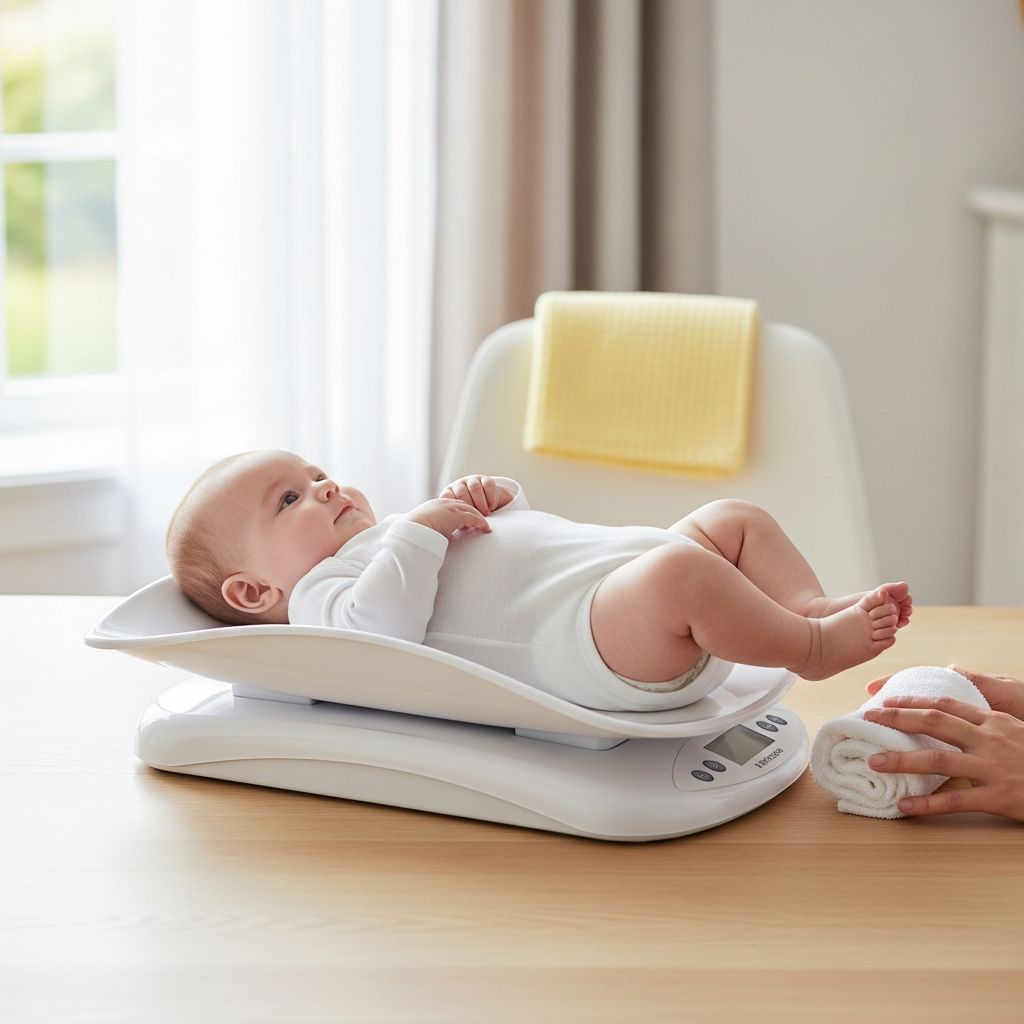
- Curved or contoured tray – Helps keep a baby from rolling off and supports the spine while lying down.
- Stable base – The scale should not wobble when placed on a hard, flat surface.
- Easy-clean materials – Smooth, non-porous surfaces simplify cleaning and reduce the chance of germs lingering after a diaper leak.
3. Essential Functions
- Tare function – Subtracts the weight of a blanket, towel, or diaper so you can keep your baby warm and still get accurate results.
- Hold function – Captures the weight while your baby squirms so the final number is readable.
- Multiple measurement units – Quickly switch between kilograms, grams, pounds, and ounces to match your pediatrician’s preference.
- Memory or trend display – Saves at least the previous measurement so you can quickly compare changes over time.
4. Power and Durability
- Battery life – An auto-off function preserves battery power between uses.
- Build quality – Look for solid construction with no sharp edges or loose parts.
- Warranty – A manufacturer warranty or calibration guarantee can be useful, especially if growth monitoring is medically important.
Using a Baby Scale Safely and Accurately
Even the best baby scale only helps if you use it correctly. These tips can improve both safety and accuracy.
Prepare the Weighing Area
- Place the scale on a hard, level surface such as the floor or a solid table.
- Never leave your baby unattended on the scale, even for a second.
- Keep one hand close to your baby to prevent rolling or sudden movements, especially with newborns.
Step-by-Step Weighing for Newborns
- Turn on the scale and wait for it to show zero.
- Lay a light blanket or towel if needed, then press the tare button to zero out the extra weight.
- Gently place your baby in the center of the tray, keeping them calm and still if possible.
- Use the hold button, if available, to capture the reading once it stabilizes.
- Record the result with date and time, noting any special circumstances (e.g., after a big feed).
How Often Should You Weigh Your Baby?
- Follow your pediatrician’s recommendation if they have set a specific schedule.
- For most babies, weekly or even less frequent home measurements are sufficient, as health agencies emphasize tracking trends over time rather than daily changes.
- Weighing too often can cause unnecessary anxiety and may tempt you to overinterpret normal fluctuations.
Interpreting Weight and Growth Safely
Weight is only one part of your baby’s overall growth picture. Pediatric teams look at several measures together to understand how a baby is doing.
Weight, Length, and Head Circumference
- Weight reflects short-term changes in feeding or fluid balance.
- Length/height shows longer-term growth in bone and overall size.
- Head circumference helps track brain and skull development in the early years.
Growth charts from the WHO and CDC include all three, and clinicians look for a consistent pattern over time rather than the exact percentile at any single visit.
When to Call Your Pediatrician
Contact your child’s healthcare provider promptly if you notice any of the following:
- Weight that is dropping across percentiles over several measurements.
- Very little or no weight gain over a period your doctor said should show growth.
- Sudden, unexplained weight loss.
- Feeding difficulties, fewer wet diapers, or changes in alertness alongside weight concerns.
Only a healthcare professional can interpret growth data in context and decide whether additional evaluation is needed.
Balancing Data With Peace of Mind
Used well, a baby scale can be a useful tool—especially if your baby has special health needs or if your pediatrician has recommended closer monitoring. At the same time, it is important not to let the numbers dominate your parenting experience.
- Combine scale readings with other signs of health, such as contentment after feeds, regular wet diapers, and steady developmental progress.
- Share your records with your pediatrician at each visit instead of trying to interpret trends alone.
- If checking the scale repeatedly increases your anxiety, consider reducing how often you weigh or asking your provider for guidance.
Ultimately, the goal is not a perfect number on the screen but a thriving, well-supported baby.
Frequently Asked Questions About Baby Scales
Q1: Can I use my regular bathroom scale to weigh my baby?
A bathroom scale is not ideal for infants. It lacks the precision needed to detect small changes in newborn weight and does not provide a safe, contoured surface for a baby to lie down. For accurate and safe measurements, a dedicated baby or pediatric scale is recommended.
Q2: Do I need a hospital-grade or medically certified scale?
For most families, a consumer-grade digital baby scale with good reviews and clear specifications is sufficient. Medical-grade scales used in clinics must meet specific accuracy standards and regulatory classifications, such as Class III approval for patient monitoring. If your baby has complex medical needs, ask your healthcare team whether a particular certification is necessary.
Q3: How accurate is weigh-feed-weigh for measuring breast milk intake?
Weighing a baby immediately before and after breastfeeding can estimate how much milk was transferred, especially when using a highly sensitive, well-calibrated scale. However, the technique requires careful handling and can be affected by timing, diaper changes, and scale precision. Many parents get the best results when they do this under the guidance of a lactation consultant.
Q4: My baby’s weight looks different from the doctor’s scale. Which is right?
Small differences between scales are common because of calibration, surface, clothing, and timing. Health professionals focus on measurements taken under consistent conditions on calibrated equipment. Use your home scale mainly to follow trends, and rely on clinic measurements as the official record.
Q5: When should I stop using a baby scale?
Once your child is walking steadily and your pediatrician is satisfied with growth, you can usually transition to a standard family scale or rely on measurements taken at routine health visits. Many baby scales convert into toddler scales by removing the infant tray, which can extend their useful life if you prefer to keep tracking at home.
References
- Child growth standards — World Health Organization. 2006-01-01. https://www.who.int/tools/child-growth-standards
- Growth Chart Training — Centers for Disease Control and Prevention. 2022-05-09. https://www.cdc.gov/growthcharts/index.htm
- Infant Scale: Complete Guide to Baby Weight Monitoring Equipment — Selleton Scales. 2023-08-15. https://selletonscales.com/blogs/news/infant-scale-complete-guide-to-baby-weight-monitoring-equipment
- Baby Scales | Infant Scales | Pediatric Scales — Scales Plus. 2023-02-10. https://www.scalesplus.com/baby-scales/
- Baby Weighing Scales: Uses, Specifications, & Why It’s Essential for Pediatric Care — EG Kantawalla. 2022-11-21. https://www.egkantawalla.com/blog/baby-weighing-scales-uses-specifications-why-it-s-essential-for-pediatric-care
- Digital Versus Analog Baby Scale: Which Is the Best Choice? — HiWeigh. 2023-06-05. https://www.hiweigh.com/news/latest-news/baby-scale-which-is-the-best-choice/