The first year of life marks an extraordinary period of transformation for your baby, evolving from a newborn with basic reflexes to a mobile, communicative explorer. This guide draws on authoritative pediatric resources to outline key developmental stages, offering parents practical strategies to foster growth while ensuring safety.
Understanding Developmental Milestones
Developmental milestones represent skills most babies achieve by certain ages, spanning motor abilities, language, social interactions, and cognitive progress. These benchmarks help track typical growth, though individual variation is normal—some babies advance quickly, others take time. Pediatricians use them during checkups to monitor health.
Focus on encouragement through play, responsive caregiving, and safe environments rather than rigid timelines. If concerns arise, consult a healthcare provider early for interventions like speech therapy or physical assessments.
Newborn Foundations: Months 0-3
In the initial months, babies build core skills. Newborns exhibit reflexive movements like grasping and startling, gradually gaining control. By 2 months, most lift their head briefly during tummy time, track moving objects with eyes, and respond with social smiles.
- Physical growth: Jerky arm and leg movements smooth out; head control strengthens for brief holds by 2 months.
- Sensory development: Vision sharpens to recognize faces up to 12 inches away; hearing tunes to voices, turning toward sounds.
- Social cues: Cooing begins around 2-3 months, with responsive smiling fostering bonding.
Support this phase with daily tummy time (starting 3-5 minutes, supervised), high-contrast toys for visual stimulation, and gentle talking to promote language foundations.
Exploring Movement: Months 4-6
Around 4 months, babies roll from front to back, laugh aloud, and grasp rattles firmly. By 6 months, rolling both ways, sitting with minimal support, and reaching become common.
| Milestone | Typical Age | How to Encourage |
|---|---|---|
| Rolls over | 4-6 months | Tummy time, toys just out of reach |
| Sits with support | 5-6 months | Boppy pillow, propped play |
| Babbles | 6 months | Respond to sounds, mirror play |
| Transfers objects | 6 months | Hand over safe toys |
These achievements signal strengthening muscles and coordination. Introduce soft finger foods if ready, but prioritize breastfeeding or formula for nutrition.
Mobility Milestones: Months 7-9
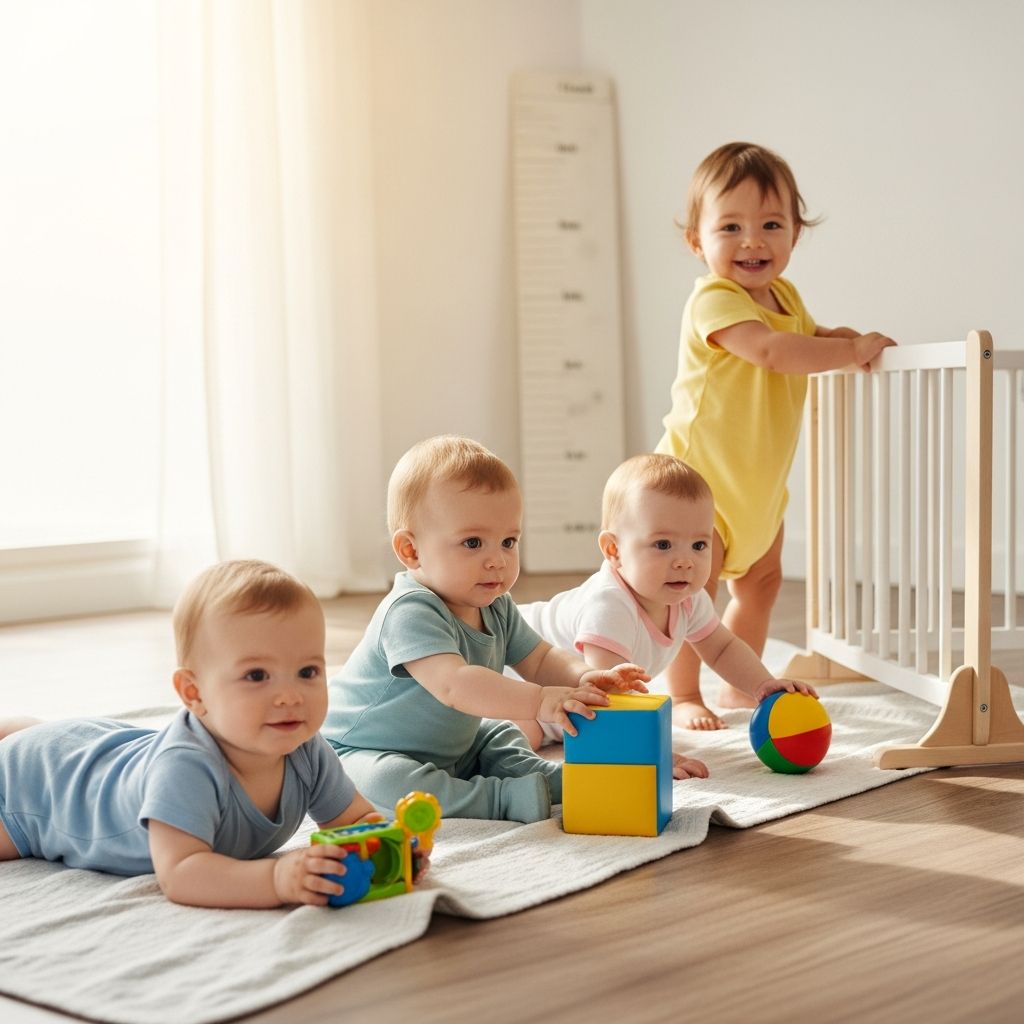
Mid-year brings dynamic changes: babies scoot, army crawl, or crawl traditionally by 7-9 months, pull to stand, and master the pincer grasp for tiny objects. Socially, stranger anxiety peaks, and babbling mimics speech.
- Gross motor: Sitting unsupported, crawling variations prepare for standing.
- Fine motor: Thumb-finger precision allows self-feeding bits like cereal.
- Language: Waves bye-bye, says ‘mama/dada’ indiscriminately, responds to name.
Baby-proof now: secure furniture, gate stairs, as exploration surges. Gesture games like pat-a-cake enhance cognitive links.
Toward Independence: Months 10-12
The final quarter focuses on autonomy. Babies cruise along furniture, stand alone, and take first steps around 12 months. They point to desires, use 1-3 words specifically, and engage in simple pretend play.
By year’s end, most drink from open cups, stack blocks, and follow basic directions with gestures. Celebrate these with praise, but manage frustration from falls or failed attempts patiently.
| Domain | 10-12 Month Examples |
|---|---|
| Movement | Cruises, stands alone, first steps |
| Communication | Says 2-3 words, understands ‘no’ |
| Social | Imitates actions, shows preferences |
| Cognitive | Points, pretends with toys |
Nutrition Through the Year
Feeding evolves rapidly. Exclusive breastfeeding or formula sustains until 6 months, then introduce purees, progressing to finger foods by 9 months. By 12 months, most handle table foods with whole milk transition.
- 0-6 months: Breast milk/formula every 2-3 hours; no solids yet to protect gut.
- 6-9 months: Iron-fortified cereals, mashed veggies/fruits; 2-3 meals daily.
- 9-12 months: Self-feed chunks, cups for water/milk; limit juice.
Watch for allergies: introduce one new food every 3-5 days. Responsive feeding—follow hunger cues—prevents over/under-eating.
Sleep Patterns and Routines
Newborns sleep 16-18 hours fragmented; by 3 months, 14-15 hours with longer stretches. Night sleep consolidates to 10-12 hours by 6-12 months, plus 2 naps.
Establish routines: dim lights, white noise, consistent bedtime. Safe sleep mandates back-sleeping in cribs without loose items, reducing SIDS risk per AAP guidelines (aligned with CDC).
Safety Essentials for Every Stage
As mobility grows, hazards multiply. Never leave babies unattended on elevated surfaces; use rear-facing car seats until age/weight limits. Childproof outlets, cabinets from 6 months.
- Choking prevention: Cut foods small, supervise eating.
- Falls: Gates, anchors for TVs/furniture.
- Bumps/bruises: Soft corners, helmets for early walkers.
Vaccinations at 2, 4, 6, 12 months protect against diseases; track via CDC schedule.
Emotional and Cognitive Growth
Bonding via eye contact, talking, reading builds secure attachment. Peekaboo teaches object permanence by 8-9 months; imitation games spur learning.
Respond to cries promptly early on, gradually teaching self-soothing. Limit screens; interactive play trumps passive viewing per pediatric consensus.
Month-by-Month Milestone Tracker
| Month | Key Physical | Key Social/Language |
|---|---|---|
| 1 | Head side-to-side, fists | Alerts to sound, tracks eyes |
| 3 | Lifts head/chest | Smiles responsively, coos |
| 6 | Rolls both ways, sits propped | Babbles, recognizes faces |
| 9 | Crawls, pulls up | Pincer grasp, waves bye |
| 12 | Stands, steps | 1-3 words, points |
Frequently Asked Questions (FAQs)
What if my baby misses a milestone?
Variation is common; track overall progress. Discuss delays at checkups—early therapy aids 90% of cases.
How much tummy time is enough?
Start 3 minutes daily, build to 30-60 minutes by 7 months, always supervised.
When to introduce solids?
Around 6 months, when ready: good head control, interest in food.
Is crawling necessary?
No—some skip to walking; motor skills develop regardless.
How to handle separation anxiety?
Consistent routines, short goodbyes; it peaks 8-10 months, fades by 18.
References
- Baby Development Stages: The First Year — WebMD. 2023. https://www.webmd.com/parenting/baby/features/stages-of-development
- Developmental Milestones: Birth to 5 years — Stanford Medicine. 2022-10-01. https://med.stanford.edu/content/dam/sm/pediatricsclerkship/documents/5-Developmental-Milestones-MedU.pdf
- Milestones by 1 Year | Learn the Signs. Act Early. — CDC. 2024-09-12. https://www.cdc.gov/act-early/milestones/1-year.html
- Infant development: Birth to 3 months — Mayo Clinic. 2024-05-15. https://www.mayoclinic.org/healthy-lifestyle/infant-and-toddler-health/in-depth/infant-development/art-20048012
- Baby Developmental Milestones By Month — Cleveland Clinic. 2023-11-20. https://my.clevelandclinic.org/health/articles/22063-baby-development-milestones-safety
- CDC’s Developmental Milestones | Learn the Signs. Act Early. — CDC. 2024. https://www.cdc.gov/act-early/milestones/index.html