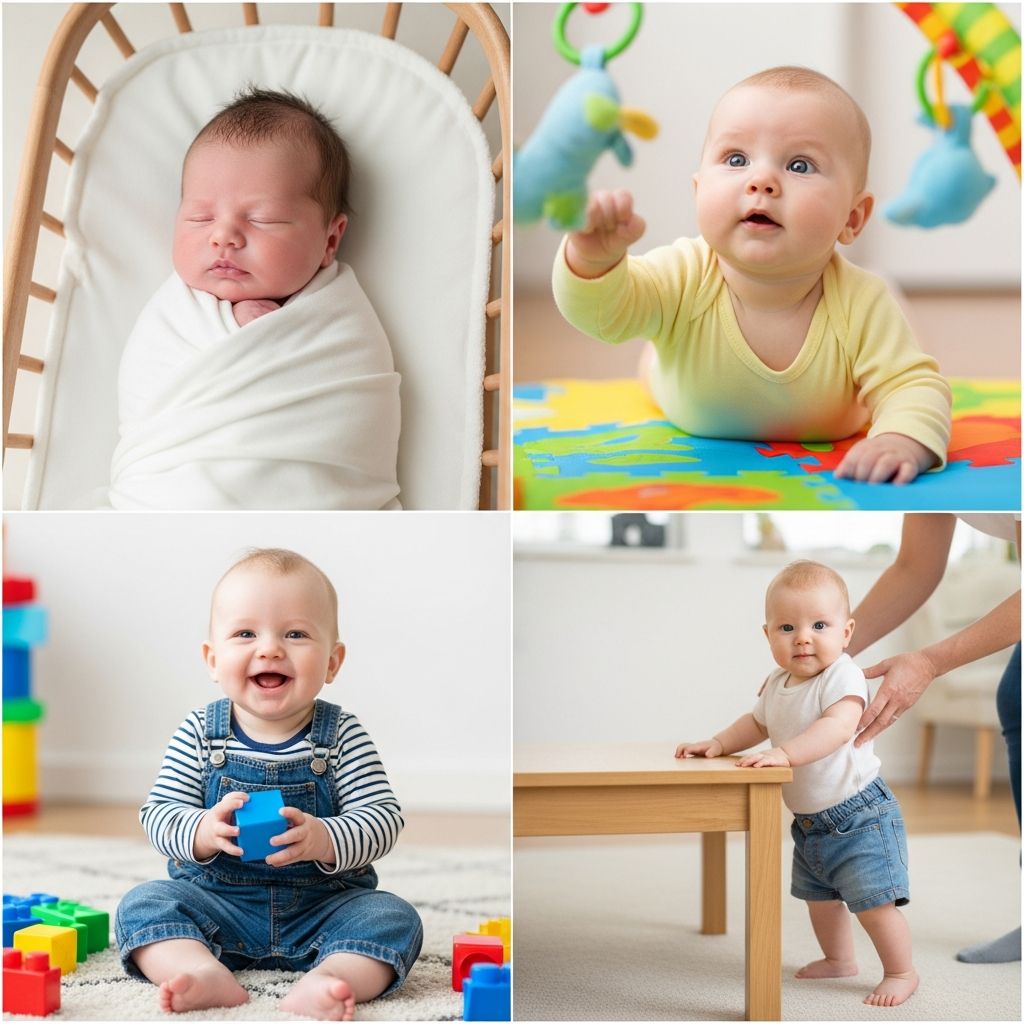
Your baby’s first year is a whirlwind of rapid changes, marked by remarkable achievements in movement, communication, thinking, and social bonds. Understanding these **developmental milestones** helps parents celebrate progress and spot when professional advice might be needed. This guide draws from authoritative pediatric sources to outline what to expect each month, empowering you to nurture your little one’s growth effectively.
Understanding Developmental Milestones
Developmental milestones represent skills most babies acquire by certain ages, categorized into gross motor (large movements like rolling), fine motor (precise actions like grasping), language (sounds and words), cognitive (problem-solving), and social-emotional (interactions). While every child develops at their own pace, tracking these benchmarks ensures early intervention if delays occur. The CDC emphasizes acting early on concerns to support optimal outcomes.
Factors like prematurity or health conditions can influence timing, so consult your pediatrician for personalized guidance. Regular well-child visits align perfectly with monitoring these stages.
Newborn to 1 Month: Building Foundations
In the earliest weeks, your newborn focuses on basic reflexes and sensory adaptation. They instinctively root for feeding, grasp fingers tightly, and startle to loud noises. Visually, they track faces and objects within 8-12 inches, preferring high-contrast patterns.
- Physical: Lifts head briefly during tummy time; fists mostly clenched.
- Sensory: Turns head toward sounds; quiets to familiar voices.
- Social: Stares at faces; brief eye contact.
Support this stage with frequent skin-to-skin contact and gentle tummy time to strengthen neck muscles. By month’s end, many coo softly in response to your voice.
2 to 3 Months: Emerging Smiles and Strength
Around 2 months, social smiles light up interactions, signaling emotional connection. Babies hold heads steadier and track moving toys smoothly, reducing eye crossing.
| Area | Milestones |
|---|---|
| Gross Motor | Pushes up on elbows during tummy time; smoother head control. |
| Fine Motor | Opens/closes hands; swipes at objects. |
| Language | Cooing and gurgling; imitates sounds. |
| Social | Responsive smiles; enjoys faces. |
Encourage play with mobiles and mirrors. By 3 months, laughter emerges, and they reach for dangling toys, honing hand-eye coordination.
4 to 6 Months: Rolling and Babbling Begin
This period brings exciting mobility leaps. Babies roll front-to-back first, then both ways, and sit with support. Teething may start, accompanied by drooling and raspberry blowing.
- Physical feats: Pushes up strongly on tummy; rolls over; transfers objects hand-to-hand.
- Communication: Babbles with varied sounds; laughs aloud.
- Cognitive: Explores with mouth; recognizes familiar faces.
Introduce soft toys and teethers. Tummy time now exceeds 15 minutes daily to build core strength. Socially, they show joy in play but may cry when it ends.
7 to 9 Months: Crawling and First Words
Mobility explodes as babies army-crawl, scoot, or crawl on all fours. They pull to stand, mastering the pincer grasp for tiny foods like cereal.
| Month | Key Achievements |
|---|---|
| 7 Months | Begins crawling; thumb-finger grasp; complex babbling. |
| 8 Months | Sits unsupported; claps; responds to name. |
| 9 Months | Pulls to stand; immature pincer; “mama/dada” nonspecific; points to objects. |
Stranger anxiety peaks, a normal sign of attachment. Offer safe spaces for exploration and books for pointing practice. They understand object permanence—hidden toys still exist.
10 to 12 Months: Standing, Cruising, and Words
The home stretches as babies cruise along furniture, stand alone, and take first steps. Language blooms with specific “mama/dada,” waving bye-bye, and 2-3 words by year-end.
- Motor: Cruises; pincer grasp perfected; stacks toys.
- Language: Imitates sounds; follows simple commands.
- Social: Plays pat-a-cake; shows preferences.
First molars appear, aiding self-feeding with spoons. They test boundaries, dropping food to gauge reactions, learning cause-and-effect.
Physical Growth and Nutrition Tips
Babies double birth weight by 5 months and triple by year one. Introduce solids around 6 months per AAP guidelines, starting with iron-fortified cereals and purees. By 9 months, finger foods promote independence. Ensure variety for nutrients: veggies, fruits, proteins. Hydrate with breast milk or formula primarily.
Cognitive and Sensory Development
Cognitive growth shines in problem-solving, like banging toys or peeking for hidden items. Vision sharpens to 20/20; they focus across rooms, kick balls accurately. Touch exploration drives learning—safe textures build sensory maps. Make-believe hints emerge, like “feeding” dolls.
Social-Emotional Milestones and Parenting Strategies
Babies thrive on responsive caregiving. Parallel play starts; separation anxiety tests bonds around 8-10 months. Temper tantrums signal growing independence—respond calmly with words like “I see you’re upset.” Use positive reinforcement: praise gentle petting over tail-pulling. Security objects comfort during transitions.
Activities to Boost Development
- Read daily, pointing to pictures.
- Play peekaboo for object permanence.
- Encourage stacking blocks and puzzles.
- Sing songs for rhythm and words.
- Practice dressing with loose clothes.
Limit screen time; interactive play fosters bonds best.
When to Consult a Professional
Most babies hit milestones within ranges, but flag concerns like no smiling by 3 months, no babbling by 9, or no walking by 18 months. The CDC’s “Learn the Signs. Act Early” program offers free trackers. Early therapy can address delays effectively.
Frequently Asked Questions
What if my baby skips crawling?
Some babies go straight to walking—it’s normal if other motor skills progress.
How much tummy time is enough?
Aim for 15-30 minutes daily, building gradually from birth.
Is stranger anxiety a problem?
No, it’s a healthy attachment sign peaking at 9 months.
When should solids start?
Around 6 months, when ready: good head control, interest in food.
How many words by 12 months?
Average 2-3, like mama/dada specifically; range varies widely.
References
- Toddler Milestones: Your Baby’s Development at 1 Year — CHOC. 2023. https://choc.org/ages-stages/1-year/
- Baby Development Stages: The First Year — WebMD. 2024-01-15. https://www.webmd.com/parenting/baby/features/stages-of-development
- Developmental Milestones: Birth to 5 years — Stanford Medicine. 2022. https://med.stanford.edu/content/dam/sm/pediatricsclerkship/documents/5-Developmental-Milestones-MedU.pdf
- Milestones by 1 Year | Learn the Signs. Act Early. — CDC. 2025-06-01. https://www.cdc.gov/act-early/milestones/1-year.html
- Baby Developmental Milestones By Month — Cleveland Clinic. 2024. https://my.clevelandclinic.org/health/articles/22063-baby-development-milestones-safety
- First Year Milestones — Texas WIC. 2023. https://texaswic.org/health-nutrition/baby/first-year-milestones
- Infant development: Milestones from 4 to 6 months — Mayo Clinic. 2024-09-10. https://www.mayoclinic.org/healthy-lifestyle/infant-and-toddler-health/in-depth/infant-development/art-20048178