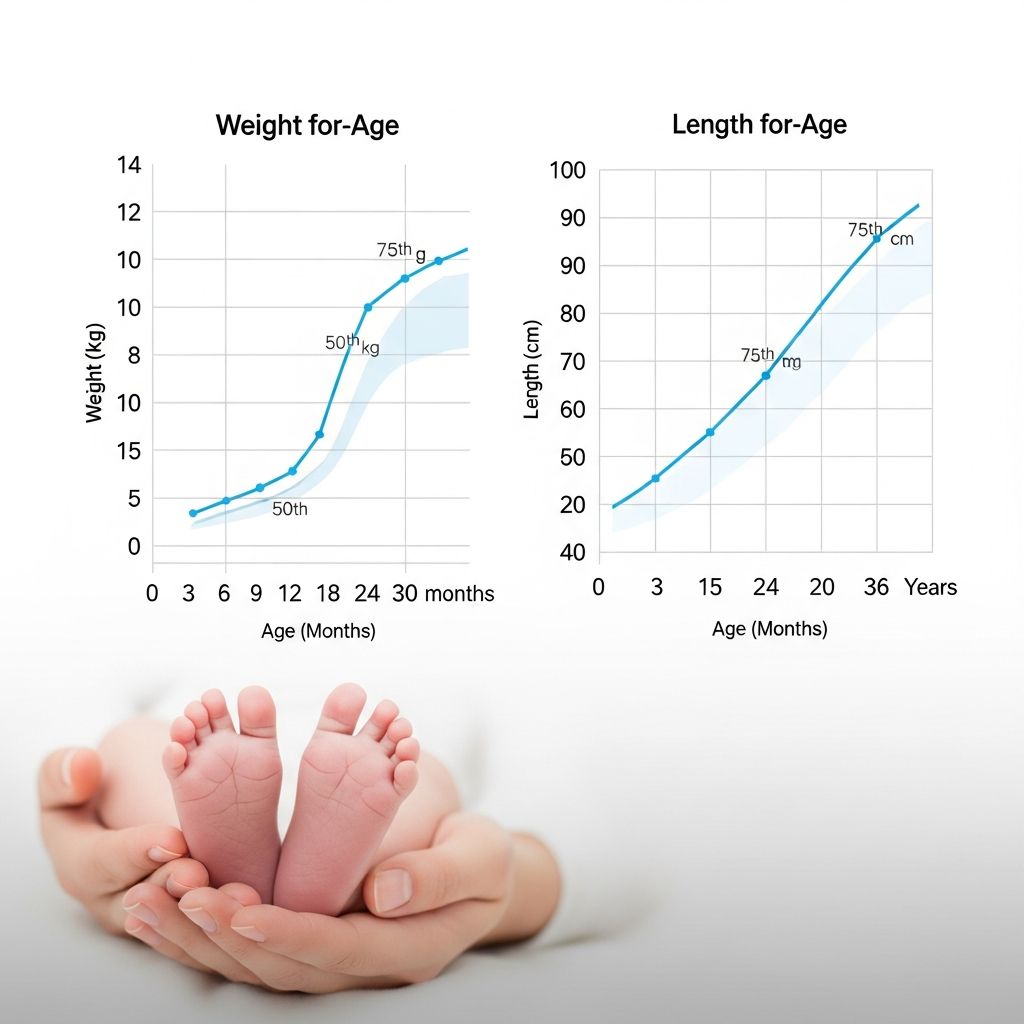
Understanding your baby’s growth trajectory is fundamental to ensuring their health and well-being. Growth charts serve as standardized tools that plot measurements like weight, length, and head circumference against age-specific percentiles, helping parents and pediatricians assess if a child is developing appropriately. These charts, developed from large population studies, provide a benchmark rather than a strict rule, accounting for natural variations in growth patterns.
Understanding Growth Percentiles and What They Mean
Growth percentiles indicate how a baby’s measurements compare to others of the same age and sex. For instance, a baby at the 50th percentile has measurements typical for half the population, while the 10th or 90th percentiles represent the lower or upper ranges. Consistent tracking along the same percentile curve is more important than the exact number, as rapid shifts may signal nutritional or health issues. Pediatric organizations emphasize using separate charts for boys and girls due to inherent differences in growth rates.
Key factors influencing growth include genetics, nutrition, sleep, and overall health. Breastfed infants may initially gain weight more slowly than formula-fed peers but often catch up by the first year. Regular check-ups at well-baby visits—typically at 1, 2, 4, 6, 9, 12, 18, 24, and 36 months—allow for precise plotting and early intervention if needed.
Newborn to 3 Months: The Rapid Early Growth Phase
In the first three months, babies experience their fastest growth spurt, often doubling birth weight by around 4-6 months. Newborns lose 5-10% of birth weight initially due to fluid loss but regain it within two weeks. Average weight gain is 5-7 ounces per week, with length increasing by about 1 inch monthly. Head circumference grows rapidly as the brain triples in size during the first year.
- Physical milestones: Lifts head briefly when prone, tracks objects with eyes, opens and closes hands.
- Social/emotional: Develops social smile by 2 months, enjoys face-to-face play, recognizes parents.
- Cognitive/language: Alerts to sounds, coos and babbles by 3-4 months.
Parents should watch for red flags like not supporting head by 3 months or absence of smiling response, prompting a doctor’s consultation.
4 to 6 Months: Building Strength and Coordination
By 6 months, most babies have doubled their birth weight and gained about 6 inches in length. They transition to solid foods around this time, supporting further growth. Head control strengthens, enabling supported sitting.
| Age | Average Weight (Boys) | Average Weight (Girls) | Average Length |
|---|---|---|---|
| 4 months | 14-16 lbs | 12-15 lbs | 23-25 inches |
| 6 months | 16-18 lbs | 15-17 lbs | 25-27 inches |
Data derived from population standards; individual variations are normal. Milestones include rolling over, reaching for toys, and stranger anxiety emerging around 6-8 months. Babies grasp rattles, laugh, and respond to their name, marking cognitive leaps.
7 to 12 Months: Mobility and Independence Emerge
This period sees babies tripling birth weight by the first birthday, with length increasing by 50%. Crawling, pulling to stand, and first steps often occur. Fine motor skills advance with pincer grasp for finger foods.
- Gross motor: Sits without support, creeps on hands and knees, pulls to stand by 9 months.
- Fine motor: Transfers objects hand-to-hand, bangs toys together.
- Language: Babbles “mama/dada” nonspecifically, follows simple commands with gestures.
Toilet training groundwork begins with awareness of wet diapers. Nutrition shifts to purees and soft solids, ensuring iron-rich foods for brain development.
13 to 24 Months: Toddlerhood Takes Shape
Toddlers grow steadily, adding 4-6 pounds and 4-5 inches yearly. Walking becomes confident, evolving to running and climbing. Weight gain slows as activity increases.
By 18 months, most walk alone, use spoons clumsily, and say 10-20 words. At 24 months, vocabulary explodes to 50+ words, with two-word sentences forming. Socially, they imitate adults, show independence, and engage in parallel play.
| Milestone Category | 13-18 Months | 19-24 Months |
|---|---|---|
| Movement | Walks alone, pulls toys | Runs, kicks ball |
| Hand Skills | Scribbles, stacks blocks | Turns pages, builds tower of 4 |
| Social | Shows affection, defiant | Takes turns, names self |
Red flags include not walking by 18 months or limited words by 24 months.
25 to 36 Months: Refining Skills and Preschool Readiness
By 3 years, children reach about half their adult height, with smoother growth curves. They pedal tricycles, hop on one foot, and use utensils proficiently.
- Physical: Climbs slides independently, throws/kicks ball overhead, dresses self partially.
- Cognitive: 900-1000 word vocabulary, 3-5 word sentences, 75-80% intelligible speech.
- Social/emotional: Associative play, expresses sympathy, greater impulse control.
They name body parts, count simple objects, and show pride in accomplishments. potty training often completes, with independent toileting.
How to Read and Use Growth Charts Effectively
Charts feature curved lines representing 3rd, 5th, 10th, 25th, 50th, 75th, 90th, 95th, and 97th percentiles. Plot weight-for-age, length-for-age, weight-for-length, and head circumference-for-age separately. Tools like the CDC app simplify this for parents. Consistency on or near the same curve indicates healthy growth; crossing two major curves warrants evaluation.
Consult WHO charts for breastfed populations or CDC for general U.S. use. Always discuss with a pediatrician for personalized advice.
Factors Affecting Growth and When to Seek Help
Genetics set potential, but environment matters: balanced diet with proteins, fats, carbs, vitamins; adequate sleep (14-17 hours for newborns, 11-14 for toddlers); and stimulation through play. Illnesses, prematurity, or chronic conditions may alter patterns—preemies follow corrected age charts.
See a doctor if: no weight gain in months, extreme percentiles without family history, or developmental delays like not babbling by 12 months. Early intervention programs can address concerns effectively.
Nutrition Tips to Support Optimal Growth
From birth, breast milk or formula provides complete nutrition. Introduce solids at 6 months: iron-fortified cereals, pureed veggies/fruits, then proteins. Toddlers need 1,000-1,400 calories daily, emphasizing whole foods over juices. Hydration via water/cups post-12 months prevents obesity risks.
Encourage self-feeding for motor skills, even with mess. Limit screens; prioritize active play for gross motor development.
Integrating Growth Tracking with Developmental Milestones
Growth charts complement milestone checklists. Physical growth pairs with motor achievements: e.g., head growth supports cognitive expansion. Track both at home via apps or journals, sharing at visits. Celebrating small wins fosters secure attachment.
Frequently Asked Questions (FAQs)
What if my baby falls off their growth curve?
Growth curves are guidelines; slight variations are common. Consult your pediatrician if crossing two major percentile lines or stagnant growth occurs.
Are there separate charts for boys and girls?
Yes, due to sex-based differences. Use the appropriate one based on your baby’s sex.
When should I worry about head circumference?
Rapid changes or extremes may indicate issues like hydrocephalus. Routine plotting catches this early.
How often are weight and length measured?
At every well-child visit, typically 9 times in the first 3 years.
Do breastfed babies grow differently?
They may follow leaner curves initially; WHO charts reflect this population.
References
- Developmental Milestones – 31 through 36 Months — Nebraska Department of Education. Accessed 2026. https://edn.ne.gov/cms/developmental-milestones-31-through-36-months
- Important Milestones: Birth to 36 Months — New Jersey Department of Health. Accessed 2026. https://www.nj.gov/health/fhs/eis/documents/NJEIS%20brochure%20-%20Updated%20Logo%20-%20No%20bleed.pdf
- Developmental Milestones: Birth to 5 years — Stanford Medicine. Accessed 2026. https://med.stanford.edu/content/dam/sm/pediatricsclerkship/documents/5-Developmental-Milestones-MedU.pdf
- Physical Developmental Milestones — Virtual Lab School. Accessed 2026. https://www.virtuallabschool.org/infant-toddler/physical-development/lesson-2
- Important Milestones By The End Of 3 Years (36 Months) — UC Berkeley. Accessed 2026. https://hia.berkeley.edu/wp-content/uploads/2015/05/3-years-milestone.pdf
- CDC’s Developmental Milestones — Centers for Disease Control and Prevention. 2024-01-15. https://www.cdc.gov/act-early/milestones/index.html