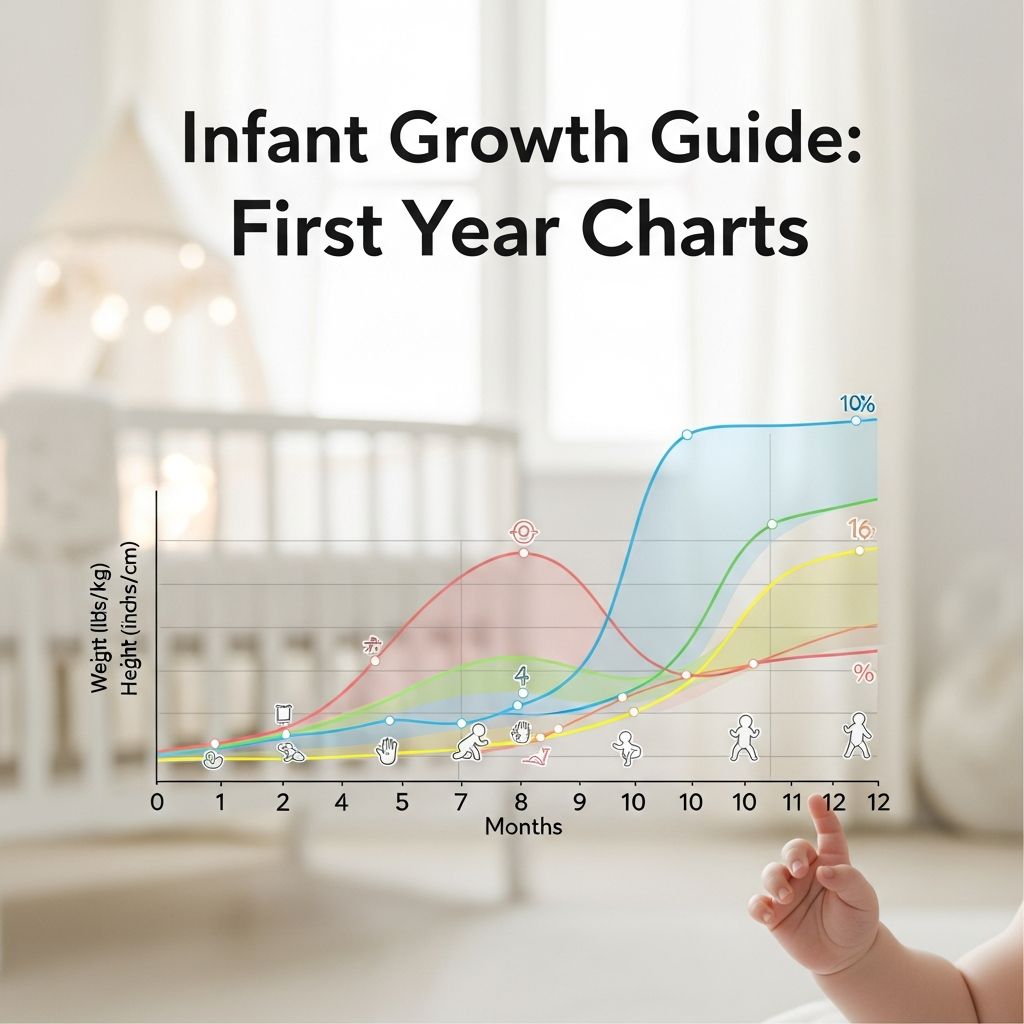
Understanding your baby’s growth trajectory is fundamental to ensuring their health and well-being during the rapid changes of the first year. Pediatric experts use standardized charts to monitor metrics like weight, length, and head circumference, helping parents and doctors spot patterns of healthy progress or potential concerns early on.
Why Monitoring Growth Matters in Infancy
The initial 12 months represent a period of extraordinary physical and cognitive expansion for infants. Growth charts, developed by authoritative bodies such as the CDC, provide percentile rankings that compare a baby’s measurements against large population samples. These tools reveal if a child is following a consistent curve, which is more indicative of health than absolute numbers alone. Consistent tracking at well-child visits allows pediatricians to intervene if growth deviates significantly, potentially addressing issues like nutritional needs or underlying medical conditions.
Key benefits include early detection of growth faltering, reassurance for parents observing wide variations in normal ranges, and guidance on feeding practices. For instance, breastfed and formula-fed babies may follow slightly different patterns, with breastfed infants often appearing leaner after six months.
Understanding Percentiles and Normal Ranges
Percentiles indicate where a baby’s measurement falls compared to peers of the same age and sex. A baby at the 50th percentile weighs more than 50% of infants their age. Importantly, ‘normal’ spans the 5th to 95th percentiles; extremes warrant evaluation but do not automatically signal problems. Trends matter most—steady progress along any curve is ideal.
| Percentile | Meaning | Action Needed |
|---|---|---|
| Below 5th | Smaller than 95% of peers | Monitor closely; consult doctor |
| 5th-95th | Normal range | Regular check-ups |
| Above 95th | Larger than 95% of peers | Monitor for rapid changes |
Sex-specific charts account for average differences, with boys typically heavier and longer than girls.
Average Weight Expectations by Month
Birth weight usually doubles by 5-6 months and triples by the first birthday. Here’s a breakdown of average weights for full-term babies:
- Newborn (0-1 month): Boys: 7.5-8 lbs (3.4-3.6 kg); Girls: 7-7.5 lbs (3.2-3.4 kg)
- 2 months: Boys: 11-12 lbs (5-5.5 kg); Girls: 10-11 lbs (4.5-5 kg)
- 4 months: Boys: 14-15 lbs (6.4-6.8 kg); Girls: 12.5-14 lbs (5.7-6.4 kg)
- 6 months: Boys: 17-18 lbs (7.7-8.2 kg); Girls: 15.5-17 lbs (7-7.7 kg)
- 9 months: Boys: 19-21 lbs (8.6-9.5 kg); Girls: 17.5-19 lbs (7.9-8.6 kg)
- 12 months: Boys: 22-24 lbs (10-10.9 kg); Girls: 20-22 lbs (9.1-10 kg)
These averages derive from CDC data and reflect steady gains of 5-7 ounces weekly early on, slowing to 3-5 ounces monthly later.
Length and Height Progression
Infants grow about 1-1.5 inches monthly in the first half-year, then 0.5-1 inch thereafter, reaching roughly 50% more than birth length by year one. Recumbent length (measured lying down) transitions to standing height around 24 months.
- Newborn: Boys: 19.5-20 inches (49.5-50.8 cm); Girls: 19-19.5 inches (48.5-49.5 cm)
- 6 months: Boys: 25.5-26.5 inches (64.5-67.5 cm); Girls: 24.5-25.5 inches (62-65 cm)
- 12 months: Boys: 29-30 inches (73.5-76 cm); Girls: 28.5-29.5 inches (72-75 cm)
Consistent upward trends on charts confirm healthy skeletal development.
Head Circumference: A Key Indicator
Brain growth drives rapid head expansion in infancy, measured to detect issues like microcephaly or hydrocephalus. Expect 0.5 inches monthly initially.
- Newborn: 13.5-14 inches (34-35.5 cm)
- 6 months: 16.5-17 inches (42-43.5 cm)
- 12 months: 17.5-18 inches (44.5-46 cm)
Deviations prompt neurological assessments.
Developmental Milestones Aligned with Growth
Growth intertwines with motor, social, and cognitive advances. Here’s a month-by-month overview:
Birth to 1 Month
Reflexive movements dominate. Babies lift heads briefly prone, track faces, and startle to sounds.
2 Months
- Lifts head/chest during tummy time
- Social smiles emerge
- Tracks moving objects
4 Months
- Rolls tummy to back
- Grasps rattles, laughs
- Reaches for toys, coos
6 Months
- Sits with support, rocks on all fours
- Babbles consonants (ba, da)
- Transfers objects, stranger awareness
9 Months
- Pulls to stand, immature pincer grasp
- Says mama/dada specifically
- Follows simple commands
12 Months
- Stands alone, first steps possible
- Uses 1-3 words, finger feeds
- Waves, imitates actions
Factors Influencing Growth Patterns
Genetics, nutrition, sleep, and health play roles. Premature babies follow adjusted-age charts. Frequent illnesses or poor feeding can temporarily slow gains, but recovery is common. Breast milk supports optimal growth; introduce solids around 6 months.
When to Consult a Pediatrician
Seek advice if your baby:
- Drops percentiles abruptly
- Shows no weight gain for 2-3 visits
- Misses multiple milestones
- Has feeding difficulties or extreme fussiness
Regular vaccinations and screenings catch issues early.
Practical Tips for Supporting Growth
Offer responsive feeding, tummy time daily, and interactive play. Track measurements at home between visits using printable CDC charts. Ensure safe sleep and hygiene to prevent setbacks.
Frequently Asked Questions
At what age should my baby double birth weight?
Typically by 5-6 months, tripling by 12 months.
Is it normal for growth to slow after 6 months?
Yes, weight gain decreases as activity increases.
What if my baby is always in the 10th percentile?
Consistent curves are healthy; discuss trends with your doctor.
Do boys and girls grow differently?
Boys average larger; use sex-specific charts.
How often are growth checks done?
At 1, 2, 4, 6, 9, and 12 months typically.
References
- A Parent’s Guide to Milestones and Healthy Growth — The Iowa Clinic. 2023. https://www.iowaclinic.com/specialties/primary-care/pediatrics/a-parents-guide-to-milestones-and-healthy-growth/
- Baby Milestones by Month: What to Know At Each Stage — The Bump. 2024. https://www.thebump.com/a/baby-milestone-chart
- Developmental Milestones: Birth to 5 years — Stanford Medicine. 2022. https://med.stanford.edu/content/dam/sm/pediatricsclerkship/documents/5-Developmental-Milestones-MedU.pdf
- Baby Developmental Milestones — Pediatric Associates. 2024. https://www.pediatricassociates.com/health-topics/baby-developmental-milestones
- Baby Developmental Milestones By Month — Cleveland Clinic. 2025-01-10. https://my.clevelandclinic.org/health/articles/22063-baby-development-milestones-safety
- CDC’s Developmental Milestones — Centers for Disease Control and Prevention. 2025. https://www.cdc.gov/act-early/milestones/index.html
- Developmental Milestones Table — University of Washington. 2016-01. https://depts.washington.edu/dbpeds/Screening%20Tools/Devt%20Milestones%20Table%20(B-6y)%20PIR%20(Jan2016).msg.pdf