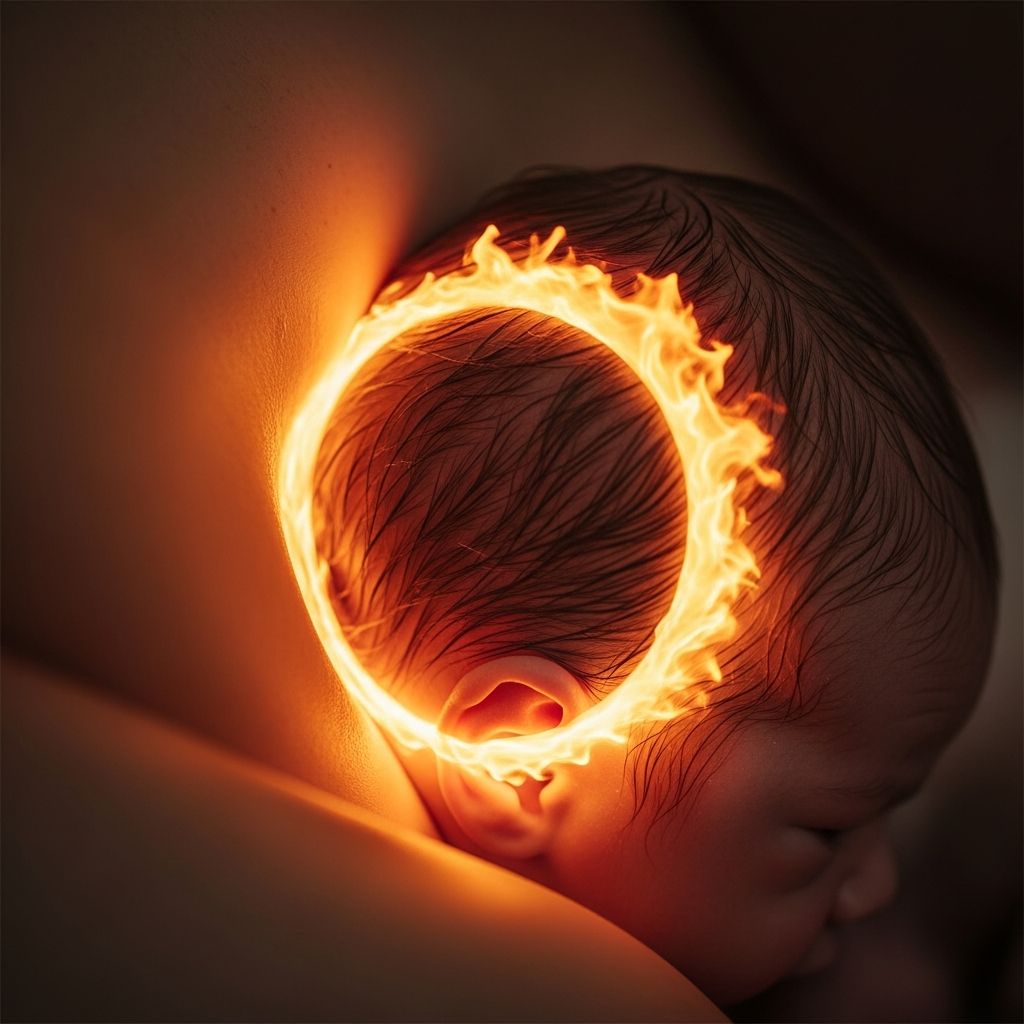
The culmination of labor often brings an unforgettable sensation known as the **ring of fire**, occurring precisely when your baby’s head crowns during vaginal birth. This phase marks the transition from intense pushing to imminent delivery, stretching vaginal tissues to their limit and creating a burning feeling that signals birth is near.
Understanding Labor Stages Leading to Crowning
Labor unfolds in distinct phases, each building toward the moment of crowning. The first stage involves cervical dilation from 0 to 10 cm, split into early labor (0-6 cm, lasting hours to days) and active labor (6-10 cm, typically 4-8 hours). For multiparous women, this accelerates, sometimes shortening to under 12 hours total.
Once fully dilated, the second stage begins: pushing and fetal descent. Here, crowning happens—the visible emergence of the baby’s head that doesn’t recede between contractions. This stage averages 20 minutes to 2 hours for first-time mothers, potentially longer with epidurals, but can be mere minutes for veterans.
- Early Labor: Mild contractions thin and open the cervix gradually.
- Active Labor: Stronger contractions dilate fully; transition phase intensifies.
- Pushing Phase: Baby descends; crowning signals the end.
What Precisely Is Baby Crowning?
**Baby crowning** is the point where the widest part of the baby’s head—the parietal eminences—becomes visible at the vaginal introitus and remains so between pushes. Visually, it resembles a crown encircling the scalp, hence the name. Care providers confirm it by sight or your ability to touch the head, often using mirrors for reassurance.
At this juncture, delivery accelerates: the head may emerge fully within 1-2 contractions, followed swiftly by the shoulders and body. Progress halts the head’s retraction, driven by uterine contractions and controlled maternal effort.
The Intense Sensation: Decoding the Ring of Fire
The **ring of fire** describes the fiery, stretching burn as vaginal tissues expand around the baby’s head. This arises from nociceptors in the perineum firing amid extreme distension, often accompanied by poop-like pressure from pelvic floor engagement.
Sensations vary: unmedicated births yield sharp burning; epidurals dull it to pressure. Intensity peaks briefly (seconds to minutes per contraction) before natural nerve blockade induces numbness, acting like a built-in analgesic as tissues thin. First-time mothers may endure it across multiple contractions; subsequent births shorten it.
| Sensation | Common Description | Duration | Influencing Factors |
|---|---|---|---|
| Burning | Fiery ring around vagina | Seconds-minutes | No epidural, first birth |
| Pressure | Heavy, bowel-full feeling | Throughout push | Epidural use |
| Numbness | Loss of pain post-stretch | Immediate after peak | Tissue blockade |
Strategies for Navigating Crowning Smoothly
Resist the urge to push frantically upon crowning—relaxation minimizes trauma. Providers coach ‘puffing’ breaths or passive descent, letting contractions advance the head millimeter by millimeter. This ‘hands-off’ approach, if fetal monitoring permits, reduces tearing odds.
Perineal massage antenatally enhances elasticity; warm compresses during labor support tissues. Positions like hands-knees or side-lying ease passage for occiput-posterior babies.
- Breathe deeply: Pant to override push reflex.
- Follow cues: Heed midwife’s timing.
- Visualize: Seeing the head motivates many.
Perineal Trauma: Degrees, Risks, and Prevention
Tearing affects 53-79% of vaginal births, graded by depth. Controlled crowning curbs severity.
| Tear Grade | Areas Affected | Treatment | Recovery | Complications |
|---|---|---|---|---|
| First-Degree | Skin only | None/Sutures | Days | Minimal |
| Second-Degree | Skin + vaginal muscle | Sutures | Weeks | Stinging urination |
| Third-Degree | Perineum + anal sphincter | Surgery | Weeks-Months | Incontinence risk |
| Fourth-Degree | Full to rectum | Surgery | Months | Severe incontinence, dyspareunia |
Episiotomies, once routine, now rare unless urgent, as slow crowning often suffices. Postpartum care includes stool softeners, hygiene, and pelvic floor therapy.
Factors Shaping Your Crowning Experience
Primiparity prolongs it; baby size, position (anterior ideal), and interventions like forceps alter dynamics. Epidurals extend pushing but mute pain. Fetal heart rate guides pacing—healthy tracings allow leisure.
- Maternal Fitness: Strong pelvic floors aid control.
- Birth History: Multiparas crown faster.
- Interventions: Avoid rushed pushing.
Emotional Realms of the Crowning Moment
Elation mixes with overwhelm; some thrill at the head’s sight, others feel visceral intensity. Validation normalizes all reactions—labor’s raw power unites birthers universally.
Frequently Asked Questions About Baby Crowning and Ring of Fire
Is the ring of fire always painful?
Not uniformly; it burns intensely but numbs quickly via nerve compression. Epidurals transform it to pressure.
How long does crowning last?
Variable: minutes for veterans, up to hours for first-timers, averaging 20-120 minutes.
Can I prevent tearing during crowning?
Yes, via slow pushing, perineal support, and positions. 53-79% still tear mildly.
What if crowning stalls?
Providers monitor; interventions like vacuum assist if needed, prioritizing safety.
Does crowning differ with epidural?
Yes, less burning, more pressure; may prolong stage.
Preparing Mentally and Physically for Success
Antenatal classes demystify crowning; doula support empowers. Post-birth, celebrate this gateway to holding your newborn—the ring of fire fades, joy endures.
Expand knowledge with birth plans incorporating crowning preferences. Hydrate, rest between pushes, trust your team. Vaginal birth’s resilience shines here, fostering rapid recovery and bonding.
References
- Baby Crowning: What (and When) Is It and What Does It Feel Like? — Healthline. 2023-10-15. https://www.healthline.com/health/pregnancy/baby-crowning
- Ring of Fire Birth: What Is Baby Crowning? — The Bump. 2024-02-20. https://www.thebump.com/a/baby-crowning
- Birth Crowning — Hello Doktor. 2023-05-10. https://hellodoktor.com/en/birth-crowning/
- What Happens During Baby Crowning and How It Feels — WebMD. 2024-01-08. https://www.webmd.com/baby/baby-crowning-overview
- Baby Crowning — American Pregnancy Association. 2023-11-12. https://americanpregnancy.org/healthy-pregnancy/labor-and-birth/baby-crowning/