Supporting Personal Care Development During the Adolescent Years
Adolescence represents a significant transition for all teenagers, but for young people on the autism spectrum, this period brings distinctive challenges alongside typical developmental changes. As bodies mature and social expectations shift, teenagers with autism spectrum disorder (ASD) must navigate new self-care responsibilities while managing the sensory sensitivities, executive function differences, and learning styles that characterize their condition. Developing competence in personal hygiene and grooming represents far more than simply maintaining cleanliness—these skills form the foundation for independence, social integration, and long-term quality of life.
Parents and caregivers often find that strategies effective during childhood require substantial modification during the teenage years. The emergence of puberty introduces new bodily changes that demand unfamiliar hygiene practices, from deodorant use to menstruation management or facial hair grooming. Simultaneously, adolescents with autism may struggle to recognize social cues from their peers regarding grooming standards, making explicit instruction increasingly necessary. Understanding how autism affects self-care development, combined with knowledge of evidence-based teaching approaches, enables families to create supportive environments where teenagers can develop these critical life skills.
Recognizing Why Self-Care Challenges Emerge in Autism
Personal care difficulties in autistic teenagers stem from several interconnected factors rooted in how autism affects neurological processing and behavioral learning. Rather than reflecting lack of motivation or capability, these challenges represent genuine differences in how autistic individuals process sensory information, organize sequential tasks, and understand social expectations.
Sensory Processing Differences
Many autistic teenagers experience heightened sensitivity to sensory stimuli, making routine hygiene activities genuinely uncomfortable or distressing. Water temperature, the texture of soap or toothbrush bristles, the sound of running water, and the smell of personal care products can all trigger defensive responses. A teenager who finds typical toothbrush bristles painful, for instance, is not being difficult—they are experiencing genuine sensory discomfort. Similarly, the feeling of water on skin during bathing, the sensation of deodorant application, or the texture of clean clothing may provoke anxiety or avoidance behaviors. These sensory differences are neurological in nature and require accommodation rather than punishment or coercion.
Executive Function and Task Organization
Autistic teenagers frequently struggle with executive functioning—the mental processes that enable planning, sequencing, time management, and task initiation. Showering, for example, involves numerous sequential steps: undressing, adjusting water temperature, washing different body areas in logical order, rinsing, drying, and dressing. For teenagers with executive function challenges, even remembering this sequence or initiating the process without prompting can prove difficult. They may begin one step and forget what comes next, or struggle to understand why each component matters. This is not laziness; it reflects genuine cognitive processing differences that require structured external support.
Social Understanding and Peer Awareness
Autistic teenagers typically pay less attention to social modeling from peers than their non-autistic counterparts. When classmates change deodorant brands, upgrade grooming routines, or modify clothing choices based on social trends, autistic teenagers may not notice or understand the significance of these shifts. This reduced sensitivity to peer social cues means that motivation based on “fitting in” may be ineffective. Instead, teenagers need explicit instruction about why hygiene matters and direct teaching about age-appropriate practices, rather than assumption that they will naturally absorb these standards through observation.
Establishing Foundation Routines During Puberty
The onset of puberty necessitates introducing new hygiene practices and explaining physical changes in concrete, non-judgmental terms. Rather than assuming a teenager understands why these new routines matter, parents should provide clear explanations anchored to observable facts.
When introducing new hygiene expectations, frame explanations around biological reality: “During puberty, your body produces more sweat and oils. Sweat can create odors that most people find unpleasant, so we wash regularly and use deodorant.” This approach avoids shame-based language while establishing clear rationale. Similarly, explaining that hormonal changes affect skin by stating “Your skin produces more oils during puberty, which is why some people get pimples. Washing twice daily helps keep skin clean” provides practical understanding.
Consider implementing a daily schedule that encompasses all personal care needs:
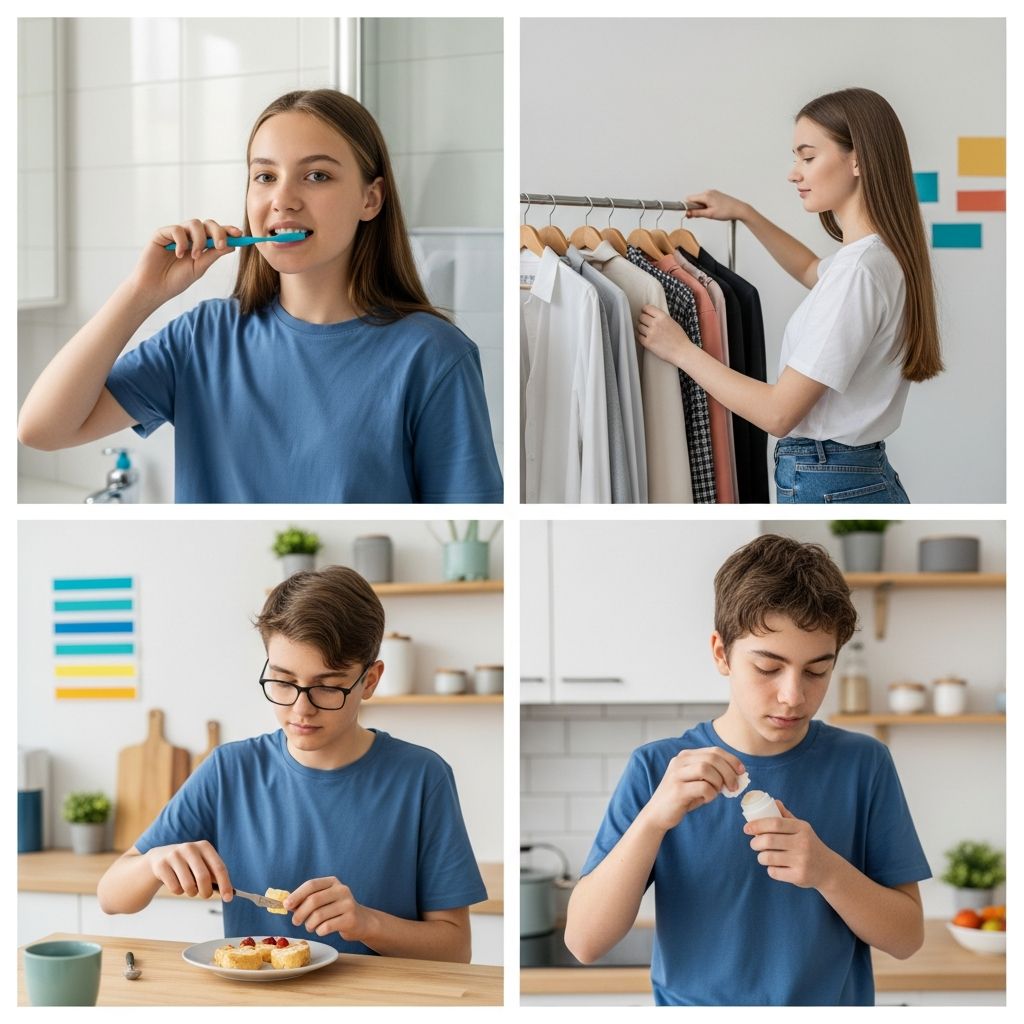
- Morning routine: Using the toilet, washing hands and face, brushing teeth, applying deodorant, getting dressed in clean clothes, and eating breakfast
- Daytime maintenance: Handwashing before meals and after bathroom use, reapplying deodorant if needed, and changing clothes if visibly soiled
- Evening routine: Bathing or showering, washing face, brushing teeth, putting on clean pajamas, and preparing for sleep
Consistency across days and weeks helps autistic teenagers internalize these patterns until they become more automatic. When routines remain constant, teenagers expend less mental energy on task sequencing and can focus on skill development.
Leveraging Visual Systems and Structured Supports
Autistic teenagers typically demonstrate strong visual learning preferences, making visual supports among the most effective teaching tools available. Unlike verbal instructions that may disappear once spoken, visual systems provide persistent, accessible reference materials that teenagers can consult independently.
Creating Effective Visual Schedules
A visual schedule breaks hygiene routines into discrete, manageable steps displayed through pictures, words, or combinations of both. The schedule for showering, for instance, might display sequential steps: removing clothes, stepping into shower, wetting hair, applying shampoo, rinsing thoroughly, applying body wash, washing underarms and genitals, rinsing completely, exiting shower, drying body systematically, applying deodorant, and dressing in clean clothes. Posting this schedule in the bathroom where it is visible during the actual routine allows the teenager to reference it without requiring parental prompts.
Visual schedules work most effectively when they:
- Use clear, recognizable images that accurately depict the action (photographs work better than abstract clip art for many autistic learners)
- Present steps in logical, chronological order
- Include enough detail to guide action without overwhelming with information
- Use consistent formatting so the teenager can quickly locate and interpret each step
- Remain accessible in the locations where routines occur
Social Stories as Teaching Tools
Social stories—personalized narratives describing situations, expected behaviors, and reasons for those expectations—help autistic teenagers understand the “why” behind hygiene practices. A social story about deodorant use might explain: “When I reach puberty, my body produces more sweat. Sweat on my skin can create an odor. People enjoy being near others who smell fresh and clean. I use deodorant under my arms to help me smell fresh. Using deodorant is something many teenagers do.” This approach makes implicit social expectations explicit while normalizing the behavior.
Managing Sensory Sensitivities in Self-Care Products
Rather than forcing teenagers with sensory sensitivities to tolerate uncomfortable products, strategic modifications allow them to maintain hygiene while avoiding genuine distress. This represents accommodation, not accommodation, and builds positive associations with self-care routines.
| Hygiene Task | Common Sensory Challenges | Potential Adaptations |
|---|---|---|
| Toothbrushing | Bristle texture, flavor, gag reflex, minty sensation | Soft-bristled toothbrushes, child-formulated toothpaste, unflavored options, weighted toothbrushes for better control |
| Bathing/Showering | Water temperature, water pressure, soap texture, product scents | Temperature-controlled shower heads, adjustable water pressure, fragrance-free or lightly scented products, specific body wash textures |
| Deodorant Application | Scent intensity, sticky texture, application sensation | Unscented or mildly scented options, stick versus spray versus roll-on formats, practice with neutral-scent products first |
| Hair Care | Brush/comb resistance, water in hair, shampoo/conditioner texture | Wide-toothed combs, gentle brushing techniques, conditioning sprays, specific product brands the teenager prefers |
| Shaving (if applicable) | Razor blade sensation, shaving cream texture, skin irritation | Electric razors, weighted razors for better control, pre-shave oils, specific shaving cream formulations |
Offering choices within these parameters—allowing the teenager to select among several acceptable deodorant brands, soap textures, or toothpaste flavors—simultaneously addresses sensory needs and builds autonomy and investment in the process.
Building Independence Through Gradual Responsibility Increase
Autistic teenagers benefit from gradually expanding their self-care responsibilities rather than sudden, wholesale transitions to independence. This scaffolded approach allows skill-building while preventing the anxiety that can accompany abrupt changes.
Initially, a parent might completely manage a routine while narrating each step aloud: “Now I’m wetting your hair with warm water. I’m applying shampoo and massaging it into your scalp.” Next, the parent continues managing the task while the teenager watches a visual schedule or video model. Subsequently, the teenager begins participating in specific steps while the parent provides physical guidance. Gradually, the parent provides only verbal rempts, then gesture prompts, then subtle cues. Eventually, the teenager performs the routine independently, with the parent monitoring from a distance. This progression acknowledges that skill development occurs across a continuum rather than suddenly “clicking” into place.
Celebrate incremental progress explicitly. Rather than assuming independence is obvious, acknowledge specific achievements: “You remembered to brush your teeth without me reminding you today. That shows you are learning this routine really well.”
Addressing Period Management and Menstruation
Autistic teenagers who menstruate require explicit instruction about period management, including recognizing when menstruation has begun, understanding the timeline of typical periods, selecting and using period products appropriately, and managing hygiene during menstruation. Many autistic teenagers do not naturally understand these processes or recognize when menstruation is beginning.
Teaching about periods should include concrete facts: “You will have menstruation once per month. Menstruation lasts about 5 to 7 days. During menstruation, blood comes from your uterus and exits your body. You need to wear a period product to catch the blood so it does not stain your clothes.” Explain available product options (pads, tampons, menstrual cups) with honest information about how each works. Some autistic teenagers prefer specific product types based on sensory preferences—some find pads less intrusive while others prefer tampons or cups.
Create a visual chart marking menstruation dates, allowing the teenager to recognize patterns and anticipate upcoming periods. Include reminders about changing products regularly and disposing of used products appropriately. For some teenagers, a period-tracking app or calendar notification helps with prediction and preparedness.
Frequently Asked Questions
Can sensory sensitivities be overcome, or must accommodations continue indefinitely?
Sensory sensitivities are neurological in nature and typically persist throughout life, though individuals can develop coping strategies and increased tolerance over time. Rather than viewing accommodation as a temporary crutch, consider it an ongoing support that allows the teenager to maintain hygiene without unnecessary distress. Some sensory sensitivities may decrease with maturation and exposure, but forcing discomfort rarely produces this outcome.
What if my teenager refuses to bathe despite repeated attempts and visual supports?
Persistent refusal often signals underlying sensory distress, anxiety, or executive function overwhelm rather than deliberate defiance. Try isolating the specific problem: Is the issue water temperature? The sensation of water pressure? Undressing? Product smells? Once identified, address that specific barrier through sensory modification. Consider whether bathing frequency can be reduced while maintaining adequate hygiene, or whether alternative cleansing methods (sponge baths, shower versus tub) might prove more tolerable.
Should rewards or consequences be used to motivate hygiene compliance?
External reward systems can be helpful for building routine habits, but they should be age-appropriate and tied to skill development rather than compliance for its own sake. Positive reinforcement when the teenager completes routine steps independently (“You did an excellent job brushing your teeth today”) can reinforce behavior. Consequences for refusing hygiene are generally less effective than identifying and addressing the underlying barrier causing resistance.
Is it normal for an autistic teenager to require ongoing reminders for hygiene routines?
Yes. Executive function differences mean that many autistic teenagers require external reminders throughout adolescence and into adulthood to initiate self-care routines, even if they can perform the actual tasks independently once begun. Gradual reduction of reminders can occur, but expecting complete independence without any prompting may be unrealistic for many autistic teenagers.
References
- Personal hygiene for autistic pre-teens and teenagers — Raising Children Australia. 2024. https://raisingchildren.net.au/autism/health-wellbeing/toileting-hygiene/personal-hygiene-autistic-teens
- Teen with autism needs help with hygiene & appropriate behavior — Autism Speaks. 2024. https://www.autismspeaks.org/expert-opinion/teen-autism-needs-help-hygiene-appropriate-behavior
- Autism and Hygiene: Tips for Parents of Teens on the Spectrum — Autism Parenting Magazine. 2024. https://www.autismparentingmagazine.com/approach-asd-teen-about-hygiene/
- Autism in the Teen Years: What to Expect, How to Help — Kennedy Krieger Institute. 2024. https://www.kennedykrieger.org/stories/interactive-autism-network-ian/autism_in_teens
- Teaching Hygiene to Students with Autism: Your Trusted Guide — Rise Up for Autism. 2024. https://riseupforautism.com/blog/autism-hygiene-checklist
- Hygiene Tips for Teens — Milestones Autism Resources. 2024. https://www.milestones.org/map/browse-articles/hygiene-tips-for-teens
- Staying clean and healthy — Leicestershire Partnership NHS. 2024. https://www.leicspart.nhs.uk/autism-space/health/staying-clean-and-healthy/