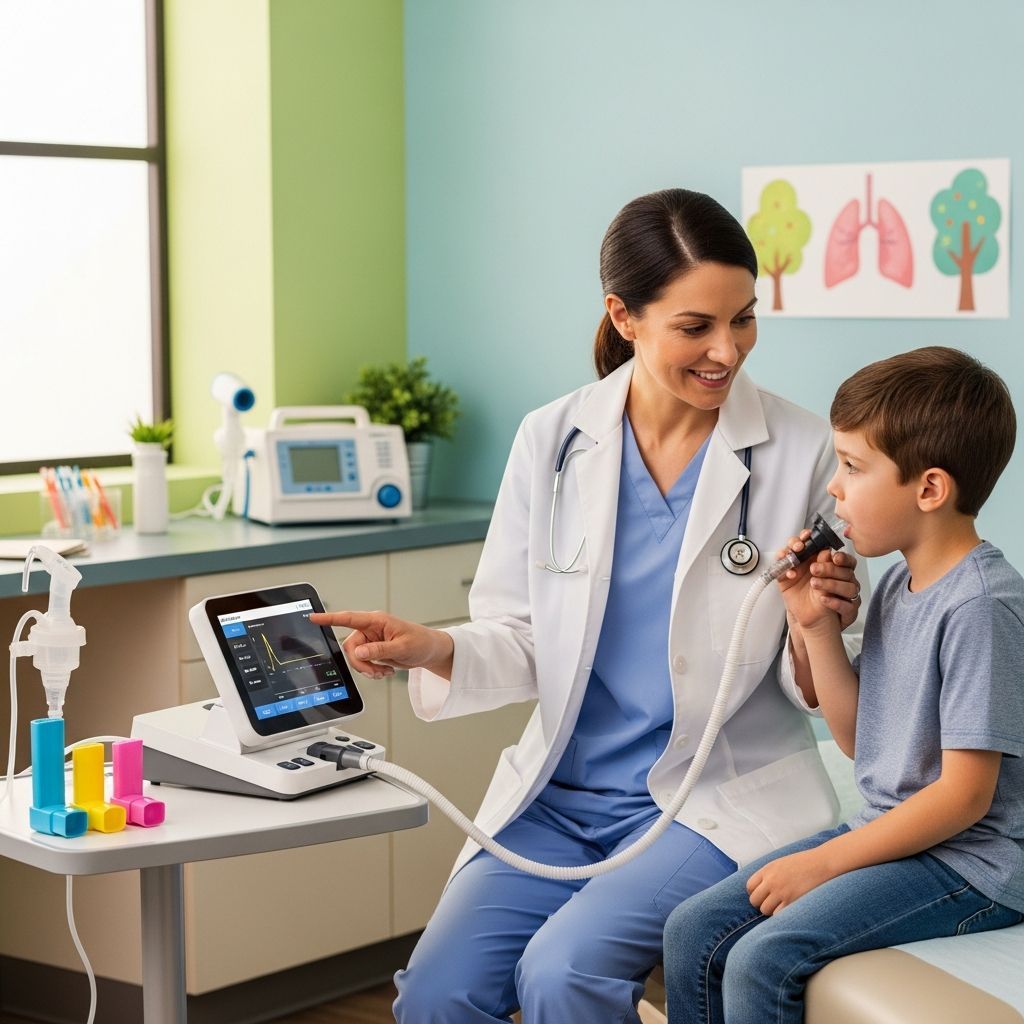
When your child has ongoing coughing, wheezing, or trouble breathing, their doctor may recommend tests to check for asthma. Understanding how these tests work can make the process less stressful and help you feel more confident in the care your child receives.
This guide explains the main types of asthma tests used in children, what they show, and how the results help doctors confirm a diagnosis and plan treatment.
Why Doctors Test Children for Asthma
Asthma is a chronic condition where the airways become inflamed and narrowed, making it hard to breathe. Typical symptoms include:
- Wheezing or whistling sounds when breathing
- Frequent or persistent coughing, especially at night or with exercise
- Shortness of breath or fast breathing
- Chest tightness or discomfort
These symptoms can also be caused by other conditions, such as respiratory infections, structural airway problems, or allergies, so tests are important to help distinguish asthma from other issues.
There is no single perfect test that proves a child has asthma. Instead, doctors combine:
- A detailed medical history and symptom review
- A physical examination
- One or more breathing and allergy tests
- How much the child improves with asthma medications
Together, this information gives a clearer picture of whether asthma is the most likely diagnosis.
First Step: History and Physical Examination
Before ordering any tests, your child’s clinician will ask questions and examine your child. This first step guides which tests are most useful.
Questions You May Be Asked
- What symptoms does your child have (coughing, wheezing, shortness of breath, chest tightness)?
- When do symptoms happen (at night, with colds, during exercise, with exposure to animals or pollen)?
- How often symptoms occur and how long they last
- Whether symptoms wake your child at night or limit play, sports, or school activities
- Any known allergies, eczema, or food reactions
- Family history of asthma, allergies, or other lung conditions
- Exposure to tobacco smoke, pollution, or other irritants at home or school
- What medicines you’ve tried and how well they worked
What the Physical Exam Looks For
The doctor may:
- Listen to your child’s chest for wheezing or other unusual sounds
- Look for signs of labored breathing, such as skin pulling in between the ribs or at the neck
- Check the nose, throat, and skin for signs of allergies or infection
- Measure oxygen levels with a painless fingertip sensor (pulse oximeter), if needed
If asthma is suspected, the next step is usually a lung function test, if your child is old enough to cooperate.
Age Matters: Testing Options by Age Group
Asthma testing is adjusted based on a child’s age and ability to follow instructions.
| Age Group | Common Testing Approaches |
|---|---|
| Under 5 years | History, exam, careful observation, trial of asthma medications; limited lung tests because they are hard to perform. |
| 5–7 years | Simple lung function tests such as spirometry or impulse oscillometry in some centers, plus symptom review and response to treatment. |
| Over 7 years | Standard lung function tests (spirometry, FeNO, peak flow) and, if needed, more specialized tests. |
Key Lung Function Tests Used in Children
Lung function tests measure how well air moves in and out of your child’s lungs. They help show whether the airways are narrowed or inflamed, which is typical in asthma.
Spirometry: Measuring Airflow In and Out
Spirometry is one of the most common tests to evaluate asthma in school-age children.
How the test works:
- Your child wears a soft nose clip to keep air from leaking out of the nose.
- They take a deep breath in and then blow out as hard and fast as they can into a tube connected to a machine called a spirometer.
- The test is usually repeated several times to get consistent results.
What spirometry measures:
- FEV1 (forced expiratory volume in one second): how much air your child can blow out in the first second of exhaling.
- FVC (forced vital capacity): the total amount of air they blow out after a deep breath.
- The ratio FEV1/FVC, which shows how much air flow is limited.
If your child’s FEV1 is lower than expected for their age, height, and sex, it suggests narrowed airways.
Bronchodilator Response Test
To see how reversible the airway narrowing is, doctors often repeat spirometry after giving a quick-acting asthma medicine.
- Your child inhales a bronchodilator medication (such as albuterol) that relaxes the airway muscles.
- After several minutes, spirometry is done again.
- If the FEV1 increases significantly, it supports a diagnosis of asthma, because asthma usually improves with bronchodilators.
Fractional Exhaled Nitric Oxide (FeNO): Checking Airway Inflammation
The FeNO test measures how much nitric oxide is in your child’s breath. Higher levels are linked with allergic airway inflammation, which is common in asthma.
What to expect:
- Your child takes a steady breath into a handheld device through a mouthpiece.
- The machine analyzes the exhaled air and reports how much nitric oxide is present.
A higher FeNO level makes asthma more likely, especially when combined with typical symptoms, but a normal FeNO does not completely rule out asthma.
Peak Flow Meter: Simple Daily Monitoring
A peak flow meter is a small, portable device that measures how fast your child can blow air out of their lungs.
How it is used:
- Your child takes a deep breath and blows into the meter as hard and fast as possible.
- The device shows a number called the peak expiratory flow (PEF).
- Readings are often taken twice a day over several weeks and recorded in a diary.
By looking at patterns in these readings and comparing them with symptoms, doctors can see how stable or variable your child’s lung function is. Large day-to-day swings are typical in asthma.
Additional and Specialized Tests
Most children are diagnosed using history, exam, and basic lung function tests. When the diagnosis remains unclear or symptoms are unusual, more specialized tests may be considered.
Bronchoprovocation (Challenge) Tests
Bronchoprovocation tests check how sensitive the airways are to specific triggers.
- The child breathes in a substance (such as methacholine) or exercises under supervision.
- Spirometry is performed before and after exposure.
- A drop in FEV1 after the challenge suggests airway hyperreactivity, a hallmark of asthma.
These tests are usually done in specialty centers with emergency equipment and trained staff, because they intentionally provoke temporary airway narrowing.
Impulse Oscillometry and Plethysmography
Some hospitals offer advanced lung testing for younger children or complex cases.
- Impulse oscillometry: The child breathes quietly into a mouthpiece while the device uses sound waves to measure resistance in the airways. It is helpful for children unable to perform forceful exhalations.
- Plethysmography: The child sits in a clear booth and breathes into a mouthpiece while changes in pressure and volume are measured. This provides total lung capacity and can help distinguish asthma from muscle weakness or other lung diseases.
Allergy Testing and Blood Tests
Because allergies are a major trigger for asthma in many children, allergy evaluation can be helpful.
- Skin prick tests expose the skin to tiny amounts of common allergens (such as dust mites, pollens, or animal dander) to check for an allergy response.
- Blood tests can measure total and specific immunoglobulin E (IgE) levels or blood eosinophil counts, which are often higher in allergic asthma.
Finding relevant allergies allows families to reduce exposure and tailor treatment more precisely.
Imaging and Bronchoscopy (For Selected Cases)
Most children with typical asthma patterns do not need imaging or invasive procedures. However, in some situations doctors may order additional tests.
- Chest X-ray: To look for pneumonia, structural problems, or foreign bodies that could mimic asthma.
- Bronchoscopy: A specialist passes a thin camera into the airways under sedation to directly view the tissues and, if needed, collect samples. This is reserved for children with unusual, severe, or persistent symptoms, or when other diseases are suspected.
How Doctors Put the Pieces Together
Asthma is diagnosed by combining all the available information rather than relying on one test result.
Doctors look for:
- Typical symptoms that come and go over time
- Triggers such as exercise, viral infections, allergens, or cold air
- Evidence of variable airflow obstruction on spirometry or peak flow monitoring
- Improvement after bronchodilators or controller medicines
- Signs of allergic inflammation (e.g., FeNO, allergy tests, blood markers)
In very young children who cannot do lung tests, a trial of asthma medication over several weeks and close follow-up is often used to see whether symptoms improve.
How Test Results Guide Treatment and Follow-Up
Once asthma is diagnosed or strongly suspected, tests continue to play a role in monitoring how well treatment is working.
- Spirometry may be repeated at regular intervals to track lung function over time.
- Peak flow meters can help families follow day-to-day control at home and recognize early signs of worsening asthma.
- FeNO and other markers can be used in some settings to monitor airway inflammation and adjust anti-inflammatory medicines.
Your child’s clinician may provide a written asthma action plan that uses symptoms and, in some cases, peak flow zones (for example, green, yellow, red) to explain what steps to take as asthma changes.
Helping Your Child Prepare for Testing
Parents can play an important role in making asthma testing easier for children.
- Explain in simple language what will happen (for example, “You will blow into a tube like blowing out birthday candles.”)
- Practice taking deep breaths and blowing out at home.
- Reassure your child that the tests are safe and that you will stay with them.
- Follow any instructions you receive about medicines to stop before testing, as some drugs can affect results.
Frequently Asked Questions (FAQs)
Q: Can my child have asthma even if their test results look normal?
Yes. Some children have normal results when they are not having symptoms. In those cases, doctors may repeat tests during flare-ups, use challenge tests, or rely more on symptom patterns and response to medications to make a diagnosis.
Q: Are asthma tests painful or dangerous?
Most common tests, such as spirometry, FeNO, and peak flow, are noninvasive and painless. Challenge tests and bronchoscopy carry small risks, so they are done only when clearly needed and always under close medical supervision in appropriate facilities.
Q: How long does it take to find out if my child has asthma?
Some children can be diagnosed at the first visit if symptoms, exam findings, and tests fit a clear pattern. In other cases, doctors may monitor your child over weeks or months, repeat tests, or try medications to see how symptoms change before confirming the diagnosis.
Q: Why does my child need repeat lung function tests?
Asthma changes over time. Repeating tests helps track whether your child’s lungs are improving, staying stable, or getting worse, and allows the care team to adjust medications and triggers avoidance strategies as needed.
Q: What should I bring to the appointment?
Bring a list of your child’s symptoms (including when they happen), all medications and doses, any previous test results, and information about family history and environmental exposures, such as smoke or pets. This helps the clinician choose the most appropriate tests and interpret them accurately.
References
- Testing for your child’s asthma — Asthma + Lung UK. 2023-09-21. https://www.asthmaandlung.org.uk/conditions/asthma/child/diagnosis/tests
- Childhood asthma: Diagnosis & treatment — Mayo Clinic. 2023-04-11. https://www.mayoclinic.org/diseases-conditions/childhood-asthma/diagnosis-treatment/drc-20351513
- Diagnosing Asthma in Children — HealthyChildren.org (American Academy of Pediatrics). 2022-07-12. https://www.healthychildren.org/English/health-issues/conditions/allergies-asthma/Pages/Diagnosing-Asthma.aspx
- Diagnosing Asthma in Children — NYU Langone Health. 2023-05-30. https://nyulangone.org/conditions/asthma-in-children/diagnosis
- How Is Asthma Diagnosed? — American Lung Association. 2023-02-08. https://www.lung.org/lung-health-diseases/lung-disease-lookup/asthma/symptoms-diagnosis/how-is-asthma-diagnosed
- Diagnosis and management of asthma in children — BMJ. 2019-03-01. https://pmc.ncbi.nlm.nih.gov/articles/PMC9045042/
- Asthma — NHS. 2023-06-30. https://www.nhs.uk/conditions/asthma/