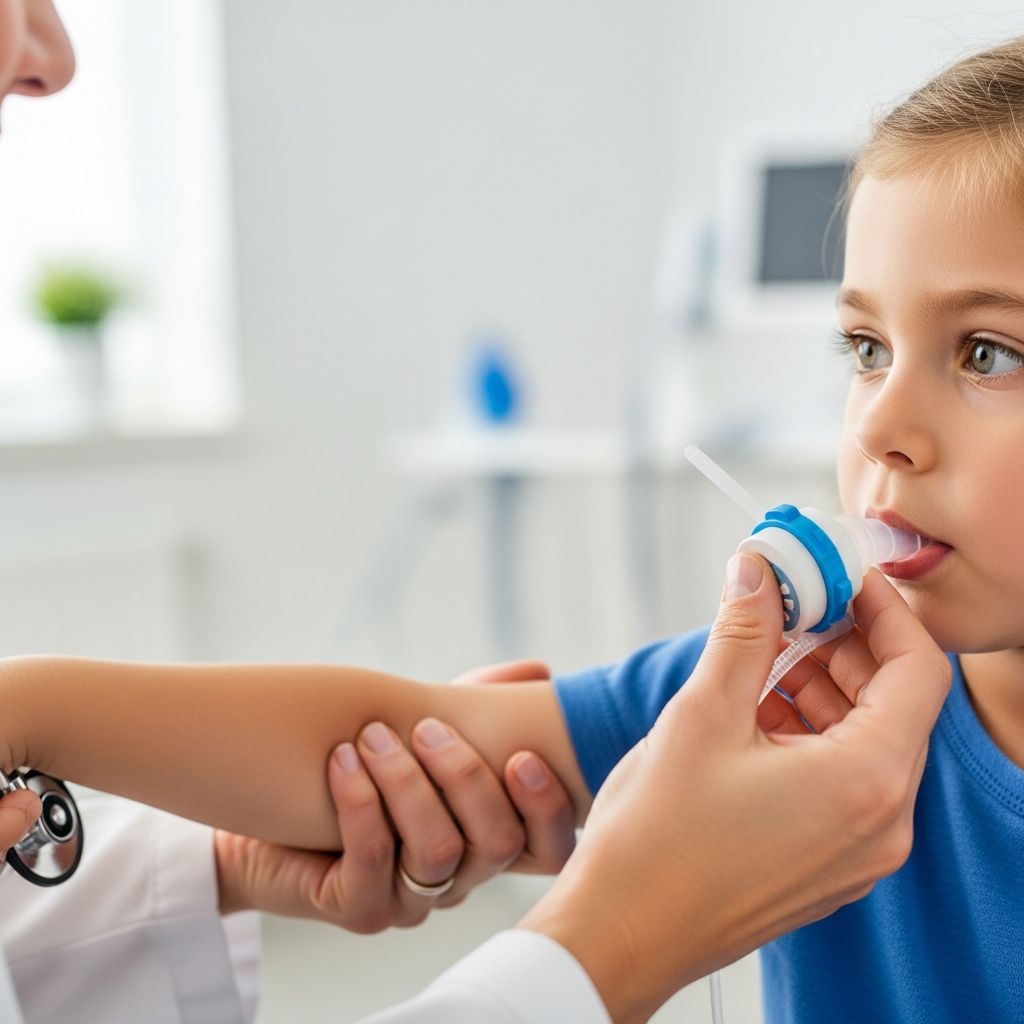
Asthma is one of the most common chronic conditions in childhood, but confirming the diagnosis is not always straightforward. Doctors use a combination of your child’s symptoms, medical history, physical exam, and specific tests to work out whether asthma is the cause of breathing problems.
This guide explains the most commonly used asthma tests in children, what they feel like from a child’s perspective, what the results mean, and how they help your child’s care team create a safe and effective treatment plan.
Why Doctors Test Children for Asthma
There is no single test that can prove or rule out asthma on its own. Instead, doctors gather pieces of information from several sources and put the puzzle together.
- Symptoms – such as wheeze, cough, shortness of breath, or chest tightness that come and go.
- Triggers – including viral infections, exercise, cold air, smoke, pollen, pets, or dust mites.
- Pattern over time – how often the symptoms happen, whether they disturb sleep, and how they affect play and school.
- Family and personal history – including eczema, hay fever, allergies, or relatives with asthma or allergic conditions.
- Physical examination – listening to the chest, observing the breathing pattern, and checking growth and overall health.
- Test results – lung function tests and, when needed, allergy or blood tests.
Testing is especially important because many other conditions can mimic asthma in children, such as airway infections, anatomical narrowing of the airways present from birth, or other lung diseases.
Age Matters: How Testing Differs in Younger and Older Children
Some asthma tests require your child to follow quite specific breathing instructions. This is easier for older children and teenagers than for toddlers or preschoolers.
| Age Group | Common Approaches |
|---|---|
| Under 5 years |
|
| 5 years and older |
|
Key Lung Function Tests Used in Children
Lung function tests help show how well your child’s airways are working and whether they are narrower or more reactive than expected. These tests also help monitor how well treatment is working over time.
Spirometry: Measuring How Hard and Fast Your Child Can Breathe Out
Spirometry is one of the most widely used tests for children old enough to follow breathing instructions, often around age 5–7 and above.
- Your child takes a deep breath in and then blows out as hard and as fast as possible into a mouthpiece connected to a machine called a spirometer.
- The machine records how much air is blown out and how quickly, producing measurements such as FEV1 (the amount of air exhaled in one second) and FVC (total exhaled volume).
- The test may be repeated several times to ensure consistent results, with rests in between.
If the results show that your child’s airways are narrowed, this supports a possible asthma diagnosis. However, normal spirometry does not completely rule out asthma, especially if symptoms come and go.
Bronchodilator Response Test: Does Medicine Open the Airways?
To check whether airway narrowing improves with asthma medication, doctors often perform spirometry before and after giving a bronchodilator (reliever) medicine, such as albuterol.
- Your child first completes spirometry.
- They then inhale a bronchodilator medicine using an inhaler or nebulizer.
- After waiting a short period, spirometry is repeated.
- If the airflow measurements improve significantly, this suggests that the airways were narrowed in a way that responds to asthma medicines, which strongly supports an asthma diagnosis.
Peak Flow Monitoring: A Simple Tool You May Use at Home
A peak flow meter is a handheld device that measures how fast your child can blow air out of their lungs.
- Your child takes a deep breath and blows out as hard and fast as possible into the device.
- The meter provides a number called the peak expiratory flow (PEF).
- Readings are often taken twice a day for several weeks and recorded in a diary along with symptoms.
- Patterns in the readings can help doctors see whether airway narrowing varies over time and whether it improves with treatment.
Peak flow meters are more commonly used in older children who can reliably perform the maneuver and understand the routine.
FeNO Test: Measuring Inflammation in the Airways
The fractional exhaled nitric oxide (FeNO) test measures the level of nitric oxide gas in your child’s breath, which can reflect inflammation in the airways typical of allergic asthma.
- Your child breathes slowly and steadily into a special device through a mouthpiece.
- The machine analyzes the breath and provides a numerical result.
- Higher FeNO levels can indicate eosinophilic airway inflammation, which often responds well to inhaled steroid medicines.
A high FeNO reading supports an asthma diagnosis but a low result does not fully exclude it; doctors interpret FeNO alongside symptoms, exam findings, and other tests.
Other Specialized Lung Function Tests
In some hospitals or specialist centers, additional lung function tests may be offered, especially if the diagnosis remains unclear.
- Impulse oscillometry – your child breathes normally into a tube while the device uses sound waves to measure resistance in the airways; this can be especially useful in younger children who cannot perform forceful blows.
- Plethysmography – your child sits in a clear, airtight booth and breathes through a mouthpiece while a computer calculates lung volumes to see how much air the lungs can hold.
- Bronchoprovocation tests – controlled exposure to exercise, cold air, or inhaled substances like methacholine while spirometry is measured, to see how reactive the airways are; these tests are usually done in specialist settings.
Allergy and Blood Tests: Looking for Triggers and Allergic Patterns
Because allergies and asthma are closely linked in many children, doctors may use tests that look for allergic tendencies, especially when the diagnosis is uncertain or symptoms are difficult to control.
- Skin prick tests – tiny amounts of common allergens, such as dust mites, pollens, or pet dander, are placed on the skin with a light scratch; a small itchy bump suggests an allergy.
- Blood tests – can measure levels of immunoglobulin E (IgE) antibodies and certain types of white blood cells involved in allergic reactions; raised levels can support an allergic asthma pattern.
- Additional blood work or imaging – occasionally used to rule out other causes of symptoms if the pattern is unusual or severe.
Allergy information can help families avoid triggers and guide decisions about treatments such as inhaled steroids, antihistamines, or, in some cases, allergy immunotherapy.
Tests for Children With Unusual or Persistent Symptoms
When a child’s symptoms are atypical, very persistent, or do not respond as expected to asthma medicines, doctors may investigate further to look for other explanations.
Bronchoscopy
Bronchoscopy is a more invasive test reserved for selected cases, for example when a child has chronic wet cough, persistent wheeze, or suspected structural problems in the lungs or airways.
- Your child is given medicine to help them relax and sometimes to sleep lightly.
- A thin, flexible tube with a camera (bronchoscope) is gently passed through the nose or mouth into the airways.
- The doctor can directly see inside the airways to check for swelling, blockage, or an abnormal structure, and can wash the airway with saline to collect cells for analysis.
Bronchoscopy is not routine for asthma; it is used mainly to rule out other conditions that can mimic asthma in young children.
How Doctors Put All the Information Together
Asthma is typically diagnosed when there is a combination of characteristic symptoms plus evidence of variable or reversible airway narrowing, and alternative causes have been ruled out.
- Recurrent episodes of wheeze, cough, breathlessness, or chest tightness, especially at night or early morning.
- Symptoms triggered by exercise, viral infections, allergens, or irritants like smoke.
- Improvement with inhaled asthma medicines, such as bronchodilators and inhaled corticosteroids.
- Lung function test results showing narrowed airways that improve after bronchodilator or vary over time.
For younger children who cannot reliably perform lung function tests, doctors may use a trial of asthma medication for several weeks and monitor whether symptoms and sleep improve, then adjust the plan accordingly.
What Parents Can Do Before and After Testing
Parents play a key role in helping doctors make an accurate diagnosis and in making tests less stressful for their child.
Before the Appointment
- Keep a simple record of your child’s symptoms, including how often they happen, what seems to trigger them, and whether they disturb sleep or play.
- Note any family history of asthma, allergies, or eczema, and any past serious breathing problems such as hospital admissions.
- Bring a list of any medicines, inhalers, or supplements your child is taking.
- Explain to your child in simple language that they will be asked to take deep breaths or blow into a tube like blowing out candles.
After Testing
- Ask the doctor to explain what each test showed in everyday language.
- Clarify whether the results confirm asthma, suggest another problem, or mean that more observation is needed.
- Discuss the treatment plan, including daily medicines (if needed), quick-relief medicines, and when to seek urgent help.
- Request a written asthma action plan if your child is diagnosed, outlining what to do when symptoms change.
Frequently Asked Questions (FAQs)
Can my child be diagnosed with asthma without any tests?
In very young children, particularly under age 5, doctors may rely mostly on symptom patterns, examination findings, and a trial of asthma medicines because standard lung function tests are hard to perform at this age. As children get older, objective tests like spirometry are strongly recommended to support the diagnosis whenever possible.
Are asthma tests painful or dangerous?
Most commonly used asthma tests, such as spirometry, FeNO, and peak flow, are noninvasive and painless. Children may feel tired or lightheaded briefly from repeated blowing, but serious complications are very rare when tests are supervised by trained staff.
What if the tests are normal but my child still wheezes?
Asthma symptoms can vary from day to day, and tests may be normal between flare-ups. Doctors may repeat tests at another time, use additional investigations, or focus on how your child responds to asthma medicines over several weeks.
How often will my child need repeat tests?
Many children with asthma have lung function tests when first diagnosed, after major treatment changes, and periodically to monitor control. The exact schedule depends on age, severity of symptoms, and how stable their condition is over time.
Can asthma tests tell how severe my child’s asthma is?
Lung function results offer important clues, but severity is judged by a combination of test results, symptom frequency, night-time awakenings, need for rescue medicines, and impact on play, school, and sleep.
References
- Testing for your child’s asthma — Asthma + Lung UK. 2023-06-01. https://www.asthmaandlung.org.uk/conditions/asthma/child/diagnosis/tests
- Diagnosing Asthma in Children — NYU Langone Health. 2022-05-10. https://nyulangone.org/conditions/asthma-in-children/diagnosis
- Childhood asthma: Diagnosis & treatment — Mayo Clinic. 2023-04-28. https://www.mayoclinic.org/diseases-conditions/childhood-asthma/diagnosis-treatment/drc-20351513
- How Is Asthma Diagnosed? — American Lung Association. 2022-09-15. https://www.lung.org/lung-health-diseases/lung-disease-lookup/asthma/symptoms-diagnosis/how-is-asthma-diagnosed
- Diagnosing Asthma in Children — HealthyChildren.org (American Academy of Pediatrics). 2023-02-01. https://www.healthychildren.org/English/health-issues/conditions/allergies-asthma/Pages/Diagnosing-Asthma.aspx
- Diagnosis and management of asthma in children — BMJ / PubMed Central. 2022-03-30. https://pmc.ncbi.nlm.nih.gov/articles/PMC9045042/
- Asthma in Children — Cleveland Clinic. 2023-06-12. https://my.clevelandclinic.org/health/diseases/6776-asthma-in-children