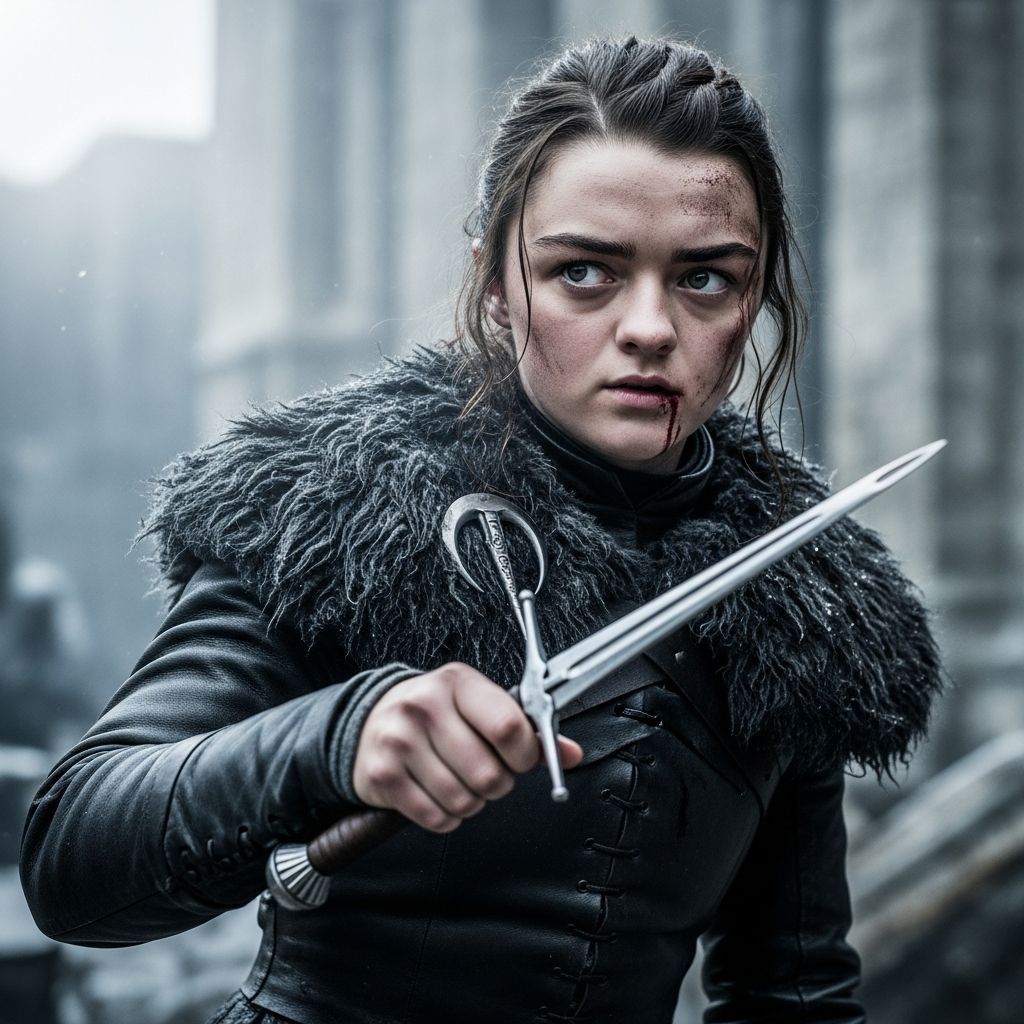
Arya Stark’s journey in Game of Thrones is one of the most dramatic transformations in modern television, taking her from an overlooked child in Winterfell to the assassin who kills the Night King. Whether she is truly the show’s greatest warrior is debatable, but there is little doubt that she becomes one of its most dangerous and unpredictable fighters.
This article explores Arya’s evolution, her unique training, the skills that set her apart, and how she compares to other legendary warriors in Westeros. It also examines what her victory over the Night King means for the story, and why her character resonates so strongly with audiences.
Arya’s Unlikely Path From Misfit to Fighter
When we first meet Arya, she is a highborn girl who openly rejects the traditional expectations placed on noble daughters in Westeros. She dislikes embroidery, courtly manners, and the idea of a politically arranged marriage, preferring archery, swordplay, and rough play with her brothers.
Several early influences help push Arya onto a warrior’s path:
- Her Stark upbringing: Arya grows up in a culture that values honor, endurance, and loyalty. These values later shape how she uses the violent skills she acquires.
- Jon Snow’s support: Jon recognizes Arya’s unconventional interests and gifts her the small sword Needle, taking her desire to fight seriously instead of mocking it.
- Witnessing trauma: The execution of her father and the destruction of her family strip away any remaining innocence and cement her resolve to survive and fight back.
Unlike knights who train in open fields or in royal courts, Arya’s development happens while she is on the run, in hiding, or under the guidance of people who operate in the shadows. This gives her a set of tools that looks very different from the battlefield heroics of characters like Jaime Lannister or Brienne of Tarth.
Training That Forged a Different Kind of Warrior
Arya’s growth as a fighter can be divided into two major phases of formal training, combined with years of hard survival experience.
Water Dancing with Syrio Forel
In King’s Landing, Arya studies under Syrio Forel, the former First Sword of Braavos, who teaches her the Braavosi style of fencing known as water dancing.
- Speed and agility: Syrio focuses on light footwork and quick attacks rather than heavy armor and brute strength.
- Awareness and precision: Arya learns to stay alert, anticipate attacks, and strike vital targets with accuracy.
- Mindset: The mantra of being “quick as a deer” and “calm as still water” pushes Arya to rely on intelligence and reflex rather than size.
This style proves crucial later when she fights much larger opponents and when she moves silently through crowded castles and battlefields.
The Faceless Men and the Art of Assassination
In Braavos, Arya is introduced to the House of Black and White and trains with the Faceless Men, an elite order of assassins who use masks to assume other identities.
- Disguise and infiltration: Arya learns to mimic the voice, posture, and habits of others, allowing her to pass unnoticed behind enemy lines.
- Poison and subtlety: She becomes proficient in killing without open combat, favoring stealth and timing.
- Emotional control: The “game of faces” teaches her to lie convincingly, conceal her emotions, and survive interrogation.
While she never fully abandons her Stark identity, Arya absorbs enough of this training to become one of the most versatile killers in Westeros, able to strike both on crowded banquet floors and in the chaos of all-out war.
Core Skills That Make Arya So Dangerous
Arya is not the strongest or the largest warrior in the series, but several abilities combine to make her uniquely lethal.
| Attribute | Arya Stark | Typical Westerosi Knight |
|---|---|---|
| Primary Style | Stealth, agility, precise strikes | Heavy armor, strength, endurance |
| Weapons | Needle, dagger, occasional poison | Sword, shield, lance |
| Battlefield Role | Assassin, infiltrator, scout | Frontline infantry or cavalry |
| Defense | Evasion, concealment | Armor, shields, formations |
Exceptional Swordsmanship
Arya’s signature weapon, Needle, is a thin, light sword that rewards precision and speed. Her training with Syrio and later practical experience in street fights, ambushes, and duels make her a highly skilled swordswoman.
- She defeats multiple armed foes despite being outnumbered or physically smaller.
- Her sparring match with Brienne of Tarth illustrates her ability to challenge a towering, heavily trained knight through agility and unpredictability.
Stealth and Mobility
From hiding as a boy on the Kingsroad to moving unseen through Winterfell during the battle against the dead, Arya repeatedly relies on the ability to disappear in plain sight. Her Faceless Men training and time among commoners refine this talent.
- She navigates dangerous cities and camps without attracting attention.
- She can silently approach targets even in fortified locations.
Strategic Thinking and Patience
Arya develops a capacity for long-term planning that goes beyond the impulsive revenge fantasies of her childhood. Many of her kills involve careful staging, timing, and psychological manipulation.
- She waits for the right moment, rather than charging into hopeless encounters.
- She exploits her enemies’ arrogance, habits, and blind spots.
The Night King: Arya’s Most Controversial Kill
One of the defining moments of the series is Arya’s assassination of the Night King during the Battle of Winterfell. This event instantly changes how audiences view her place in the larger mythos of the story.
Why Arya Was a Plausible Choice
- Stealth in chaos: The Night King is surrounded by White Walkers and wights. A heavy-armor fighter would struggle to get close, but Arya’s entire skill set is about moving unseen in impossible situations.
- Previous setup: Earlier in the same battle, she demonstrates her ability to navigate through packed hallways of undead without being detected for long stretches.
- Weapon and technique: Arya uses a Valyrian steel dagger, one of the few known materials capable of killing the Night King, and employs an unexpected hand-switch maneuver to strike.
From a tactical perspective, the assassin who specializes in bypassing conventional defenses is a logical candidate to take down the enemy commander in a single blow.
Why Some Fans Disputed the Moment
Despite these justifications, the decision to have Arya kill the Night King was controversial among viewers and commentators.
- Expectations around prophecy: Many expected characters like Jon Snow or Daenerys Targaryen—who are heavily tied to ancient prophecies—to play the decisive role against the White Walkers.
- Perceived lack of foreshadowing: Some critics argued that the specific moment lacked explicit buildup, even if Arya’s training generally supported it.
- Power scaling concerns: Viewers questioned whether one surprise stab should end such a long-running existential threat.
These debates highlight how Arya’s kill not only solves a battle problem but also reshapes the narrative hierarchy of power in the series.
Is Arya Really the Greatest Warrior in Game of Thrones?
To evaluate whether Arya deserves the title of “greatest warrior,” it helps to compare her to other elite combatants on different criteria: raw battlefield ability, one-on-one dueling, and overall impact on the war.
Comparisons with Other Legendary Fighters
- Brienne of Tarth: Brienne is arguably the strongest classic knight in the series, defeating formidable champions and protecting key characters through open combat. She excels in sustained, honorable fights.
- Jaime Lannister (in his prime): Once considered one of the deadliest swordsmen in Westeros, Jaime’s reputation is built on noble-house warfare and traditional duels.
- The Hound and The Mountain: These brothers embody brute force and physical intimidation, slaughtering large numbers of foes on open fields and in brutal melees.
Arya differs from all of them in purpose and method. She is not designed to break enemy lines or lead cavalry charges. Instead, she specializes in:
- Neutralizing critical targets
- Operating behind enemy lines
- Ending threats quickly and surgically
If “greatest warrior” means the most effective single combatant in traditional battle, one could argue for Brienne, Jaime, or the Cleganes. If it means the person whose skills most dramatically alter the fate of Westeros, Arya has a strong case because of her role in ending the Night King and eliminating enemies others could not reach.
Effectiveness vs. Spectacle
Much of Arya’s deadliness occurs off-screen or in quick, decisive moments. Unlike a shining knight whose achievements are witnessed by armies, Arya often kills in the shadows, with only a few people or sometimes no one at all knowing what she has done.
This raises an interesting narrative tension:
- She may be one of the most effective warriors in terms of results.
- But she is rarely recognized as such within the world of the story, which still values visible heroics and noble titles.
Emotional Resilience and Moral Complexity
Arya’s physical skills cannot be separated from her psychological journey. Her kill list, her time living under false identities, and her training to become “no one” all take a heavy toll, raising questions about trauma and morality.
Resilience in the Face of Trauma
- She witnesses widespread slaughter, including the fall of her house and repeated betrayals by supposed protectors.
- Instead of collapsing, she channels her pain into disciplined training and a relentless drive to survive.
Viewed through the lens of trauma research, characters like Arya illustrate how some individuals respond with remarkable adaptability and determination after severe stress, a pattern sometimes described as post-traumatic growth in psychology literature.
Moral Ambiguity
Arya’s arc also explores how easily the pursuit of justice can blur into vengeance. She kills sadistic villains and mass murderers, but she also commits acts that are ethically murky, targeting entire families or using disguises to get close to her enemies.
This complexity is one reason the character feels grounded and human. She is neither a pure hero nor a simple antihero; her growth involves not only learning to kill but also learning when to stop.
Why Arya Resonates with Audiences
Beyond combat feats, Arya’s story taps into broader cultural themes that help explain her enduring popularity.
- Subversion of gender expectations: Arya pushes back against strict gender roles, carving out space for a girl who chooses the sword over the sewing needle—yet still keeps the name “Needle” as her cherished weapon.
- Coming-of-age under pressure: Her path mirrors a heightened version of adolescence: identity struggles, anger at injustice, and a search for belonging.
- Agency in a brutal world: In a narrative where many characters are trapped by duty or birth, Arya repeatedly chooses her own path, even when it leads through danger.
FAQs About Arya Stark and Her Legacy
Is Arya Stark the most powerful fighter in Game of Thrones?
Arya is not the physically strongest warrior, but she may be among the most efficient and versatile due to her blend of stealth, assassination skills, and swordsmanship. Whether she is the “greatest” depends on whether you value battlefield dominance or strategic, surgical kills.
How did Arya become skilled enough to kill the Night King?
Her water-dancing training with Syrio Forel, years of survival on the run, and advanced assassin training with the Faceless Men all contribute to her ability to move unseen and strike precisely with a Valyrian steel weapon.
Does Arya have any magical powers?
Arya does not cast spells or control dragons. Her “magic” is practical: disguise, stealth, and psychological manipulation learned from the Faceless Men. The masks and rituals of that order have a mystical element in the story’s lore, but Arya’s main advantages are skill and discipline.
Why didn’t Arya stay with the Faceless Men?
Arya ultimately chooses her Stark identity over becoming “no one.” She uses what she learned but refuses to surrender her name, family loyalty, and personal sense of justice.
What makes Arya different from traditional fantasy heroes?
She is not a chosen one in the classic sense, nor a crowned ruler. Instead, she is a small, often underestimated figure who changes history through stealth, adaptability, and a relentless will to survive rather than prophecy or royal birthright alone.
References
- Arya Stark’s Skills and Abilities: Master of Stealth & Combat — Game of Thrones Insider. 2023-05-12. https://gameofthronesinsider.com/arya-starks-skills-and-abilities/
- Arya Stark’s Abilities & Skills! (Game of Thrones) — LukeSEA (YouTube). 2017-03-15. https://www.youtube.com/watch?v=LTNTcScUszA
- What is Arya Stark’s Great Role? — A Forum of Ice and Fire (Westeros.org). 2019-05-05. https://asoiaf.westeros.org/index.php?/topic/162700-what-is-arya-starks-great-role/
- Arya Stark — Game of Thrones Wiki (Fandom). 2022-10-10. https://gameofthrones.fandom.com/wiki/Arya_Stark
- Posttraumatic Growth: Conceptual Foundations and Empirical Evidence — American Psychological Association. 2019-06-01. https://psycnet.apa.org/record/2019-45686-000