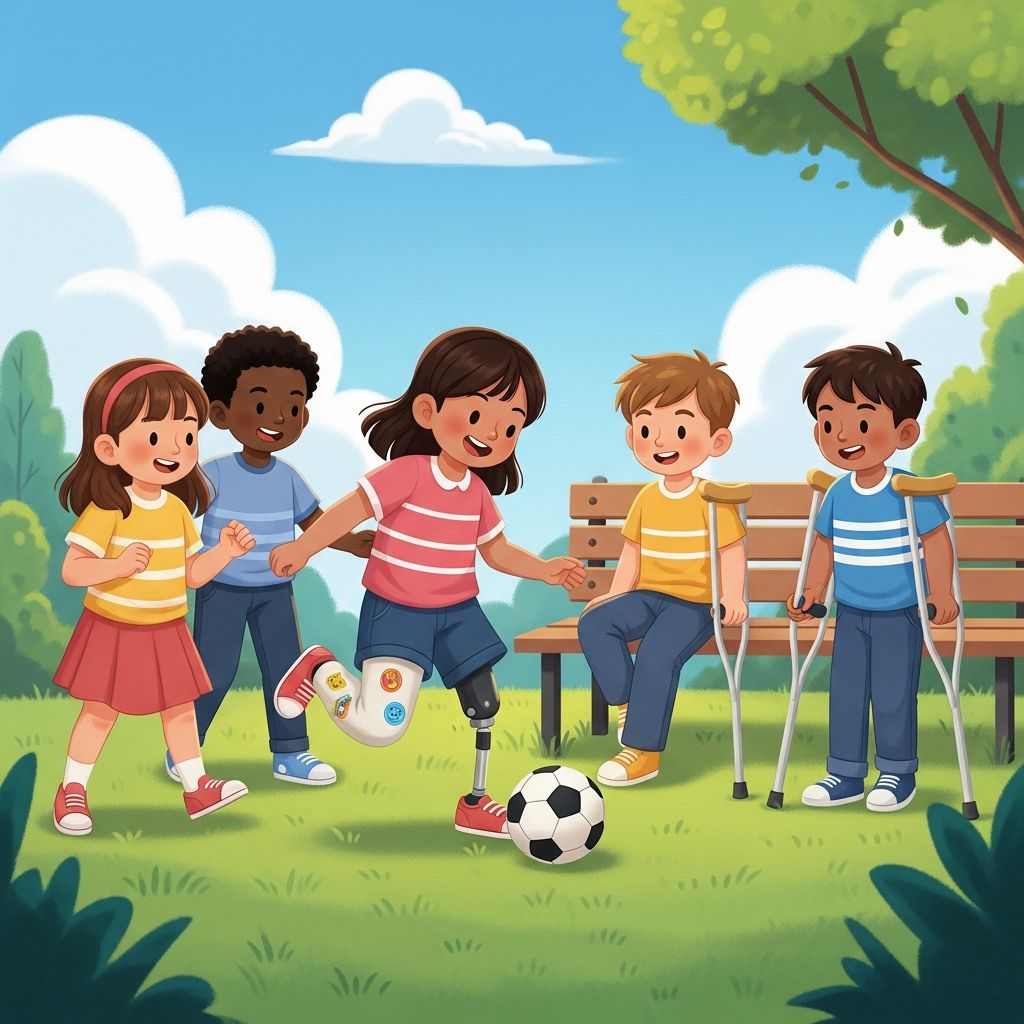
Sometimes, to save a person’s life or to stop a serious problem in a body part, doctors may need to remove part or all of an arm, leg, hand, or foot. This is called an amputation. It can sound scary, but for many kids and adults, it is a step that helps them feel better, stay healthy, and keep doing the things they love in a new way.
What Does “Amputate” Mean?
The word amputate means to surgically remove a limb or part of a limb such as a leg, arm, hand, or foot.1 Doctors do this in an operating room while the person is asleep under anesthesia, so they do not feel pain during the surgery.2
- Limb: an arm or a leg.
- Partial amputation: only part of the limb is removed (for example, part of a foot).
- Complete amputation: the whole arm or leg is removed above a joint like the knee or elbow.
After an amputation, the part that remains attached to the body is called the residual limb or sometimes the “stump.” Doctors and therapists work carefully to keep this area healthy and comfortable so it can move, be used for balance, or fit a prosthetic limb if needed.2
Why Would a Doctor Remove a Limb?
Doctors only suggest an amputation when it is the safest and best choice to protect a person’s health or life. In children, amputations are uncommon, but they do happen for several reasons.14
| Reason | What It Means | Why Amputation Helps |
|---|---|---|
| Serious injury (trauma) | A body part is badly damaged in an accident, like a car crash or machinery injury. | Sometimes the limb cannot be safely repaired and keeping it could be more dangerous than removing it.2 |
| Cancer in the bone or muscle | Some tumors, like osteosarcoma, grow inside bones or tissues in a limb. | Removing the limb can help remove all the cancer and stop it from spreading.1 |
| Severe infection | Germs damage tissue so badly that medicine cannot fix it. | Amputation can prevent infection from spreading to the rest of the body.56 |
| Blood flow problems | Blood vessels are blocked or damaged so the limb does not get enough oxygen. | Without blood flow, tissue dies; removing the affected part may be necessary.5 |
| Being born with a limb difference | A child is born with part of a limb missing or not fully formed (called a limb deficiency). | Sometimes a small amputation can make the limb more comfortable and easier to fit with a prosthesis.34 |
What Happens Before Amputation Surgery?
When doctors think an amputation might be needed, they do a lot of checking and planning. They also talk with the child and family so everyone understands what is happening and why.24
Important steps before surgery
- Health check-up – Doctors examine the child, look at the injured or sick limb, and check things like heart rate, breathing, and blood pressure.
- Imaging tests – X-rays, CT scans, or MRIs show bones, blood vessels, and soft tissue to help doctors know exactly where to operate.2
- Team planning – Orthopedic surgeons, plastic surgeons, rehabilitation doctors, nurses, and prosthetists decide the best level and type of amputation so a prosthetic limb will work well later on.23
- Talking about feelings – A social worker, psychologist, or child-life specialist may explain the surgery in kid-friendly terms and help with fears or worries.
- Pain and infection prevention – Doctors plan anesthesia for surgery and choose antibiotics if there is a risk of infection.2
For kids who are still growing, doctors think carefully about how long the remaining bone should be, so that as the child grows, the limb will be the right length to fit into a prosthesis later.12
What Is the Surgery Like?
During an amputation, the child is in an operating room and is given general anesthesia, which means they are completely asleep and do not feel the surgery.2
During the operation
- The surgeon carefully removes the part of the limb that is damaged or diseased.
- They shape the end of the bone so it is smooth and rounded.
- Muscles are attached in a way that helps the limb move and later fit into a prosthetic device (this is called myoplasty or myodesis).2
- Blood vessels are tied off so bleeding stops, and nerves are trimmed so they can move back into soft tissue, which can reduce later pain or nerve problems.2
- The skin is gently closed over the end of the limb.
Doctors also protect the limb with soft dressings or a splint. This helps keep it safe while it heals and can shape it to fit a prosthesis in the future.2
Healing After an Amputation
Healing takes time, but kids’ bodies are very good at recovering. In the hospital, the medical team focuses on comfort, wound care, and early movement.34
In the first days after surgery
- Pain control – Medicines, nerve blocks, and other methods are used so kids can rest, move, and start therapy.
- Wound checks – Nurses and doctors look at the skin, stitches, and bandages to make sure there is no infection or extra swelling.
- Positioning – The limb may be placed in certain positions to keep joints from getting stiff or stuck.
- Emotional support – Parents, counselors, and staff talk with kids about worries, sadness, or anger, which are all normal feelings after a big change.
Possible challenges in kids
- Bony overgrowth – In some children, the cut end of the bone can keep growing and form a sharp point that bothers the skin, especially if the amputation happened at a young age.13
- Need for more surgery – If bone or skin causes pain or makes it hard to wear a prosthesis, doctors may do a smaller follow-up surgery to smooth or reshape the limb.1
- Phantom sensations – Some kids feel as if the missing limb is still there. This can be strange but is very common and often lessens over time.
What Is a Prosthetic Limb?
A prosthetic limb is an artificial arm, hand, leg, or foot that takes the place of the missing part of the body.34 Not everyone needs or wants one, but many kids find that it helps them move, play, and do everyday tasks more easily.
Parts of a prosthetic limb
- Socket – The part that fits over the residual limb.
- Joints – Artificial knees, elbows, or ankles that can bend.
- Foot or hand – Shaped parts that help with walking, balance, grasping, or holding.
- Suspension system – Straps, liners, or suction that help keep the prosthesis in place.
As a child grows, the prosthetic limb usually needs to be adjusted or replaced so that it stays comfortable and works well.34
Life After Amputation: Moving, Playing, and Learning
Even though life after an amputation is different, kids can still be active, independent, and successful. With practice and support, they often run, play sports, draw, type, and do almost everything they enjoy.34
How kids stay active
- Using a prosthetic leg to walk, run, jump, and climb.
- Using a prosthetic arm or hand to hold toys, eat, or write.
- Trying adaptive sports like wheelchair basketball, swimming, or running with a special prosthetic leg.
- Using everyday tools like grabbers, adapted bikes, or special grips.
Rehabilitation doctors and therapists work with families to create a plan that fits the child’s age, goals, and interests.34
Feelings and Emotional Health
Amputation is not just a change to the body; it can also bring strong feelings. Kids might feel sad, angry, scared, or embarrassed. This is normal, and talking about it helps.
- Family support – Parents, siblings, and caregivers can listen, encourage, and help with daily tasks while the child learns new ways to move.
- Counseling – Psychologists and social workers can teach coping skills, help kids handle teasing, and support their self-confidence.
- Peer groups – Meeting other kids with limb differences can help a child feel less alone and see what is possible in the future.4
Many children who have had amputations grow up to enjoy school, hobbies, friendships, and careers just like their peers. They often develop strong problem-solving skills and resilience along the way.
How Friends and Classmates Can Help
If someone at school has had an amputation, classmates can make a big difference by being kind, patient, and welcoming.
- Use the person’s name instead of labels like “the kid with one leg.”
- Ask respectful questions if they seem open to talking, but accept it if they do not want to share details.
- Include them in games and activities, and help find ways everyone can participate.
- Avoid staring, whispering, or teasing about the way they walk or look.
Remember: an amputation does not change who a person is on the inside. They still like jokes, games, hobbies, and friends just like anyone else.
Quick Facts About Amputation in Kids
- Amputations in children are less common than in adults, but when they do occur, doctors plan carefully for the child’s future growth and activity.12
- Common reasons include serious injury, tumors, infections, and limb differences present at birth.145
- Many children use prosthetic limbs and can run, play sports, and join in physical activities.34
- Some kids need additional surgeries as they grow, especially if bones grow faster than soft tissue.13
- Emotional support, rehabilitation, and family encouragement help kids live full, active lives after an amputation.34
Frequently Asked Questions (FAQs)
Does an amputation hurt?
During the surgery itself, no. Doctors give anesthesia so the person is asleep and does not feel anything. After surgery, there can be pain or soreness, but medicine, careful bandaging, and therapy help control it, and it usually improves over time.23
Can kids still play sports after an amputation?
Yes. Many kids take part in regular and adaptive sports. With a prosthetic leg or arm, or with specialized equipment, they can run races, swim, play ball games, and more. Doctors and therapists help choose safe activities and the right equipment.34
Will the limb grow back?
Human arms and legs do not grow back. However, children’s bodies can get stronger in other ways, and prosthetic limbs can be adjusted or replaced as the child grows, so they continue to fit well.34
Why do some kids feel a foot or hand that is not there?
This is called a phantom limb sensation. The brain and nerves sometimes still send signals that feel like the missing limb is present. This is very common after an amputation and often becomes less noticeable over time.
Is amputation always the last choice?
Doctors try other treatments first when it is safe to do so, like medicines, surgeries to repair blood vessels, or limb-saving treatments for cancer. When those are not enough to protect a person’s health or life, amputation may be the safest and most effective option.125
References
- Lower-Limb Amputation in Children and Adolescents—A Rare but Challenging Procedure — Khalifa et al., Children (Basel). 2022-06-26. https://pmc.ncbi.nlm.nih.gov/articles/PMC9320991/
- Pediatric Traumatic Limb Amputation: The Principles of Management — Naidu et al., J Orthop. 2015-07-23. https://pmc.ncbi.nlm.nih.gov/articles/PMC4904133/
- Pediatric Acquired Upper and Lower Limb Deficiency — American Academy of Physical Medicine and Rehabilitation (AAPM&R). 2021-05-10. https://now.aapmr.org/pediatric-acquired-upper-and-lower-limb-deficiency/
- Pediatric Limb Loss and Limb Difference: An Introduction for Parents — Amputee Coalition. 2020-08-01. https://amputee-coalition.org/resources/pediatric-limb-loss-and-limb-difference-an-introduction-for-parents/
- Amputations — Shriners Children’s. 2023-03-15. https://www.shrinerschildrens.org/en/pediatric-care/amputations
- Conditions We Treat: Prosthetics Clinic — Phoenix Children’s Hospital. 2022-11-10. https://phoenixchildrens.org/specialties-conditions/prosthetics-clinic/conditions-we-treat