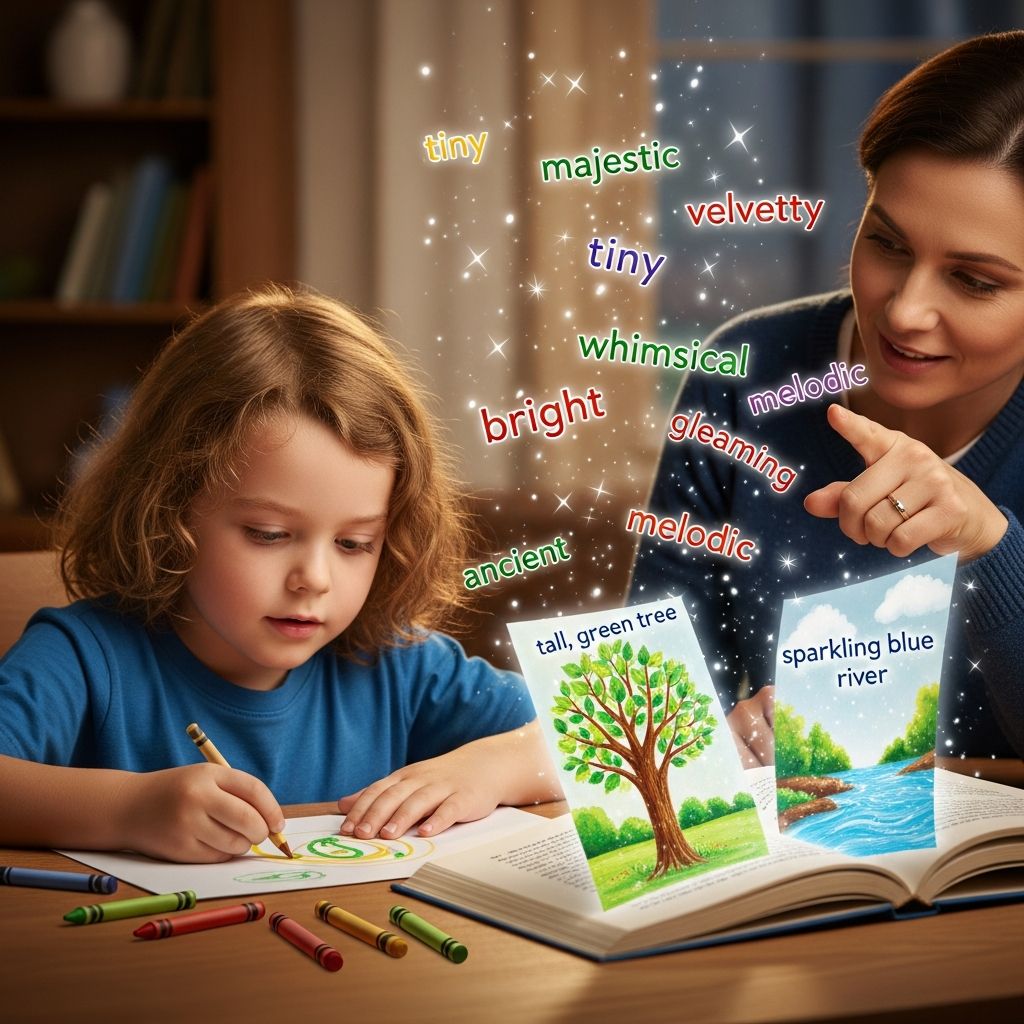
Adjectives are the words that add color, detail, and personality to every sentence. They help children move beyond basic statements like “I have a dog” to richer descriptions such as “I have a small, playful dog with silky ears.” When kids understand how adjectives work, their speaking and writing become clearer, more interesting, and more confident.
What Exactly Is an Adjective?
An adjective is a word that tells us more about a person, place, thing, or idea. It often answers questions like:
- What kind? (furry cat, kind teacher, rainy afternoon)
- Which one? (this book, that game, first prize)
- How many? (three cookies, several toys, many questions)
- How much? (little time, enough water, no sugar)
In simple terms, if a word is adding a description to a noun, it is probably acting as an adjective. Teaching children to spot these describing words is an easy first step toward stronger writing.
Why Adjectives Matter for Young Learners
Adjectives are more than just “extra” words. They shape how a reader or listener imagines what is being described. A “house” could be almost anything, but a “tiny wooden house with bright blue shutters” feels specific and memorable. Children who learn to choose clear adjectives can express their thoughts and feelings more accurately.
Adjectives also support reading comprehension. When kids recognize descriptive words in stories, they grasp scenes, characters, and emotions more easily. That understanding makes reading more enjoyable and supports success in every school subject that uses written text.
Key Types of Adjectives You Can Teach
There are many ways to sort adjectives, but grouping them by what they describe makes things easier for kids. Below are beginner-friendly categories with examples you can share and adapt.
Describing How Something Looks
These adjectives focus on color, shape, and general appearance. They help children paint a mental picture of what they see.
- Colors: red, pale, golden, bright, gray
- Shapes: round, square, curved, flat, pointy
- General looks: shiny, messy, neat, wrinkled, spotless
Try asking children to look around a room and name one adjective for each object they see. For example, “striped pillow,” “dusty shelf,” or “sparkling window.”
Describing Size and Amount
Size and number adjectives help children be more exact instead of saying “a lot” or “big” every time.
- Size: tiny, huge, narrow, wide, short, tall
- Amount: several, few, many, countless, enough
Challenge children to “upgrade” a plain sentence such as “I saw a big dog” into more specific versions like “I saw a huge dog” or “I saw a tiny dog.” Encourage them to explain which feels more accurate for what they imagine.
Describing Feelings and Personality
These adjectives are especially useful when children write about people, animals, or characters in stories. They help show what someone is like on the inside.
- Positive traits: kind, patient, brave, cheerful, thoughtful
- Neutral or mixed traits: quiet, curious, serious, shy, energetic
- Negative traits: rude, selfish, grumpy, stubborn, impatient
When talking about characters, ask questions such as “Was the main character brave or fearful?” or “Would you describe this character as generous or selfish?” This helps kids connect adjectives to behavior and choices in a story.
Describing How Things Feel, Smell, or Sound
Adjectives can describe more than what we see. Sensory adjectives help children explore all five senses in their writing.
- Touch: smooth, rough, sticky, soft, icy, fluffy
- Smell: sweet, smoky, spicy, fresh, rotten
- Sound: loud, quiet, squeaky, deep, musical, harsh
- Taste: salty, bitter, sour, sweet, spicy, bland
Encourage children to include at least one sense-based adjective when they describe an experience, such as “the crunchy leaves,” “the smoky air,” or “the icy water.”
Describing Time, Age, and Condition
Some adjectives answer questions like “When?” or “In what state?” They are helpful for organizing events and setting scenes.
- Time or age: early, late, modern, ancient, new, old
- Condition: broken, clean, dirty, finished, healthy, tired
Children often say “then this happened, then that happened.” Teaching time and condition adjectives invites them to write sentences such as “After a long, tiring day, we had a quiet dinner.”
Where Adjectives Go in a Sentence
Most adjectives appear right before the noun they describe, especially in sentences that are easy for children to read. In “the tall tree,” the word “tall” describes “tree.” In “a noisy classroom,” the word “noisy” describes “classroom.”
Adjectives can also appear after linking verbs such as “is,” “are,” “was,” and “seems.” For instance, “The soup is hot” or “The children are excited.” In these sentences, the adjectives come after the verb but still describe the noun at the beginning.
Combining Adjectives Without Confusing Kids
Children quickly learn to stack adjectives when they get excited: “I saw a big red fast car!” While there are patterns for ordering adjectives in advanced grammar, young writers mainly need two ideas:
- Keep groups of adjectives short so the sentence is easy to understand.
- Place adjectives that feel most important closer to the noun.
Instead of overwhelming children with strict rules, invite them to read sentences out loud and listen for what sounds clear and natural. If a sentence feels crowded, suggest choosing the two or three strongest adjectives and removing the rest.
Adjectives in Action: Simple Before-and-After Table
The table below shows how a few adjectives can transform basic sentences into more vivid ones. Use it as a model for practicing with your child.
| Plain sentence | With adjectives added |
|---|---|
| The cat slept on the rug. | The tired gray cat slept on the soft rug. |
| We walked through the park. | We walked through the wide, quiet park. |
| She told us a story. | She told us a funny, magical story. |
| He ate the sandwich. | He ate the warm, spicy sandwich. |
Invite your child to create their own “before and after” sentences and see how many improvements they can make with just one or two adjectives.
Helping Children Choose Strong Adjectives
Children often fall back on vague words like “nice,” “good,” and “bad.” These are comfortable but do not tell the reader very much. Guide them to swap these for more specific options that show what they really mean.
- Instead of “nice,” try helpful, friendly, generous, or caring.
- Instead of “good,” try exciting, useful, delicious, or successful.
- Instead of “bad,” try dangerous, unfair, disappointing, or messy.
When a child uses a vague adjective, ask, “What kind of nice?” or “What made it bad?” Their answers often contain stronger words that can replace the weaker ones.
Practical Activities to Practice Adjectives
Learning adjectives should feel playful, not stressful. Here are easy activities you can use at home or in the classroom to reinforce descriptive language.
Adjective Scavenger Hunt
Choose a room, a page from a picture book, or a short paragraph. Ask your child to find and list all the describing words they can spot. Younger children may circle words directly on a printed page, while older kids can create a list and group the adjectives by type, such as color, size, or emotion.
“Upgrade the Sentence” Game
Write simple sentences on slips of paper, such as “The dog ran” or “We had dinner.” Challenge kids to rewrite each sentence, adding at least one adjective. Turn it into a friendly competition by awarding points for sentences that feel clear and interesting without becoming too long.
Five-Senses Descriptions
Give children a common object such as an orange, a blanket, or a leaf. Ask them to describe it using one adjective for each sense: sight, smell, touch, sound, and taste (where safe and appropriate). This exercise pushes them to move beyond appearance and consider all aspects of the object.
Character Building with Adjectives
When reading stories together, pause and ask: “Which three adjectives would you choose to describe this character?” Encourage kids to back up their choices with evidence from the story. This improves both vocabulary and critical thinking skills.
Common Mistakes Kids Make with Adjectives
Some adjective errors are very typical in early writing. Gentle correction and repeated exposure usually fix them over time.
- Overloading sentences: Children sometimes stack too many adjectives in a row. Suggest keeping the two or three strongest ones and removing the rest.
- Using an adjective instead of an adverb: Kids may write “He ran quick” instead of “He ran quickly.” Explain that adjectives describe nouns, while adverbs more often describe actions.
- Repeating the same word: Young writers might use “big” or “fun” repeatedly. Offer a short list of alternatives nearby so they can choose different words while writing.
Praise effort and creativity first, then offer one or two focused suggestions for improvement to avoid overwhelming them.
Supporting Different Age Groups
The way you teach adjectives will change as children grow. Adjust your approach so it fits their stage of development and confidence level.
Early Elementary Children
Younger kids often learn best through pictures and movement. Use colorful storybooks, flashcards with images, and objects they can hold. Focus on basic categories such as colors, sizes, and simple emotions, and let them act out adjectives like “sleepy” or “excited.”
Upper Elementary Children
Older children are ready for more nuanced adjectives and comparisons. Introduce words that show degree, such as “very,” “more,” or “less,” and explore subtle differences between similar adjectives like “angry,” “upset,” and “annoyed.” Encourage them to use adjectives in short stories, reports, and personal narratives.
SEO-Friendly FAQ About Adjectives
What is a simple definition of an adjective for kids?
A child-friendly way to define an adjective is to call it a “describing word.” It tells more about a person, place, thing, or idea by giving details such as color, size, shape, or feeling.
How can I help my child learn more adjectives?
Reading aloud every day is one of the best ways for children to meet new adjectives naturally. You can also play simple games such as “upgrade the sentence,” use adjective scavenger hunts in books, and encourage kids to keep a personal list of descriptive words they like.
What are some useful adjectives for everyday conversations?
Practical adjectives for daily use include words for feelings, such as calm, nervous, proud, and disappointed, along with basic descriptors like clean, crowded, noisy, quiet, heavy, and light. These words help children explain their experiences more clearly at home and at school.
How many adjectives should a child use in one sentence?
There is no strict limit, but for beginning writers, one or two well-chosen adjectives per noun is usually enough. Too many adjectives can make a sentence feel crowded or confusing, while a few strong ones keep the meaning clear and the writing smooth.
What is the difference between adjectives and adverbs?
Adjectives describe nouns, while adverbs more often describe verbs, adjectives, or other adverbs. For example, in “the slow turtle,” “slow” is an adjective describing “turtle,” but in “the turtle moved slowly,” “slowly” is an adverb describing how the turtle moved.
Bringing It All Together
Adjectives give children the tools to share what they see, feel, and imagine with precision and flair. By learning a variety of describing words, practicing them in fun ways, and using them thoughtfully in speaking and writing, young learners can transform simple sentences into vivid, meaningful communication.
Parents and teachers do not need to memorize long lists of adjectives to be helpful. A supportive environment, regular reading, gentle correction, and playful practice are enough to build a strong foundation in descriptive language that will serve children for years to come.