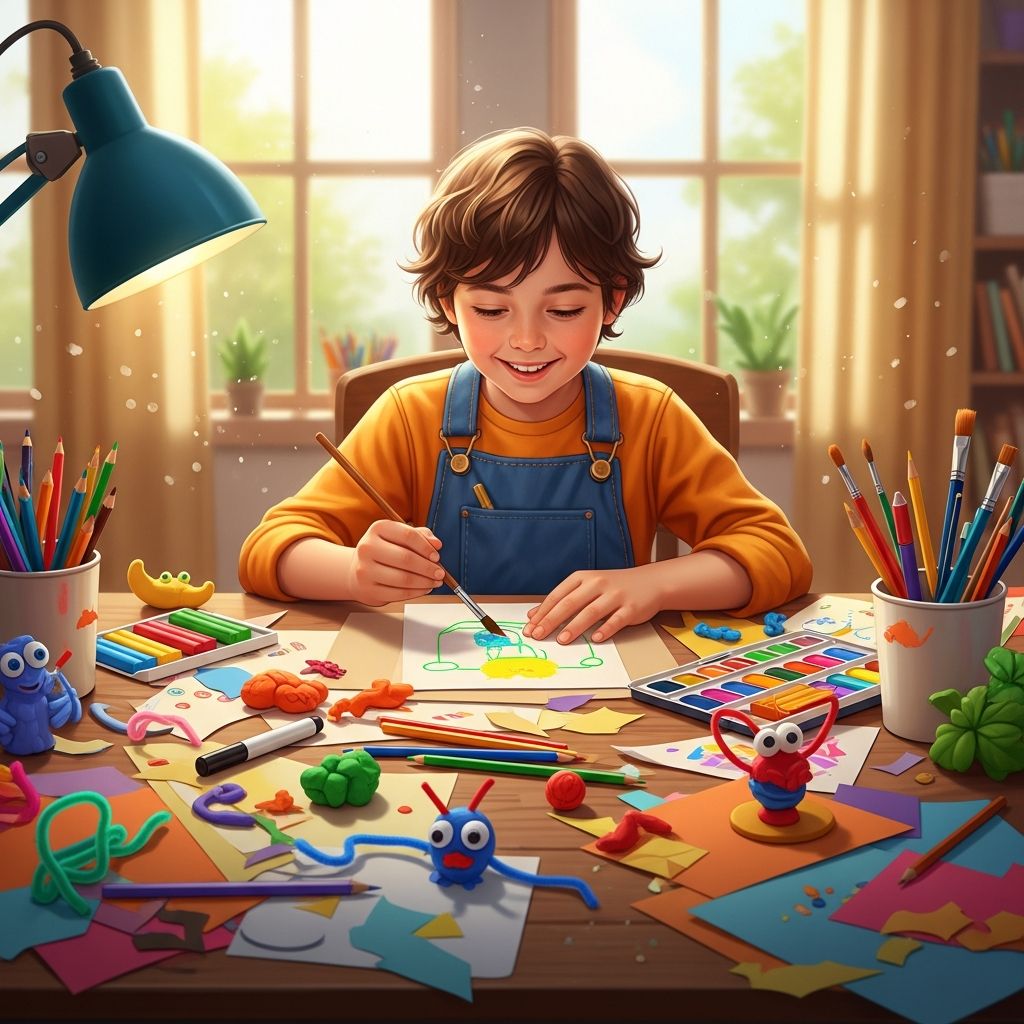
Children with ADHD often face challenges in focus and impulse control, but recent research highlights a surprising upside: enhanced creativity. Studies reveal that traits like mind wandering and divergent thinking can lead to innovative ideas and real-world accomplishments, offering parents a new lens on their child’s potential.
Understanding the Science Behind ADHD and Creative Thinking
Attention Deficit Hyperactivity Disorder (ADHD) involves symptoms such as inattention, hyperactivity, and impulsivity. Traditionally viewed through a deficit lens, emerging evidence points to cognitive styles in ADHD that foster creativity. Creativity is defined as generating novel and useful ideas, often requiring divergent thinking—the ability to produce multiple solutions to a problem.
Key to this connection is mind wandering, where thoughts drift from the primary task. In neurotypical individuals, this might hinder productivity, but for those with ADHD, deliberate mind wandering correlates with higher creative output. Researchers from Radboud University Medical Centre analyzed 750 participants across two groups, finding that stronger ADHD traits predicted greater creative achievements, mediated by intentional thought drifting.
Another mechanism is reduced inhibitory control. People with ADHD struggle to filter out irrelevant stimuli, allowing more ideas to enter awareness. This ‘idea flood’ promotes unconventional connections, as seen in studies where ADHD participants excelled in verbal originality tasks.
Evidence from Recent Studies on Creative Achievements
Multiple studies confirm ADHD’s link to tangible creativity. In one investigation, adults with ADHD scored higher on the Creative Achievement Questionnaire (CAQ), which measures accomplishments in domains like arts, science, writing, and invention. ADHD groups outperformed controls across all 10 areas, with greater score variability indicating exceptional performers.
| Domain | ADHD Average Score | Control Average Score |
|---|---|---|
| Music | Higher | Lower |
| Visual Arts | Higher | Lower |
| Science | Higher | Lower |
| Writing | Higher | Lower |
| Architecture | Higher | Lower |
This table summarizes findings from the CAQ, showing consistent advantages for ADHD participants. Pediatric implications are strong, as childhood creativity patterns often persist.
A peer-reviewed study emphasized goal-directed motivation. ADHD individuals generated more original ideas under competition for rewards, suggesting extrinsic motivators amplify their creativity. They also self-reported strengths in performance (e.g., music, acting) and mechanical/scientific domains.
How Mind Wandering Fuels Innovation in Kids with ADHD
For children, mind wandering isn’t mere distraction—it’s a creativity engine. The 2025 ECNP congress presentation highlighted deliberate mind wandering as the bridge between ADHD symptoms and creative prowess. Kids with ADHD reported higher intentional thought drifting, linking directly to inventive thinking.
Consider a child zoning out during homework, suddenly sketching an elaborate invention. This spontaneous ideation leverages ADHD’s hyperfocus on interests, bypassing rigid thinking. Unlike lab tests where ADHD kids may not outperform peers, real-world measures capture their strengths, as daily life rewards flexibility.
Parents observe this in play: ADHD children invent complex games, blend unrelated concepts, or excel in improvisational activities. These behaviors stem from cognitive flexibility, a hallmark of creativity enhanced by ADHD.
Domain-Specific Talents: Where ADHD Kids Shine Brightest
Creativity in ADHD isn’t uniform; it thrives in matching domains. Research shows elevated self-perceived abilities in hands-on fields like engineering, performing arts, and sciences, but not always visual arts.
- Performance Arts: Acting, music—impulsivity aids expressive spontaneity.
- Mechanical/Scientific: Experimenting, programming—hyperfocus drives deep dives.
- Invention: Combining ideas from scattered attention yields breakthroughs.
Children gravitate toward these, building confidence. A subset achieves outlier success, pulling up group averages.
Practical Strategies for Parents to Nurture Creative Sparks
Harnessing ADHD creativity requires balance. Here are evidence-based tips:
- Encourage Deliberate Mind Wandering: Set ‘dream time’ without screens, journaling stray ideas to channel into projects.
- Competitive Fun: Use games or challenges with rewards to boost idea generation.
- Domain Matching: Enroll in STEM clubs, theater, or maker spaces aligning with interests.
- ADHD-Tailored Mindfulness: Train shifting spontaneous to deliberate wandering, reducing impairments.
- Portfolio Building: Track achievements in a creativity journal for self-esteem.
Integrate into routines: Replace rigid homework with creative problem-solving. Tools like divergent thinking exercises (e.g., ‘list 20 uses for a paperclip’) build skills.
Challenges and Balanced Perspectives on ADHD Creativity
Creativity benefits don’t erase ADHD struggles. High variability means some kids excel creatively while others face impairments needing treatment. Medication shows no creativity detriment in small samples, but larger studies are needed.
Overemphasizing positives risks minimizing needs for structure, therapy, or meds. The goal: Leverage strengths without ignoring deficits. Psychoeducation programs teaching idea utilization can empower kids.
Implications for Education and Future Research
Schools should adapt: Flexible seating, project-based learning suit ADHD creativity. Teacher training on recognizing divergent thinking as an asset, not disruption, is crucial.
Future research must include more children, longitudinal tracking, and diverse populations. Replicating adult findings in youth will solidify links. Meanwhile, parents can celebrate these traits, fostering resilience.
Frequently Asked Questions (FAQs)
Does ADHD make all children more creative?
No, benefits vary; a subset shows exceptional creativity due to greater variability in achievements.
Can medication affect creativity in kids with ADHD?
Studies find no negative impact, though small samples limit conclusions. Monitor individually.
How can parents tell if their child’s mind wandering is creative?
Look for novel ideas or inventions emerging from ‘zoning out,’ especially in interest areas.
Are there specific activities to boost ADHD creativity?
Yes: Improv games, invention challenges, music composition, and reward-based brainstorming.
Should schools treat ADHD creativity differently?
Absolutely—offer choice in projects, reduce rigid focus demands to unlock potential.
References
- New research reveals how ADHD sparks extraordinary creativity — ScienceDaily. 2025-10-12. https://www.sciencedaily.com/releases/2025/10/251012054608.htm
- New Evidence that ADHD May Enhance Creativity — ADDA (Attention Deficit Disorder Association). 2025 (inferred recent). https://add.org/new-evidence-that-adhd-may-enhance-creativity/
- Creativity in ADHD: Goal-Directed Motivation and Domain Specificity — PMC / National Library of Medicine. 2020-10-01. https://pmc.ncbi.nlm.nih.gov/articles/PMC7543022/
- The Link Between ADHD & Creativity — Triangle Child Psychology. Recent (2025 context). https://trianglechildpsychology.com/the-link-between-adhd-creativity/