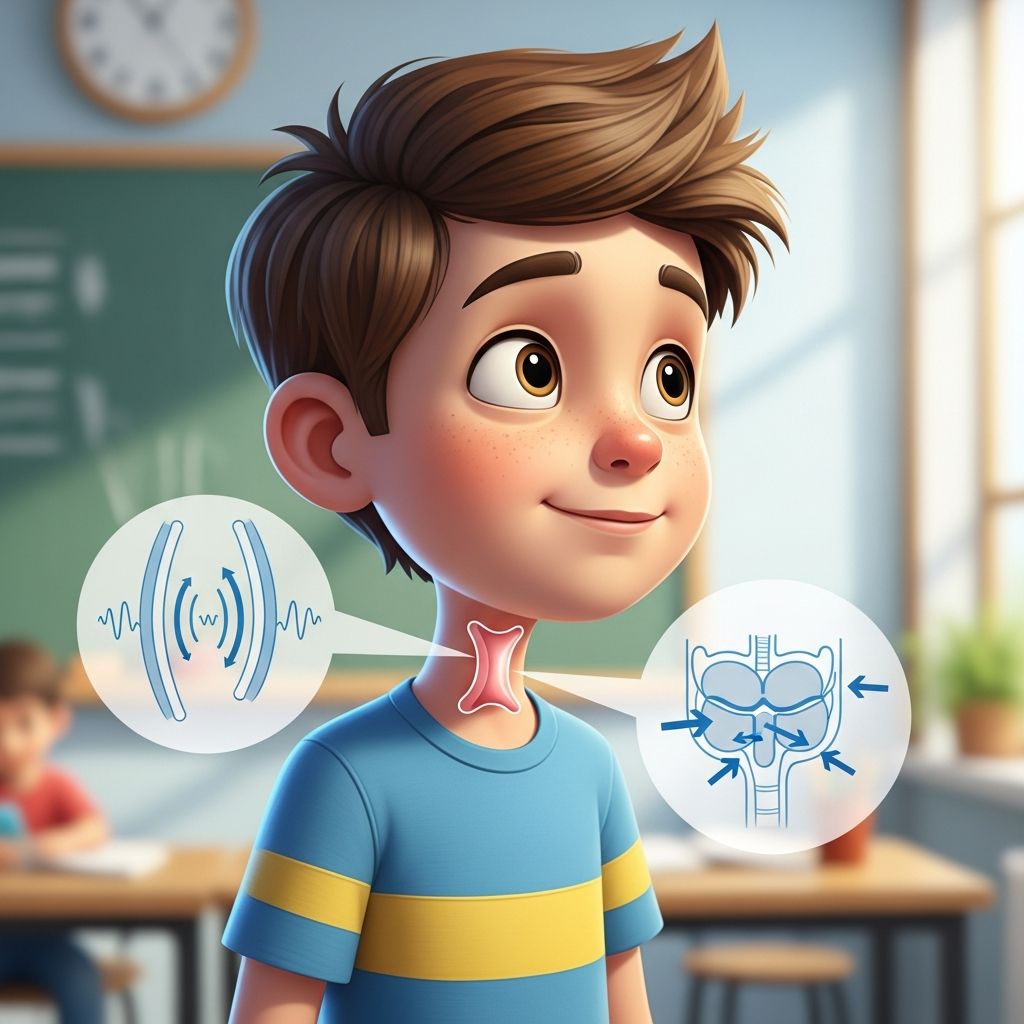
As you grow up, you might notice new bumps, curves, and changes in your body. One of those changes can appear right in the front of your neck: the Adam’s apple. This visible bump is connected to your voice box and is a normal part of growing and changing.
This guide explains what the Adam’s apple is, who has one, why some are bigger than others, and how it helps you talk and breathe.
What Is the Adam’s Apple, Really?
The Adam’s apple is the name people use for the laryngeal prominence, the front part of a firm structure in your neck called the thyroid cartilage. This cartilage forms the front wall of your larynx (voice box), which sits above your windpipe and helps you breathe and speak.
- Location: It sits in the middle of your neck, just above your thyroid gland and in front of your windpipe.
- Feel: It feels like a hard bump under the skin because cartilage is tough but slightly flexible tissue.
- Official name: Doctors call it the laryngeal prominence of the thyroid cartilage.
Even though we call it an Adam’s apple, it isn’t a fruit or a bone. It is simply part of the cartilage that protects your voice box.
Meet Your Larynx: The Voice Box
The Adam’s apple is just the tip of a larger structure: your larynx. Understanding the larynx makes it easier to understand what the Adam’s apple does.
- Breathing: The larynx is part of your airway. Air passes through it on the way to and from your lungs so you can breathe.
- Speaking: Inside the larynx are your vocal cords, two small bands of tissue that vibrate when air moves past them, producing sound.
- Protection: The larynx helps keep food and drink out of your lungs when you swallow, with the help of a flap called the epiglottis.
| Part of the larynx | What it does |
|---|---|
| Thyroid cartilage (forms the Adam’s apple) | Acts like a shield around the larynx and vocal cords. |
| Cricoid cartilage | Forms a complete ring below the thyroid cartilage and supports the airway. |
| Vocal cords | Vibrate to create sound when you talk, sing, or hum. |
| Epiglottis | Flips down when you swallow to keep food and drink out of your windpipe. |
The Adam’s apple is simply the most noticeable part of this system from the outside.
Who Has an Adam’s Apple?
Many people think only boys or men have an Adam’s apple, but that is not true. Both boys and girls, and both men and women, have the same basic larynx and thyroid cartilage.
- Everyone is born with a larynx and thyroid cartilage.
- The angle and size of the cartilage changes as you grow.
- In some people, the bump is easy to see; in others, it is small or hidden by muscle or fat in the neck.
The difference is mostly in how big and sharp the cartilage becomes, especially during puberty.
Puberty and the Growing Adam’s Apple
Puberty is the time when your body begins to change from a child’s body into an adult body. One of the body parts that changes a lot is the larynx.
What Happens During Puberty?
As kids go through puberty:
- The larynx grows larger and moves slightly lower in the neck.
- The thyroid cartilage becomes bigger and more angled, forming a stronger bump at the front.
- The vocal cords lengthen and thicken, which changes the sound of the voice.
In boys, an increase in the hormone testosterone during puberty causes the larynx and thyroid cartilage to grow more and tilt forward more sharply. That is why the Adam’s apple usually:
- sticks out more
- is easier to see and feel
- is often larger than in most girls and women
In girls, the larynx also grows, but usually not as much, so the bump is often smaller or less visible from the outside.
Why Voices Change (and Sometimes Crack)
When the larynx gets bigger, your vocal cords get longer and thicker. Longer, heavier vocal cords usually produce a lower-pitched sound, which is why most boys’ voices get much deeper during puberty.
- Boys: The voice may change quickly, causing moments when it sounds squeaky or cracks as the larynx adjusts to its new size.
- Girls: The voice usually gets a little deeper and fuller but often stays higher than most boys’ voices.
Researchers note that the growth of the Adam’s apple is linked with these voice changes, although the exact relationship between size and pitch can vary from person to person.
What Does the Adam’s Apple Do?
The Adam’s apple is not just decoration. It helps your body in a few important ways.
- Protects your voice box: The thyroid cartilage acts like a small shield around the larynx and vocal cords, helping protect them from injury.
- Helps shape your airway: It is part of the structure that keeps the airway open so air can move in and out of your lungs.
- Landmark for doctors: Doctors and emergency teams use the Adam’s apple to help find other important neck structures, such as the membrane used for life-saving airway procedures.
Even though the Adam’s apple is helpful, people can still breathe and talk if it is made smaller or removed during certain surgeries. Its main job is protection and shaping, not a unique life-or-death function.
Why Is It Called an “Adam’s Apple”?
The name “Adam’s apple” comes from old European stories and writings that linked the bump in the throat with the Bible story of Adam and the forbidden fruit. In some versions of the story, part of the fruit is said to have become stuck in Adam’s throat, leaving a visible lump.
In medicine and science, however, people prefer the more accurate name laryngeal prominence.
Differences Between People: Big, Small, or Hard to See
Just like height, eye color, and shoe size, Adam’s apples can look very different from one person to another. Many things affect how visible the bump is:
- Genetics: The shape and angle of the thyroid cartilage are influenced by the traits you inherit from your parents.
- Body build: People with thinner necks or less fat around the neck may have a more noticeable Adam’s apple.
- Sex and hormones: Males usually develop a larger and sharper laryngeal prominence during puberty, while females typically develop a smaller one.
- Age: The larynx changes shape with age, and cartilage can become firmer over time.
All of these differences are normal. Having a big, small, or barely visible Adam’s apple has no automatic link to health, strength, or gender identity. It is simply one of many natural body variations.
Can the Adam’s Apple Cause Problems?
For most people, the Adam’s apple never causes trouble. However, because it is part of the larynx and sits near the thyroid gland and windpipe, pain or swelling in this area can sometimes signal a problem.
You should talk to a parent, guardian, or doctor if you notice:
- pain or soreness in the front of the neck that won’t go away
- difficulty swallowing or a feeling like something is stuck
- trouble breathing or noisy breathing
- hoarseness or voice changes that last more than a couple of weeks
- visible swelling, redness, or a growing lump
Doctors can examine the neck, listen to your voice, and sometimes use special tools or cameras to look at the larynx if needed. Often, symptoms in this area are caused by common problems like infections, voice strain, or irritation, but it is always safest to ask a professional to check.
Common Myths About the Adam’s Apple
- Myth: Only boys and men have Adam’s apples.
Fact: Everyone has the same basic larynx and thyroid cartilage. Boys usually just develop a larger, sharper bump. - Myth: A big Adam’s apple means a stronger or better voice.
Fact: Voice strength and quality depend on many things, including how you use and care for your voice. A larger larynx can help lower pitch, but size alone does not guarantee any special talent. - Myth: The Adam’s apple is a bone.
Fact: It is made of cartilage, a tough but flexible tissue, not bone. - Myth: If you can’t see your Adam’s apple, something is wrong.
Fact: Many healthy people have a barely visible Adam’s apple because of genetics or the way their neck is built.
Keeping Your Voice Box Healthy
Even though the Adam’s apple itself doesn’t need special care, the larynx and vocal cords it protects do. Here are simple ways to be kind to your voice box:
- Drink plenty of water to keep your throat moist.
- Avoid shouting or screaming for long periods, which can strain your vocal cords.
- Rest your voice if your throat feels tired or sore.
- Stay away from cigarette smoke, which can irritate and damage the larynx.
- Tell an adult if you have ongoing hoarseness, pain, or trouble speaking.
Frequently Asked Questions (FAQs)
At what age will I start to see an Adam’s apple?
The larynx starts to grow more quickly during puberty. For many kids, this happens between about 9 and 14 years old, but the exact timing is different for everyone. Some people never get a very visible bump, and that is still normal.
Can girls have a noticeable Adam’s apple?
Yes. Although most girls have a smaller laryngeal prominence, some girls and women have a clearly visible Adam’s apple. This is simply a natural variation and not a medical problem.
If my Adam’s apple is big, does that mean my voice will be very deep?
A larger larynx and longer vocal cords usually help produce a lower pitch, but voice depth also depends on how you use your voice, your breathing, and other parts of your vocal tract. Two people can have similar Adam’s apples and still sound quite different.
Is it dangerous to get hit in the Adam’s apple?
A hard blow to the front of the neck can hurt and, in serious cases, may injure the larynx or airway. The thyroid cartilage helps protect this area, but it is still important to avoid direct hits to the neck and to see a doctor if you have pain, trouble breathing, or trouble speaking afterward.
Can doctors change the size of the Adam’s apple?
Yes. Certain surgeries can reduce or reshape the thyroid cartilage to make the Adam’s apple less visible, or occasionally to change its contour. These are usually done for adults who want a different appearance or for medical reasons, not for kids.
References
- What Is the Adam’s Apple? Anatomy, Function, and More — Rupa Health. 2022-08-10. https://www.rupahealth.com/post/what-is-the-adams-apple-anatomy-function-and-more
- Anatomy, Head and Neck: Adam’s Apple — StatPearls Publishing (NCBI Bookshelf). 2023-07-17. https://www.ncbi.nlm.nih.gov/books/NBK535354/
- What’s an Adam’s Apple? (for Kids) — Nemours KidsHealth. 2020-09-01. https://kidshealth.org/en/kids/adams-apple.html
- What Is An Adam’s Apple? — Saxon MD. 2021-05-05. https://saxonmd.com/blog/what-is-an-adams-apple/
- Adam’s apple: What it is, what it does, and removal — Medical News Today. 2019-01-21. https://www.medicalnewstoday.com/articles/324146