Understanding Your Nine-Month-Old’s Developmental Journey
At nine months of age, infants undergo remarkable transformations that set the stage for toddlerhood. This period marks a significant shift from relatively stationary babies to curious, mobile explorers who engage actively with their environment. Understanding what developmental changes to expect helps parents support their child’s growth while maintaining appropriate safety measures in the home.
Every baby develops at their own pace, and variations in timing are completely normal. However, recognizing typical developmental patterns allows caregivers to identify potential concerns early and celebrate their child’s unique achievements. The nine-month milestone represents a convergence of physical abilities, cognitive understanding, and social awareness that transforms how infants interact with the world around them.
Physical Mobility and Motor Development
One of the most visible changes at nine months involves dramatic improvements in movement and coordination. Babies at this age typically display increased independence in navigating their surroundings, moving from supported movements to more autonomous exploration. This physical transformation represents months of practice and neural development coming together.
Infants around nine months often demonstrate the ability to sit upright without assistance for extended periods, maintaining balance and stability without needing parental support. This achievement frees their hands for exploration and play, allowing them to engage with toys and objects while seated. Many babies also roll easily in both directions, moving from front to back and back to front with increasing confidence and control.
Crawling patterns vary significantly among babies at this age. Some infants crawl forward using their hands and knees, while others scoot on their bottoms or move backward before progressing forward. Interestingly, some babies skip the crawling phase entirely and move directly toward standing and walking. Regardless of the specific movement pattern, the ability to propel oneself across space represents crucial developmental progress.
Standing represents another major milestone emerging around this age. Many nine-month-olds begin pulling themselves to a standing position by holding onto furniture, toys, or adult hands. While their legs may appear bowed during this phase—a completely normal developmental characteristic that typically resolves by eighteen months—babies gain confidence and strength through repeated practice. Some infants may even take tentative steps while holding onto stable surfaces, though independent walking typically emerges several months later.
Fine Motor Skill Development
Beyond gross motor achievements, nine-month-olds refine their hand control and object manipulation abilities. Babies develop the pincer grasp, the ability to pick up small objects using their thumb and index finger together, typically by eight to nine months. This refined grip opens new possibilities for exploration and play, allowing infants to investigate objects of varying sizes and textures.
Hand-eye coordination improves significantly during this period. Babies can now spot a toy across the room, focus on it, move toward it, pick it up, and explore it through various methods including shaking, banging, and mouthing. This integration of visual perception with physical movement demonstrates advancing cognitive and motor development working in concert.
Infants at this age often enjoy banging objects together, creating cause-and-effect relationships through sound production. They may hold objects in each hand simultaneously, transferring items from one hand to the other with increasing control. Some babies begin showing interest in manipulating containers, learning to open and close simple items, which lays groundwork for future problem-solving skills.
Communication and Language Emergence
Language development accelerates noticeably during the ninth month, moving from simple vocalizations toward more intentional communication. Babies engage in extensive babbling, producing strings of repeated sounds that resemble conversational speech patterns. This babbling represents important practice for the mouth and throat muscles necessary for eventual word production.
Many nine-month-olds produce recognizable syllables and may say words like “mama” or “dada,” sometimes demonstrating that they understand what these words mean. Early talkers might use one or two additional words beyond parental names. However, the timeline for first words varies considerably among typically developing infants, with some babies speaking several words before their first birthday while others remain primarily nonverbal until after twelve months.
Babies demonstrate comprehension abilities that exceed their expressive language skills. Infants understand their own names and respond when called, turning their heads toward the sound of a familiar voice. They follow simple one-step commands when accompanied by visual cues, such as reaching for an object when a parent points and says “get the ball.”
Intentional communication through gesture and vocalization increases substantially. Babies make attention-getting sounds such as coughs or snorts to summon adult assistance or engagement. They use body language, pointing, and facial expressions to convey wants and needs. This developing ability to communicate intentionally represents growing awareness that their actions influence caregiver responses.
Cognitive and Social-Emotional Development
At nine months, babies demonstrate increasingly sophisticated understanding of their social world. Stranger awareness and wariness emerge as normal developmental phenomena, with many infants showing shyness, clinginess, or fearfulness around unfamiliar people. This developmental shift reflects growing cognitive ability to distinguish between familiar and unfamiliar faces, and represents healthy attachment formation with primary caregivers.
Object permanence—the understanding that objects continue to exist even when hidden from view—develops during this period. Infants can uncover toys after watching them be concealed, demonstrating mental representation of hidden objects. This cognitive achievement represents significant progress in abstract thinking and memory development.
Emotional expression becomes more nuanced and intentional. Babies display several distinct facial expressions, including happiness, sadness, anger, and surprise. They react noticeably when caregivers leave their presence, showing concern through looking, reaching, or crying. These emotional responses demonstrate deepening understanding of relationships and attachment security.
Play becomes increasingly purposeful and interactive. Babies enjoy games like peek-a-boo and pat-a-cake, demonstrating understanding of turn-taking and anticipation of predictable outcomes. They engage with picture books, though they may handle pages roughly or focus primarily on grasping and mouthing rather than observing illustrations. Music and singing capture their attention, and some babies begin attempting to dance or sway when hearing rhythmic sounds.
Sensory Perception and Hand-Eye Coordination
Vision continues maturing throughout the ninth month, with significant improvements in focusing ability and visual tracking. Babies can now see clearly both near and far, and they track quickly moving objects with increasing accuracy. This enhanced visual acuity, combined with improving motor skills, enables sophisticated exploration of the visual world.
Hand-eye coordination reaches new levels of sophistication, with babies successfully coordinating what they see with what their hands can accomplish. This integration allows for more purposeful object exploration and increasingly complex play patterns. Infants demonstrate emerging depth perception, understanding spatial relationships between themselves and objects in their environment.
Hearing remains acute, and babies respond to sounds with increasing discrimination. They turn their heads toward familiar voices and recognize the sounds associated with common activities. Some babies begin responding to simple sign language, especially if caregivers introduce basic signs consistently.
Self-Care Skills and Daily Routines
Nine-month-olds begin showing interest and capability in aspects of self-care. Many babies can drink from a cup when an adult holds it, and some may hold the cup themselves with assistance. During feeding, infants often try to hold a spoon, though coordination for independent self-feeding remains months away. These early attempts represent important steps toward future independence in feeding and personal care.
Teeth typically begin erupting around this age, usually starting with the two center front teeth in the lower jaw, followed by the two center front teeth in the upper jaw. Teething may cause drooling, desire to chew, and occasionally disrupted sleep or mild fever. Providing appropriate teething toys and maintaining good oral hygiene helps manage this developmental phase.
Sleep patterns show increasing stability, with most nine-month-olds taking two to three naps daily for one to two hours each. Nighttime sleep typically spans longer periods, though some babies may begin waking during the night and crying. Maintaining consistent bedtime routines helps establish healthy sleep patterns and supports overall development.
Home Safety Considerations for Mobile Infants
As babies become increasingly mobile, home safety assumes paramount importance. Crawling, pulling to stand, and exploring with hands creates numerous hazards that previously posed no risk. Caregivers should examine the home environment systematically to identify and eliminate potential dangers.
Secure heavy furniture to walls to prevent tipping when babies pull up to stand. Remove choking hazards such as small objects, coins, or foods that pose risk. Protect access to stairs with appropriate gates, keep electrical outlets covered, and store cleaning products and medications in secure locations away from reach. Never leave babies unattended on furniture such as beds, sofas, or changing tables, as they may fall or roll unexpectedly.
Create safe spaces where babies can explore freely without constant restriction. Removing hazards allows caregivers to supervise with less anxiety while babies develop confidence in their expanding abilities. Designated play areas with age-appropriate toys support both exploration and safety.
Supporting Development Through Play and Interaction
Parents and caregivers play essential roles in fostering healthy development during this dynamic period. Interactive play strengthens relationships while supporting skill development across multiple domains. Engaging in singing, playing with toys, games like peek-a-boo, and making various sounds with voice and rhythm-producing objects all support language and cognitive growth.
Reading together daily develops imagination and language comprehension while establishing literacy foundations. Discussing pictures in books, telling stories, and narrating daily activities all contribute to language exposure and learning. Outdoor play, when weather permits, provides varied sensory experiences and opportunities for movement in different environments.
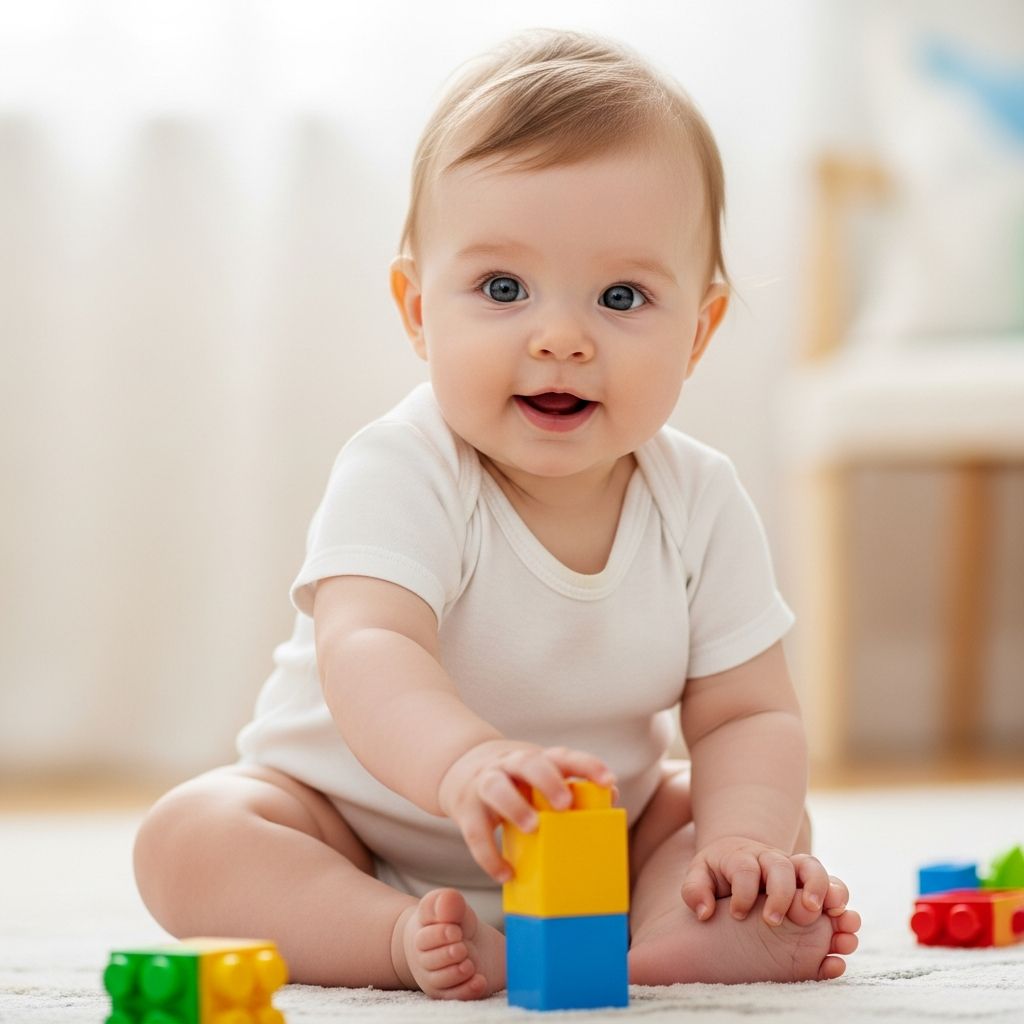
Providing toys with objects to push, poke, or turn challenges developing motor skills. Stacking and nesting toys help babies understand spatial relationships and problem-solving. Building structures together and demonstrating how to knock them down creates shared play experiences while supporting cognitive development.
When to Seek Professional Guidance
While developmental variation is normal, certain indicators warrant consultation with healthcare providers. Babies who are not making eye contact, not following moving objects with their eyes, or showing consistent eye turning in or out may need vision evaluation. Absence of babbling, not turning toward sounds or voices, or not responding to caregiver voice and facial expressions warrant assessment for hearing or communication concerns.
Lack of mobility progress—such as inability to sit with support or absence of any forward movement—may indicate motor development delays. Babies who show no interest in play, no response to their own name, or no social engagement with caregivers require professional evaluation. Extreme fearfulness, lack of emotional expression, or seeming indifference to caregiver departure also suggest need for developmental screening.
Healthcare providers can determine whether developmental variations represent individual differences within normal ranges or indicators of delayed development requiring intervention. Early identification of concerns allows for timely support that optimizes developmental outcomes.
Developmental Variation and Individual Differences
Significant individual variation exists in how and when babies achieve developmental milestones. Some babies crawl extensively before pulling to stand, while others skip crawling and move directly to standing and cruising. Some babies speak multiple words by nine months; others communicate primarily through gestures and babbling.
Gender, genetic factors, temperament, and individual experiences all influence developmental timing. Premature birth requires age adjustment in calculating developmental expectations for the first two years. Cultural practices, such as how much time babies spend in carriers versus on the floor, also influence movement pattern development.
Parents should celebrate their baby’s unique developmental journey rather than comparing progression to peers or external timelines. Focus on observing emerging abilities and supporting their baby’s individual strengths and interests creates positive developmental environments.
Preparing for the Transition to Toddlerhood
As babies approach their first birthday, they stand on the threshold of toddlerhood. The skills emerging at nine months—mobility, communication, cognitive understanding, and social awareness—form foundations for the rapid developments ahead. Nine-month-olds who are crawling, pulling to stand, babbling expressively, and showing social engagement typically progress toward independent walking and expanded language in the months ahead.
Maintaining safe, supportive environments while encouraging exploration helps babies develop confidence in their emerging abilities. Responsive caregiving that interprets and responds to communication attempts supports language development. Regular healthcare visits allow monitoring of physical growth and developmental progress while providing opportunities for parents to discuss observations and concerns with professionals.
Frequently Asked Questions
Q: Is it normal for my nine-month-old not to crawl yet?
A: Yes, absolutely. Some babies begin crawling around six to eight months, while others don’t crawl until ten months or later. Some babies skip crawling entirely and move directly to pulling up and walking. As long as your baby is moving in some manner—rolling, scooting, or rocking—crawling development is progressing typically.
Q: My baby isn’t saying words yet at nine months. Should I be concerned?
A: Babies develop language at different rates. By nine months, some babies say mama or dada with meaning, while others babble extensively but don’t produce recognizable words. If your baby babbles, responds to their name, turns toward sounds, and communicates through gestures and facial expressions, language development is progressing normally. Discuss any concerns about hearing or lack of babbling with your pediatrician.
Q: How can I encourage my nine-month-old’s mobility without being overprotective?
A: Create safe, supervised spaces where your baby can explore freely. Get down on the floor with them, demonstrate movements, and play alongside them. Allow supervised access to safe climbing opportunities like low steps or cushions. Avoid constant restriction that prevents practice of emerging skills. Balance safety with appropriate independence.
Q: What should I do if my nine-month-old shows extreme fear of strangers?
A: Stranger wariness is developmentally normal at this age and reflects healthy attachment to caregivers. Never force your baby to interact with unfamiliar people. Allow your baby to warm up gradually from your secure presence. Preparing your baby for transitions, maintaining familiar routines, and validating their emotions all help manage this phase.
Q: Are there specific toys that are best for nine-month-olds?
A: Toys that encourage exploration, problem-solving, and movement work well. Consider stacking and nesting toys, toys with buttons or knobs to push, large balls to roll, picture books, and toys that produce sounds. Avoid small objects, plastic bags, or anything with detachable parts that pose choking hazards. Simple toys often engage babies more than complex ones.
References
- Developmental Milestones — Children’s Hospital of Philadelphia. Accessed January 17, 2026. https://www.chop.edu/primary-care/developmental-milestones
- Baby Development at 9-10 Months — Raising Children Network. Accessed January 17, 2026. https://raisingchildren.net.au/babies/development/development-tracker-3-12-months/9-10-months
- Growth & Development: 9-11 Months — Riley Children’s Health. Accessed January 17, 2026. https://www.rileychildrens.org/health-info/growth-development-9-11-months
- Infant Development: Milestones from 7 to 9 Months — Mayo Clinic. Accessed January 17, 2026. https://www.mayoclinic.org/healthy-lifestyle/infant-and-toddler-health/in-depth/infant-development/art-20047086
- 7-9 Month Old Baby Development & Milestones — CHOC. Accessed January 17, 2026. https://choc.org/ages-stages/7-to-9-months/
- Milestones by 9 Months — Centers for Disease Control and Prevention. Accessed January 17, 2026. https://www.cdc.gov/act-early/milestones/9-months.html
- Baby Developmental Milestones By Month — Cleveland Clinic. Accessed January 17, 2026. https://my.clevelandclinic.org/health/articles/22063-baby-development-milestones-safety