Effective communication forms the cornerstone of a toddler’s cognitive and social growth. Between ages one and three, children transition from basic gestures and babbles to forming sentences and engaging in simple dialogues. Parents play a pivotal role by creating enriching environments that encourage this progression. Drawing from established developmental guidelines, this guide outlines seven actionable strategies to elevate your toddler’s expressive and receptive language abilities.
Understanding Toddler Language Milestones
Grasping typical milestones helps parents gauge progress and intervene timely. At 12 months, toddlers often say ‘mama’ or ‘dada’ specifically, wave bye-bye, and follow simple directives like ‘no’. By 18 months, they use 20-100 words, combine two words such as ‘more milk’, and point to body parts. At 24 months, expect two-word sentences, pointing to named objects, and basic gestures like blowing kisses. By 36 months, children carry two-way conversations, ask questions like ‘what’ or ‘where’, and use three-to-four-word phrases.
Receptive skills—understanding language—often precede expressive ones. Toddlers comprehend action words like ‘clap’ or ‘jump’ by 18-23 months and follow two-key-word instructions like ‘give me the ball’. Track these benchmarks to celebrate achievements and spot delays early.
| Age | Receptive Milestones | Expressive Milestones |
|---|---|---|
| 12 Months | Responds to name, follows simple gestures | Says 1-3 words, waves, shakes head no |
| 18 Months | Follows two-step instructions, points to body parts | 20+ words, two-word combos like ‘me go’ |
| 24 Months | Understands questions, sorts by size | Two-three word sentences, names pictures |
| 36 Months | Follows complex directions, answers wh- questions | Three-four word sentences, clear speech |
Strategy 1: Immerse in Rich Daily Narratives
Turn routine moments into language lessons by describing actions aloud. While dressing, say, ‘We’re putting on your red socks now—feel how soft they are.’ This models sentence structure and expands vocabulary. Research shows toddlers exposed to varied words early build larger lexicons. Repeat phrases consistently to reinforce comprehension, like ‘time for bath’ during evening rituals. Over time, your child mimics these patterns, boosting both understanding and speech output.
Strategy 2: Master the Art of Active Listening
Give full attention during your toddler’s attempts to communicate. Kneel to eye level, nod, and reflect back: If they babble ‘ba ba’, respond ‘Ball? You want the ball?’ This validates efforts and clarifies intent. Active listening fosters turn-taking in conversations, a key social skill. By 24 months, toddlers thrive on reciprocal exchanges, imitating your responsive style. Avoid interruptions; let them finish, even if incoherent, to build confidence.
Strategy 3: Harness Play for Verbal Exploration
Play is toddlers’ natural language lab. During block play, narrate: ‘The tall tower is falling down—crash!’ Introduce new terms like ‘stack’ or ‘balance’. Use toys to role-play scenarios: ‘Doll says, “I’m hungry.” What does teddy eat?’ This encourages imaginative expression. Gestures like pointing or pretending amplify learning; by 18 months, most use them alongside words. Dedicate 15-20 minutes daily to unstructured play, watching skills flourish.
- Sort toys by color: ‘Red car, blue truck.’
- Puppet shows: Let characters ‘talk’ to prompt responses.
- Sensory bins: Name textures—’squishy sand, crunchy leaves.’
Strategy 4: Read Aloud with Interactive Flair
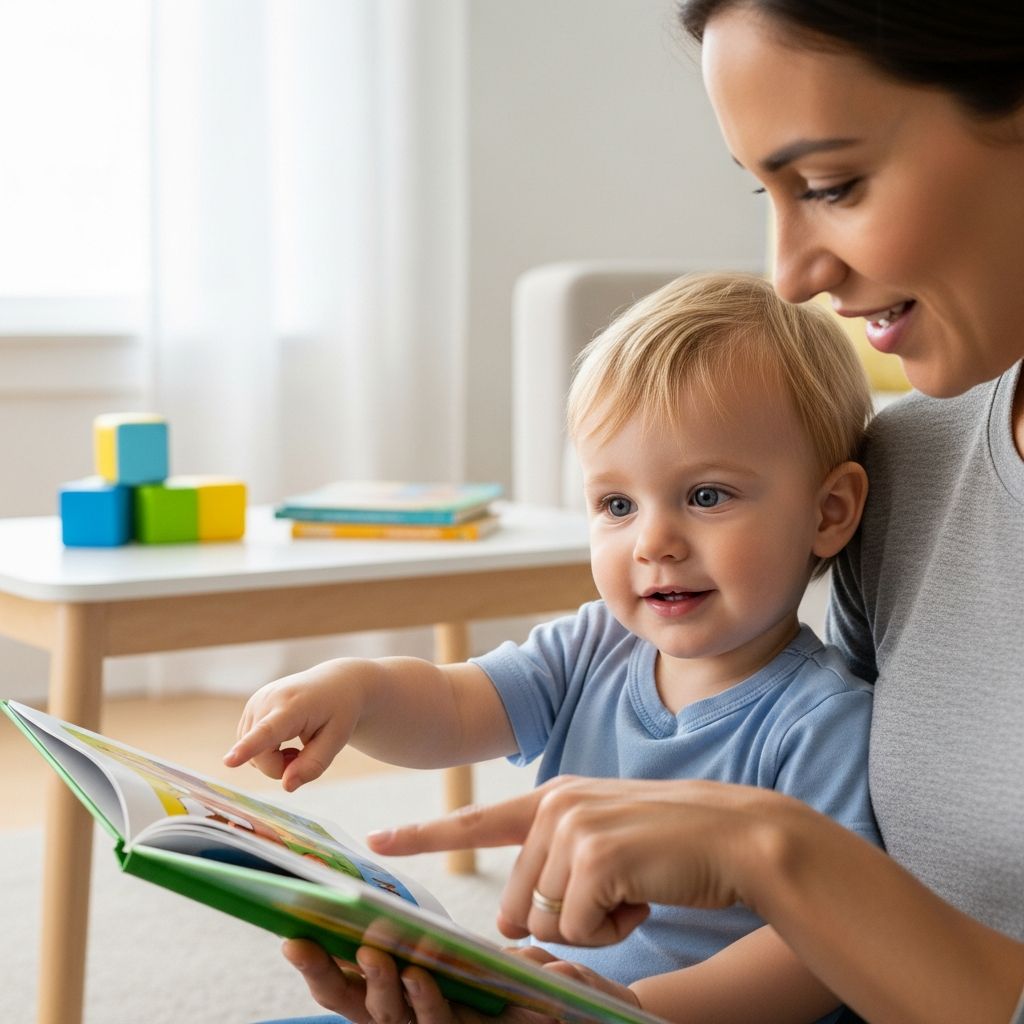
Daily reading sessions spark curiosity and vocabulary. Choose board books with vivid pictures; point and label: ‘Look, the dog runs fast!’ Pause for predictions: ‘What happens next?’ Toddlers at 12-17 months enjoy being read to and follow picture narratives. Vary tones—whisper, roar—to mimic speech rhythms. Repetition familiarizes phrases; by 24 months, they point to named items in books. Aim for 10-15 minutes twice daily.
Strategy 5: Expand and Echo Their Words
When your toddler says ‘dog’, enrich it: ‘Yes, big brown dog runs!’ This technique, called expansion, teaches grammar without correction. Echo gestures too—if they wave, exclaim ‘Bye-bye, wave wave!’ It models fuller expressions. Studies confirm caregivers’ expansions accelerate sentence formation. Use positivity; never mock mispronunciations, as toddlers produce sounds like p, b, m by age three.
Strategy 6: Sing, Chant, and Rhyme Routines
Music aids memory and phonetics. Sing ‘Wheels on the Bus’ during car rides, emphasizing actions. Nursery rhymes like ‘Itsy Bitsy Spider’ teach sequencing and sounds. Toddlers respond to rhythms from four months, cooing back. Chants during cleanup—’Pick up toys, one two three!’—make tasks communicative. This builds prosody, the musicality of speech, essential for clarity.
Strategy 7: Encourage Questions and Choices
Pose open-ended queries: ‘What color is this?’ or ‘Where does the bird fly?’ Offer choices: ‘Apple or banana?’ This promotes decision-making language. By 36 months, toddlers ask ‘why’ questions; modeling responses prepares them. Respond patiently to their queries, expanding: ‘The sky is blue because of the sun’s light.’ Limit screen time, favoring interactive talks, as real exchanges outperform passive media.
Spotting and Addressing Delays
Monitor for red flags. By 12 months, lack of babbling, gestures, or name response warrants attention. At 18 months, no words or two-word phrases signals potential delay. By 24 months, if speech is mostly unintelligible to strangers, consult professionals. Early intervention via speech therapy yields best outcomes. Track with milestone checklists and discuss with pediatricians.
| Red Flags by Age | Action Steps |
|---|---|
| 12 Months: No gestures, ignores sounds | Hearing test, monitor closely |
| 18 Months: Fewer than 6 words | Speech screening, enrich environment |
| 24 Months: No two-word sentences | Consult SLP, early intervention |
Frequently Asked Questions (FAQs)
What if my 18-month-old only says a few words?
Some variation exists, but under 20 words prompts evaluation. Boost with strategies above and seek pediatric advice.
How much daily interaction is enough?
Quality trumps quantity: 30-60 minutes of focused talk/play daily suffices alongside routines.
Does screen time help language?
Limited educational content may aid, but interactive parent-child talk is superior. Cap at 1 hour/day for 2+ year-olds.
When is speech ‘clear enough’?
By 36 months, familiar listeners understand most; strangers by age 4. Therapy if persistent issues.
Can bilingual homes delay speech?
No, bilingual toddlers meet milestones similarly; mix languages naturally.
Implementing these strategies consistently transforms toddler-parent bonds and equips children for school readiness. Patience and enthusiasm yield lasting gains in communication prowess.
References
- Communication: Infants and Toddlers — Virtual Lab School. 2023. https://www.virtuallabschool.org/infant-toddler/communication-and-language-development/lesson-2
- Language development: 1-2 years — Raising Children Network. 2024-01-16. https://raisingchildren.net.au/toddlers/development/language-development/language-1-2-years
- Age-Appropriate Speech and Language Milestones — Children’s Hospital of Philadelphia (CHOP). 2024. https://www.chop.edu/health-resources/age-appropriate-speech-and-language-milestones
- Speech and language development (from 12 to 24 months) — Great Ormond Street Hospital (GOSH). 2023. https://www.gosh.nhs.uk/conditions-and-treatments/procedures-and-treatments/speech-and-language-development-12-24-months/
- Communication Milestones: 2 to 3 Years — American Speech-Language-Hearing Association (ASHA). 2024. https://www.asha.org/public/developmental-milestones/communication-milestones-2-to-3-years/
- Speech and Language Developmental Milestones — National Institute on Deafness and Other Communication Disorders (NIDCD), NIH. 2024-05-15. https://www.nidcd.nih.gov/health/speech-and-language