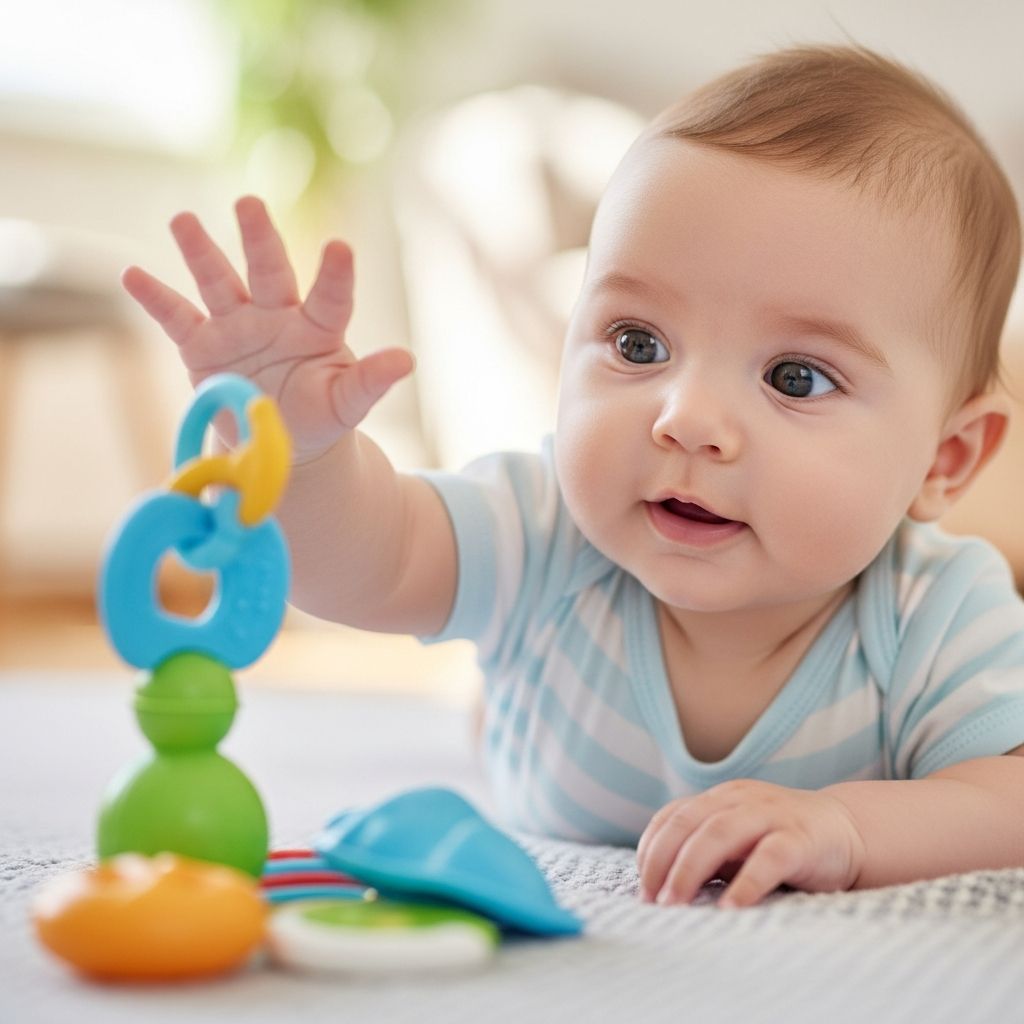
By around 5 months of age, your baby is rapidly sharpening all five senses and beginning to connect what they see, hear, feel, taste, and smell. This growing sensory world is the foundation for later skills like language, movement, attention, and social-emotional development.
Every baby grows on their own timeline, but understanding typical patterns can help you respond confidently to your child’s needs and know when to ask questions.
Big Picture: Sensory Development at 5 Months
Experts describe the first year as a time when babies learn about their environment primarily through their senses and movement. By 4–6 months, most babies are more alert, interactive, and ready to explore.
- Vision is clearer; babies track moving objects, recognize familiar faces, and notice details farther away.
- Hearing guides attention; babies turn toward sounds and begin experimenting with different pitches and babbles.
- Touch becomes a favorite way to learn; hands and mouth are used constantly to explore objects and textures.
- Taste and smell help babies recognize caregivers, milk or formula, and early food flavors when solids are introduced.
- Movement and body awareness (sometimes called vestibular and proprioceptive senses) grow as babies roll, sit with support, and reach.
These senses work together. For example, when your baby sees a toy, reaches for it, feels its texture, then puts it in their mouth, they are building a complete picture of what that object is.
Seeing the World: Visual Growth at Five Months
From birth to 12 months, babies gradually move from blurry, close-up vision to clearer, more detailed sight. Between 4 and 6 months, vision becomes much more coordinated.
Typical visual abilities around 5 months
- Eyes move smoothly together to follow a moving toy or face across the room.
- Recognizes familiar faces and may smile or become excited when you appear.
- Notices small objects within reach and tries to look back and forth between two interesting things.
- Shows interest in bright colors, simple patterns, and contrasts (like dark and light).
Ways to support healthy vision
- Hold toys 8–18 inches from your baby’s face so they can see details clearly.
- Move a soft, colorful toy slowly from side to side to encourage smooth tracking.
- Offer time in different positions (on the back, tummy time, supported sitting) to give new visual angles on the room.
- Limit long stretches of screen exposure; professional groups recommend avoiding screens for infants except for brief video chatting with family.
Listening and Learning: Hearing at Five Months
Hearing is fully developed at birth, but the brain’s ability to interpret sounds changes dramatically throughout the first year. By 4–6 months, babies are usually very tuned in to human voices and everyday noises.
Typical hearing and communication signs
- Turns their head or eyes toward your voice or a sound-making toy.
- Gets quiet or more alert when they hear something new.
- Babbles using repeated sounds (like “ba-ba” or “ma-ma”), though not yet with meaning.
- Enjoys musical toys, songs, and changes in your tone of voice.
How to nurture your baby’s hearing and language
- Talk often during everyday tasks—describe what you are doing, what your baby is looking at, or what will happen next.
- Imitate and respond to your baby’s sounds, taking turns as if you are in conversation; this back-and-forth supports early communication.
- Read aloud simple board books, even if your baby only looks for a short time. Hearing your voice and rhythm of language matters more than how long they pay attention.
- Sing songs and nursery rhymes; repetition and melody are powerful learning tools.
Hands, Skin, and Movement: Touch and Body Awareness
Touch is one of the earliest senses to develop and plays a key role in bonding and calming. Around 5 months, babies are using touch in more intentional ways.
Common touch and motor behaviors
- Grasps toys placed in their hand and may reach out to grab objects they see.
- Brings hands together, examines them, and often brings them to the mouth.
- Rolls from tummy to back or back to side; some may roll both ways by the end of this age range.
- Enjoys being held, cuddled, and gently bounced; often relaxes when comforted by a familiar caregiver.
Supporting touch and movement safely
- Provide daily tummy time while your baby is awake and supervised to build strength in the neck, shoulders, and core.
- Offer soft toys and household-safe objects with different textures (smooth, crinkly, slightly bumpy) for supervised exploration.
- Let your baby play on a firm, flat surface rather than spending long periods in swings or seats; this gives more freedom to move and learn new skills.
- Use gentle touch—stroking arms, legs, and back—to help your baby relax before sleep or after excitement.
Smell and Taste: Early Steps Toward Eating
Even before birth, babies can sense flavors and smells from the parent’s diet through amniotic fluid, and later through breast milk. By 5 months, these senses help them recognize people and prepare for the introduction of solid foods (usually between 4 and 6 months, depending on pediatric guidance).
What smell and taste can do at this age
- Recognize the scent of parents and primary caregivers, which helps with bonding and comfort.
- Respond differently to familiar and unfamiliar odors (showing interest or dislike through facial expressions or body language).
- Notice flavor differences in breast milk or formula and, when solids start, in early purees.
Supporting healthy taste and smell experiences
- Follow your pediatrician’s guidance on when and how to begin solids; many babies are ready to practice sitting with support, hold their head steady, and show interest in food by 4–6 months.
- Begin with simple, single-ingredient foods if cleared by your child’s doctor, watching carefully for signs of allergy.
- Avoid adding salt or sugar to baby foods; infants do not need extra sodium or added sugars and may learn to prefer very strong flavors too early.
- Keep strong household odors (harsh chemical cleaners, smoke) away from your baby’s environment whenever possible.
Putting It All Together: Multi-Sensory Experiences
Real-life activities rarely use just one sense at a time. A feeding, for example, includes the sight of your face, the sound of your voice, the feel of your touch, and the taste and smell of milk or formula. These combined experiences help the brain form richer connections.
| Everyday moment | Senses involved | What your baby may be learning |
|---|---|---|
| Feeding (breast or bottle) | Taste, smell, touch, hearing, vision | Comfort, hunger and fullness cues, bonding with caregiver |
| Tummy time on a play mat | Vision, touch, movement, body awareness | Head and trunk control, exploring space, reaching for toys |
| Bath time | Touch, temperature, hearing, smell | Different water sensations, routine signals, relaxation |
| Outdoor walk in a stroller | Vision, hearing, smell, movement | New sights and sounds, calming motion, day–night patterns |
Simple Sensory-Rich Play Ideas
You do not need special equipment to support your 5-month-old’s development. Short, frequent playtimes that match your baby’s mood are best.
- Face-to-face time: Lie next to your baby, make calm facial expressions, talk or sing softly, and let them study your features.
- Sound games: Gently shake a rattle from one side to the other and pause, allowing your baby to find the sound; celebrate when they turn toward it.
- Texture exploration: Offer a clean washcloth, a soft cloth book, and a smooth plastic ring—rotate them so your baby can feel differences.
- Gentle movement: Hold your baby securely and sway, walk, or gently bounce; this supports the inner ear system involved in balance and spatial awareness.
- Story moments: Look at a few pages of a book; point to big pictures and name what you see, even if your baby only glances briefly.
Creating a Supportive Sensory Environment
A calm, predictable environment helps babies feel secure enough to explore. Too little stimulation can limit learning opportunities, while too much can be overwhelming. Watching your baby’s cues helps you find the right balance.
Tips for everyday settings
- Keep a regular routine for sleep, feeding, and play when possible; predictability supports regulation.
- Offer a variety of safe sights, sounds, and textures over time—rotate toys rather than having everything out at once.
- Protect your baby from loud, sudden noises and excessively bright lights that may be distressing.
- Watch for signs of overload (turning away, stiffening, fussing) and take breaks when needed.
When to Talk With a Pediatrician
There is a wide range of typical development, but certain signs may warrant a closer look. Regular well-child visits are an opportunity to discuss milestones and any concerns you notice.
Possible red flags around 5–6 months
- Does not respond to loud sounds or to your voice at all.
- Does not follow moving objects with their eyes or seems to have trouble focusing.
- Very stiff or very floppy muscles, with little movement of arms or legs.
- Does not show pleasure from social interaction (no smiles, little eye contact) by this age.
- Seems unusually upset by touch, movement, light, or sound compared with other babies.
If something worries you, trust your instincts and ask your pediatrician. Early evaluation can provide reassurance or help connect you with services if needed.
Frequently Asked Questions About 5-Month-Old Senses
My 5-month-old puts everything in their mouth. Is that normal?
Yes. Mouthing is a key way babies explore textures, shapes, and even temperatures. Supervise closely, offer objects that are too large to swallow and free of choking hazards, and keep small items out of reach.
How can I tell if my baby can see and hear well?
Most babies at this age look toward faces, track moving toys, and turn to your voice or other sounds. If your baby rarely reacts to visual or sound cues, or you have any concern, discuss it with your child’s healthcare provider.
Do I need special sensory toys?
Not necessarily. Household items like soft cloths, plastic measuring cups, or simple rattles can provide rich sensory input when used safely and with supervision. Your voice, touch, and presence are still the most important “toys.”
When should I worry about sensory processing problems?
If your baby consistently avoids touch, sound, or movement, seems unusually fussy in normal environments, or is missing multiple milestones, talk with your pediatrician. They may suggest a hearing or vision test or a developmental evaluation.
How much playtime does a 5-month-old need?
Short, frequent periods of interaction throughout the day—talking, cuddling, tummy time, and simple games—are ideal. Follow your baby’s cues: they may enjoy just a few minutes of focused play before needing a rest.
References
- Sensory and Motor Development, Ages 1 to 12 Months — MyHealth.Alberta.ca. 2022-09-08. https://myhealth.alberta.ca/Health/pages/conditions.aspx?hwid=ue5465
- Infant development: Milestones from 4 to 6 months — Mayo Clinic Staff, Mayo Clinic. 2023-08-23. https://www.mayoclinic.org/healthy-lifestyle/infant-and-toddler-health/in-depth/infant-development/art-20048178
- Sensory and social skill development: Newborn to 2 years — Children’s Hospital of Richmond at VCU. 2024-01-10. https://www.chrichmond.org/services/therapy-services/developmental-milestones/sensorysocial-skills-birth-to-2-years/
- Tracking Sensory Development Milestones in Infants and Toddlers — FDNA Health Resource Center. 2023-06-15. https://fdna.com/health/resource-center/tracking-sensory-development-milestones-in-infants-and-toddlers/