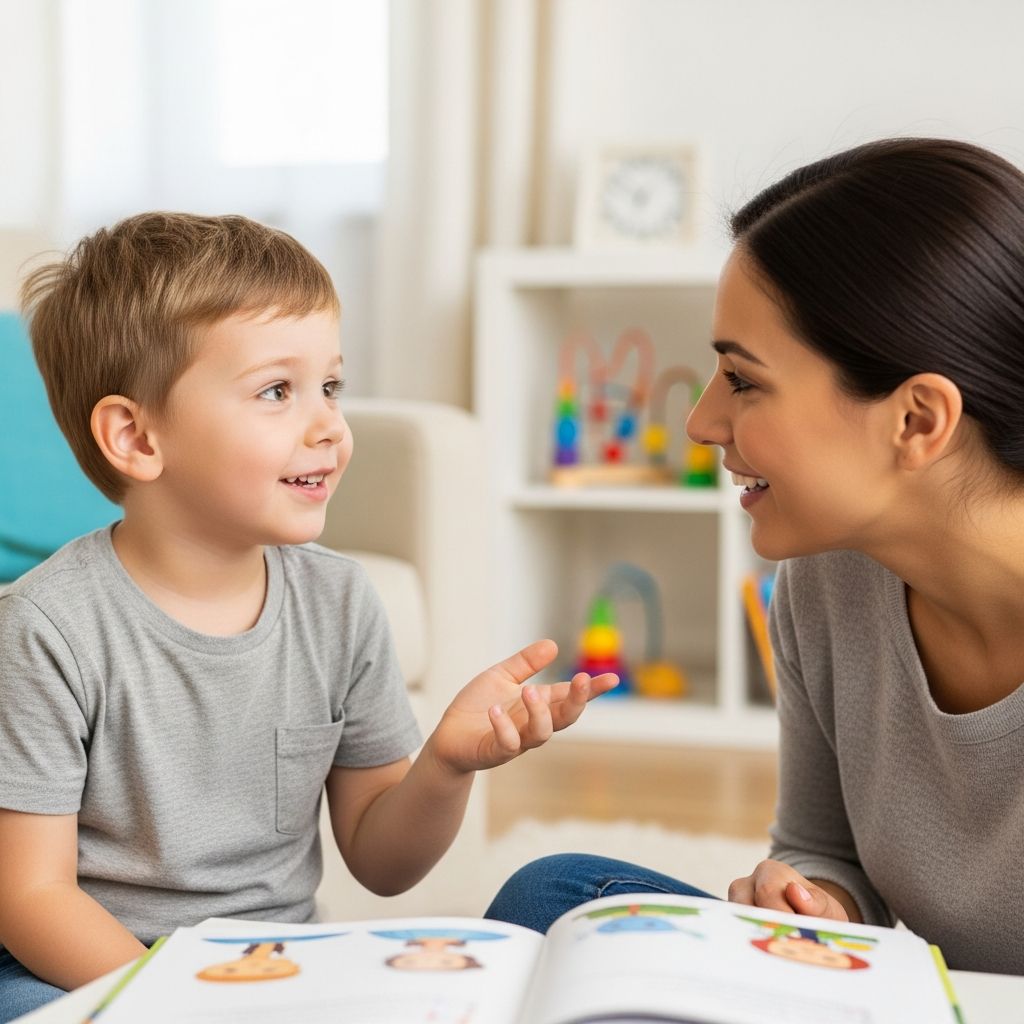
Between 40 and 48 months, children typically advance to producing sentences with five to six words, marking a pivotal shift in expressive language skills. This period sees toddlers transitioning from simple phrases to more detailed expressions that convey thoughts, observations, and basic narratives.
Understanding Language Explosion at Age 4
At this stage, a child’s vocabulary surges, often reaching around 900 words by 48 months, enabling them to form coherent sentences like “I want the red ball now.” This growth reflects improved neural connections in brain areas responsible for language processing, allowing children to combine nouns, verbs, adjectives, and prepositions fluidly. Parents often notice their little ones engaging in back-and-forth conversations, asking questions with words like “when” or “how,” and describing everyday objects’ functions, such as “This spoon stirs soup.”
Receptive language, or comprehension, outpaces expression, with children understanding 1500-2000 words and following multi-step directions like “Put the toy on the shelf then close the door.” This disparity is normal, as listening skills develop earlier, providing a foundation for speaking proficiency.
Key Expressive Milestones in 40-48 Months
- Forms sentences of 4-5 words routinely, progressing to 5-6 words by 48 months, e.g., “The dog is running fast.”
- Uses plurals (“dogs”), possessives (“mom’s hat”), pronouns (“he/she/it”), and prepositions (“under the table”) correctly in context.
- Incorporates conjunctions like “so” and “because,” e.g., “I cried because it hurt.”
- Relates personal experiences or sequences events, such as recounting a playground visit.
- Asks and answers problem-solving questions, like “What happens if we mix colors?”
These skills emerge through play and interaction, with imaginative pretend play enhancing narrative abilities, like using a block as a phone to “call” a friend.
Receptive Language Advances
Children grasp complex structures, tracking 6-word sentences and retelling short stories with main ideas intact. They understand abstract concepts including textures (“smooth/rough”), quantities (“empty/full”), comparatives (“bigger than”), and time distinctions (“yesterday/tomorrow”). By 48 months, they follow 3-part commands, identify “odd one out” in sets, and predict outcomes in scenarios, fostering cognitive flexibility.
| Concept Category | Examples Understood | Age of Mastery |
|---|---|---|
| Locational | Next to, behind, on top | 42-48 months |
| Comparatives | Taller than, faster | 44-48 months |
| Time | Morning, night, before/after | 40-48 months |
| Quantity/Quality | One/many, clean/dirty | 36-48 months |
This table summarizes common receptive milestones, drawn from developmental guidelines.
Phonological and Articulation Progress
By 48 months, most consonants are produced accurately, with words featuring final sounds (“hat,” “duck”) and minimal syllable deletions (occasional “efant” for “elephant”). Speech intelligibility reaches 75-90% to unfamiliar listeners, though dysfluencies like repetitions (“ma-ma-mom”) may appear due to rapid language demands outpacing motor skills. These are typically transient; persistent issues beyond six months warrant monitoring.
Auditory skills sharpen, with attention to 15-minute stories and memory for 4 items, supporting phonological awareness like rhyming and initial sounds.
Social-Pragmatic Language Skills
Pragmatics, or language in social contexts, blooms as children use indirect requests (“Can you help me?”), discuss emotions (“I’m happy because…”), and take turns in dialogue, though they may interrupt due to excitement. They distinguish real from pretend in stories and use language to persuade, plan, or solve conflicts, e.g., “Let’s share the blocks so we both play.”
How Parental Interactions Boost Development
Daily routines offer prime opportunities: narrate actions (“We’re washing the apple now”), expand utterances (child says “big dog”; respond “Yes, the big brown dog is running”), and pose open questions (“What do you think happens next?”). Reading diverse books introduces new vocabulary, while play encourages storytelling. Limit screens to foster direct talk; responsive listening builds confidence.
- Model complex sentences during meals or baths.
- Play turn-taking games like “Simon Says” for commands.
- Encourage emotion labeling: “You look frustrated; tell me why.”
- Use songs and rhymes to practice sounds.
Activities to Encourage 5-6 Word Sentences
- Story Sequencing: Use picture cards for 3-part stories; child narrates “Boy falls, cries, mom hugs.” Builds syntax.
- Puppet Shows: Act dialogues with toys, prompting full sentences.
- Descriptive Walks: Label surroundings: “See the tall green tree waving?”
- Problem-Solving Toys: Puzzles prompt explanations like “I put the red piece here because it fits.”
- Rhyme Time: Create silly verses to play with sounds and words.
Consistency yields results; track progress via journals.
Red Flags and When to Seek Help
While variation is normal, consult professionals if by 48 months: fewer than 4-word sentences persist, speech <75% intelligible, no questions asked, or ignores instructions. Early intervention via speech-language pathologists can address delays effectively. Factors like bilingualism or ear infections may influence pace but rarely halt progress with support.
Frequently Asked Questions (FAQs)
What if my 40-month-old only uses 3-word sentences?
Monitor for 3-6 months; if no progress, screen for evaluation. Most catch up with stimulation.
Is stuttering normal at this age?
Occasional repetitions are common; provide time to speak without interruption. Persistent beyond 6 months? Consult SLP.
How much daily talk time is ideal?
30-60 minutes of rich, child-directed conversation boosts vocabulary exponentially.
Does screen time help or hinder?
Interactive co-viewing aids, but passive screens reduce parent-child talk; prioritize real interactions.
Can bilingual homes delay milestones?
No, total language (both) meets norms; expect code-mixing initially.
Long-Term Benefits of Strong Language Foundations
Mastering these milestones predicts school readiness: better literacy, social skills, and problem-solving. Children who articulate complex ideas early excel in reading by kindergarten and show advanced executive function. Investing now pays dividends in academic and emotional resilience.
Track via apps or charts, celebrating small wins like first “because” sentence. Collaborate with preschool for reinforcement.
References
- Speech Language Developmental Milestones 36-48 Months — iCommunicate Therapy. Accessed 2026. https://www.icommunicatetherapy.com/child-speech-language/child-speech-language-development/child-speech-language-milestones-stages-of-development/speech-language-developmental-milestones-36-48-months-3-4-years/
- Age-Appropriate Speech and Language Milestones — Children’s Hospital of Philadelphia (CHOP). Accessed 2026. https://www.chop.edu/health-resources/age-appropriate-speech-and-language-milestones
- 48 Months to 60 Months – All About Young Children — All About Young Children. Accessed 2026. https://allaboutyoungchildren.org/english/48-months-to-60-months/
- Language Development Milestones — Putnam Northern Westchester BOCES (.gov equivalent educational resource). Accessed 2026. https://www.ppboces.org/DocumentCenter/View/2158/Language-development-milestones
- Speech and Language Developmental Milestones — National Institute on Deafness and Other Communication Disorders (NIDCD), NIH (.gov). 2023-02-01. https://www.nidcd.nih.gov/health/speech-and-language