Balancing remote work with childcare demands inventive solutions that entertain children while nurturing their minds. These activities promote cognitive growth, creativity, and self-reliance, allowing parents brief focused work periods without screens dominating playtime.
Why Play Matters for Growing Minds
Play serves as a cornerstone for intellectual advancement in children. Research from the American Academy of Pediatrics emphasizes that playful engagement builds cognitive connections, enhancing memory, problem-solving, and language skills. Unstructured play fosters independent thinking, while structured tasks develop logic and planning. For parents working from home, selecting age-appropriate options ensures kids stay occupied productively, turning potential disruptions into opportunities for development.
Activities tailored for short bursts—15 to 45 minutes—align with attention spans of young learners. They encourage exploration without constant supervision, freeing parents for meetings or tasks. Benefits extend beyond entertainment: children gain confidence, emotional regulation, and foundational skills for school success.
Building Blocks of Creativity and Logic
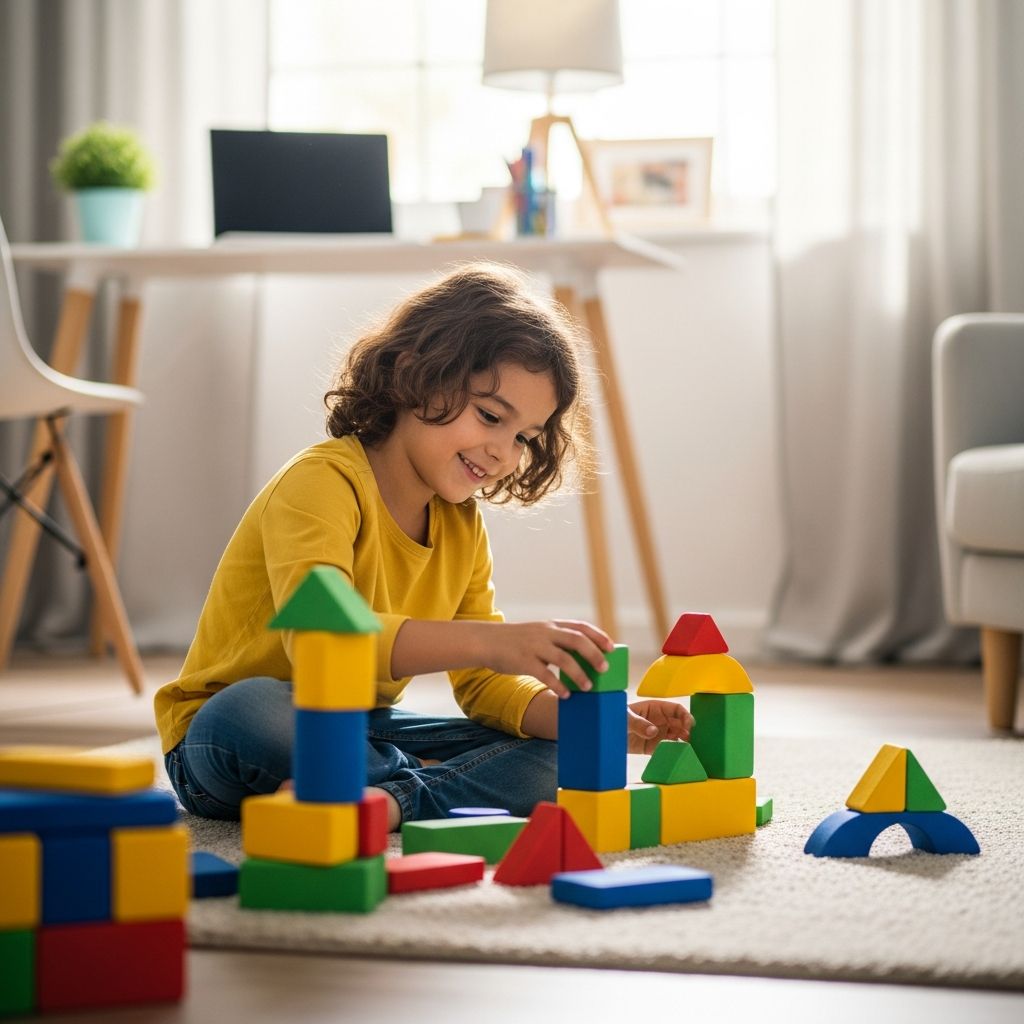
Hands-on construction sparks innovation and spatial awareness. Provide safe materials like wooden blocks, recycled containers, or magnetic tiles for open-ended building. Children engineer towers, bridges, or vehicles, experimenting with balance and design. This mirrors STEM principles, introducing engineering concepts naturally.
- Sort items by size, color, or shape before stacking to add sorting skills.
- Challenge them to replicate a simple structure from a picture, promoting observation.
- Extend play by discussing ‘what if’ scenarios, like adding wheels for mobility.
These sessions build persistence as structures topple, teaching resilience through trial and error.
Brain Teasers and Puzzle Challenges
Puzzles sharpen focus and pattern recognition. Start with large-piece sets for toddlers, progressing to intricate 50-100 piece jigsaws for older kids. Matching games, like pairing animal cards or shapes, enhance memory and categorization.
| Age Group | Recommended Puzzle Types | Skills Developed |
|---|---|---|
| 3-5 years | Large knob puzzles, shape sorters | Hand-eye coordination, basic matching |
| 6-8 years | 24-48 piece jigsaws, memory pairs | Patience, visual memory |
| 9-10 years | 100-piece puzzles, logic grids | Strategy, spatial reasoning |
Rotate puzzles weekly to maintain novelty. For solo play, set a timer for gentle motivation, rewarding completion with praise upon check-ins.
Literacy Adventures Without Books
Instill a love for words through interactive literacy games. Scatter magnetic letters on a tray for word hunts or rhyming challenges. Invent stories using picture prompts, or play ‘I Spy’ with descriptive clues to expand vocabulary. Nursery rhymes and sing-alongs reinforce phonics and rhythm.
- Hide letter cards around the room for a scavenger hunt, spelling simple words found.
- Create a ‘word wall’ with sticky notes labeling household objects.
- Act out fairy tales using props from around the house, assigning roles to toys.
These activities mimic read-aloud benefits, improving comprehension and expression without requiring constant reading.
Science Experiments from Kitchen Staples
Transform everyday items into lab wonders. Mix baking soda and vinegar for fizzy reactions, observing cause and effect. Sink-or-float tests with household objects teach density basics. Plant seeds in clear cups to track growth, journaling observations.
Prepare trays in advance: vinegar volcanoes, color-changing cabbage indicators, or homemade slime for sensory science. Safety first—supervise initially, then allow independent repetition. Such experiments cultivate curiosity and hypothesis testing.
Artistic Expression Stations
Dedicate a corner with washable supplies: crayons, playdough, collage materials. Theme it weekly—’ocean scenes’ or ‘robot inventors’—to guide creativity without limits. Finger painting on trays builds fine motor control; sculpting fosters three-dimensional thinking.
- Provide nature items like leaves for eco-art.
- Set up a ‘drip art’ station with yarn and paint for abstract designs.
- Encourage storytelling through sequential drawings.
Display creations to boost self-esteem, rotating space to prevent overwhelm.
Imaginative Role-Play Worlds
Pretend scenarios develop social-emotional intelligence. Stock a dress-up bin with old clothes, hats, and props for ‘restaurant,’ ‘hospital,’ or ‘space explorer.’ Solo play with stuffed animals practices dialogue and empathy.
Enhance with simple sets: cardboard box ‘shops’ or pillow forts. This play hones narrative skills and emotional navigation, preparing kids for real interactions.
Musical Explorations at Home
Rhythm instruments like shakers from rice-filled bottles or DIY drums ignite auditory processing. Play freeze dance to classical tunes or create beats with pots and spoons. Expose to genres via playlists, encouraging mimicry.
- Compose simple songs about daily routines.
- Match sounds to sources, like rain or animals.
- Dance patterns following numbered floor mats.
Music bolsters language, math (counting beats), and emotional expression.
Outdoor-Inspired Indoor Quests
Weather-proof nature play: indoor scavenger hunts for textures, colors, or sounds. Build ‘habitats’ with toys mimicking ecosystems. Yoga cards or obstacle courses promote gross motor ties to cognition.
These maintain physicality indoors, linking movement to mental acuity.
Game Night Staples for Daytime
Board games like simplified checkers or card matches teach strategy. ‘Simon Says’ or ‘Go Fish’ build listening and memory. Rotate to avoid burnout, setting up for 20-minute rounds.
Setting Up for Independent Success
Curate activity bins labeled by time needed. Use visual timers for transitions. Rotate stock bi-weekly. Brief morning ‘play plans’ empower choice, fostering autonomy. Safety checklists ensure worry-free work blocks.
Frequently Asked Questions
How long should play sessions last for young kids?
Ages 3-5 thrive on 15-20 minute bursts; 6-10 can manage 30-45 minutes. Use timers to build stamina gradually.
Can these activities replace preschool learning?
They complement formal education by reinforcing skills playfully, but variety and social interaction remain key.
What if my child resists independent play?
Start with parallel play nearby, gradually increasing distance. Choice and novelty reduce resistance.
Are supplies expensive?
Most use recyclables; invest minimally in reusables like puzzles for long-term value.
How to track developmental progress?
Note milestones like puzzle completion times or vocabulary growth in a journal.
Daily Play Routines for Busy Families
Sample schedule: 9 AM puzzle, 10 AM art, post-lunch science. Adapt to work calls, blending quiet and active options. Consistency breeds routine-loving kids.
Long-term, these habits yield resilient, curious learners. Parents report reduced stress and stronger bonds from structured fun.
References
- Activities That Help Children Grow Intellectually — Imagination Crossing. Accessed 2026. https://imaginationcrossing.com/activities-that-help-children-grow-intellectually/
- How Does Play Improve Children’s Intellectual Development? — WonDIRful Play. 2025-01-13. https://www.wondirfulplay.com/blog/how-does-play-improve-childrens-intellectual-development
- Growing Minds With Cognitive Development Activities for Toddlers — ECCM. Accessed 2026. https://www.eccm.org/blog/cognitive-development-activities-for-toddlers
- Brain-Building Cognitive Development Activities for Young Students — Studentreasures. Accessed 2026. https://studentreasures.com/blog/classroom-activities/cognitive-development-activities/
- Play ideas for children’s cognitive development — Raising Children Network (Australian Govt-funded). Accessed 2026. https://raisingchildren.net.au/school-age/play-media-technology/play-school-age-development/thinking-play-school-age
- Brain-Building Through Play: Activities for Infants, Toddlers, and Preschoolers — Center on the Developing Child at Harvard University. Accessed 2026. https://developingchild.harvard.edu/resources/handouts-tools/brainbuildingthroughplay/