Physical Growth and Body Changes in Three-Year-Olds
As children enter their fourth year of life, they experience measurable changes in their physical dimensions and proportions. During this period, children typically gain between 4 to 5 pounds annually, with corresponding increases in height of 2 to 3 inches per year. By age three, most children have reached approximately half of their final adult height, providing an important milestone in understanding long-term growth trajectories.
Vision capabilities advance significantly during this developmental window. Children’s eyesight improves to approximately 20/30, with continued refinement toward normal adult vision. Additionally, by the third birthday, children have acquired all 20 primary teeth, completing their initial set of deciduous dentition. This dental development represents a major physiological milestone in early childhood.
Sleep requirements remain substantial during this age, with children typically needing 11 to 13 hours of sleep daily to support ongoing growth and development. Many three-year-olds continue to benefit from a mid-afternoon nap, though the duration and necessity of daytime sleep varies considerably among individual children.
Motor Skills: From Gross Movement to Fine Coordination
Three-year-olds demonstrate remarkable improvements in their ability to control and coordinate their bodies. Large muscle development, known as gross motor skills, becomes evident through increasingly complex movement patterns. Children at this age run with greater confidence, jump with both feet leaving the ground, and climb with improved safety awareness. Walking up stairs without handrail support becomes possible, though they may still benefit from assistance on particularly steep or lengthy staircases.
Major Gross Motor Achievements
- Running and jumping with relative ease and minimal stumbling
- Ascending and descending stairs independently, though rhythm may still alternate feet
- Balancing briefly on one foot, typically for up to 5 seconds
- Hopping movements, though distance and duration remain limited
- Kicking balls forward with directional control
- Pedaling tricycles and other riding toys
- Throwing balls overhead with emerging accuracy
- Climbing on and off furniture with decreasing clumsiness
Fine motor development—the ability to manipulate small objects and perform precise movements—progresses substantially during this year. Children develop greater dexterity in their fingers and hands, enabling them to manage buttons, fasten simple closures, and manipulate writing instruments with improved control. The tripod grasp, where crayons and pencils are held between thumb and fingers rather than in a closed fist, emerges during this period, facilitating more controlled drawing and writing movements.
Fine Motor and Self-Care Capabilities
- Drawing recognizable circles and copying circular shapes
- Creating simple straight lines and basic geometric forms
- Building towers with 9 or more blocks without structural collapse
- Placing small objects into narrow openings with increasing precision
- Using child-safe scissors with developing blade control
- Feeding themselves with spoons and forks
- Partially dressing and undressing independently
- Washing and drying hands with assistance
Language Development and Communication Expansion
Language acquisition accelerates dramatically during the third year of life. Most three-year-olds can understand and use a vocabulary ranging from several hundred to potentially 900 words by age four. This rapid expansion reflects the brain’s increasing capacity for word storage and retrieval, as well as exposure to diverse linguistic inputs from their environment.
Speech production becomes more sophisticated, transitioning from simple one or two-word utterances to complete sentences. Children at this age typically speak in sentences of three words and progress toward four to five-word combinations as they approach their fourth birthday. While pronunciation may still contain some errors and immaturities, speech becomes sufficiently clear that unfamiliar listeners can understand most of what the child says.
Language Milestones and Communication Skills
- Engaging in back-and-forth conversational exchanges with caregivers
- Asking “who,” “what,” “where,” and “why” questions with increasing frequency
- Using pronouns correctly, including “I,” “you,” “he,” and “she”
- Understanding and using plural forms of words
- Comprehending past tense concepts like “yesterday”
- Following multi-part directions, typically up to three sequential steps
- Recalling and recounting parts of familiar stories
- Naming colors and understanding size differences (big/little)
- Using polite social language such as “please” and “thank you”
- Demonstrating understanding of prepositions like “on,” “under,” and “behind”
Cognitive Development and Intellectual Growth
Three-year-olds experience significant advances in thinking, learning, and problem-solving abilities. Cognitive development at this age involves expanding capacity for symbolic thinking, where children use words, images, and objects to represent things in their minds. This cognitive shift enables more complex imaginative play and improved understanding of the world.
Attention span increases noticeably during this period, with children demonstrating ability to concentrate on specific tasks for 8 to 9 minutes—substantially longer than previous years. This increased focus capacity reflects maturation in the brain regions responsible for sustained attention and executive function.
Cognitive Capabilities and Learning Areas
- Counting objects with understanding, though typically only a few items
- Recognizing and naming some colors and shapes
- Understanding “same” and “different” concepts
- Grasping sequential ordering in familiar routines
- Anticipating what happens next in well-known stories
- Engaging in pretend play with dolls, vehicles, and household items
- Creating imaginative scenarios involving family roles (“playing house”)
- Demonstrating ability to negotiate solutions to simple conflicts
- Beginning to understand cause-and-effect relationships
Social and Emotional Development Trajectory
Three-year-olds begin transitioning from solitary play to cooperative play with peers, though this social evolution occurs gradually over the year. While younger toddlers primarily engaged in parallel play (playing alongside rather than with others), three-year-olds increasingly demonstrate interest in peer interaction and collaborative activities. However, understanding the rules of reciprocal play and taking turns remains a developing skill that requires patient guidance.
Emotional regulation improves during this period, with temper tantrums becoming less frequent and intense than during earlier toddler years. Children develop greater capacity to express feelings in socially appropriate ways, such as comforting distressed peers or communicating emotions verbally rather than exclusively through behavior. Despite this progress, three-year-olds still experience strong emotions and require adult support in managing intense feelings.
Social and Emotional Milestones
- Initiating play with other children and requesting peer companionship
- Demonstrating ability to take turns in games and activities
- Beginning to share toys and materials with peers
- Showing empathy through comforting behaviors toward others
- Exhibiting less separation anxiety from primary caregivers
- Developing fears of imaginary characters while understanding they are pretend
- Expressing preferences and opinions about activities and choices
- Demonstrating increased independence in self-care tasks
- Showing interest in being a “helper” and contributing to family tasks
- Developing awareness of own gender identity
Autonomy and Self-Care Development
Three-year-olds increasingly manage self-care tasks that previously required complete adult assistance. This emerging independence represents a crucial step toward the autonomy characteristic of older childhood. While children still need guidance and supervision, their growing ability to manage toileting, dressing, and feeding reflects advancing motor skills and cognitive understanding of sequential steps.
Toilet training often becomes possible during this period, with many children achieving daytime bladder and bowel control. However, nighttime dryness typically develops later and represents a separate developmental achievement. Individual variation in readiness remains substantial, and forcing toilet training before a child demonstrates genuine readiness often proves counterproductive.
Independence Areas and Parental Support
- Dressing and undressing independently except for complex fasteners
- Using toileting facilities with minimal assistance
- Feeding themselves entirely using utensils
- Washing and drying hands with reminders
- Brushing teeth with parental supervision and assistance
- Participating in household chores like picking up toys
- Making simple choices from limited options
- Following familiar routines with verbal reminders
Practical Strategies for Supporting Three-Year-Old Development
Parents and caregivers play a crucial role in facilitating optimal development during this formative year. Creating supportive environments and providing age-appropriate activities accelerates skill acquisition while maintaining safety and enjoyment.
Physical Activity and Movement
Three-year-olds require ample opportunities for active play to build strength, coordination, and confidence in their bodies. Regular movement activities should combine structured and unstructured play, allowing children both teacher-led instruction and independent exploration. Outdoor play, dancing, playing follow-the-leader, and games like “Ring Around the Rosie” provide excellent movement practice while maintaining engagement through playfulness.
Language Stimulation Techniques
Enriching language development involves regular conversation, reading, and interactive activities. Speaking directly with children, asking open-ended questions, and attentively listening to their responses creates optimal conditions for language growth. Reading stories with picture identification and narrative discussion strengthens vocabulary and comprehension. Singing songs, learning nursery rhymes, and engaging in storytelling activities support phonological awareness and memory.
Cognitive and Learning Activities
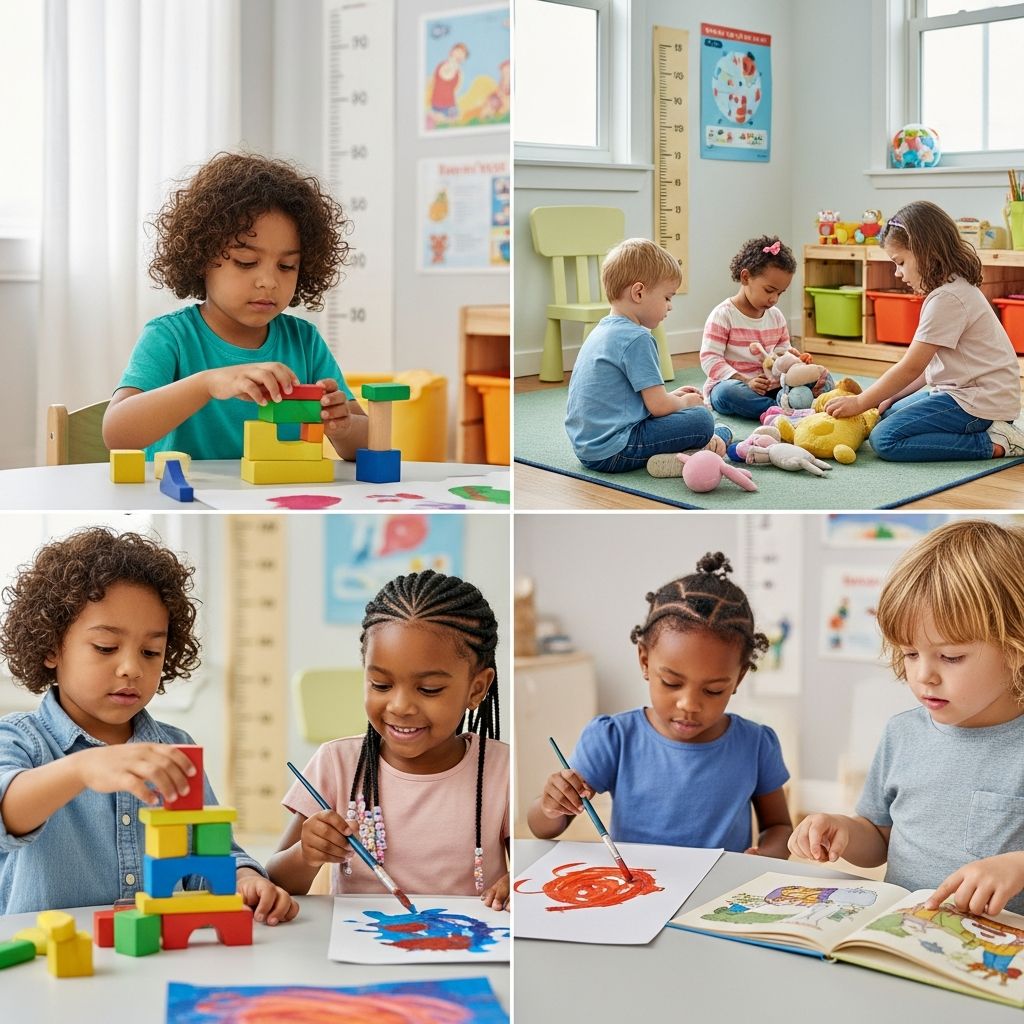
Educational play activities including block building, puzzles, drawing, and pretend play support cognitive development without requiring formal instruction. Providing materials for creative expression like crayons, paper, clay, and safe craft supplies encourages exploration and imaginative thinking. Counting practice during routine activities, teaching how mechanisms work, and discussing concepts like colors and shapes integrate learning into daily life.
Social and Emotional Support
Providing opportunities for supervised peer interaction through playgroups, library programs, or community recreation centers facilitates social skill development. Modeling and teaching appropriate emotional expression helps children learn to communicate feelings verbally. Validating emotions while setting behavioral limits establishes healthy emotional regulation patterns.
Environmental Safety and Supervision
Maintaining constant supervision in safe, age-appropriate play spaces remains essential despite increased independence. Removing hazards, establishing clear boundaries, and providing appropriate challenges appropriate to developmental level protects children while encouraging exploration and skill-building.
Frequently Asked Questions About Three-Year-Old Development
When should I be concerned about my 3-year-old’s speech development?
Consult your pediatrician if your child uses fewer than 50 words, doesn’t combine two words, or speech is incomprehensible to family members. Some children develop language at slightly different rates, but significant delays warrant professional evaluation to rule out hearing problems or other concerns.
Is it normal for my 3-year-old to have imaginary fears?A: Yes, developing fears of imaginary characters like monsters is a normal part of cognitive development, reflecting increasing imagination and understanding of fantasy. Providing reassurance, maintaining consistent bedtime routines, and avoiding scary media content helps children manage these fears.
Q: How much screen time is appropriate for a 3-year-old?
Limiting both duration and content of television and digital viewing is recommended. High-quality educational programming with parental co-viewing provides greater benefit than passive viewing. Balance screen time with active play, reading, and social interaction.
What should I do about frequent temper tantrums in my 3-year-old?
While tantrums decrease in frequency by age three, they remain normal. Remaining calm, maintaining consistent boundaries, acknowledging feelings while limiting problematic behaviors, and ensuring adequate sleep and nutrition help reduce tantrum frequency and intensity.
How can I encourage my 3-year-old to be more independent?
Provide opportunities for child to attempt self-care tasks, praise effort and success, allow extra time for task completion, and offer choices within safe limits. Breaking tasks into manageable steps and demonstrating techniques before expecting independence facilitates skill development.
References
- Developmental Milestones Record – 3 Years — MedlinePlus, National Library of Medicine. Accessed January 2026. https://medlineplus.gov/ency/article/002014.htm
- Development Milestones for Your 3-Year-Old Child — Children’s Hospital of Orange County (CHOC). Accessed January 2026. https://choc.org/ages-stages/3-years/
- Developmental Milestones: 3 to 4 Year Olds — American Academy of Pediatrics, HealthyChildren.org. Accessed January 2026. https://www.healthychildren.org/English/ages-stages/preschool/Pages/Developmental-Milestones-3-to-4-Year-Olds.aspx
- Milestones by 3 Years — Centers for Disease Control and Prevention (CDC), Learn the Signs. Act Early. January 2026. https://www.cdc.gov/act-early/milestones/3-years.html
- The Growing Child: 3-Year-Olds — Stanford Medicine Children’s Health. Accessed January 2026. https://www.stanfordchildrens.org/en/topic/default?id=the-growing-child-3-year-olds-90-P02296