Building Connections Through Intentional Play and Interaction
The early months and years of your child’s life represent a unique window of opportunity for meaningful connection and developmental growth. While many parents understand that spending quality time with their babies matters, the specific ways to engage infants and toddlers can sometimes feel unclear. Beyond simply keeping your child content, purposeful activities—whether quiet moments together or active exploration—serve as the foundation for emotional security, cognitive development, and language acquisition.
The beauty of engaging with your baby lies in its simplicity. You don’t need expensive toys, specialized equipment, or elaborate plans. Instead, the most powerful interactions often emerge from everyday moments when you’re fully present with your child, responsive to their cues, and willing to explore the world through their developing perspective.
The Power of Physical Connection and Tactile Engagement
Among the most fundamental ways to connect with your infant is through direct physical contact. Skin-to-skin contact, particularly in the early weeks, provides far more than emotional comfort—it helps regulate your baby’s body temperature, heart rate, and nervous system responses. This type of closeness creates a secure foundation upon which all future development rests.
Beyond simple holding, intentional touch-based activities deepen your connection while supporting your baby’s sensory development. Gentle massage—a practice used across cultures for centuries—offers remarkable benefits for both parent and child. As you massage your baby’s limbs with slow, deliberate strokes, you’re not only promoting relaxation and better sleep patterns but also creating moments of profound presence and attunement. These tactile interactions help babies understand their own bodies while simultaneously reinforcing the secure attachment that underlies healthy emotional development.
Bath time naturally incorporates several bonding elements at once. When you create a calm environment with warm water, soft lighting, and minimal noise while maintaining gentle conversation or singing throughout the process, your baby experiences security through temperature regulation, auditory comfort, and nurturing touch simultaneously.
Communication Through Sound, Voice, and Music
Your voice represents one of the most powerful tools for connection and development. Babies are hardwired to respond to human speech from birth, and the specific patterns of parent-directed speech—characterized by higher pitch, exaggerated intonation, and slower pace—actually enhances language learning. This natural communication style isn’t something parents need to learn; most instinctively adopt it when interacting with infants.
Narrating daily activities creates an rich language environment while strengthening your bond. As you change your baby’s diaper, you might say, “Now we’re taking off your wet diaper and putting on a fresh one.” During a walk outdoors, you can describe what you’re seeing: “Look at the big tree. Do you hear the birds singing?” This running commentary isn’t just filling silence—it’s building neural pathways, expanding vocabulary, and reinforcing that your baby is interesting to you.
Singing, whether lullabies, folk songs, or your favorite contemporary music, offers multiple developmental benefits. The rhythm and melody can soothe an upset baby, while the emotional tone of your voice communicates safety and love. You needn’t be a talented singer; babies respond to the authenticity of their parent’s voice far more than to technical skill.
Music classes designed for parents and babies provide structured opportunities to explore rhythm, movement, and sound together while meeting other families on similar journeys. Even without formal classes, creating dance parties in your kitchen or living room combines music, movement, and joy in ways that are developmentally enriching and emotionally bonding.
Visual Connection and Facial Communication
Babies are naturally drawn to human faces, and eye contact represents a crucial component of early bonding and social learning. During feeding—whether breastfeeding or bottle-feeding—maintaining eye contact transforms a nutritional necessity into an intimate connection ritual. Your baby learns that their needs matter to you and that being with you brings comfort and joy.
Interactive games like peek-a-boo leverage your baby’s developing understanding of object permanence while incorporating surprise, delight, and the reassurance of your reappearance. These simple games build trust and introduce the early foundations of social reciprocity. When you exaggerate your facial expressions—widening your eyes, dropping your jaw, shifting between expressions—you’re providing a masterclass in emotion recognition and communication.
Reading together, even with the simplest board books designed for newborns, combines visual engagement with language exposure. Your animated narration of the pictures, your finger pointing to objects, and your slowed speech patterns all support language development while the shared focus creates intimacy.
Sensory Exploration and Play-Based Learning
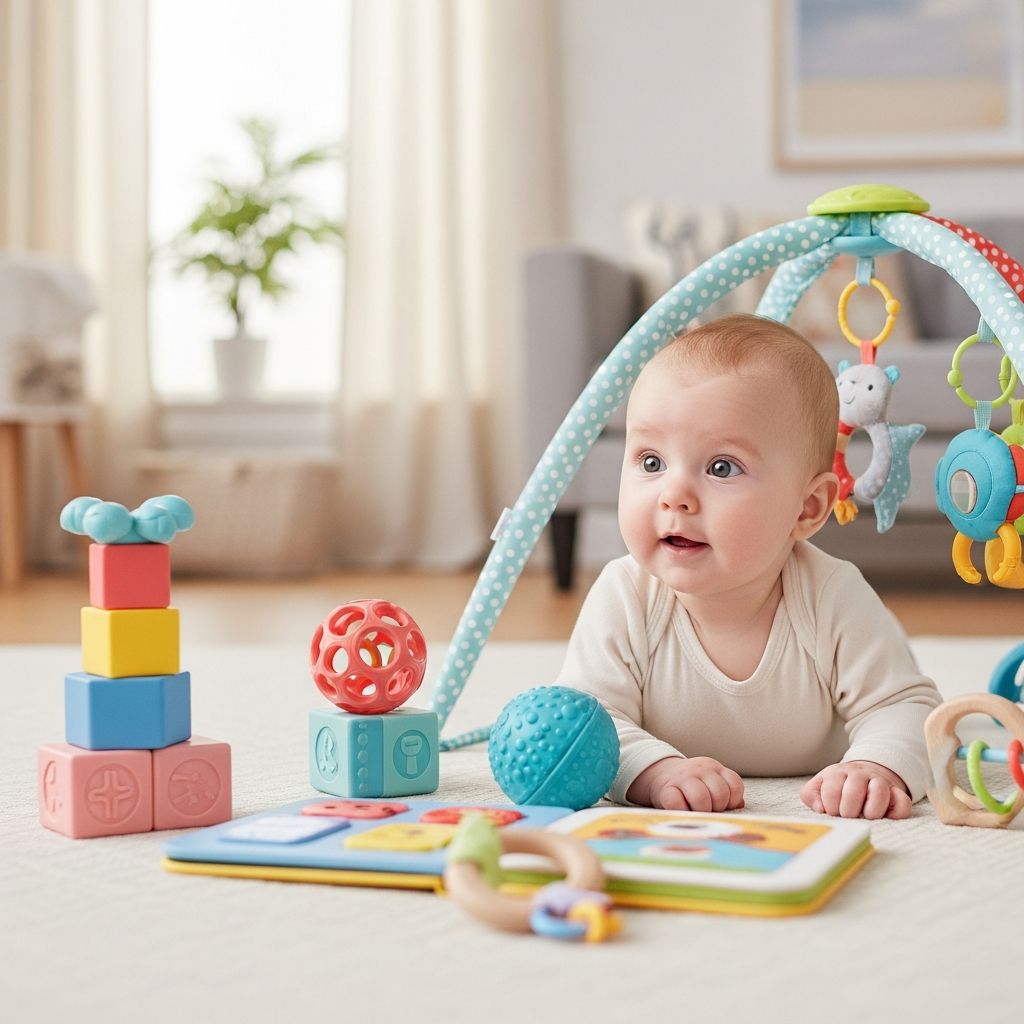
As your baby grows beyond the newborn stage, purposeful sensory play becomes an increasingly important developmental tool. Babies are natural scientists, driven by curiosity to understand how their environment works. Providing varied textures to explore—soft blankets, textured brushes, crinkly materials—allows your baby to build sensory categories and neural connections.
Simple activities offer rich learning opportunities. A basket containing non-choking hazard items like wooden spoons, plastic cups, bells, and soft scarves invites exploration and discovery. Supervised water play—whether in a shallow bin with measuring cups or during bath time—combines sensory stimulation with early physics learning as your baby observes water movement and containment.
Tummy time, essential for physical development, becomes more engaging when you’re positioned at your baby’s level, making eye contact and talking to them. This transforms a sometimes-challenging developmental necessity into a bonding opportunity where your baby experiences the security of your presence while building the neck, shoulder, and arm strength necessary for future mobility.
Movement, Mobility, and Physical Milestones
As babies develop the ability to roll, sit, crawl, and eventually walk, they benefit enormously from activities specifically designed to encourage these physical progressions. Positioning toys strategically around your baby—rather than directly in front—encourages reaching and rolling. As your baby becomes mobile, creating safe pathways through play tunnels, positioning balls to chase, and offering sturdy furniture for practice standing and pulling up supports both physical development and confidence.
Walking together—through your neighborhood, in a local park, to a farmer’s market, or through an art museum—provides multisensory stimulation while supporting bonding. The rhythm of walking, the novelty of outdoor sights and sounds, and your presence as a secure base all contribute to both developmental gains and connection. For babies old enough to collect items, bringing along a small bucket encourages exploration and ownership during these adventures.
Structured Classes and Community Connection
While one-on-one time remains invaluable, parent-baby classes offer structured opportunities for development while reducing parental isolation. Mom and baby yoga classes, open to babies as young as eight weeks, combine gentle movement that aids digestion and sleep with stress relief for parents. These classes explicitly welcome all baby behaviors—feeding, diaper changes, crying—creating judgment-free spaces for parents and babies to learn together.
Parent-baby swim classes introduce water safety while building confidence in aquatic environments. Music classes expose babies to diverse sounds and instruments while building community with other parents navigating similar developmental stages.
Age-Specific Activity Progression
The activities that engage and delight your baby evolve as their capabilities advance. Understanding developmentally appropriate activities ensures you’re meeting your baby where they are while gently challenging them toward the next milestone.
Newborn Through 2 Months
- Skin-to-skin contact and gentle massage
- Narration of daily activities and talking through caregiving routines
- Singing and soothing music
- Eye contact during feeding and interactive moments
- Simple high-contrast visual cards or books
3 to 6 Months
- Peek-a-boo games with your hands, scarves, or by hiding behind objects
- Tummy time with parental engagement and eye contact
- Reading board books with animated narration
- Exploration of different household textures
- Outdoor walks with narration of sights and sounds
7 to 12 Months
- Advanced peek-a-boo with object permanence understanding
- Floor play with positioning of toys to encourage reaching and crawling
- Sensory bins with safe textured materials
- Water play in shallow containers with supervision
- Simple music-making with instruments
- Standing and cruising practice with stable furniture
13 to 18 Months
- Role-play activities mimicking daily household tasks
- Walking adventures with collection activities
- Bath time extended with floating toys
- Nature exploration with bucket for gathering
- Imitation games and helping with simple household tasks
Supporting Sibling Bonding Alongside Baby Connection
For families with multiple children, activities that incorporate siblings create opportunities for connection across age groups. Older children can sing lullabies or nursery rhymes to the baby, building their own connection while developing caregiving confidence. Involving older siblings in age-appropriate baby care tasks—holding a towel during bath time, helping to select a book for story time—gives them meaningful roles and helps prevent the resentment sometimes accompanying a new sibling’s arrival.
Creating Consistency and Routine
While varied activities support development, the predictability of routine creates security. A consistent bath-time ritual, daily outdoor walks, regular singing at transition times, and dedicated floor play periods all signal to your baby that they can anticipate safety and presence. This predictability, combined with your responsive attention during these moments, builds the secure attachment foundation that supports all future learning and emotional health.
The Broader Impact of Intentional Engagement
Research increasingly confirms what intuitive parents have long known: the quality and consistency of early interaction shapes brain development, emotional regulation capacity, social skills, and language acquisition. Every moment of eye contact, every song sung, every narrated walk isn’t just pleasant—it’s foundational. The activities parents engage in with their babies aren’t luxuries or distractions; they’re the essential building blocks of healthy development.
Perhaps most importantly, these activities don’t require perfect execution or special circumstances. They emerge naturally from daily life when parents approach their babies with presence, responsiveness, and genuine interest in sharing the world together. Whether through the simplest skin-to-skin contact or through elaborate music classes, the consistent message that your baby is worthy of your attention and worthy of connection represents the most powerful gift you can offer.
Frequently Asked Questions
Q: When should I start engaging my baby in activities beyond basic care?
A: You can begin bonding and engagement activities from birth. Even newborns benefit from skin-to-skin contact, your voice, and eye contact during feeding. Activities naturally evolve as your baby’s abilities develop, but connection begins immediately.
Q: Do I need special toys or materials to engage my baby?
A: No. Household items, your voice, your face, and your presence are the most powerful tools for engagement. While age-appropriate toys can support development, intentional interaction with basic materials is often more valuable than expensive equipment.
Q: How much time should I dedicate to activities with my baby?
A: Quality matters more than quantity. Consistent, focused engagement during daily routines—feeding, bathing, dressing, walking—provides abundant opportunities for connection. Dedicated play periods of 15-30 minutes, adjusted for your baby’s developmental stage and attention span, complement these routine moments.
Q: Is it too late to start engaging if I’ve felt disconnected initially?
A: It’s never too late. While early bonding offers advantages, babies and children are remarkably resilient. Beginning intentional engagement at any point provides benefits and strengthens connection moving forward.
Q: How do I know if my baby is enjoying an activity?
A: Babies communicate through facial expressions, body movements, vocalizations, and eye contact. Signs of enjoyment include sustained eye contact, smiling, reaching toward you, cooing or laughing, and relaxed body posture. If your baby seems distressed, overstimulated, or disinterested, it’s appropriate to pause and try a different activity.
Q: Can screen time substitute for interactive activities?
A: No. While some screen content may have educational elements, it cannot replace the interactive, responsive engagement that builds secure attachment and supports optimal development. Face-to-face interaction, physical touch, and reciprocal communication are irreplaceable.
References
- Newborn Baby Bonding Activities — Omega Pediatrics. 2024. https://www.omegapediatrics.com/newborn-baby-bonding-strengthenconnection/
- Baby Friendly Activities for New Moms — Twin Cities Birth Center. 2024. https://www.twincitiesbc.com/blog/baby-friendly-activities-for-new-moms
- Activities for Babies (0–18 Months) — Taking Care Babies. 2024. https://www.takingcarababies.com/blogs/development/activities-for-babies-0-18-months